Shopping for a home battery in 2026 means choosing between two lithium chemistries: LFP (lithium iron phosphate, LiFePO4) and NMC (nickel manganese cobalt). They both store kilowatt-hours; they differ in almost everything else — safety margin, cycle life, size, and cost. Here's the honest comparison, with current examples and prices from our live catalog.
The two chemistries in plain terms
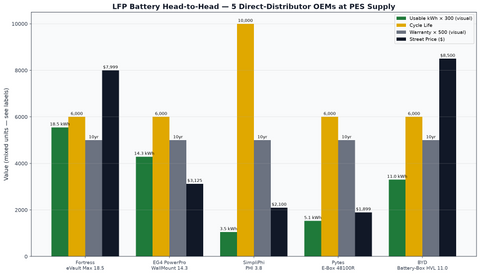
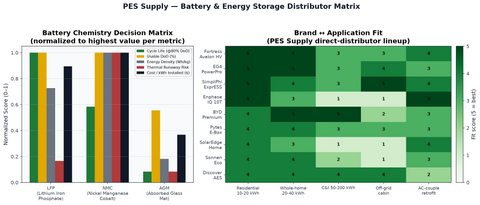
LFP trades energy density for durability. The cathode is iron phosphate — no nickel, no cobalt — which makes the cells far more resistant to thermal runaway, tolerant of being charged to 100% daily, and good for roughly 6,000+ cycles before meaningful fade. The cost: bigger and heavier per kWh. That's why LFP dominates server-rack and wall-mount home storage.
NMC packs more energy into less space — the reason it powers EVs and compact all-in-one home batteries. The trade-offs: a lower thermal-runaway threshold, sensitivity to spending its life at 100% charge, and a typical cycle life around 2,000–3,000 cycles in stationary use. Integrated systems manage this with reserve buffers and active thermal management.
What each chemistry costs on our shelf today
Prices below were pulled from the live PES catalog on October 11, 2026; per-kWh figures are computed from those prices (note: expansion modules and full integrated systems aren't apples-to-apples — a module price excludes the inverter and cabinet it plugs into).
LFP side of the aisle (server rack batteries and EG4 Electronics):
- EG4 LiFePower4 48V V1 100Ah (5.12 kWh) — $1,196.60 → about $234/kWh
- Fortress eFlex Max 5.4 kWh — $1,399.00 → about $259/kWh
- EG4 LL-S 48V 100Ah (5.12 kWh), UL1973 & UL9540A listed — $1,536.99 → about $300/kWh
- EG4 PowerPro WallMount AllWeather 14.3 kWh — $3,124.99 → about $219/kWh
NMC / lithium-ion side (system components and integrated units):
- Generac PWRcell 3.0 kWh battery module — $2,144.62 (an expansion module for the PWRcell cabinet, not a standalone battery)
- SolarEdge Energy Bank 10 kWh — $8,349.08 → about $835/kWh as a fully integrated battery
- Panasonic EverVolt 9.0 kWh ESS — $8,314.37 → about $924/kWh as an integrated system
The pattern is consistent: modular LFP storage lands in the $220–300/kWh range, while integrated NMC systems run higher because the price includes the enclosure, controls, and thermal management — not just cells.
Which one belongs in your home
Choose LFP if you're building solar-plus-storage with daily cycling, off-grid, or want maximum lifespan per dollar. A decade of daily cycling is exactly what LFP is built for, and the $/kWh math above is hard to argue with. Most of our battery storage collection — EG4, Fortress Power, Discover — is LFP for a reason.
Choose NMC if space is tight or you're already inside an ecosystem: PWRcell owners expand with PWRcell modules, SolarEdge homes add the Energy Bank, and the integrated form factor installs fast with factory-matched controls.
Not sure which way your project points? Send us your load profile — the wholesale desk specs both chemistries daily.
Frequently asked questions
Is LFP safer than NMC?
LFP has a meaningfully higher thermal-runaway threshold and contains no cobalt or nickel, which is why it's favored for indoor and garage installs. Modern NMC home batteries are engineered with detection and thermal management to be safely installed — but LFP starts with a chemistry-level advantage.
How long does each chemistry last?
LFP typically delivers 6,000+ cycles before dropping to 80% capacity — a decade-plus of daily use. NMC in stationary service is typically rated around 2,000–3,000 cycles, with system buffers protecting day-to-day wear.
Can I mix LFP and NMC in one system?
No — don't mix chemistries in the same battery bank. Different voltage curves and charging profiles make mixed banks unsafe and unmanageable. Expand within the same battery family.
Why is NMC still used if LFP is cheaper and lasts longer?
Energy density. Where weight and volume matter — EVs, compact wall units, integrated systems — NMC's smaller footprint wins, and manufacturers build the safety management around it.