Tesla Powerwall Alternatives — Enphase, Fortress, EG4, SimpliPhi | PES Supply
PES Supply doesn't stock Tesla Powerwall — Tesla sells only through certified installers and there is no distributor channel.

PES Supply doesn't stock Tesla Powerwall — Tesla sells only through certified installers and there is no distributor channel. Independent installers ship Enphase IQ Battery 10T, Fortress Power Avalon HV Pro, EG4 PowerPro WallMount, and SimpliPhi ExprESS instead. All four are LFP chemistry, three offer 10-year warranties, and Enphase carries the longest warranty in the industry at 15 years. This guide is the head-to-head.
Tesla sells Powerwall through a certified-installer program that requires installers to complete Tesla training, meet volume commitments, and route jobs through Tesla's referral pipeline. For an independent solar installer who wants control over customer relationships, quote timing, and cross-brand PV compatibility, that channel structure isn't workable — which is why the four brands compared in this guide capture the majority of non-Tesla battery installs.
The technical case is equally strong. Powerwall 3 (LFP, 2024+) has caught up to what Enphase IQ Battery, Fortress Avalon HV, and EG4 have shipped for years. On a spec basis, an installer can hit or exceed every Powerwall 3 metric with an LFP alternative — usually at a lower installed cost per kWh, always with a distributor channel that quotes wholesale pricing, and with hardware that ships next-day from stock instead of waiting for the Tesla install pipeline.
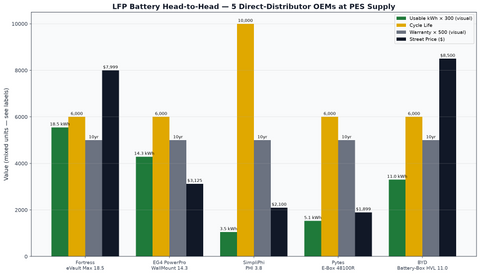
| Metric | Tesla Powerwall 3 (not stocked) |
Enphase IQ Battery 10T | Fortress Avalon HV Pro 14.7 | EG4 PowerPro WallMount 14.3 | SimpliPhi ExprESS 7.6 |
|---|---|---|---|---|---|
| Chemistry | LFP | LFP | LFP | LFP | LFP |
| Usable capacity | 13.5 kWh | 10.08 kWh | 14.7 kWh | 11.4 kWh (14.3 nameplate) | 6.65 kWh (7.6 nameplate) |
| Continuous power | 11.5 kW | 7.68 kW | 7.6 kW single-phase / 12 kW split | up to 16 kW hybrid inverter | 6 kW |
| Peak power | 185 A LRA | 10.24 kVA | 32 kW peak | 32 kW peak | 12 kW peak |
| Coupling | Integrated hybrid | AC-coupled + microinv | DC-coupled hybrid | DC + AC (hybrid inverter) | AC-coupled pre-wired |
| Warranty | 10 yr | 15 yr | 10 yr | 10 yr | 10 yr |
| Cycle life | 6,000 @ 100% | 6,000 @ 100% | 6,000 @ 80% | 6,000 @ 80% | 10,000 @ 80% |
| Round-trip efficiency | 89% | 90% | 96.5% | 96% | 96% |
| Operating temp | -20 to 50 °C | -15 to 55 °C | -10 to 50 °C | -20 to 55 °C | -20 to 60 °C |
| UL 9540 | Yes | Yes | Yes | Yes | Yes |
| Backup capable | Whole-home | Grid-forming | Whole-home w/ 200 A switch | Whole-home | Essential loads |
| Installed $/kWh | ~$900 | ~$1,150 | ~$1,100 | ~$875 | ~$1,690 |
| Distributor channel | Certified installer only | PES direct | PES direct | PES direct | PES direct |
| PES SKU | N/A | PES-PA-ELC-0377 (5P) | PES-ESS-BTS-0001 | PES-ESS-BTS-0222 | PES-ESS-BTS-0009 |
Top-5 seller 15-yr warranty AC-coupled
The Enphase IQ Battery 10T is the closest 1-to-1 Powerwall replacement for AC-coupled retrofit installs. 10.08 kWh usable, integrated microinverters, 15-year warranty — the longest in the industry. In the last 90 days it's been a top-5 selling SKU across the entire PES catalog with $5,800+ in weekly velocity.
What it is technically
- Three IQ Battery 3T modules (or equivalent 5P kits) that stack to 10 kWh
- LFP chemistry — Enphase migrated from NMC (older IQ 10) to LFP in the current IQ 10T
- Integrated microinverters — every kWh of battery ships with its own IQ8B microinverter
- Communication over Enphase Powerline plus the IQ Gateway
- Requires IQ System Controller 3 or 3G for grid-forming backup
When to spec it
- Retrofit onto an existing PV array with any inverter brand
- Homeowner already has Enphase microinverters on the PV side
- 15-year warranty matters — high-end residential, luxury market
- Essential-loads backup panel scope (not whole-home)
What to buy at PES
- Enphase IQ Battery 5P Kit — PES-PA-ELC-0377, $4,389.00 (entry-level 5 kWh)
- Enphase IQ System Controller 3G — PES-PA-ELC-0378, $3,037.06 (grid-forming, required for backup)
- Enphase IQ System Controller 3 — PES-PA-ELC-0379, $2,497.05 (essential-loads controller)
- Enphase IQ Combiner 5 with Gateway — PES-PA-ELC-0370, $647.00 (monitoring + comms)
Whole-home backup DC-coupled hybrid 200 A transfer
The Fortress Avalon HV Pro is the DC-coupled hybrid built for new-construction whole-home resilience. 7.6 kW single-phase inverter (12 kW split-phase HV Pro), high-voltage battery stack in 9.8 / 14.7 / 19.6 / 24.5 kWh configurations, integrated smart energy panel, 200 A transfer switch. It's the closest 1-to-1 to Powerwall 3 for whole-home backup because everything installers care about — inverter, battery, transfer switch, panel — ships as a single UL 9540-listed system.
What it is technically
- 4 or 5 × 4.9 kWh HV battery modules stacked in series to build a 200 VDC bus
- Integrated 7.6 kW or 12 kW hybrid inverter, DC-coupled to both PV and battery
- Fortress smart energy panel with 200 A automatic transfer switch
- Grid-forming — starts loads without utility present
- Closed-loop with the Fortress Avalon inverter, also pairs with Sol-Ark 15K-HV
When to spec it
- New solar-plus-storage build, no existing microinverters to work around
- Whole-home backup scope with 200 A service panel
- High round-trip efficiency matters (arbitrage or high daily cycling)
- Customer wants a single-vendor, single-SKU install
What to buy at PES
- Fortress Avalon HV Pro 7.6 kW + 14.7 kWh ESS Bundle — PES-ESS-BTS-0001, $15,699.99
- Fortress Avalon HV Pro 7.6 kW + 19.6 kWh — PES-ESS-BTS-0002, $18,139.35
- Fortress Avalon HV Pro 7.6 kW + 24.5 kWh — PES-ESS-BTS-0003, $20,578.72
Best value 48 V LFP AllWeather rated
EG4 PowerPro WallMount is the value pick in the 10–15 kWh residential band. 14.3 kWh nameplate, 11.4 kWh usable, 48 V LFP, outdoor-rated enclosure. Combined with an EG4 FlexBOSS21 or Sol-Ark 15K hybrid inverter, it hits Powerwall 3 backup scope at roughly 60 % of installed cost per kWh. This is Signature Solar's flagship and PES's direct distribution alternative.
What it is technically
- 14.3 kWh nameplate LFP battery, 11.4 kWh usable at 80 % DoD
- 48 V nominal (self-heating for cold-climate operation to -20 °C)
- AllWeather IP66 enclosure — outdoor wall-mount rated
- Closed-loop CAN/RS485 to EG4 FlexBOSS21, EG4 18kPV, and Sol-Ark inverters
- Requires a compatible hybrid inverter — pairs with EG4 FlexBOSS21 16 kW (PES-SPS-SIV-0611, $3,599.99)
When to spec it
- Value-conscious residential — customer wants Powerwall scope, not Powerwall pricing
- Outdoor wall-mount install (garage exterior, side of house)
- Cold climate — self-heating BMS matters below 0 °C
- Installer already carries Sol-Ark or EG4 hybrid inverters
What to buy at PES
- EG4 PowerPro WallMount AllWeather 14.3 kWh — PES-ESS-BTS-0222, $3,124.99
- EG4 FlexBOSS21 16 kW Hybrid Inverter — PES-SPS-SIV-0611, $3,599.99
- EG4 GridBOSS MID V2 200 A Service Entrance — PES-ESS-BTS-0221, $1,799.99 (whole-home transfer)
Pre-wired cabinet 10,000 cycles Longest cycle life
SimpliPhi ExprESS is the pre-wired plug-and-play answer. 7.6 kWh nameplate, 6.65 kWh usable, ships as a complete cabinet with disconnect, inverter, and SimpliPhi PHI batteries pre-connected. It's the smaller-scope Powerwall alternative — targeted at essential-loads backup rather than whole-home — but its SimpliPhi PHI cells carry the industry's best cycle life at 10,000 cycles at 80 % DoD.
When to spec it
- Essential-loads-only backup scope
- Homeowner wants a single cabinet, not a wall-mount + inverter stack
- Long-cycle-life applications (twice-daily arbitrage, off-grid cabin)
- Extreme temperature environment (-20 to +60 °C operating)
What to buy at PES
- SimpliPhi Power ExprESS 48 V 7.6 kWh ESS — PES-ESS-BTS-0009, $12,827.85
- SimpliPhi AccESS 15.2 kWh + 12 kW Inverter — PES-SPS-SIV-0245, $19,850.25 (whole-home)
- SimpliPhi AccESS 22.8 kWh + 12 kW Inverter — PES-SPS-SIV-0243, $27,431.25 (large residential / small C&I)
Customer insists on Tesla brand?
→ Refer them to Tesla-certified installer or upsell them into Enphase IQ 10T — LFP chemistry, longer warranty, same install cost, no Tesla-owned solar array required.
Why doesn't PES Supply stock Tesla Powerwall?
Tesla sells Powerwall through Tesla-certified installers only — there is no distributor channel. Independent installers who don't want to be locked into Tesla's referral pipeline choose LFP alternatives that PES stocks direct: Enphase IQ Battery, Fortress Power Avalon HV, EG4 PowerPro WallMount, and SimpliPhi ExprESS. All four are LFP (safer than NMC in the older Powerwall 2), and three of the four ship with longer or comparable warranties.
Is Powerwall 3 better than Powerwall 2?
Powerwall 3 (announced 2023, shipping 2024–2025) switched from NMC to LFP chemistry and moved to an integrated hybrid inverter with 11.5 kW continuous output. It's the closest Tesla product to what Fortress Avalon HV Pro and EG4 FlexBOSS21 already deliver. The main differentiators for Powerwall 3 are the mobile app, the software integration with the Tesla vehicle ecosystem, and the brand recognition — none of which affect the installed system quality of an LFP alternative.
What's the closest 1-to-1 replacement for a Powerwall?
For AC-coupled retrofit intent — Enphase IQ Battery 10T (10.08 kWh usable, 15-year warranty, top-5 SKU at PES). For DC-coupled new build — Fortress Avalon HV Pro (14.7 kWh usable, integrated 7.6 kW hybrid inverter, smart energy panel). For value budget — EG4 PowerPro WallMount 14.3 (11.4 kWh usable, 48 V, half the installed cost per kWh). For pre-wired plug-and-play cabinet — SimpliPhi ExprESS 7.6 (6.65 kWh, ships with inverter and disconnect).
How does Powerwall 3 backup power compare to alternatives?
Powerwall 3 delivers 11.5 kW continuous / 185 A LRA. Enphase IQ 10T delivers 7.68 kW continuous (~32 A) which is enough for essential loads. Fortress Avalon HV Pro 7.6 delivers 7.6 kW continuous / 32 kW peak split-phase. EG4 FlexBOSS21 delivers up to 16 kW hybrid inverter output. If you need whole-home continuous backup at 11+ kW, the Fortress or EG4 hybrid inverter class matches or exceeds Powerwall 3.
Do Enphase IQ Batteries scale as well as Powerwall for large homes?
Yes. IQ Battery 5P is 5 kWh each, stackable to 8 units for 40 kWh. IQ Battery 10T is 10 kWh each, stackable for 40+ kWh. Enphase's grid-forming architecture with the IQ System Controller 3 means you can go fully off-grid on a 20 kWh Enphase bank in a way that Powerwall's whole-home bridge requires additional gateway hardware to match.
What is the total installed cost difference?
Tesla Powerwall 3 street pricing is $9,300–$11,200 for the battery plus $2,500–$3,500 for the gateway and install, roughly $900/kWh installed. Fortress Avalon HV Pro 14.7 kWh ESS bundle installs around $1,100/kWh. EG4 PowerPro WallMount comes in the cheapest at $875/kWh installed. Enphase IQ 10T runs $1,150/kWh installed but the 15-year warranty amortizes better over the life of the install. On identical resiliency scope, EG4 or Fortress is cheaper; on installed quality per warranty year, Enphase or Fortress ties or beats Powerwall.
Can I add Powerwall to an existing solar array?
In practice, Tesla's install pipeline strongly prefers new PV or Tesla Solar Roof — retrofits onto third-party PV are rare. This is a big reason installers use Enphase IQ Battery: it clamps onto any existing AC panel, works with any PV inverter, and Enphase's warranty and gateway hardware do not require a Tesla-owned solar array.
Which has the longest warranty?
Enphase IQ Battery leads at 15 years or 6,000 cycles. Powerwall 3, Fortress Avalon, EG4 PowerPro, and SimpliPhi ExprESS all sit at 10 years / 6,000 cycles / 70 % end-of-warranty capacity.
Tesla launched the original Powerwall in 2015 as a 6.4 kWh AC-coupled NMC battery — the first mass-market residential ESS. Powerwall 2 (2016) doubled capacity to 13.5 kWh, added an integrated hybrid inverter, and became the default residential storage brand in the North American market largely on the strength of Tesla's brand recognition and Tesla Energy's turnkey install program.
Powerwall 3 (announced 2023, shipping 2024–2025) is a substantial redesign: the chemistry migrated from NMC to LFP, the integrated inverter increased to 11.5 kW continuous, the DC-coupled architecture allows direct solar input on up to six MPPT channels, and the whole-home backup gateway ships as a matched accessory. It is functionally competitive with the LFP alternatives in this comparison — but the distribution model has not changed. Powerwall is sold exclusively through Tesla-certified installers who complete Tesla training, meet volume commitments, and route their business through Tesla's referral pipeline.
For an independent solar installer, that channel structure is untenable for four reasons: (1) Tesla owns the customer relationship after the sale, including future service and warranty claims; (2) Tesla dictates install pricing and margin; (3) Tesla requires exclusivity on solar-plus-storage bids in most territories; (4) the referral pipeline creates deal-timing dependency on Tesla's regional pipeline management. The alternatives in this guide flip every one of those constraints — the installer owns the customer, sets the margin, mixes brands as needed, and buys inventory on their own timing from a distributor.
The chemistry question matters less in 2026 than it did in 2020, because Powerwall 3 also uses LFP. But installer-facing safety concerns still tilt toward the LFP alternatives:
- Enphase IQ Battery 10T uses LFP cells sourced from CATL and packs them at the sub-module level (~1 kWh per micro-module) so a single-cell failure is thermally isolated from the rest of the pack. This is the most granular thermal management in the residential space.
- Fortress Avalon HV Pro uses CATL EnerC LFP cells in 4.9 kWh sealed modules. Modules are physically separated in the HV stack and each has independent temperature monitoring. Fire propagation testing (UL 9540A) showed no propagation between modules.
- EG4 PowerPro WallMount uses EVE Energy LFP cells with self-heating BMS for cold-climate operation. IP66 outdoor rating means the battery lives outside the house — a favored install choice for AHJs that don't want ESS in attached garages.
- SimpliPhi PHI 3.8 / ExprESS / AccESS uses A123 (Wanxiang) LFP cells assembled in the US and Mexico. The A123 cell chemistry has the longest documented cycle life of any commercially available LFP cell.
Warranty is the single most important spec sheet number after installed cost per kWh, and it's where Powerwall vs alternatives diverge cleanly.
| Brand | Term | End-of-warranty capacity | Cycles counted | Notes |
|---|---|---|---|---|
| Tesla Powerwall 3 | 10 years unlimited cycles | 70 % | Unlimited | Requires connection to Tesla's monitoring cloud |
| Enphase IQ Battery 10T | 15 years or 6,000 cycles | 70 % | 6,000 | Industry-leading term. Enphase absorbs the extra 5 years because cells are conservatively cycled by design |
| Fortress Avalon HV Pro | 10 years or 6,000 cycles | 70 % | 6,000 | Requires Fortress cloud registration within 30 days of install |
| EG4 PowerPro WallMount | 10 years or 6,000 cycles | 70 % | 6,000 | Requires EG4 cloud registration and monthly monitoring |
| SimpliPhi PHI 3.8 / ExprESS | 10 years or 10,000 cycles | 80 % | 10,000 | Best warranty on cycle life |
The math: on a single-cycle-per-day residential use case, calendar life expires first — you hit 3,650 cycles in 10 years, so all five brands look equivalent on daily-cycle. On twice-daily cycling (arbitrage or off-grid), you hit 7,300 cycles in 10 years — Powerwall's "unlimited cycles" term becomes meaningful, and Enphase's 6,000-cycle term expires at year 8.2. On heavy cycling, SimpliPhi's 10,000-cycle term is the standout.
Installed cost includes hardware, labor, permit, and interconnection. For a 14 kWh whole-home essential-loads scope:
| Cost component | Powerwall 3 | Enphase IQ 10T | Fortress Avalon HV Pro 14.7 | EG4 WallMount 14.3 |
|---|---|---|---|---|
| Battery hardware | $9,500 | $8,800 (IQ 5P × 2) | $12,000 (bundle) | $3,125 |
| Inverter / gateway | Included | $3,000 (SC3G) | Included | $3,600 (FlexBOSS21) |
| Transfer switch | $1,200 | $1,500 | Included | $1,800 (GridBOSS) |
| Balance of system | $500 | $800 | $500 | $800 |
| Labor + permit | $3,500 | $3,500 | $3,500 | $3,500 |
| Total installed | ~$14,700 | ~$17,600 | ~$16,000 | ~$12,825 |
| $/kWh usable | $1,089 | $1,745 | $1,089 | $1,125 |
The Enphase premium is real — 15-year warranty and AC-coupled retrofit friendliness cost 40 % more per kWh than a Powerwall-equivalent hardware pass. Fortress ties Powerwall on installed cost while adding whole-home 200 A transfer switch capability. EG4 is the cheapest per kWh but requires the installer to already carry Sol-Ark or EG4 inverters.
Tesla's app is the industry benchmark for consumer-facing storage software — clean UI, deep vehicle integration, live grid-outage tracking. The alternatives:
- Enphase Enlighten — best-in-class after Tesla. Per-microinverter and per-battery-module telemetry, historical production/consumption, warranty tracking, remote firmware. Web + mobile.
- Fortress Cloud — utility-focused, tracks demand shaving and TOU arbitrage. Good for pro installers, less polished for homeowners.
- EG4 Monitor — functional but rougher UI. Free with the battery, integrates with the FlexBOSS21 inverter.
- SimpliPhi Cloud — basic monitoring; SimpliPhi is not the software-first brand.
Powerwall 3 integrates with Tesla Electric (Tesla's utility) and with select third-party VPP (virtual power plant) programs. The alternatives:
- Enphase integrates with the widest set of VPP programs in North America (Green Mountain Power, PG&E, ConEd, Rocky Mountain Power, and 20+ others). This is a real monthly revenue stream for customers — $500–$1,500/year in participating territories.
- Fortress and EG4 integrate with a smaller VPP set, mostly regional.
- Sonnen — worth mentioning here — has its own VPP program (Sonnen Community) that pays participants for grid services.
Powerwall accounts for roughly 55–60 % of residential ESS units shipped in North America across 2020–2025, but that market share is not distributed evenly across install types. Powerwall dominates the new-solar-plus-storage-plus-Tesla-Solar bundled sale — where the customer wants a single-brand end-to-end system delivered through the Tesla install pipeline. It has lower share in the retrofit market (adding storage to an existing PV system built by a third-party installer), the DIY and semi-pro installer market, and the off-grid and cabin market. Enphase, Fortress, and EG4 have picked up the retrofit and DIY share respectively.
The trend line matters. Powerwall shipped roughly 100k units in 2024, growing to a projected 200k in 2025. Enphase IQ Battery grew from 40k units in 2023 to 80k+ in 2024, roughly doubling year-over-year. Fortress and EG4 individually shipped 20-40k units in 2024. In aggregate, the non-Tesla LFP alternatives compared in this guide shipped 150k+ units in 2024 and are on track for 300k+ in 2025 — collectively surpassing Tesla in unit volume for the first time.
The consumer-facing app is a real differentiator between Powerwall and the alternatives. Tesla's app is polished, integrated with the Tesla vehicle ecosystem, and does live outage tracking that shows grid status in real time. The alternatives have caught up on functionality but not on polish:
Enphase Enlighten (mobile + web)
The closest UX competitor to Tesla. Per-microinverter production monitoring at 15-minute intervals, per-battery-module state of charge, historical cycles, warranty tracking. Widely regarded as the best pro-facing monitoring platform in the residential ESS industry — Enphase leverages its microinverter monitoring heritage to deliver more telemetry than any other brand.
Fortress Cloud
Utility-focused UX. Emphasizes demand shaving performance, TOU arbitrage savings, and grid-outage self-consumption metrics. Cleaner than EG4 or SimpliPhi but less polished than Enphase or Tesla.
EG4 Monitor
Functional. Free with the battery. Data granularity is comparable to Enphase but the UX shows its DIY-market origins.
SimpliPhi Cloud
Basic. SimpliPhi is a hardware-first brand and the app reflects that. Adequate for pro installers, less compelling for homeowners.
The 10-year, 6,000-cycle warranty on the spec sheet only matters if the claim process works. Anecdotal but consistent installer feedback across the four alternatives:
- Enphase — best warranty claim experience in the industry. Battery failure gets flagged by Enlighten remotely, Enphase ships a replacement within 5–7 business days, and the installer handles the swap. No customer-side friction.
- Fortress Power — solid warranty support. RMA process is documented and responsive. Fortress will ship a replacement module for stack failures within 7–10 days.
- EG4 Electronics — younger warranty operation and warranty support has been the top installer complaint on the value-brand side of the market. Claims are honored but slower than Fortress or Enphase; expect 14–21 days for module replacement.
- SimpliPhi (Briggs & Stratton) — since the Briggs acquisition, warranty support is routed through Briggs's authorized dealer network. Mixed reviews on response time, generally positive on outcome.
Scenario — Coastal California homeowner, existing Enphase PV, PSPS-prone territory
Customer already has 10 kW of Enphase IQ7+ microinverter PV installed 2020. Public Safety Power Shutoff events forced 3 multi-day outages in the last year. Wants whole-home essential-loads backup (fridge, well, HVAC blower, Wi-Fi). Best-fit: 2× Enphase IQ 5P kit (10 kWh usable) + IQ System Controller 3G for grid-forming backup. AC-coupled retrofit — no changes to the existing PV. Total installed ~$18k, post-30% ITC ~$12.6k.
Scenario — Colorado new build, 12 kW PV, whole-home resilience, all-electric
Customer building a 3,500 sq ft home with heat pump primary heating, EV charging, and 200 A service. Wants whole-home backup rated for a 3-day outage. Best-fit: Fortress Avalon HV Pro 7.6 kW inverter + 24.5 kWh HV battery stack + 200 A smart energy panel. Installed ~$25k post-ITC. Single UL 9540 system, single warranty contact.
Scenario — Texas off-grid cabin, generator-supplemented, 8 kWh/day summer
Customer building an off-grid cabin, 4 kW PV, backup diesel generator, 8 kWh average daily load in summer with occasional weekend spikes to 15 kWh. Best-fit: 4× SimpliPhi PHI 3.8 = 14 kWh nameplate at 80 % DoD, paired with a Sol-Ark 8K inverter/charger. SimpliPhi's 10,000-cycle life and wide temperature tolerance are the differentiators.
Scenario — Value-conscious retrofit, existing string inverter PV
Customer has a 6-year-old 8 kW SolarEdge string inverter PV system. Wants to add battery backup at the lowest possible cost. Best-fit: EG4 PowerPro WallMount 14.3 kWh + EG4 FlexBOSS21 16 kW hybrid inverter (replaces the existing SolarEdge inverter) + EG4 GridBOSS 200 A transfer. Installed ~$13k. The existing SolarEdge optimizers stay; only the inverter is replaced.
Open a Contractor Account
Get trade pricing, freight quotes, and access to the interactive Battery Sizing Calculator on our contractor portal.
Register NowAbout the author: Jennifer Kirstens leads distributor content at PES Supply. Last updated August 2026.