Updated September 2026 — refreshed against the live PES catalog; product pricing verified 2026-09-26.
Commercial BESS Financing and the Investment Tax Credit: 2026 Playbook
How the 30% Section 48 ITC, domestic-content and energy-community adders, 60% bonus depreciation, and PPA/EaaS structures actually stack on a 500 kWh commercial BESS — with the paperwork and placed-in-service traps that decide whether the credit sticks.

The Inflation Reduction Act (IRA), passed in August 2022, rewrote the economics of standalone commercial battery energy storage. For the first time, a battery installed with no coupled solar PV qualified for the same federal Investment Tax Credit (ITC) that solar has received since 2006. The provision — Section 48 of the Internal Revenue Code, as amended by IRA §13102 — took effect January 1, 2023.
Three years later, in tax year 2026, the credit stack is at its most valuable point in the schedule:
- 30% base ITC for systems meeting prevailing-wage and apprenticeship requirements (defaulted for projects >1 MW; broadly claimed by any C&I system above $1M).
- +10% domestic-content adder when US-made steel and components clear the Treasury threshold.
- +10% energy-community adder in designated brownfield, closed-coal, or high-unemployment census tracts.
- 60% bonus depreciation on the depreciable basis (100% minus half the ITC), phasing down 20 points per year.
Total effective tax benefit on a $220,000 500 kWh BESS with the full adder stack: roughly $118,000 to $128,000, or 54–58% of gross project cost. Net installed cost after all federal benefits: $92,000 to $102,000.
The economics only work if the ITC is captured cleanly. Section 48 has specific requirements around eligible cost, placed-in-service date, ownership structure, and documentation. Miss any one of them and the credit shrinks or disappears at audit. This guide walks through the actual mechanics of claiming the credit on a C&I BESS project.
Section 48 eligible cost includes the "energy property" itself and its integral components. For a BESS, that includes:
- Battery modules, racks, and enclosures.
- Power conversion system (PCS) and controls.
- Thermal management (HVAC, liquid cooling).
- Fire suppression integrated with the BESS.
- Foundation slab and pad costs directly attributable to the BESS.
- Interconnection equipment (transformer, switchgear) where dedicated to the BESS.
- Labor for installation, commissioning, and integration.
- Design, engineering, and permitting costs.
- Sales tax on eligible equipment.
What is not eligible:
- Site work not directly attributable to the BESS (general grading, fencing beyond BESS perimeter, driveway access improvements).
- Utility service upgrades beyond what the BESS requires.
- Financing costs, insurance, and reserves.
- Building improvements (roofing, siding, electrical panels not dedicated to BESS).
- Any equipment placed in service after the project's placed-in-service date but not documented as part of the original scope.
The practical implication: an eligible-cost worksheet has to be built from the invoice line items, not from the gross project number. On a $220,000 project, eligible cost is typically $195,000–$210,000 — a 5–12% reduction from gross that most first-time claimers miss and that shows up at audit.
The domestic-content adder adds 10 percentage points to the ITC (raising a 30% credit to 40%) when the project meets the Treasury's domestic-content threshold. Treasury Notice 2023-38 and the subsequent Treasury Notice 2024-41 set the rules:
- 100% of iron and steel components used in the BESS must be produced in the US.
- An "adjusted percentage" of the manufactured products (batteries, inverters, controls) must be produced in the US. The threshold is 40% in 2024, 45% in 2025, 50% in 2026, and rises to 55% in 2027 and after.
- Documentation must include a supplier certification from each covered vendor.
What this means in practice: containerized BESS assembled in the US with US-made steel enclosures and a substantial share of US-made components can clear the domestic-content threshold. Several containerized OEMs PES sources produce systems specifically engineered to meet this bar, with the domestic-content certifications on file.
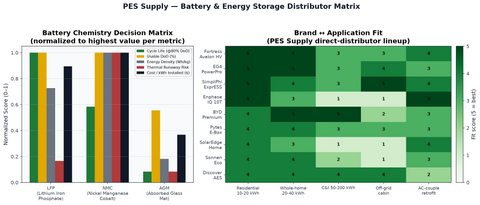
Fortress, BYD, and Pytes rack-and-cabinet systems have a mixed profile. Fortress and Pytes have US assembly with a growing share of US components; whether a specific project clears the 50% 2026 threshold depends on the exact configuration and vendor mix. BYD Battery-Box HVM is largely offshore-manufactured and typically does not qualify for the domestic-content adder as of 2026.
Before claiming the adder, request the domestic-content certification from PES for the specific project configuration. We supply the supplier-cert package as part of the ITC documentation.
The energy-community adder adds another 10 percentage points to the ITC when the project is located in a designated energy community. Treasury and the DOE jointly maintain the mapping. Three qualification paths:
- Brownfield sites — properties with real or perceived environmental contamination. EPA maintains lists; site owner can also self-designate with documentation.
- Coal-community census tracts — areas where a coal mine or coal-fired power plant has closed since 2000. DOE publishes annual maps.
- Statistical Area energy communities — MSAs and non-MSAs meeting fossil-fuel employment and unemployment thresholds. Updated annually by DOE.
Verification is straightforward: pull the DOE energy-community map, enter the project address, confirm the tract's status. If it qualifies, retain the map screenshot and the qualifying census tract designation in the ITC documentation.
Practical impact: roughly 40% of the continental US falls into at least one energy-community category. Rural communities, former manufacturing towns, and much of Appalachia, the Ohio River Valley, and parts of the Southeast qualify broadly. Metropolitan cores in the Northeast, California, and the Pacific Northwest typically do not.
On a $220,000 BESS project, the energy-community adder adds $22,000 in tax credit for zero incremental effort beyond documenting the location. It is the highest-ROI compliance work on the project.
| Scenario | Base ITC | Domestic Content | Energy Community | Total ITC $ | Bonus Depreciation NPV | Total Tax Benefit |
|---|---|---|---|---|---|---|
| Urban core, offshore battery, no adders | 30% | — | — | $66,000 | $18,500 | $84,500 |
| Suburban, offshore battery, energy community | 30% | — | 10% | $88,000 | $16,600 | $104,600 |
| Suburban, US-content battery, no energy community | 30% | 10% | — | $88,000 | $16,600 | $104,600 |
| Rural, US-content, energy community (full stack) | 30% | 10% | 10% | $110,000 | $14,700 | $124,700 |
| Same project, 40% bonus depreciation (2027) | 30% | 10% | 10% | $110,000 | $9,800 | $119,800 |
| Same project, no bonus depreciation (2030+) | 30% | 10% | 10% | $110,000 | $0 | $110,000 |
The ITC reduces federal tax liability by a fixed percentage of eligible cost. Depreciation is separate: BESS falls into MACRS 5-year property under IRS Publication 946, which allows the project owner to depreciate the eligible cost (reduced by half the ITC, per Section 50(c)) over five years using an accelerated schedule.
The bonus depreciation provision under Section 168(k) allows the owner to accelerate a portion of the depreciation into year 1. The schedule:
- 2023: 80% — property placed in service in 2023 can depreciate 80% in year 1.
- 2024: 60%
- 2025: 40%
- 2026: 20% (Note: the Tax Relief for American Families and Workers Act of 2024 restored 100% bonus depreciation through 2025; for 2026, we assume the phase-down schedule holds unless further Congressional action).
- 2027 and after: 0% (standard MACRS 5-year applies).
Important: the bonus depreciation schedule is set by statute and subject to Congressional revision. As of the drafting of this guide (September 2026), the schedule above reflects current law. Consult a tax professional for the applicable rate in your specific tax year.
The NPV of bonus depreciation on a $220,000 BESS with $110,000 ITC (adjusted basis = $220,000 − $55,000 = $165,000, using half-ITC adjustment) is roughly $9,000–$18,500 depending on the year of placement and the taxpayer's effective rate.
Not every C&I customer can use the ITC. A tax-exempt entity (school, hospital, municipality, nonprofit) has no federal tax liability to offset. A cash-constrained customer may not have the capital to buy the BESS outright even after the tax stack. Four ownership structures address these cases:
Direct ownership — the customer buys the BESS, claims the ITC and depreciation, and captures 100% of the revenue. This is the highest-return structure but requires tax appetite and upfront capital. Most manufacturing, cold-storage, and mid-market commercial owners fall here.
Power Purchase Agreement (PPA) — a third party (developer, IPP) owns the BESS, claims the ITC and depreciation, and sells the energy or capacity to the customer under a 10–20 year contract at a $/kWh or $/kW-year rate. Customer pays no upfront capital and gets a discount to prevailing utility rates. Common for schools, hospitals, and municipalities.
Energy-as-a-Service (EaaS) — a variant of PPA where the third party owns the equipment and provides a bundled service (energy, capacity, resiliency, DR management) for a monthly fee. Term typically 10–15 years. Customer treats the payment as OpEx, avoiding capital budget cycle. Common for retail chains and mid-market commercial.
Sale-leaseback — the customer builds the BESS, sells it to a tax-equity partner at cost, and leases it back over 6–10 years. The tax-equity partner captures ITC and depreciation; the customer avoids upfront capital and eventually buys the BESS back at fair market value. Common for larger 2–5 MWh projects.
PES supplies equipment for all four structures. On PPA and EaaS deployments, we quote the developer or IPP directly and support the tax-equity partner's due diligence on eligible cost and domestic-content documentation.
-
1
Confirm placed-in-service date at commissioning.
Placed-in-service is the date the BESS is ready and available for its intended use — typically the utility PTO date. Document this with a signed commissioning report, the utility PTO letter, and the customer's operational acceptance. This date determines which tax year the credit applies to and which bonus depreciation rate applies.
-
2
Build the eligible-cost worksheet from invoice line items.
Group project costs into eligible (equipment, integration labor, permitting, sales tax on equipment) and non-eligible (general site work, financing). PES supplies a template worksheet with the equipment invoice broken into ITC-eligible categories.
-
3
Confirm prevailing wage and apprenticeship compliance.
For projects >1 MW, this is required for the 30% rate; without it, the credit drops to 6%. Retain payroll records, apprentice hours, and wage determinations. Most union C&I install contractors satisfy this by default; non-union contractors need explicit documentation.
-
4
Pull the domestic-content certification for the adder.
Request from PES the supplier certifications for battery, PCS, and structural components, plus the calculated adjusted percentage. Retain the certifications with the project file.
-
5
Verify energy-community location.
Screenshot the DOE energy-community map at the project address. Retain the qualifying tract designation with the project file.
-
6
File Form 3468 with the tax return.
IRS Form 3468 (Investment Credit) is the primary form. Attach the eligible-cost worksheet, PTO letter, commissioning report, and adder certifications. For projects using Direct Pay (elective payment under IRC §6417) or Transferability (elective transfer under IRC §6418), additional forms apply.
-
7
Coordinate with a CPA or tax counsel experienced in energy credits.
This is not a DIY area. A CPA who has done 5+ energy-credit filings knows the placed-in-service traps, the eligible-cost carve-outs, and the audit patterns. Budget $4,000–$8,000 for the tax filing on a project of this size — it's cheap insurance against an audit adjustment.
-
8
Retain the ITC documentation package for the audit window.
IRS audit window on energy credits is typically 3 years from the return filing date, extended to 6 years if there's a substantial understatement. Retain the full package — equipment invoices, PTO letter, commissioning report, wage records, adder certifications, DOE map screenshot — for at least 6 years.
Two IRA provisions materially expanded who can benefit from the ITC:
Direct Pay (IRC §6417) — allows tax-exempt entities (governments, nonprofits, schools, tribes, rural electric coops, Indian tribal governments, Alaska Native Corporations) to receive the ITC as a cash refund from the IRS. The entity files Form 3468 and receives the credit value directly, whether or not they have tax liability. This effectively converts the tax credit into a grant for the 30–50% eligible cost, subject to the same eligibility and documentation requirements as a private taxpayer.
For a school district installing a 1 MWh BESS at a middle-school campus, Direct Pay is transformative: a project that was previously unfundable becomes viable because the district receives $200,000–$300,000 back from Treasury.
Transferability (IRC §6418) — allows a for-profit taxpayer with insufficient tax appetite to sell the credit to a third party for cash. The transfer is a one-time sale at typically $0.85–$0.95 per $1 of credit. The buyer claims the credit on their return. This lets small businesses and startups monetize a credit they could not otherwise use in full.
Both provisions have specific pre-registration requirements with IRS via a Registration Number system. Requires a filing at least 120 days before the return due date. Coordinate with the CPA during commissioning, not at tax-filing time.
For BESS projects >1 MW nameplate, the ITC rate depends on whether the project meets Treasury's prevailing-wage and apprenticeship (PWA) requirements. Meeting PWA: 30% base ITC. Missing PWA: 6% base ITC. That's a 24-point difference on a system that might have $500K–$2M in eligible cost. On a $1.5M BESS project, PWA compliance is worth $360,000 in tax credit.
The requirements:
Prevailing wage — all laborers and mechanics working on the project (including subcontractors) must be paid at least the prevailing wage as determined by the Department of Labor for the local geographic area and job classification. Wage determinations are on file at DOL SAM.gov. The requirement applies during construction and during the first 5 years of operation for any alterations or repairs.
Apprenticeship — a specified percentage of labor hours must be performed by qualified apprentices. The percentage rises annually: 12.5% for projects beginning construction in 2023, 15% in 2024 and after. Apprentices must be registered with a DOL-approved apprenticeship program.
Documentation that has to be retained:
- Certified payroll records showing wage rates paid to each worker.
- DOL wage determinations for the applicable area and classifications.
- Apprentice hours worked, with registration documentation from the apprenticeship program.
- Good-faith effort documentation if the apprentice percentage cannot be met (limited relief available).
- Contractor and subcontractor certifications.
PWA compliance is straightforward with a union C&I contractor — union payrolls default to prevailing wage and pull apprentices from the local hall. Non-union contractors can comply but require careful documentation and often have to hire apprentices specifically for the project. Budget 2–4% higher labor cost on a PWA-compliant non-union project vs a non-PWA build.
Sub-1 MW projects are exempt from PWA — the 30% base rate applies without documentation requirements. Sub-1 MW covers most 100–500 kWh commercial installations and many 1–2 MWh containerized deployments (a 1 MWh / 250 kW PCS system is below the 1 MW threshold).
Section 50(a) requires the ITC to be recaptured if the property is disposed of within 5 years of placement. Recapture percentages by year:
- Year 1: 100% recapture
- Year 2: 80%
- Year 3: 60%
- Year 4: 40%
- Year 5: 20%
- Year 6+: 0%
"Disposition" includes sale, abandonment, or a change in use that removes the property from ITC-eligible service. It does NOT include events like insured casualty loss with replacement or continuation of the trade or business.
Practical implications:
- Direct-purchase customers — plan to hold the BESS for at least 5 years, ideally through the 10-year warranty. Selling the property or the business before year 6 triggers partial recapture.
- PPA and EaaS structures — the developer or IPP holds the ITC. If they sell the project in year 3, they recapture. Contract structures typically include indemnification clauses.
- Sale-leaseback — the tax-equity partner holds the ITC. The customer's option to purchase in year 6+ is timed to avoid recapture.
- Bankruptcy / abandonment — abandoning the BESS (not maintaining, not operating) can trigger recapture. Continuous operation is a defense.
Beyond the federal ITC, several states offer their own tax credits or rebate programs that stack with federal:
- Massachusetts — Residential and commercial rebates through Mass Save and SMART; commercial storage adders on solar+storage projects.
- New York — NYSERDA Retail Storage Program pays $200–$350/kWh in Con Ed and PSEG-LI territories; NY-Sun program pays adders for commercial storage.
- California — SGIP rebates $200–$1,000/kWh depending on customer type; specific tiers for equity-eligible, medical, agricultural, and food-service customers.
- Connecticut — Energy Storage Solutions program pays up-front plus performance-based over 10 years.
- Rhode Island — Commercial energy storage rebates through Rhode Island Energy.
- Puerto Rico — DEQP subsidies for resilient storage systems, particularly for medical, cold-storage, and telecommunications facilities.
- Vermont, New Hampshire, Maine — Various utility-managed storage incentive programs of varying scale.
Tax treatment of state incentives varies. Some (California SGIP treated as a rebate) reduce the ITC-eligible basis. Others (NYSERDA payments treated as taxable income) do not reduce basis. The tax treatment is specific to each program and should be confirmed with a CPA before assuming stackability.
PES's project team pulls the active state and utility incentives for each project's ZIP code and utility service address during the quote process. If a rebate is available and the customer qualifies, we include the application coordination as part of the project scope.
IRS audit window on energy credits is 3 years from filing, extended to 6 years for substantial understatement. Retain the ITC package for at least 6 years, ideally 10. The package should include:
- Equipment purchase invoices, itemized by ITC-eligible category.
- Installation labor invoices with PWA documentation attached (for >1 MW projects).
- Permit and engineering invoices.
- Site work invoices, with allocation between eligible (dedicated to BESS) and non-eligible (general site).
- Utility PTO letter dated the placed-in-service date.
- Factory-authorized commissioning report signed by the manufacturer's technician.
- UL 9540 listing certificate and UL 9540A summary letter.
- Domestic-content certifications from each covered supplier.
- DOE energy-community map screenshot with date and address annotation.
- Form 3468 filing package and any elective payment or transfer documentation.
- State-level incentive applications and award letters.
- Depreciation schedule showing MACRS treatment.
Best practice: store the package in a project folder with a naming convention that ties to the placed-in-service date and the tax year of the credit. Cloud storage with automated backup is fine; local-only storage on a laptop that gets replaced is a common audit disaster.
The ITC delivers value over multiple tax years, but different buyer profiles have different capacities to consume that value. Structuring the transaction correctly is a project-level decision:
Profitable C-corp buyer — the simplest case. Files Form 3468 with the annual return, claims the ITC in the placed-in-service year, and offsets tax liability directly. Bonus depreciation flows to the 5-year MACRS schedule. If the credit exceeds current-year liability, it carries back 1 year and forward 20. Most manufacturing, cold-storage, and mid-market commercial owners fall here.
Pass-through entity (LLC, S-Corp, partnership) — the credit passes through to the individual member/shareholder returns. Individuals then face passive-activity limitations under Section 469 unless they materially participate. This is a real limitation for many owners; the workaround is typically to restructure ownership or use Transferability to sell the credit.
Tax-exempt entity (school, hospital, municipality, nonprofit) — use Direct Pay (IRC §6417). File Form 3468 and receive the credit as a cash payment from Treasury. Requires pre-registration with the IRS Registration Number system at least 120 days before the return due date.
Cash-constrained for-profit — use Transferability (IRC §6418). Sell the credit to a third-party buyer for $0.85–$0.95 per $1 of credit. The sale is a one-time transaction; the credit is then claimed by the buyer. Requires the same pre-registration process.
Real estate investor with material passive income — the credit is generally usable against passive income sources. Coordinate with tax counsel on Section 469 passive activity rules.
The right structure is a decision at the tax-planning stage, not at commissioning. PES coordinates with the customer's CPA during the pre-quote phase to identify the intended structure and any documentation implications.
Beyond direct-cash purchase and PPA/EaaS structures, several dedicated BESS financing products are active in 2026:
Commercial energy loans — offered by specialty green-energy lenders (Sunwealth, Generate Capital, KeyBank Green Energy, others). Rates typically 7.5–10% on 7–10 year terms. Loan proceeds fund the BESS; the ITC and depreciation flow to the customer.
Equipment leases — traditional operating or capital leases from equipment-finance divisions of major banks. Structured as tax-oriented leases where the lessor claims the ITC and depreciation and passes the benefit through as lower lease payments. 7–10 year terms typical.
C-PACE (Commercial Property Assessed Clean Energy) — a real-estate-secured financing structure available in about 30 states. Loan is repaid through a property tax assessment; long terms (20–30 years) and low rates (5.5–7.5%). Available for BESS as of 2024 in most C-PACE-enabled states. Works especially well for building-owner customers.
Green bonds — for portfolio deployments (10+ sites, $10M+ total), green bond issuance can be the lowest-cost capital. Requires investment-grade credit or a strong sponsor.
Utility on-bill financing — offered by some utilities (Con Ed, Xcel, PG&E). The financing is repaid through a rider on the utility bill. Available for small commercial deployments; loan amounts and terms vary by utility.
PES's finance team maintains relationships with active BESS lenders and lease providers, and can facilitate introductions to appropriate financing partners as part of the project package. The financing structure is separate from the equipment supply, but coordination ensures the timing works.
Does the BESS need to be paired with solar PV to qualify for the ITC?
Can a 100 kWh BESS installed on a commercial site claim the ITC?
What if the BESS is placed in service partway through the tax year — can it still claim bonus depreciation?
How is the eligible cost different from the gross project cost?
Can a customer combine the ITC with state or utility rebates?
Does prevailing wage apply to a 500 kWh BESS at ~$220K installed?
What happens if the BESS is decommissioned before year 5?
Get ITC-Ready BESS Quote and Documentation
Every commercial BESS PES ships includes eligible-cost worksheet template, domestic-content certifications where applicable, and coordination with a CPA experienced in Section 48 filings.
Register NowNeed pricing or availability on anything in this guide?
Portlandia Electric Supply dropships direct from the manufacturer — most items Ship Direct with lead times stated up front, no surprises.
Get a quote from PESBulk, pallet and contractor pricing available.