Commercial & Industrial Energy Storage Sizing Guide 50-500 kWh | PES Supply
Commercial and industrial energy storage sizing — 50 to 500 kWh — with peak shaving, demand charge reduction, and resiliency as the primary economic drivers.

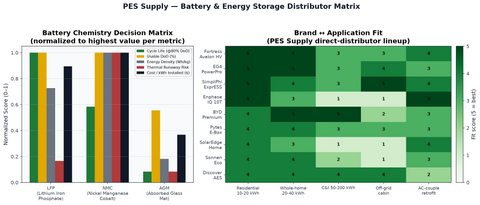
Commercial and industrial energy storage sizing — 50 to 500 kWh — with peak shaving, demand charge reduction, and resiliency as the primary economic drivers. Direct-distributor lineup at PES Supply: Fortress Avalon HV Pro Business, SimpliPhi AccESS, and BYD Battery-Box Premium HVM. This guide covers the sizing math, the utility economics, and the specific SKU combinations that install in each kWh band.
Commercial storage economics look nothing like residential. A homeowner buys 10 kWh for backup peace of mind. A commercial customer buys 200 kWh to reduce a $3,000/month demand charge. The four drivers, ranked by contribution to a typical 5-year savings model:
Driver 1 — Demand charge reduction (~40–45 %)
Utility bills for commercial customers include a demand charge — a per-kW rate applied to the peak 15-minute average kW draw across the billing month. In California IOU territory this is $15–$40/kW. In Con Ed territory it's $25–$45/kW. A 100 kW peak facility pays $2,500–$4,500/month in demand charges alone. Reducing the peak by 30 kW through a scheduled battery discharge during the peak window saves $750–$1,350/month, or $9,000–$16,200/year.
Driver 2 — Time-of-use energy arbitrage (~20–25 %)
Commercial TOU rates typically have a 3× or 4× ratio between off-peak overnight energy and on-peak afternoon energy. A 200 kWh battery cycled once a day between $0.08/kWh off-peak and $0.32/kWh on-peak generates $48/day of arbitrage value, or $17,500/year. In flat-rate territories this driver disappears.
Driver 3 — Solar self-consumption (~15 %)
If the facility has PV, the battery captures midday excess generation and displaces evening grid consumption. This is a net-metering-rate-arbitrage lever that grew as utilities cut net metering (NEM 3.0 in California, similar reforms elsewhere).
Driver 4 — Resiliency (10–15 %)
Backup value is harder to monetize but real. For grocery, cold storage, data centers, and healthcare, the cost of an hour of outage is measured in $10k–$100k. Even a partial backup scope (compressor loads, IT, critical HVAC) at 100 kWh moves the P&L in the customer's favor over a 10-year horizon.
Driver 5 (stacked on top) — 30 % ITC + bonus depreciation
The Investment Tax Credit at 30 % of installed cost applies to standalone storage under the IRA. Bonus depreciation on the 5-year MACRS class then compounds — for a $200,000 install, the effective post-incentive cost drops to $110,000–$130,000 in year 1.
C&I ESS sizing has three parameters:
- kW (power) — the peak discharge rate. Sized to the demand-charge reduction target. If you're trying to shave 40 kW off a 120 kW peak, the battery needs to discharge at 40 kW.
- kWh (energy) — total usable storage. Sized to the duration of the peak window × kW. If the peak window is 4 hours and you're discharging at 40 kW, you need at least 160 kWh usable.
- Duration ratio (C-rate) — most C&I LFP systems are sized for 0.25C to 0.5C — a 200 kWh battery discharging at 50 kW (0.25C) has 4 hours of runtime.
Worked sizing example — small commercial (retail, office)
Facility: 8,000 sq ft office building, 25 kW peak demand, 8 kW average, $18/kW demand charge, PG&E TOU rate.
Target: Reduce peak from 25 kW to 15 kW during 4 – 9 PM TOU window (5 hours).
Battery kW: 10 kW discharge capacity.
Battery kWh: 10 kW × 5 h = 50 kWh usable, 62.5 kWh nameplate at 80 % DoD.
System: Fortress Avalon HV Pro Business 60 kWh cabinet + 12 kW three-phase hybrid inverter, or SimpliPhi AccESS 60 kWh + 12 kW paralleled.
Annual savings: 10 kW × $18 × 12 months = $2,160 demand + $3,000 TOU + $1,200 self-consumption = ~$6,360/year. Installed cost ~$65,000. Post-ITC ~$45,500. Payback ~7 years.
50–75 kWh — small retail, office, professional services
Target 20–30 kW peak demand, 25 kW inverter. Fortress Avalon HV Pro Business 60 or SimpliPhi AccESS 22.8 × 3 units paralleled. Installed ~$60k–$80k. Single-pallet or two-pallet freight.
100 kWh — restaurant, QSR, small manufacturing
Target 40–60 kW peak, 50 kW inverter. BYD Battery-Box Premium HVM 100 kWh stack or Fortress HV Pro Business 100. Installed ~$110k–$140k. Two-pallet freight.
200 kWh — light manufacturing, mid-size warehouse
Target 80–120 kW peak, 100 kW inverter. Parallel two BYD HVM stacks or Fortress HV Pro Business paralleled cabinets. Installed ~$220k–$280k.
350 kWh — cold storage, mid-size retail chain
Target 120–180 kW peak, 150 kW inverter. Skidded configuration — 3–4 paralleled cabinets. Installed ~$385k–$490k.
500 kWh — multi-unit residential, large warehouse, small industrial
Target 200 kW peak, 200 kW inverter. Full skidded system, 5+ paralleled cabinets or a container-scale ESS. Installed ~$550k–$700k. Multi-pallet freight, forklift install required.
Fortress Avalon HV Pro Business is the C&I extension of the Avalon platform. Cabinet-scale HV LFP stacks with matched three-phase hybrid inverters (208 Y/120 or 480 Y/277), 100 kWh per cabinet, parallelable to 500+ kWh. Fortress ships as a factory-assembled skid for larger orders.
Configurations
- Fortress HV Pro Business 60 — 60 kWh + 25 kW inverter
- Fortress HV Pro Business 100 — 100 kWh + 50 kW inverter
- Fortress HV Pro Business paralleled — 200/300/500 kWh + 100–200 kW inverter stack
Best-fit applications
- Small retail and office (50–100 kWh)
- Restaurant and QSR (100 kWh)
- Multi-unit residential and light industrial (200–500 kWh)
- Solar-plus-storage new-build with three-phase service
SimpliPhi AccESS scales through paralleled cabinets — each cabinet is 15.2 kWh or 22.8 kWh with 12 kW inverter. Paralleled to 40–100 kWh, the AccESS is the pick for extreme-climate C&I where SimpliPhi's -20 to +60 °C operating range and 10,000-cycle A123 cells matter.
PES SKUs
- SimpliPhi AccESS 15.2 kWh + 12 kW Inverter — PES-SPS-SIV-0245, $19,850.25
- SimpliPhi AccESS 22.8 kWh + 12 kW Inverter — PES-SPS-SIV-0243, $27,431.25
Best-fit applications
- Extreme temperature — desert Southwest, cold Northeast
- High cycle life required — twice-daily arbitrage, industrial UPS
- Pre-wired cabinet preference — install crew wants plug-and-play
BYD Battery-Box Premium HVM is the high-voltage C&I platform — 400–500 VDC bus, 100 kWh per stack, closed-loop with SolarEdge Energy Hub, Fronius GEN24, Kostal Plenticore, and Sol-Ark 15K-HV. HVM stacks parallel cleanly to 500+ kWh.
PES SKUs
- BYD Battery-Box Premium HVL BCU + Base — PES-PA-ELC-0113, $682.50 (stack head)
- BYD 2.5 kWh HV Battery Module (B-Plus-H) — PES-ESS-BTS-0180, $2,117.32
Best-fit applications
- Large residential + light C&I (100–200 kWh)
- SolarEdge, Fronius, or Kostal inverter already on the design
- European mechanical build quality valued
- Multi-stack scale to 500+ kWh
Every C&I ESS install triggers a permit and typically a plan review. The relevant sections in 2026:
- NEC 706 — ESS disconnects, labeling, working space, arc-fault protection.
- NFPA 855 — Installation of stationary energy storage systems. For C&I, this drives cabinet spacing (minimum 3 ft between ESS units, 3 ft from egress), maximum aggregate kWh per room (typically 600 kWh residential, 1,500 kWh commercial before enhanced fire suppression required), and ventilation requirements.
- IBC 1207 — Commercial ESS occupancy classification and separation.
- UL 9540 and UL 9540A — System listing + cell-level fire propagation test.
- Local fire marshal review — Almost always required for >20 kWh commercial. Provide signed listing letters.
- Interconnection agreement — Storage is a generation source on the utility side; NEM 3.0 or equivalent interconnection paperwork is required.
Typical permit timeline
- Load study and utility interconnection application — 30–60 days
- Building permit application with NFPA 855 site plan — 30–90 days
- Fire marshal review — 15–45 days
- Post-install inspection and Permission to Operate — 15–30 days
Total: 3–6 months for most C&I ESS. Larger installs (>250 kWh) can hit 9 months.
What's the ROI horizon on a C&I ESS install?
Typical C&I ESS payback in high-demand-charge utility territories (California IOUs, Con Ed, National Grid) is 4–7 years without solar, 3–5 years with solar plus ITC. In low-demand-charge territories (much of the Southeast and Midwest), payback stretches to 8–12 years and the customer buys on resiliency rather than economics. The 30 % Investment Tax Credit plus bonus depreciation on the storage asset closes 30–35 % of the installed cost immediately.
How is a commercial demand charge calculated?
Utility bills for commercial and industrial customers have three components — energy (kWh consumed), demand (peak kW during any 15-minute window in the billing month), and fixed charges. The demand charge is typically $10–$40 per kW per month depending on the utility. A facility with a 100 kW peak pays $1,000–$4,000/month on demand alone, and reducing that peak by 30 kW through battery discharge during the peak window saves $300–$1,200/month — that's the primary ESS payback engine.
Peak shaving vs time-of-use arbitrage — which matters more?
Peak shaving (demand charge reduction) is the bigger dollar lever in almost every US utility market — typically 40–50 % of total savings. TOU arbitrage (charging off-peak, discharging on-peak) is 20–25 %. Self-consumption of solar is 15 %. Backup / resiliency value is 10–15 %. ITC and bonus depreciation is the 30–35 % installed-cost reduction on top of all savings.
What's the largest single-cabinet C&I ESS at PES Supply?
Fortress Avalon HV Pro Business scales in cabinet form to 100+ kWh per cabinet with paralleled cabinets to 500+ kWh. SimpliPhi AccESS in the largest configuration (22.8 kWh + 12 kW inverter) parallels to 100+ kWh for medium C&I. BYD Battery-Box Premium HVM stacks to 100 kWh per stack and parallels for large C&I. For 500 kWh and up, the design shifts to skidded systems shipped on multiple pallets.
Do I need three-phase for C&I ESS?
Most US commercial services above 100 A are three-phase (208 Y/120, 480 Y/277, or 480 delta). The Fortress Avalon HV Pro Business, SimpliPhi AccESS 12 kW, and BYD HVM systems all support three-phase inverter configurations. For split-phase 200 A commercial (small retail, restaurants), the residential-scale hybrid inverters still apply — EG4 18kPV, Sol-Ark 15K-2P, Fortress Avalon HV Pro.
How does UL 9540 apply to C&I?
UL 9540 is the same listing standard for residential and C&I — the system is listed as a complete package (battery + inverter + BMS + enclosure). At the C&I scale, NFPA 855 also drives separation distances between cabinets (minimum 3 ft between ESS units, minimum 3 ft from egress doors), maximum kWh per room, and fire-suppression triggers. AHJs almost always require signed listing letters from the manufacturer for permit approval.
Example — PG&E B-19 medium commercial
PG&E's B-19 rate applies to non-residential customers with peak demand between 50 kW and 500 kW. The tariff has three demand charge components as of 2026:
- Maximum peak demand: $22.83/kW-month (summer)
- Maximum part-peak demand: $6.16/kW-month
- Facility demand: $11.53/kW-month
A 200 kW peak facility on B-19 in summer pays 200 × $22.83 = $4,566/month in maximum-demand charges alone, and additional facility demand costs another $2,306/month.
Reducing the peak by 50 kW through scheduled ESS discharge during the summer peak window (4–9 PM):
- Summer maximum-demand savings: 50 × $22.83 × 4 months = $4,566
- Winter maximum-demand savings: 50 × $17.86 × 8 months = $7,144
- Facility demand savings: 50 × $11.53 × 12 = $6,918
- Total annual demand savings: ~$18,600
Example — Con Ed SC-9 large commercial
Con Ed's SC-9 rate applies to commercial customers with peak demand above 100 kW. Demand charges range $25–$45/kW-month depending on delivery voltage. A 250 kW facility on SC-9 secondary distribution:
- Demand charge: 250 × $32 × 12 = $96,000/year
- 50 kW reduction: 50 × $32 × 12 = $19,200/year savings
The 200 kWh reference case
A 200 kWh / 100 kW ESS on either of the above tariffs delivers $18k–$24k/year in demand savings alone. Add TOU arbitrage (~$8k) and self-consumption (~$4k) and the annual gross value clears $30k. Installed cost ~$260k, post-30% ITC $182k, post-bonus-depreciation ~$120k effective. Payback: ~4 years.
The Inflation Reduction Act (IRA) of 2022 established a 30% Investment Tax Credit for standalone stationary storage starting January 1, 2023. Before the IRA, storage was only eligible when charged from a co-located solar system. The IRA also created adder credits:
- Base ITC: 30 % — applies to all standalone storage > 5 kWh capacity
- Domestic content adder: +10 % — batteries manufactured with US-content thresholds (increasing annually)
- Energy Community adder: +10 % — projects in coal-community census tracts
- Low-income community adder: +10–20 % — applies to qualified low-income service applications
MACRS depreciation applies on top of the ITC. Storage is a 5-year MACRS asset class, and (with periodic reauthorization) bonus depreciation lets the customer expense 40–60 % of the depreciable basis in year 1. On a $200k installed system with 30 % ITC:
- ITC credit: $60,000 in year 1
- Depreciable basis after ITC reduction: $170,000
- Year-1 bonus depreciation @ 40 %: $68,000 × marginal tax rate (~24 %) = $16,320 tax savings
- Year-1 MACRS on remaining basis: $102,000 × 20 % × 24 % = $4,896 tax savings
- Net year-1 cash impact: $200,000 – $60,000 – $16,320 – $4,896 = $118,784 effective installed cost
C&I ESS above ~100 kWh almost always runs three-phase. The inverter selection drives which battery brands you can pair with:
Sol-Ark 60K three-phase
60 kW three-phase hybrid inverter, 480 Y/277 or 208 Y/120. Closed-loop with Fortress Avalon HV Pro Business and Sol-Ark HV battery lines. The current default for light-C&I 100–200 kWh builds.
Fortress Avalon Business inverter
Fortress's own three-phase C&I inverter, closed-loop only with Fortress Avalon HV batteries. Ships as a complete UL 9540 system.
SolarEdge Commercial Inverter + Energy Hub
SolarEdge's C&I hybrid, closed-loop with BYD Battery-Box Premium HVM. Best fit when the facility already has SolarEdge PV.
SMA Sunny Tripower Storage
European C&I standard, closed-loop with BYD HVM and select LFP brands. Common in projects with European engineering roots.
Installing a 200 kWh cabinet is not a residential job. Practical considerations:
- Freight: Full pallet or LTL. A 100 kWh Fortress HV Pro Business cabinet is ~1,800 lb; a 200 kWh SimpliPhi AccESS parallel bank is ~3,600 lb.
- Rigging: Forklift and pallet jack at the delivery point. For upper-floor installs, a boom lift or crane.
- Pad and clearance: Concrete pad rated for the cabinet weight, 3 ft clearance on all sides for NFPA 855 compliance, 3 ft from egress doors, 5 ft from combustibles.
- DC combiner and disconnect: C&I ESS above 100 kWh requires a dedicated DC combiner with per-module fusing and a lockable DC disconnect between the battery cabinet and the inverter.
- Interconnection: Utility approval, revenue-grade metering on the ESS output, and a signed interconnection agreement.
- Commissioning: Manufacturer-authorized commissioning is required for warranty registration on most C&I platforms — Fortress, SimpliPhi, and BYD all send a factory-trained tech for cabinet-scale first installs.
Restaurant chain (QSR)
75 kW peak demand from HVAC and refrigeration, $28/kW-month demand charge. Installed 100 kWh Fortress HV Pro Business with 50 kW inverter. Reduces peak by 30 kW during 4-hour daily peak window. Annual demand savings ~$10,000, TOU arbitrage ~$4,500, backup value ~$3,000 for compressor loads during grid outages. Installed cost ~$120k, post-ITC $84k. Payback 4.8 years.
Cold storage warehouse
180 kW peak demand from compressors. Installed 350 kWh BYD Battery-Box HVM stack with SolarEdge Commercial inverter. Reduces peak by 60 kW, avoids revenue loss on compressor outage events. Annual demand savings ~$22k, resiliency value ~$40k (based on historical outage impact). Installed cost ~$420k, post-ITC + bonus depreciation ~$240k effective. Payback 4 years.
Multi-unit residential
240-unit apartment complex, 200 kW peak. Installed 500 kWh Fortress HV Pro Business paralleled cabinets. Peak shaving reduces demand by 80 kW. Building qualifies for low-income community ITC adder (+20 %), so effective ITC = 50 %. Annual demand savings ~$26k, resiliency value substantial for common-area life-safety loads. Payback 3.5 years.
Light manufacturing
150 kW peak from motor loads with high inrush. Installed 200 kWh SimpliPhi AccESS paralleled with 100 kW three-phase inverter. Battery handles motor-start inrush (peak 320 kW for 2 seconds) that was tripping the utility service. Combined demand savings + avoided utility upgrade + arbitrage = $32k/year. Payback 5.5 years.
The permit and interconnection timeline is often the critical path on a C&I ESS install, not the equipment lead time. A realistic 200 kWh install schedule:
- Weeks 0–4: Site survey, load study, ESS design, single-line drawings. Preliminary utility notification for anticipated interconnection.
- Weeks 4–8: Utility interconnection application. Most IOUs require the ESS to be sized to the customer's peak demand plus a defined export limit. Interconnection engineering review begins.
- Weeks 6–12: Building permit application with NFPA 855 site plan, UL 9540 listing letters, one-line diagrams, and structural calcs for the cabinet pad.
- Weeks 8–14: Fire marshal review. For >50 kWh commercial, almost universally required. Bring the manufacturer's UL 9540A test summary and the site cabinet spacing plan.
- Weeks 12–18: Utility interconnection approval. May include additional protective device requirements at the service entrance.
- Weeks 14–20: Equipment ordering, delivery, install, commissioning. Equipment lead time on Fortress HV Pro Business is typically 4–8 weeks; SimpliPhi AccESS is 4–6 weeks; BYD HVM is 6–10 weeks.
- Weeks 20–24: Post-install inspection, utility witness test, Permission to Operate (PTO) letter.
Total: 5–6 months from contract to PTO for a well-run project. In slower jurisdictions or first-of-kind installs, 9+ months is realistic.
Not every C&I customer wants to own the ESS. Two alternative ownership structures are increasingly common:
Power purchase agreement (PPA)
A third-party developer owns the ESS, and the customer pays for the demand savings and TOU arbitrage as a monthly fee. Customer has no capex, developer captures the ITC and depreciation. Typical PPA terms: 15–20 years, 90 % of realized savings paid to developer as the "PPA rate."
Storage as a service (StaaS)
Similar to PPA but the developer contractually guarantees a minimum demand-charge reduction. Customer pays a fixed monthly service fee (often lower than the PPA rate) and the developer bears the performance risk. Common with dedicated ESS service providers.
Both models allow the customer to deploy the ESS with zero capex, at the cost of long-term monthly cash outflow. For installers, StaaS and PPA projects are typically bid to specialized developers rather than one-off installers, but the equipment supply (Fortress HV Pro Business, BYD HVM, SimpliPhi AccESS) is the same.
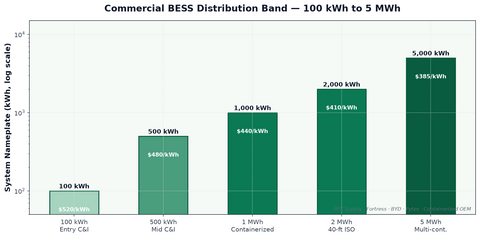
Above 500 kWh, the practical delivery form factor shifts from cabinet paralleling to skidded or containerized systems. A 500 kWh cabinet-paralleled install is 5–10 pallets and takes 3–5 days to install; a skidded or containerized 500 kWh system is one crane lift and 1–2 days to commission.
At the 500 kWh–2 MWh scale, dedicated C&I ESS platforms replace the cabinet-paralleled residential-derived systems:
- Fortress Avalon Enterprise / Business skid — 500 kWh to 2 MWh, containerized, three-phase 480 V.
- BYD Battery-Box Utility — utility-scale platform, 500 kWh to 4 MWh containers.
- Discover Energy Systems large-format — rackmount platform scaled through custom cabinet arrays.
PES distributes the residential and light-C&I ends of these platforms; for utility-scale > 1 MWh, we route to the manufacturer's C&I project team.
Most C&I ESS installs above $200k are financed rather than paid cash. Common structures:
Traditional bank loan
5–10 year term, 6–9 % rate, 20 % down. Customer captures ITC and depreciation. Simplest structure but requires customer creditworthiness and appetite for capex on balance sheet.
Equipment lease
Operating or capital lease over 5–10 years. Lease company captures ITC and depreciation on a capital lease; customer captures on operating. Payment is monthly and often matches the demand savings — self-funding structure.
Power purchase agreement (PPA)
Third-party developer owns the ESS, sells "avoided demand charges" to the customer at a discount. Customer pays a fixed monthly PPA rate (90–95 % of realized demand savings). 15–20 year term. Developer captures ITC + depreciation.
Storage as a service (StaaS)
Similar to PPA but the developer guarantees a minimum demand-charge reduction contractually. Fixed monthly service fee, developer bears performance risk. Increasingly common with dedicated ESS operators.
Property Assessed Clean Energy (PACE)
Financing attached to the property tax bill, transferable if the property sells. 15–20 year terms, non-recourse to the business. Available in some states (CA, FL, TX, CO). Good fit for owner-occupied commercial real estate.
A residential ESS is a two-party transaction — homeowner and installer. A C&I ESS has 6–8 stakeholders and the project management is a job in itself:
- Customer / facility owner — signs the contract, captures the financial benefits.
- Facility manager / operations — coordinates site access, load survey, existing infrastructure.
- Installer / EPC contractor — engineering, procurement, construction, commissioning.
- Utility interconnection engineering — reviews and approves the interconnection application.
- Local AHJ (building official) — issues building permit, reviews structural and electrical.
- Fire marshal — reviews NFPA 855 compliance, cabinet spacing, egress.
- Manufacturer's commissioning team — Fortress, SimpliPhi, or BYD tech commissions the system, validates warranty registration.
- Financing entity — bank, lease company, PPA developer, or PACE administrator.
Coordinating these stakeholders is a project management competency separate from the technical install. Larger installers have dedicated project managers; smaller installers should factor 40–80 hours of PM time into every C&I bid.
The DC-coupled C&I hybrid inverter market has consolidated around a small number of proven closed-loop pairings. Practical picks for 2026:
50–100 kW inverter class (light C&I)
- Sol-Ark 60K three-phase paired with Fortress Avalon HV Pro Business or BYD Battery-Box Premium HVM — flexible closed-loop, wide battery choice
- Fortress Avalon Business inverter with Fortress HV batteries — single-vendor UL 9540 system
- SolarEdge Commercial three-phase paired with BYD HVM stack — captive SolarEdge ecosystem
100–250 kW inverter class (medium C&I)
- Fortress Business inverter paralleled with paralleled HV Pro Business cabinets
- SMA Sunny Tripower Storage with BYD HVM stack
- Schneider Boost XL with SimpliPhi AccESS parallel bank
250 kW+ inverter class (large C&I / small utility)
Above 250 kW single-inverter, the design shifts to central inverter architecture — Sungrow, SMA Sunny Central Storage, Power Electronics FS-series. Battery selection at this scale is typically containerized rather than cabinet-scale, and the equipment is procured as an integrated MW-scale package rather than component-level.
C&I ESS is a low-maintenance asset compared to a diesel generator or a chiller, but it is not maintenance-free. Typical annual O&M budget:
- Monitoring subscription — Fortress, BYD, and SimpliPhi cloud subscriptions run $200–$600/year per system on the C&I platform.
- Annual inspection — Visual inspection, torque check on DC connections, BMS log review, thermal imaging. 4–6 hours labor, $500–$800/year.
- Firmware updates — Battery BMS and inverter firmware push 2–4 times/year, typically 1 hour of remote or on-site labor.
- Component replacement reserve — Cooling fans, contactors, and the inverter itself have shorter MTBF than the battery cells. Budget 1–2 % of installed cost per year for out-of-warranty replacement reserve.
- Capacity retest — At year 5 and year 10, run a full-discharge capacity test to verify the warranty end-of-warranty capacity target is being met. Manufacturer will honor warranty replacement if the test shows deficient capacity.
Open a Contractor Account
Get trade pricing, freight quotes, and access to the interactive Battery Sizing Calculator on our contractor portal.
Register NowAbout the author: Jennifer Kirstens leads distributor content at PES Supply. Last updated August 2026.