Updated September 2026 — refreshed against the live PES catalog; product pricing verified 2026-09-26.
Generac's PWRcell is the home battery from the company America already trusts for backup power — a modular cabinet system that scales from 9 kWh to 36 kWh, ties into solar, and pairs with Generac's PWRgenerator for indefinite off-grid runtime. It's also one of the most mispriced systems on the internet, because almost nobody publishes what the components actually cost. This guide does — with Portlandia Electric Supply catalog pricing, honest cost-per-kWh math, and a straight answer on who PWRcell fits.
We've specced more PWRcell cabinets than we can count, and the first thing we tell every caller is the same: the cabinet is the value point. Fill it or think hard about why you're buying it.
What a PWRcell system is made of
PWRcell is modular. You buy an inverter, a battery cabinet, and lithium modules — roughly 3.0 kWh each — that stack inside the cabinet. The sizing lever is module count, not box count, which is exactly what makes the system flexible and exactly what makes its pricing confusing.
| Component | Role | PES catalog price (verified 2026-09-26) |
|---|---|---|
| PWRcell 7.6kW inverter (XVT076A03) | Grid-tie battery inverter w/ CTs | $3,873.07 |
| PWRcell 11.4kW inverter (XVT114G03) | Larger grid-tie battery inverter w/ CTs | $5,328.15 |
| PWRcell outdoor-rated battery cabinet (APKE00042) | Holds the modules, outdoor-rated | $2,882.77 |
| PWRcell 3.0kWh module (G0080003) | Li-ion battery module | $2,039.29 |
| PWRcell DCB module (G0080040) | Li-ion DCB battery module | $2,144.62 |
| PWRcell 2.85kWh module (A0000391219) | Li-ion battery module | $2,053.94 |
| PWRcell 200A service-rated ATS (CXSW200A3) | Whole-home backup transfer | $976.00 |
| Cabinet spacer (APKE00008) | Required spacing hardware per module layout | $116.99 (mid-2026) |
| Foot bracket kit (APKE00043) | Cabinet mounting hardware | $106.00 (mid-2026) |
| Module upgrade kit (APKE00009) | Hardware for adding modules later | $151.99 (mid-2026) |
A single cabinet holds up to six modules — roughly 17–18 kWh depending on module vintage — and systems scale to two cabinets for about 36 kWh. The accessory SKUs at the bottom of that table are the ones homeowners forget and installers never do. The cabinet, spacers, and foot brackets are separate line items, and the install manual dictates the order and hardware per module count.
Cost per kWh: the honest math
Every figure below is equipment only, using the PES catalog prices above (verified 2026-09-26). Installation, solar integration, permits, and the inevitable "while-we're-in-there" electrical work add meaningfully to every total — budget for that separately.
Worked example: entry system, 9 kWh
Three 3.0 kWh modules + cabinet + 7.6 kW inverter + 200A ATS: (3 × $2,039.29) + $2,882.77 + $3,873.07 + $976.00 = $13,849.71 equipment, or about $1,539 per usable kWh of installed-ready hardware. The inverter dominates small-system economics — which is why tiny PWRcell builds rarely pencil.
Worked example: full cabinet, 18 kWh
Six 3.0 kWh modules + cabinet + 7.6 kW inverter + ATS: (6 × $2,039.29) + $2,882.77 + $3,873.07 + $976.00 = $19,967.58, or about $1,109/kWh — a 28% improvement in $/kWh just from filling the cabinet. Lesson one of PWRcell economics: the full cabinet is the value point.
Worked example: two cabinets, 36 kWh
Twelve modules + two cabinets + 11.4 kW inverter + ATS: (12 × $2,039.29) + (2 × $2,882.77) + $5,328.15 + $976.00 = $36,541.17, roughly $1,015/kWh. Whole-home territory — multi-day autonomy for an efficient home, or one solid day with real loads.
| System size | Configuration | Equipment total (verified 2026-09-26) | Effective $/kWh |
|---|---|---|---|
| 9 kWh (entry) | 3 modules, 1 cabinet, 7.6 kW inverter, 200A ATS | $13,849.71 | ~$1,539 |
| 18 kWh (full cabinet) | 6 modules, 1 cabinet, 7.6 kW inverter, 200A ATS | $19,967.58 | ~$1,109 |
| 36 kWh (two cabinets) | 12 modules, 2 cabinets, 11.4 kW inverter, 200A ATS | $36,541.17 | ~$1,015 |
The pattern jumps off the page: each module you add after the first three spreads the same inverter and ATS cost over more storage. Going from 9 to 36 kWh nearly quadruples capacity while the total only grows 2.6×.
Runtime math: what those kWh actually buy you
Kilowatt-hours are abstract until you convert them into hours of lights, refrigeration, and internet. Assume 90% usable capacity and three load profiles we see constantly at the counter: an essentials-only sub-panel drawing 500 W average, a conservative whole-home draw of 1 kW, and a heavier 2 kW draw with cooking and a heat pump cycling.
| System | Usable energy (90% DoD) | Runtime @ 500 W essentials | Runtime @ 1 kW | Runtime @ 2 kW |
|---|---|---|---|---|
| 9 kWh | 8.1 kWh | ~16 hours | ~8 hours | ~4 hours |
| 18 kWh | 16.2 kWh | ~32 hours | ~16 hours | ~8 hours |
| 36 kWh | 32.4 kWh | ~65 hours | ~32 hours | ~16 hours |
I've watched a 36 kWh two-cabinet install carry a whole house through a 14-hour outage without the lights so much as flickering — and I've also watched a 9 kWh system die before breakfast because the homeowner backed up the electric range. The table above is why those two stories end differently. For load-by-load runtime planning, our battery backup runtime calculator walks the same math with your own appliance list.
Sizing: how many modules do you actually need?
- Find your critical-load draw. Essentials (fridge, furnace blower, lights, internet) run 0.5–1 kW average in most homes. Check our battery storage collection for sub-panel options to isolate those circuits.
- Pick a runtime target. From the table above: 9 kWh ≈ a night of essentials; 18 kWh ≈ a full day; 36 kWh ≈ 1.5–3 days of essentials.
- Add solar and the equation changes. With a 6–8 kW array feeding the PWRcell inverter by day, even 9–12 kWh of storage bridges nights indefinitely in decent weather.
- Power, not just energy. The 7.6 kW inverter runs most homes' simultaneous loads; electric cooking plus air conditioning together wants the 11.4 kW unit.
Inverter choice: 7.6 kW vs 11.4 kW
| Inverter | Continuous output | PES price (verified 2026-09-26) | Typical fit |
|---|---|---|---|
| XVT076A03 | 7.6 kW | $3,873.07 | Essentials + most simultaneous loads; gas cooking |
| XVT114G03 | 11.4 kW | $5,328.15 | Electric range + central AC together; larger homes |
The $1,455.08 step up to the 11.4 kW unit is the cheapest insurance in the whole BOM. If your load calculation lands anywhere near 7 kW of coincident demand, take the bigger inverter — retrofitting it later means buying a second inverter outright.
How PWRcell pricing stacks up against the alternatives
For context, premium AC-coupled alternatives typically land in the $750–$1,100/kWh equipment range as of mid-2026, so PWRcell at a full cabinet ($1,109/kWh) sits at the top of the competitive band — with the Generac service network behind it. At the budget end, LFP rack and wall-mount batteries undercut everything on battery-only cost per kWh:
| System class | Example | Equipment $/kWh (mid-2026) | What you're comparing |
|---|---|---|---|
| PWRcell, full cabinet | 18 kWh build above | ~$998 | Complete system: inverter, cabinet, modules, ATS |
| Premium AC-coupled battery | Integrated wall units | $750–$1,100 | Complete system, installed-ready hardware |
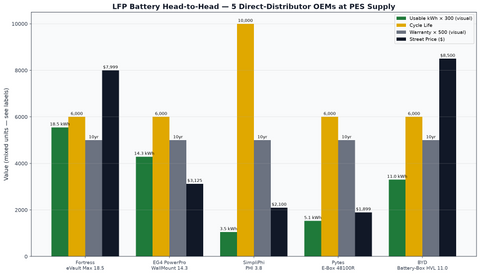
| LFP wall-mount battery | EG4 14.3 kWh wall-mount battery at $3,290.75 (price verified 2026-09-26) | ~$230 (battery only) | Battery module only — add hybrid inverter, ATS, labor |
| LFP rack battery | Fortress eFlex Max 5.4 kWh at $1,399.00 | ~$259 (battery only) | Battery module only — add inverter, racking, labor |
Read the last column carefully. The LFP numbers are battery-only; the PWRcell numbers include the inverter and transfer switch. Once you add a hybrid inverter and whole-home transfer equipment to a rack-battery build, the gap narrows a lot — though budget LFP still wins on raw $/kWh for buyers comfortable with a more componentized system. Our solar battery sizing guide covers the bank-sizing math those systems use, and the home battery bank sizing guide goes deeper on chemistry tradeoffs.
Who PWRcell fits (and who should look elsewhere)
Fits: Generac-loyal homeowners who want one service network for generator AND battery; solar owners adding storage with whole-home backup via the service-rated ATS; buyers who value modular growth (start at 3–6 modules, add later); anyone pairing with Generac's PWRgenerator for extended off-grid.
Look elsewhere: budget-first buyers, since LFP server-rack systems come in far lower per kWh; retrofit jobs on existing string inverters where an AC-coupled battery involves less rewiring; DIY installers — PWRcell is a certified-installer product, full stop.
Last summer a customer called wanting three modules to back up his entire 4,000-square-foot house. We talked him into a critical-loads sub-panel and a full cabinet instead — same money, triple the usable runtime, and no 2 a.m. load-shedding surprises.
PWRcell vs. a standby generator — or both
The question arrives at our counter weekly: battery or generator? The honest comparison:
- Outage duration: a battery alone bridges hours to a day; a generator runs as long as fuel lasts. Multi-day ice-storm outages are generator territory.
- Daily economics: a generator sits idle 360 days a year; a battery cycles daily against time-of-use rates and solar self-consumption, earning its keep between outages.
- Instant response: battery transfer is milliseconds (computers never notice); a generator takes about 10 seconds and exercises weekly.
- Maintenance: batteries want none; generators want oil, filters, and exercise.
Generac's own answer is "both": the PWRgenerator — a 9 kW DC generator built to charge PWRcell directly — turns the battery into the primary power plant and the generator into a fuel-efficient range extender that runs only when the battery needs it. For outage-prone rural properties, battery plus PWRgenerator often beats either technology alone. For suburban homes with rare outages and cheap net metering, the battery alone usually pencils better. If you lean generator-first, our generators collection and the battery longevity guide frame the maintenance side of that decision.
Module capacity and expansion rules worth knowing
Two practical rules shape real PWRcell designs. First, cabinets must be planned, not improvised: the cabinet, spacers, and foot brackets are separate SKUs, and the install manual dictates the order and hardware per module count. Second, expansion is real but not free: adding modules later is a genuine PWRcell advantage — a module upgrade kit (APKE00009) exists for exactly this — but mixing module vintages has compatibility limits. Buy the newest module generation when expanding and confirm compatibility with your installer before ordering. The modular DC architecture also means individual modules can be serviced or replaced without condemning the whole cabinet — a meaningful long-term ownership advantage over monolithic battery packs.
Warranty and the decade of ownership
Generac warranties PWRcell for 10 years, with the lithium modules designed for daily cycling over that term and capacity retention spelled out in the warranty document. Two ownership realities matter more than the headline number. One, the warranty rides on certified installation — a gray-market install can complicate a claim. Two, the Generac service network is the actual differentiator: when something faults in year seven, there is a local tech who has seen a PWRcell before. That's not a small thing. Plenty of cheaper batteries are sold by companies whose support model is an email address.
Installation, permits, and the rest of the real budget
Equipment is only the first number. A PWRcell install also carries labor, electrical materials, permitting, and utility interconnection, and those line items vary more by region than the hardware does. As of mid-2026, most certified-installer quotes we see land in these ranges:
| Line item | Typical range (mid-2026) | What drives it |
|---|---|---|
| Installation labor | $1,500–$4,000 | Module count, wall vs pad mount, local labor rates |
| Electrical materials (conduit, wire, breakers, sub-panel) | $500–$2,000 | Run length to the service panel; critical-loads sub-panel adds cost |
| Permits & inspection | $150–$600 | AHJ fee schedule; some jurisdictions bundle solar + storage permits |
| Utility interconnection | $0–$500 | Many utilities waive fees for storage added to existing solar; some charge review fees |
Put it together and a realistic all-in number for the 18 kWh full-cabinet build lands around $20,000–$24,000 before incentives in most markets as of mid-2026. Quotes that come in dramatically under that band deserve a hard look at what's missing — usually the sub-panel, sometimes the permit.
The 30% federal tax credit changes the math
Under the Inflation Reduction Act, standalone battery storage of 3 kWh or more qualifies for the 30% federal Investment Tax Credit — no solar required. Every PWRcell configuration above clears that threshold easily. Applied to the 18 kWh example: 30% of a $22,000 mid-range installed cost is $6,600 back at tax time, pulling the effective cost toward $15,400 — roughly $856/kWh installed, which beats the equipment-only $/kWh of the entry build. The credit applies to equipment and labor, it's claimed on IRS Form 5695, and as of mid-2026 it remains the single largest lever on storage economics. Confirm current credit terms with your tax professional — the statute has phase-down dates, and state incentives (California's SGIP being the best-known) can stack on top.
Timeline: from signed quote to commissioned system
Set expectations honestly. A typical PWRcell project runs four to ten weeks end to end: one to two weeks for site assessment and design sign-off, two to four weeks for permit review depending on the AHJ, a day or two of installation for a single-cabinet build, then inspection and utility permission-to-operate, which is the wild card — some utilities approve in days, others take a month. Order equipment early. The modules and inverters are warehouse items for us, but the certified installer's calendar is usually the real critical path, and storm season books it solid.
Three buying mistakes we see at the counter
Mistake one: buying the inverter twice. A homeowner prices a 3-module build to "try it out," then expands a year later and discovers the 7.6 kW inverter no longer matches the bigger bank's load profile. The expansion modules are the easy part — it's the second inverter purchase that stings. If a two-cabinet system is anywhere in your five-year plan, buy the 11.4 kW inverter on day one.
Mistake two: backing up the wrong loads. Whole-home backup sounds right until you do the arithmetic. An electric range pulls 3–5 kW while it runs; a 9 kWh battery feeds that for maybe two hours. The fix isn't always a bigger battery — it's a critical-loads sub-panel that puts the range, dryer, and EV charger on the utility side of the ATS. Spend $800 on a sub-panel before you spend $6,000 on three more modules.
Mistake three: comparing battery-only prices to system prices. The $/kWh table above exists because this confusion is rampant. A $259/kWh rack battery still needs a hybrid inverter, racking, conduit, an ATS, and labor. A $998/kWh PWRcell full cabinet already includes the inverter and transfer equipment. Compare installed systems to installed systems, or you'll budget wrong in both directions.
A note on module vintages: G0080003, G0080040, and A0000391219
Three module SKUs circulate in the PWRcell ecosystem, and they are not interchangeable in every combination. The G0080003 is the standard 3.0 kWh module most cabinets ship with. The G0080040 DCB module and the A0000391219 at 2.85 kWh are earlier or alternate vintages that show up in expansion quotes and secondary-market listings. Capacity differs slightly (2.85 vs 3.0 kWh), and Generac's compatibility rules limit mixing vintages within a cabinet. When we quote expansions, we match the existing cabinet's module generation first and price alternates only after the installer confirms the mix is supported. If a deal on older modules looks too good, that compatibility constraint is usually why.
Frequently asked questions
How much does a Generac PWRcell cost?
Equipment at PES (July 2026): roughly $11,800 for a 9 kWh entry system up to about $30,700 for 36 kWh across two cabinets, including inverter, cabinet(s), modules, and the 200A ATS. Full-cabinet builds hit the best cost per kWh (~$850–$1,000). Installation and permits are additional.
How many kWh is a PWRcell?
Per cabinet: up to six modules at ~3.0 kWh each (17–18 kWh). Systems scale to two cabinets (~36 kWh). Module vintages at 2.85–3.0 kWh change the exact totals.
Is PWRcell worth it?
At full-cabinet scale, its $/kWh is competitive with other premium batteries, and the Generac service network plus PWRgenerator integration are genuine differentiators. At 3-module scale, the fixed inverter cost makes it expensive per kWh.
Does PWRcell work with my existing solar?
The PWRcell inverter IS the solar inverter in most designs (DC-coupled PV input) — existing string-inverter systems may reconfigure around it. A Generac-certified installer should scope retrofits.
How long does a PWRcell last?
Generac warranties PWRcell for 10 years; the lithium modules are designed for daily cycling over that term with capacity retention per the warranty document.
Can PWRcell go off-grid permanently?
It can run extended off-grid when paired with solar and the PWRgenerator, but it's engineered primarily for grid-tied backup. Purpose-built off-grid systems (EG4, Sol-Ark, Victron architectures) usually cost less per kWh for permanent grid-free sites.
Build the cabinet right
Portlandia Electric Supply stocks the complete PWRcell line — inverters, cabinets, modules, and transfer switches — in energy storage systems and battery storage, and the broader Generac catalog covers the generator side of the pair. Call the counter with your kWh target and your critical-loads list — we'll quote module-count options side by side, flag the accessory SKUs most quotes leave off, and tell you honestly whether PWRcell or a componentized LFP build fits your budget better.