Key figures
New: Try the interactive Battery Runtime Calculator — a deeper version of this guide with DoD and inverter efficiency controls, worked examples, and instant results.
- Usable depth of discharge: 95–100% for LiFePO4 vs only 50% for lead-acid — a 10 kWh lead-acid bank is really a 5 kWh bank.
- Inverter efficiency costs 5–10% on quality hardware and up to 15% on cheap units.
- A 14.3 kWh LiFePO4 bank runs a 500W load ~24 hours, a 1,000W load ~13 hours, or a 200W essentials load ~64 hours.
- A 12V 100Ah LiFePO4 battery holds 1,280 Wh; a 200W panel delivers roughly 800 Wh per good 5-hour solar day.
- Runtime = (battery Wh × DoD × inverter efficiency) ÷ load W — then add a 10% reality cushion.
Source: PES Supply — Battery Backup Runtime Calculator
Updated September 2026 · Reviewed by Tom Callahan, Power Systems Specialist
Battery Runtime Calculator
How long will your battery actually run the house? Pick a bank size and a load profile — get hours of runtime and days of autonomy, with optional solar recharge.
Assumptions: inverter efficiency 95%; LiFePO4 usable depth of discharge 95%, lead-acid 50%; solar day = array kW × 4.5 peak sun hours × 90% charge path. Runtime = battery kWh × 1,000 × DoD × 0.95 ÷ load W. Real-world results run ~10% lower with idle draw, cold temperatures and aging — plan a cushion.
The Runtime Formula
Every battery runtime question on earth reduces to one line of arithmetic:
Runtime (hours) = Battery kWh × Depth of Discharge × Inverter Efficiency ÷ Load (kW)
Three multipliers do all the honest work. Depth of discharge (DoD) is how much of the nameplate capacity the battery will actually give you: 95–100% for LiFePO4, but only 50% for lead-acid if you want the bank to survive the year. Inverter efficiency — turning battery DC into household AC — costs 5–10% on quality hardware and up to 15% on cheap units. Then the load divides. That's the entire model.
Worked example, 10 kWh LiFePO4 bank feeding a 500W load: 10 × 0.95 × 0.95 = 9.0 kWh usable ÷ 0.5 kW = 18 hours. Same bank against a 2,000W load: 4.5 hours. The chart below is that formula, pre-computed.
One warning from the field before the numbers: nameplate kWh is a laboratory figure at a gentle discharge rate and room temperature. A battery asked to deliver near its maximum continuous output runs warm and delivers slightly less than nameplate; a battery in a 35°F garage delivers noticeably less. We size backup systems with a 10% reality cushion on top of the formula, and we've never once had a customer complain that the lights stayed on too long.
Battery Backup Runtime Chart (LiFePO4, 95% DoD, 95% Inverter Efficiency)
| Battery size | 200W load | 500W load | 1,000W load | 2,000W load | 3,000W load |
|---|---|---|---|---|---|
| 2.4 kWh (one US2000-class module) | 10.8 hrs | 4.3 hrs | 2.2 hrs | 1.1 hrs | 0.7 hrs |
| 5 kWh | 22.5 hrs | 9.0 hrs | 4.5 hrs | 2.3 hrs | 1.5 hrs |
| 10 kWh | 45 hrs | 18 hrs | 9 hrs | 4.5 hrs | 3 hrs |
| 13.5 kWh (Powerwall-class) | 61 hrs | 24 hrs | 12 hrs | 6 hrs | 4 hrs |
| 14.3 kWh (280Ah wall-mount) | 64 hrs | 26 hrs | 13 hrs | 6.4 hrs | 4.3 hrs |
| 20 kWh | 90 hrs | 36 hrs | 18 hrs | 9 hrs | 6 hrs |
| 30 kWh | 135 hrs | 54 hrs | 27 hrs | 13.5 hrs | 9 hrs |
Read the chart honestly and a pattern jumps out: battery size decides how long you last, but load discipline decides whether "how long" is measured in hours or days. A 14.3 kWh battery runs a 3,000W load for four hours — or a 200W essentials load for nearly three days. The Tesla Powerwall 2, the Fortress eFlex Max 5.4 kWh, and stackable server-rack modules all live somewhere on these rows; our EG4 vs. Tesla Powerwall comparison breaks down the two most-asked-about options in the catalog.
What Does a Typical Load Actually Look Like?
Before you can use the chart you need to know which column your house lives in. These are the real draws we measure with clamp meters and kill-a-watt plugs, not brochure numbers:
| Load | Average watts | Notes |
|---|---|---|
| Refrigerator (modern, Energy Star) | 100–200 | Cycles; surge 600–1,200W at start |
| Chest freezer | 80–150 | Cycles |
| LED lighting, whole house | 100–400 | Depends how many rooms |
| Internet router + modem | 15–30 | The load nobody remembers |
| Furnace blower (1/2 HP) | 500–800 | Gas heat still needs electricity |
| Well pump (1 HP) | 1,000 avg when running | Surge 2,500–3,000W — check inverter surge rating |
| Window AC (8,000 BTU) | 600–900 | Central AC usually exceeds battery inverter output |
| Electric water heater | 4,500 | Generally not battery-backup material |
Add up the essentials for a typical overnight outage — fridge (150W average), a freezer (100W), lights (150W), internet (25W), phone chargers and a fan (75W) — and you land near 500W. That's the column where a 10 kWh battery gives you 18 hours and a 20 kWh stack gives you a day and a half. Our watts-to-kWh calculator converts your specific appliance list into the daily energy number, and how many watts it takes to power a home walks the whole-house version of this audit.
Worked Example: Overnight Essentials on a 14.3 kWh Battery
Take a 280Ah-class wall-mount bank at 14.3 kWh — the size of one popular LiFePO4 wall unit. Usable energy: 14.3 × 0.95 × 0.95 ≈ 12.9 kWh. Loads from 8 p.m. to 8 a.m.: refrigerator (150W avg), freezer (100W), internet (25W), ten LED bulbs (100W), a CPAP (60W), furnace blower cycling in winter (call it 200W average across the night). Total: roughly 635W average. Runtime: 12.9 ÷ 0.635 ≈ 20 hours. The battery hands the house back to a recharging source — solar array or generator — around 4 p.m. the next day, having covered the entire night without drama. This is exactly why we tell people the first battery covers the night; the second battery covers the weather.
Worked Example: How Long to Charge a 100Ah Battery with a 200W Solar Panel
The mirror-image question — refilling storage. A 12V 100Ah LiFePO4 battery holds 1,280 Wh. If you draw it to 20% and want it back to full, you need about 1,024 Wh delivered. A 200W panel in real sun through a good MPPT controller delivers roughly 150–170W after temperature and conversion losses — call it 800 Wh per good 5-hour solar day. So: a day and a quarter of solid sun, or one strong summer day plus a morning. The full step-by-step is in how long a 200W panel takes to charge a 12V 100Ah battery.
Chemistry Changes the Math: LiFePO4 vs. Lead-Acid
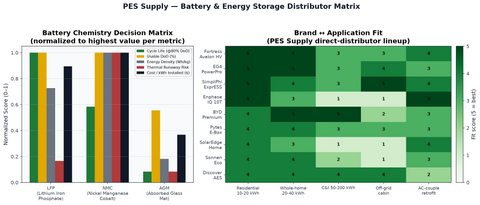
The runtime formula stays identical, but two of its three inputs swing with chemistry. This is the table we sketch on the whiteboard when someone asks why lithium costs more:
| Factor | LiFePO4 (Lithium Iron Phosphate) | AGM / Flooded Lead-Acid |
|---|---|---|
| Usable DoD | 90–100% | 50% recommended |
| Round-trip efficiency | 92–98% | 80–85% |
| Usable energy from a "10 kWh" bank | 9–10 kWh | ~5 kWh |
| Cycle life at that DoD | 3,000–6,000 cycles | 300–500 cycles |
| Effective cost per usable kWh-cycle | Lower, long-term | Higher, long-term |
| Cold-weather charging | Needs BMS low-temp cut-off or heated cells below 32°F | Tolerates cold charging, reduced capacity |
Read row three twice — it's the one that changes the quote. Two 10 kWh banks, one of each chemistry, are not the same product: the lead-acid bank is a 5 kWh bank wearing a bigger label. Our battery life extension guide covers the maintenance side, and the 20–80 rule explainer shows how partial cycling stretches lithium lifespan even further.
Battery Backup vs. Generator — the Honest Comparison
We sell both, so here's the version of this comparison without a thumb on the scale:
| Factor | Battery Backup | Standby Generator |
|---|---|---|
| Runtime limit | Hours to ~2 days; recharges from solar | Days to weeks (fuel supply permitting) |
| Response time | ~20 milliseconds — computers never notice | 10–30 seconds for ATS start and transfer |
| Noise / exhaust | Silent, zero emissions, indoor-safe | Engine noise; must live outdoors with clearances |
| Heavy loads (central AC, electric heat) | Limited by inverter kW — usually partial-home | Whole-home capable with correct sizing |
| Fuel dependence | None — sunlight recharges daily | NG/LP supply; LP tanks empty in days under heavy load |
| Maintenance | Essentially none | Oil, filters, exercise cycles, annual service |
| Best role | Nightly cycling, short outages, clean power | Multi-day outages, heavy HVAC loads |
The strongest setups we install use both: batteries handle the first silent hours and every overnight, and a standby generator starts only when the battery gets low — which, with solar contributing, can mean a generator that runs two hours a day instead of twenty-four. Fuel math for the generator half lives in our generator fuel consumption chart, and sizing is covered in what generator size you actually need.
Stacking and Expanding: Plan for the Second Battery Now
The most common regret we hear is not buying the wrong battery — it's buying the right battery in a system that can't grow. Three decisions made on day one decide whether year-two expansion is a Saturday project or a rip-and-replace:
- Inverter headroom. A 5 kW inverter paired with 5 kWh of battery is maxed on day one. Hybrid units with room to grow — like the Sol-Ark 8K or the modular EG4 FlexBOSS21 — accept additional battery capacity without replacing the inverter. Our hybrid inverter guide explains the architecture.
- Modular battery format. Rack-mount and stackable modules (5 kWh class, including the Fortress eFlex Max) scale by adding a module and a cable. Sealed all-in-ones scale by adding another whole unit — sometimes fine, sometimes a space problem.
- Physical and electrical space. Wall space, busbar capacity, and breaker spaces in the critical-loads panel. I've watched a homeowner realize his "expandable" system needed a new subpanel, a new wall, and a new permit to add battery number two. Fifteen minutes of planning would have prevented all three.
For full off-grid sizing beyond simple backup, the battery sizing calculator and our guide to calculating storage needs for off-grid living take the same formula to multi-day autonomy.
What the Chart Doesn't Capture: Five Real-World Runtime Eaters
The formula is honest, but the world isn't a lab bench. These five factors routinely shave 10–30% off chart numbers, and planning for them is the difference between a system that meets expectations and one that generates angry phone calls:
| Factor | Typical Impact | Mitigation |
|---|---|---|
| Cold battery temperature (below 40°F) | 10–25% capacity loss; LiFePO4 BMS may block charging below 32°F | Install batteries indoors or in an insulated/enclosed heated space |
| High discharge rate (near inverter max) | 5–15% less delivered energy than nameplate | Keep continuous loads under 60–70% of inverter rating |
| Battery age and cycle count | ~2–3% capacity loss per year of daily cycling (LiFePO4) | Oversize the initial bank ~15% for year-ten performance, not day-one |
| Phantom loads | 50–150W of always-on draw most owners never counted | Audit with a plug-in meter; kill standby devices on backup circuits |
| Inverter idle draw | 20–60W burned just being awake, 24/7 | Use eco/search mode for small overnight loads, or size for it explicitly |
Phantom loads are the silent killer — I've clamp-metered "500W" backup loads that were actually 680W once the garage door opener standby, the DVR, three wall warts, and the cable box joined the party. That gap costs 25% of your runtime. Thirty minutes with a $25 plug-in meter is the highest-value diagnostic in this entire guide.
The Sizing Worksheet: From Load List to Battery Order
Here's the exact sequence we run when a customer calls, in order, with a worked column you can copy:
| Step | What to Do | Worked Example |
|---|---|---|
| 1. List critical loads | Only what must run in an outage — be ruthless | Fridge, freezer, lights, internet, CPAP, furnace blower |
| 2. Measure or estimate watts | Plug-in meter for anything that cycles; nameplate for the rest | 635W measured average |
| 3. Add surge check | Largest motor's starting surge vs. inverter surge rating | Fridge 1,200W surge + 500W running else = needs ≥2,000W surge |
| 4. Set the runtime target | Hours you must survive without recharge (overnight = 12–14) | 14 hours |
| 5. Compute energy needed | Watts × hours = Wh | 635 × 14 = 8,890 Wh |
| 6. Undo the derates | Divide by DoD and inverter efficiency (0.95 × 0.95 = 0.90) | 8,890 ÷ 0.90 ≈ 9.9 kWh nameplate |
| 7. Add the age cushion | × 1.15 for year-ten capacity | ≈ 11.4 kWh → a 13.5–14.3 kWh bank |
Seven steps, no software required. The output of step 7 is the number you shop against — and it's also the number that tells you whether one battery suffices or whether you're in two-battery territory from the start.
Inverter Surge Ratings: The Spec That Kills More Backup Plans Than Capacity
Capacity (kWh) decides how long; inverter power (kW) decides whether it works at all. Every motor-driven load — refrigerator, freezer, well pump, furnace blower, air conditioner — draws two to five times its running watts for a fraction of a second at startup. If the inverter can't supply that surge, the whole system faults out and your carefully sized battery is a very heavy shelf ornament.
The rule we use: inverter continuous rating ≥ 1.5× your largest combined running load, and surge rating ≥ the biggest motor's starting draw plus everything else already running. A 4,000W-continuous / 8,000W-surge inverter covers the worked example above with margin to spare. Undersizing here is the single most common DIY backup failure we troubleshoot — the battery is fine, the math was fine, the inverter was simply never going to start that well pump. Pre-wired inverter-charger boards like the MidNite E-Panel systems exist precisely because this integration has so many ways to go wrong in a hand-built stack.
Multi-Day Outage Strategy: Cycling Loads Instead of Buying More Battery
Past the 24-hour mark, the cheapest capacity you can buy is a schedule. The fridge and freezer hold safe temperatures for four-plus hours unpowered if you keep the doors shut — so they don't need to run continuously. Run them two hours on, two hours off and you've cut their energy share nearly in half. Run the furnace blower in bursts. Charge devices while the inverter is already awake for something else, because every hour the inverter idles at 40W to serve a 10W phone charger is an hour of capacity spent on overhead.
A disciplined cycling plan turns the 14.3 kWh example above from 20 hours into 30-plus hours of effective coverage. That's the difference between "the battery died Tuesday morning" and "the battery lasted until the solar array woke up Wednesday." We wrote this schedule on a whiteboard for a customer during the 2021 ice storms, and it carried a 10 kWh bank through a 52-hour outage with the furnace, fridge, and internet alive the whole time. Discipline beat capacity by a mile.
Adding Solar to the Equation: Recharge Math
A battery with a solar array behind it isn't a tank — it's a pipeline. The question shifts from "how long until empty" to "does daily input beat daily draw":
| Array Size | Winter Daily Harvest (3 sun hrs, 0.78 derate) | Summer Daily Harvest (5.5 sun hrs) | Essentials Load It Covers Indefinitely |
|---|---|---|---|
| 1 kW (3 × 330W panels) | 2.3 kWh | 4.3 kWh | ~100W continuous |
| 2 kW | 4.7 kWh | 8.6 kWh | ~200W continuous (winter) / ~350W (summer) |
| 4 kW | 9.4 kWh | 17.2 kWh | ~400W continuous, year-round |
| 8 kW | 18.7 kWh | 34.3 kWh | Full essentials plus daytime extras |
Read the winter column as the design constraint. A 4 kW array recharges roughly 9.4 kWh on a decent winter day — enough to fully refill the overnight draw of a disciplined essentials load every single day, which makes the battery's job "bridge the night" instead of "survive the apocalypse." That is a much smaller, much cheaper battery — often a full size class smaller, which pays for a meaningful chunk of the array itself. Pair this table with the runtime chart and you can design the whole backup system on one sheet of paper, then sanity-check it against the first real utility bill after installation.
Monitoring: State of Charge Is the Gauge That Matters
A backup system you can't read is a backup system you're guessing at, and guessing ends outages early. Modern LiFePO4 banks report state of charge through the BMS, and hybrid inverters display it on screen and in an app — learn to read it like a fuel gauge, because it is one. Two habits worth building before the first outage: check that the reported 100% actually matches a full charge cycle (voltage-based gauges drift, especially on lithium's flat curve), and watch your overnight burn rate once so you know your house's real number instead of a guess. The customers who glide through outages are the ones who already know "my house burns 9% of the battery per hour overnight." That sentence, learned on a calm evening, is worth more than any extra kilowatt-hour of hardware. While you're in the app, set the low-battery alarm at 20% rather than the default 10% — the earlier warning is what gives you time to start the generator, shuffle loads, or call it a night on your own terms instead of the inverter's.
Frequently Asked Questions
How do I calculate how long my battery will last?
Multiply battery kWh × depth of discharge × inverter efficiency, then divide by your load in kW. A 10 kWh LiFePO4 battery at 95% DoD through a 95%-efficient inverter gives about 9 kWh usable — 18 hours at 500W, or 9 hours at 1,000W.
How long will a 10 kWh battery run a house?
On an essentials-only load of 400–600W (fridge, lights, internet, furnace blower), expect 15–22 hours. Against a whole-home 2–3 kW average, the same battery lasts 3–4.5 hours. Load discipline, not battery size, is the biggest runtime lever.
Is it better to have more battery or more solar?
You need both, in that order of priority: enough battery to survive the night, then enough solar to refill it by noon. A huge battery with a small array is a slowly draining tank; a huge array with a small battery wastes noon production.
Can a battery run central air conditioning?
Usually not directly — a 3–5 ton central AC draws 3,000–6,000W running with startup surges past 10,000W, exceeding most residential battery inverters. A soft-start kit and a large hybrid inverter can make a 3-ton unit workable; most designs back up a window unit or mini-split zone instead.
How many batteries do I need for three days of backup?
Daily essential kWh × 3 ÷ usable fraction. For 12 kWh/day of essentials: 36 kWh of nameplate LiFePO4, or about 72 kWh of lead-acid. Most homes pair a smaller battery with a generator or solar instead of buying three days of storage outright.
Do batteries lose capacity sitting unused?
LiFePO4 self-discharges only 1–3% per month and stores best around 50–60% charge. Lead-acid self-discharges 3–5% monthly and sulfates if left discharged — keep it on a float charger. Check stored batteries quarterly either way.
Build Your Backup
Start with the load audit, pick your runtime column from the chart, then choose hardware that grows: a hybrid inverter with headroom, rack-mount batteries and energy storage you can stack, and — if your outage history runs long — a generator to cover the gap. The formula never changes, but the hardware keeps getting better, and everything on this page is stock we actually ship. Send us your load list and we'll size the bank against it, line by line.