Solar Battery & ESS Distributor: Fortress, EG4, SimpliPhi, Enphase, BYD | PES Supply
PES Supply is the direct distributor for the LFP battery and energy storage stack North American installers actually build with — Fortress Power, EG4 Electronics, SimpliPhi, Enphase IQ Battery, BYD, Pytes, SolarEdge Home Battery, Sonnen, Discover AES, Sun Xten…

PES Supply is the direct distributor for the LFP battery and energy storage stack North American installers actually build with — Fortress Power, EG4 Electronics, SimpliPhi, Enphase IQ Battery, BYD, Pytes, SolarEdge Home Battery, Sonnen, Discover AES, Sun Xtender, and Crown. Combined, our batteries-energy-storage collection carries 1,748 SKUs across residential 5–20 kWh wall-mounts, 20–40 kWh whole-home cabinets, and 50–500 kWh C&I skids. This hub is the single reference for chemistry, architecture, sizing, and brand selection.
Three battery chemistries account for essentially every stationary energy storage SKU in the North American market. The difference matters more for installers than for spec sheets because it drives the cycle warranty, the fire code, the mounting location, and the ambient temperature envelope you can legally sell into.
Lithium iron phosphate — LFP (LiFePO₄)
LFP is the dominant residential and C&I chemistry in 2026 because its cathode does not release oxygen during thermal breakdown. A failed LFP cell vents flammable electrolyte but does not sustain a self-oxidizing fire — the practical consequence is that AHJs will permit LFP inside a garage, mechanical room, or exterior-wall-mounted enclosure without the same sprinkler and separation requirements that NMC triggers. Every residential brand PES distributes direct — Fortress Power Avalon, EG4 PowerPro, SimpliPhi PHI, Pytes E-Box, Enphase IQ Battery, BYD Battery-Box, Sonnen ecoLinx, Discover AES — is LFP.
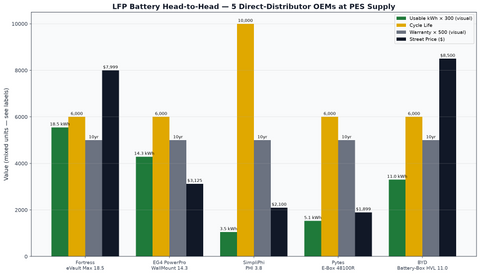
Cycle life at 80 % depth of discharge is typically 6,000 cycles to 70 % end-of-warranty capacity, and SimpliPhi PHI is the standout at 10,000 cycles. Nominal cell voltage is 3.2 V, so 48 V nominal packs are 16 cells in series (16s) and high-voltage stacks (150–500 VDC) are 48s–120s configurations. Energy density is 90–160 Wh/kg — heavier per kWh than NMC but immaterial for stationary storage.
Nickel manganese cobalt — NMC (LiNixMnyCozO₂)
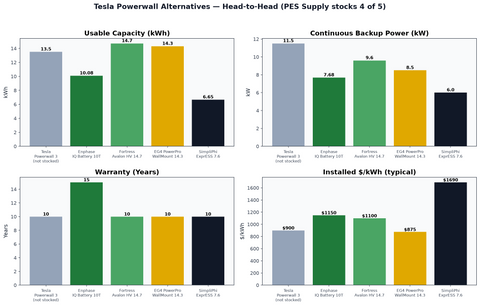
NMC is what powers Tesla Powerwall 2, most EVs, and older LG Chem RESU 10H units. Its cathode releases oxygen at ~210 °C, which is the mechanism behind the thermal runaway propagation that made the Walbridge OH and Surprise AZ incidents national news. NMC is still shipped because its 200–250 Wh/kg energy density gives the smallest wall-mount footprint per kWh, and because Tesla owns the residential mindshare. PES does not stock Tesla Powerwall — we redirect installers to the four LFP alternatives on our Powerwall alternatives comparison.
Absorbed glass mat — AGM (lead-acid)
AGM is the survivor chemistry for off-grid cabins, marine, RV, telecom shelters, and backup UPS applications where the buyer wants zero BMS complexity, wide temperature tolerance, and the lowest capital cost per nameplate kWh. Sun Xtender (Concorde) and Crown are the two lines PES distributes direct. The trade is short cycle life (500 cycles at 50 % DoD is a realistic warranty), 50 % maximum usable capacity, and roughly 3× the physical footprint per usable kWh vs LFP.
Side-by-side spec table
| Metric | LFP (LiFePO₄) | NMC | AGM (lead-acid) |
|---|---|---|---|
| Nominal cell voltage | 3.2 V | 3.7 V | 2.0 V |
| Usable DoD | 80–90 % | 90 % | 50 % |
| Cycle life @ 80 % DoD | 6,000–10,000 | 3,000–4,000 | 500–1,200 |
| Energy density (Wh/kg) | 90–160 | 200–250 | 30–50 |
| Thermal runaway risk | Low — no O₂ release | High — O₂ release >210 °C | Very low — non-flammable |
| Operating temp (charge) | 0 to 45 °C | 0 to 45 °C | -20 to 50 °C |
| Typical warranty | 10 yr / 6,000 cyc | 10 yr / 3,500 cyc | 5 yr / 500 cyc |
| Installed $/usable kWh | $850–$1,150 | $900–$1,100 | $350–$500 |
| UL 9540 systems available | Every brand PES stocks | Limited (Tesla, LG) | N/A — different code path |
| Best-fit application | Residential + C&I daily cycling | EV, ultra-tight footprint | Off-grid, marine, telecom UPS |
The battery bus voltage is a downstream consequence of picking an inverter. Every hybrid inverter is designed for either a 48 V nominal DC bus or a high-voltage (150–500 VDC) DC bus, and the batteries you can pair with it fall out from that choice. Understanding this decision before you order changes which batteries you can ship and which brand ecosystem you are locked into for the life of the install.
48 V low-voltage architecture
48 V (nominal — actual bus is 40–58 VDC across state of charge) is the default residential architecture because it maps to the vast Sol-Ark, EG4, Schneider XW Pro, Outback Radian, and Victron ecosystem, and to every off-grid inverter/charger in the market. Advantages:
- Widest inverter compatibility — Sol-Ark 12K/15K/15K-2P, EG4 18kPV, EG4 FlexBOSS21, Schneider XW Pro, Victron MultiPlus-II, Outback Radian all speak 48 V natively.
- Wide battery compatibility — Fortress eVault Max, EG4 PowerPro WallMount, SimpliPhi PHI 3.8, Pytes E-Box, Discover AES, BYD Battery-Box LVS, Enphase IQ Battery all ship in 48 V or paralleled-48 V.
- Simple parallel expansion — add a second battery in parallel and the BMS handles balancing.
Limitations kick in above ~15 kWh: to move 40 kWh over an 8-hour discharge window you're pushing 100+ amps of DC current, and the copper bus bar and DC breaker cost climbs faster than the battery cost.
High-voltage 200–500 V architecture
High-voltage systems stack many battery modules in series instead of parallel. Fortress Avalon HV stacks 4–5 × 4.9 kWh modules in series to build a 200 VDC bus at 19.6–24.5 kWh. BYD Battery-Box HVL and HVM run 400–500 VDC. SolarEdge Home Battery runs its own high-voltage bus into the SolarEdge Energy Hub inverter. The advantages:
- Lower current at the same power — 10 kW at 400 VDC is 25 A, 10 kW at 48 V is 208 A. That is a 10× difference in copper cost and breaker rating.
- Higher scalability — 40 kWh, 60 kWh, and 100+ kWh cabinets are practical.
- Higher round-trip efficiency (~97 %) on new-construction installs because the inverter runs closer to its optimal input voltage.
The trade is that HV batteries are locked to their brand-matched HV inverter. Fortress Avalon batteries only pair with Fortress Avalon inverter or Sol-Ark 15K-HV. SolarEdge Home Battery is a captive ecosystem — SolarEdge inverter or nothing.
Architecture decision table
| Install size | Recommended bus | Best-fit brands (PES stock) |
|---|---|---|
| 5–15 kWh residential retrofit | 48 V or AC-coupled | Enphase IQ 5P/10T, EG4 WallMount, SimpliPhi PHI, Pytes E-Box |
| 15–25 kWh whole-home new-build | 48 V or HV — either works | Fortress eFlex, EG4 PowerPro, Fortress Avalon HV |
| 25–40 kWh whole-home + EV | HV preferred | Fortress Avalon HV Pro, BYD Battery-Box HVL, SolarEdge Home |
| 50–200 kWh light C&I | HV mandatory | Fortress Avalon HV Pro Business, SimpliPhi AccESS, BYD Premium HVM |
| 200–500 kWh C&I | HV skidded | Fortress Business HV cabinets, BYD Premium HVM stacks |
DC-coupled — one inverter, one DC bus
DC-coupled means a single hybrid inverter is the one and only power electronics device. Solar strings feed it, the battery hangs on the same DC bus, and one AC output feeds the panel and grid. Sol-Ark 12K/15K, EG4 18kPV / FlexBOSS21, Fortress Avalon HV Pro, SolarEdge Energy Hub — all DC-coupled hybrid platforms. Round-trip efficiency is ~96–97 % because the DC coming off the panels never has to be inverted before it charges the battery.
DC-coupled is the cheaper and more efficient answer for new-construction PV + storage. It's also the answer if you are doing a full solar rebuild — the hybrid inverter replaces the existing string inverter and the microinverters if they were there.
AC-coupled — battery has its own inverter
AC-coupled means the battery ships with its own inverter built in, and it hangs onto the AC panel side of your existing PV install. The existing microinverter or string inverter is untouched. This is the retrofit answer. Enphase IQ Battery is the archetype — every IQ 5P or IQ 10T ships with integrated microinverters and clamps onto the AC panel through an IQ System Controller. SimpliPhi AccESS ships as a pre-wired AC-coupled cabinet. Fortress and EG4 both offer AC-coupled operating modes on their hybrid inverters for retrofit projects.
Round-trip efficiency is ~90–92 % because you invert DC-to-AC in the PV inverter, then AC-to-DC in the battery inverter to charge, then DC-to-AC again to discharge. You pay ~5 % efficiency for the retrofit-friendliness.
When each wins
DC-coupled wins when…
- New construction or full solar rebuild
- You want the highest round-trip efficiency
- You want the fewest boxes on the wall
- You're at 15+ kWh and cost per kWh matters
- Preferred SKUs: Sol-Ark + Fortress Avalon, EG4 18kPV + EG4 WallMount, SolarEdge Energy Hub + SolarEdge Home Battery
AC-coupled wins when…
- Retrofit onto an existing PV system
- Existing microinverters (Enphase, APsystems) you don't want to rip out
- Single-phase 200 A service where you want backup on select loads only
- Homeowner wants a "just add a battery" upgrade path
- Preferred SKUs: Enphase IQ Battery 5P/10T, SimpliPhi AccESS, EG4 GridBOSS retrofit mode
Residential — 10 to 20 kWh usable is the sweet spot
The typical US home draws 25–35 kWh/day. Full off-grid autonomy is not what most residential customers actually buy — they buy enough storage to run essential loads through a grid outage (10–15 kWh usable, 8–12 hours of backup) or to time-shift solar production into evening consumption (10–20 kWh usable, one full discharge cycle per day). Both cases land in the same 10–20 kWh usable band, which is exactly where the dominant SKUs live:
- Enphase IQ Battery 10T — 10.08 kWh usable, AC-coupled, 15-year warranty
- EG4 PowerPro WallMount 14.3 — 11.4 kWh usable, 48 V, DC-coupled or AC-coupled
- Fortress eVault Max 18.5 — 18.5 kWh usable, 48 V, DC-coupled
- Fortress Avalon HV Pro 14.7 — 14.7 kWh (3 × 4.9 kWh HV stack)
- SimpliPhi ExprESS 7.6 — 6.65 kWh usable, 48 V pre-wired cabinet
C&I — 50 to 500 kWh, peak shaving is the driver
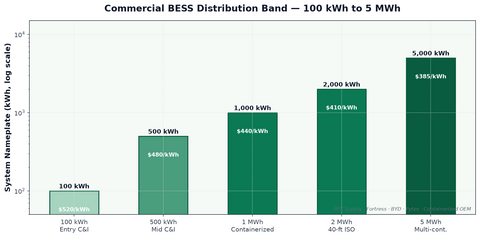
Commercial and industrial ESS is a different animal. The economic driver is not backup; it's demand charge reduction on the utility bill. A commercial customer pays for the peak 15-minute kW draw across the entire month, and reducing that peak by 20 % can pay back the ESS in 4–6 years without any solar. Load-shifting and time-of-use arbitrage stack on top. Typical sizing:
- Small retail / office (25 kW peak) — 50–75 kWh, 25 kW inverter (Fortress Avalon HV Pro Business or SimpliPhi AccESS 22.8)
- Restaurant / QSR (50 kW peak) — 100 kWh, 50 kW (BYD Premium HVM stack)
- Light manufacturing (100 kW peak) — 200 kWh, 100 kW (Fortress HV skid)
- Warehouse + cold storage (150 kW peak) — 350 kWh, 150 kW
- Multi-unit residential — 500 kWh, 200 kW
See our C&I ESS sizing guide for the full 50–500 kWh reference including peak shaving math, ROI drivers, and ITC 30 % + bonus depreciation stacking.
Whole-home resilience, DC-coupled new build → Fortress Power
Fortress Avalon HV Pro is the flagship. 7.6 kW single-phase or 12 kW split-phase hybrid inverter, HV battery stack in 9.8 / 14.7 / 19.6 / 24.5 kWh configurations, integrated smart energy panel, 200 A transfer switch. This is what installers spec for a 3,500–5,000 sq ft home with 12–20 kW of PV and an EV. PES stocks the 7.6 kW 14.7 kWh bundle (SKU PES-ESS-BTS-0001, $15,699.99) and the 7.6 kW 24.5 kWh (PES-ESS-BTS-0003, $20,578.72).
Retrofit onto existing PV, AC-coupled → Enphase IQ Battery
Enphase is the retrofit king because it clamps onto the AC panel, works with any existing PV, ships with integrated microinverters, and carries the industry's longest warranty (15 years). The IQ Battery 10T is our top-5 selling SKU in the last 90 days. The IQ Battery 5P kit (PES-PA-ELC-0377, $4,389.00) is the entry point. Pair with the IQ System Controller 3G for grid-forming backup.
Off-grid cabin with hybrid inverter → EG4 PowerPro or SimpliPhi PHI
EG4 PowerPro WallMount 14.3 (48 V, 11.4 kWh usable, LFP, closed-loop with EG4 and Sol-Ark inverters) is the best value in the 10–15 kWh residential band. EG4 WallMount AllWeather (PES-ESS-BTS-0222, $3,124.99). SimpliPhi PHI 3.8 (48 V, 3.5 kWh, 10,000 cycles) is the cabin favorite because you can parallel 4–8 units for the exact bank size you need.
Whole-home + EV, high voltage → BYD Battery-Box HVL/HVM
BYD is the choice when you want European-quality mechanical build and a 400–500 VDC bus for large residential or light C&I. BYD Battery-Box Premium HVL BCU + base (PES-PA-ELC-0113, $682.50) starts the stack; add HV modules ($2,117.32 each) to size up.
Off-grid or backup — pure LFP, open protocol → Pytes E-Box
Pytes E-Box 48100R is 5.12 kWh at 48 V with open CAN/RS485 protocols, which means you can pair it with a wider range of inverters (Sol-Ark, Victron, Schneider) than closed-loop brands. Good rack-mount option for telecom-adjacent installs.
Grid-integrated luxury home → Sonnen
Sonnen ecoLinx and sonnenCore+ are the choice when the buyer wants a "smart home battery" with virtual power plant enrollment, load prioritization, and utility program participation. sonnenCore+ 10 kWh (PES-ESS-AIO-0032, $13,265.20). Higher price per kWh but a full turnkey system with software.
Rackmount / telecom / commercial small cell → Discover AES
Discover AES Rackmount ESS is the pick for 19-inch rack installs — cell towers, small-cell shelters, industrial control rooms. Discover AES 5.0 kWh 51.2 V heated rackmount (PES-ESS-BTS-0359, $1,589.90).
AGM off-grid / marine / telecom UPS → Sun Xtender or Crown
When the customer wants no BMS, wide temperature tolerance, and lowest capex, AGM still wins. Sun Xtender (Concorde) is the aviation and marine-grade brand; Crown is the industrial value line.
Batteries are heavy. A Fortress Avalon HV Pro ESS with 4 × 4.9 kWh modules and a 200 A transfer switch is a full pallet — 800+ lb, LTL freight only, forklift or liftgate mandatory. Buying single-unit through a retail marketplace at retail freight is how installers lose $600–$1,200 per project on shipping alone.
How PES contractor pricing works
- Wholesale tier — Registered contractor accounts see tiered pricing that scales with annual battery volume. Enter your Class A / B contractor license number at registration.
- Pallet freight — For cabinets and multi-unit orders, we consolidate the shipment to a single pallet and quote pallet freight to the jobsite (residential lift-gate, commercial dock, or terminal pickup).
- Project quotes — For 3+ cabinet orders (whole-home stacks, C&I ESS, multi-site rollouts) we route to the project quote team for line-item negotiation.
- Direct-distributor access — Fortress Power, SimpliPhi, EG4, BYD, Sonnen, Pytes, Enphase, SolarEdge, Sun Xtender, Crown, Discover AES ship direct through PES with factory warranty registration handled at fulfillment.
Tesla Powerwall Alternatives
Enphase IQ 10T vs Fortress Avalon HV vs EG4 WallMount vs SimpliPhi ExprESS. Head-to-head against Powerwall 3 with usable kWh, backup capacity, warranty, and installed $/kWh.
LFP Battery Comparison
Fortress vs EG4 vs SimpliPhi vs Pytes vs BYD — chemistry, cell supplier, BMS, communication protocol, MPPT compatibility, UL 9540, cycle life at 80 % DoD.
C&I ESS Sizing Guide
50–500 kWh commercial systems — peak shaving, demand charge reduction, and resiliency use cases for Fortress Business, SimpliPhi AccESS, and BYD Premium HVM.
Battery Bank Sizing Reference
Daily kWh consumption → backup hours → required kWh with LFP / NMC / AGM DoD defaults and matched SKU recommendations.
Is LFP always safer than NMC for residential energy storage?
Yes for practical purposes. LFP (lithium iron phosphate) has an intrinsically stable cathode chemistry that does not release oxygen during thermal runaway, so a failed cell smolders rather than propagates. Every major residential brand PES stocks direct — Fortress Power, EG4, SimpliPhi, Pytes, Enphase IQ Battery, BYD Premium LVS, Sonnen — uses LFP cells for exactly this reason. The Tesla Powerwall 3 also uses LFP. NMC still ships in some EV-derived systems where energy density matters more than footprint, but for a wall-mounted or garage cabinet inside a house, LFP is the current answer.
Low-voltage 48 V vs high-voltage 400 V+ battery — which should I spec?
48 V (low-voltage) systems dominate the 5–20 kWh residential band because they mate cleanly to 48 V hybrid inverters from Sol-Ark, EG4, Schneider, Outback, and Victron and to the DC-coupled solar side. High-voltage systems (Fortress Avalon HV, BYD Battery-Box HVL/HVM, SolarEdge Home Battery) run 200–500 VDC on the battery bus, which cuts current in the DC cabling, drops copper cost on 15+ kWh installs, and pairs with inverters built for HV directly (SolarEdge Energy Hub, Sol-Ark 15K-HV, EG4 FlexBOSS21 HV mode). The rule of thumb: below 15 kWh — 48 V; 15–40 kWh — either works, HV wins on cable cost; above 40 kWh residential or any C&I — HV.
Do I have to install AC-coupled or DC-coupled?
DC-coupled means a hybrid inverter feeds both the PV array and the battery on a common DC bus (Sol-Ark, EG4, Fortress Avalon, SolarEdge Energy Hub). It is more efficient (~96–97 % round-trip), lower parts count, and cheaper per kWh on new construction. AC-coupled means the battery has its own inverter and clamps onto the existing AC panel (Enphase IQ Battery, SimpliPhi AccESS, retrofit Sol-Ark AC-coupled mode). It is the right answer whenever you are adding storage to an existing microinverter or string-inverter PV system that you do not want to rebuild. Enphase IQ Battery 10T is the top AC-coupled retrofit we ship; Fortress Avalon HV Pro is the top DC-coupled new-build.
What is UL 9540 and why does it matter?
UL 9540 is the North American standard for energy storage systems — it covers the battery, BMS, inverter, enclosure, and fire behavior as one listed system. Most AHJs (authorities having jurisdiction) now require UL 9540 for indoor and garage installations, and California's Title 24 references it. Every brand PES distributes has UL 9540 or UL 9540A test data. Buying a random Alibaba rack battery and pairing it with a random hybrid inverter is how you get a red-tag from the inspector.
Can I mix brands — Enphase battery with a Sol-Ark inverter, for example?
In practice, no — energy storage systems are certified as complete solutions and the BMS communication is proprietary per brand. Enphase IQ Battery only speaks to Enphase's IQ System Controller and Envoy gateway. Fortress Avalon batteries only pair with the Fortress Avalon or Sol-Ark HV series inverters they are certified against. EG4 batteries have a closed-loop CAN/RS485 profile for EG4 and Sol-Ark inverters. Cross-brand pairings are usually possible on open-protocol batteries (Pytes E-Box, Discover AES) with a compatible hybrid inverter — Sol-Ark, Victron, Schneider, EG4 — but you need to verify the closed-loop protocol file exists for that pair before shipping.
What is contractor pricing on ESS at PES Supply?
Registered contractors on the PES portal see tiered wholesale pricing that scales with annual battery volume and gets meaningful on cabinet-scale orders (Fortress Avalon Pro Business, SimpliPhi AccESS, BYD HVM). Pallet freight is the other lever — a single Fortress Avalon HV Pro cabinet is a pallet, and split-shipping through the retail rate blows the margin. Register at axis.pesdistribution.com/portal-registration and we quote pallet-consolidated freight to the jobsite.
How long is the warranty on a residential LFP battery?
The North American norm is 10 years / 6,000 cycles / 70 % end-of-warranty capacity for LFP. Enphase IQ Battery is the notable outlier at 15 years — Enphase absorbs the extra 5 years because its cells are conservatively cycled by design. SimpliPhi PHI historically claims 10,000 cycle life at 80 % DoD and matches or exceeds any LFP cell we ship. AGM (Sun Xtender, Crown) is 5 years at most and cycles are counted in hundreds, not thousands.
What does 'depth of discharge' actually mean for sizing?
DoD is how deep you can regularly cycle the battery before you degrade the warranted cycle count. LFP is warranted to 80 % (some brands 90 %) — you keep 20 % as a floor. NMC is often 90 % usable. AGM is 50 % — anything deeper cuts cycle life dramatically. When you spec a bank, you divide required kWh by the DoD to get nameplate kWh. Example: 15 kWh usable daily at 80 % LFP = 18.75 kWh nameplate. This is why a 'nameplate 14.3 kWh' EG4 PowerPro WallMount lists as ~11.4 kWh usable.
Why LFP dominated 2022–2026 stationary storage
Three factors combined: cathode cost collapse, safety, and cycle life. Lithium iron phosphate cathodes contain no nickel and no cobalt, which decouples pack pricing from the LME nickel spot market that made NMC unpredictable in 2021–2023. The Chinese LFP cell supply base — CATL, EVE Energy, BYD Blade, Gotion, REPT — expanded to serve the EV market and the excess capacity flowed into stationary storage at $80–$110 per kWh at the cell level. Every residential LFP brand PES ships direct sources cells from those five suppliers plus a handful of second-tier Chinese producers.
Safety-wise, LFP's thermal stability changed the AHJ calculus. NFPA 855 and IRC section R327 (residential ESS) both include separation and fire-suppression carve-outs for LFP that don't apply to NMC. In practice this means an LFP battery can be wall-mounted inside an attached garage without a fire wall, while NMC often requires either an exterior mount, a 1-hour fire-rated separation, or an approved suppression system. That distinction alone shifts installer preference before you get to spec sheets.
What the BMS actually does
Every lithium battery — LFP or NMC — is a stack of many cells in series and parallel. Individual cells drift in state of charge over cycles, and if you charge a series string without balancing, one cell hits full charge while others are at 80 % and the healthy cells get overcharged. The battery management system (BMS) monitors per-cell voltage, per-cell temperature, and pack current, then bleeds off charge from high cells or actively transfers charge between cells to keep the pack balanced. It also enforces the safe operating envelope — cuts charge if any cell exceeds 3.65 V, cuts discharge if any cell drops below 2.5 V, and de-rates power at temperature extremes.
The BMS is also the piece that talks to the inverter. Every closed-loop battery (Fortress, EG4, SimpliPhi, Enphase, BYD, SolarEdge, Sonnen) uses a proprietary CAN or RS485 profile so the inverter knows the actual state of charge, the maximum charge/discharge current, and the current cell voltages. Open-protocol batteries (Pytes, Discover AES, and some legacy 48 V lines) publish their profile so third-party inverters can implement it. If you pair a battery with an inverter that doesn't have its closed-loop profile loaded, the inverter falls back to voltage-based state-of-charge estimation, which is +/- 10 % accurate at best and cannot use the manufacturer's warranty cycle rules.
Cycle life vs calendar life
Battery warranties are two-part: cycle count and years. LFP warranties are typically 6,000 cycles OR 10 years, whichever comes first. If you cycle once a day, you'll hit 3,650 cycles in 10 years — the calendar life expires first. If you cycle twice a day (arbitrage), you'll hit 7,300 cycles in 10 years — the cycle count expires first at year 8.2. Enphase's 15-year warranty is meaningful precisely because it extends both the cycle count (7,300 cycles) and the calendar life to cover a genuinely long-tail install.
Battery-to-inverter handshake
A closed-loop battery has to be commissioned to the inverter, not just wired to it. The process:
- Physical wiring — battery terminals to inverter DC input, matched polarity, torqued to spec. DC breaker between battery and inverter is not optional.
- Comms cable — CAN or RS485 from battery BMS to inverter comms port. Fortress uses a shielded CAT5e with RJ45; EG4 uses RS485 on RJ45; Enphase communicates over Powerline plus the IQ Gateway.
- Battery profile selection — on the inverter, select the matching battery profile from the dropdown. Sol-Ark has profiles for Fortress, EG4, SimpliPhi, Pytes, Discover, and generic. If the profile doesn't exist, don't wire the battery — call the inverter manufacturer for a firmware update.
- Voltage / capacity verification — read the state of charge on the inverter display and cross-check against a battery voltmeter reading. Should agree within 3 %.
- Test charge and discharge — force a charge cycle from grid or PV, force a discharge cycle. Watch the current draw, the voltage sag, and the BMS warnings.
- Warranty registration — every LFP brand requires warranty registration within 30–60 days of commissioning with serial numbers and install photos. Skip this step and the warranty is void.
Common commissioning failures
| Symptom | Root cause | Fix |
|---|---|---|
| Inverter shows battery at 0 %, battery has voltage | Wrong battery profile selected | Reselect profile; may need firmware update |
| BMS trips on high-cell voltage during charge | Charge current too high; cells out of balance from shipping | Set inverter to 0.2C charge rate for first three cycles |
| Cannot enter grid-forming mode | Comms cable seated wrong; termination resistor missing | Verify RJ45 seating, add 120 Ω terminator on RS485 |
| Battery discharges but won't accept charge | Cell imbalance > 100 mV | Run passive balancing cycle for 24 h at low current |
Every US install triggers a code review by the AHJ. The relevant sections in 2026:
- NEC 706 — Energy storage systems. Disconnects, labeling, dc arc-fault, working space.
- NEC 480 — Storage batteries. Still applies to some AGM installs.
- NFPA 855 — Installation of stationary energy storage systems. Separation distances, spacing between units, room ventilation for larger installs.
- IRC R327 / IBC 1207 — Residential and commercial ESS chapters. UL 9540 listing is referenced.
- UL 9540 and UL 9540A — System listing and cell-level thermal runaway propagation test.
- IFC 1207 — Fire code, matches NFPA 855.
- California Title 24 Part 6 — additional requirements including seismic bracing for wall-mount and cabinet ESS.
Every SKU PES distributes ships with the listing paperwork. If the AHJ requires a signed listing letter, request it at order time and we route to the manufacturer.
Open a Contractor Account
Get trade pricing, freight quotes, and access to the interactive Battery Sizing Calculator on our contractor portal.
Register NowAbout the author: Jennifer Kirstens leads distributor content at PES Supply and has spent 12 years spec'ing residential and C&I battery systems across the West Coast. Last updated August 2026.