Updated September 2026 — content reviewed and refreshed by the PES team. For current pricing and availability, see the linked product pages or request a quote.
LFP Battery Comparison: Fortress vs EG4 vs SimpliPhi vs Pytes vs BYD | PES Supply
Head-to-head technical comparison of the five direct-distributor LFP battery brands at PES Supply — Fortress Power, EG4 Electronics, SimpliPhi, Pytes, and BYD .

Head-to-head technical comparison of the five direct-distributor LFP battery brands at PES Supply — Fortress Power, EG4 Electronics, SimpliPhi, Pytes, and BYD. Cell supplier, BMS communication, MPPT-inverter compatibility, UL 9540 listing status, cycle life at 80 % DoD, and installed price. Every SKU listed ships from PES stock with contractor wholesale pricing available.
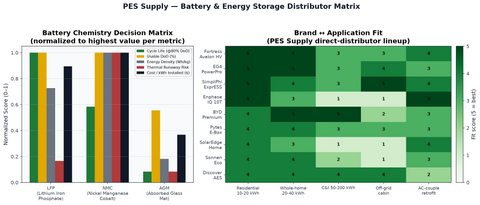
Lithium iron phosphate (LiFePO₄, LFP) accounted for over 80 % of new residential ESS installations in North America in 2025 and every major direct-distributor brand at PES ships LFP as their flagship chemistry. The reasons stack:
- Thermal stability. LFP cathodes don't release oxygen during thermal breakdown. A failed LFP cell smolders and vents electrolyte but does not sustain a self-oxidizing fire. That single fact is what let AHJs write LFP-friendly separation rules into NFPA 855 and IRC R327.
- Cycle life. LFP cells deliver 6,000–10,000 cycles at 80 % DoD to 70 % capacity, roughly 2–3× NMC. For daily-cycle storage, LFP amortizes better over a 10–15 year warranty.
- Cost. LFP has no nickel or cobalt in the cathode. Cell-level cost decoupled from LME nickel volatility and settled at $80–$110/kWh in 2024–2026.
- Supply. Chinese LFP capacity (CATL, EVE, BYD Blade, Gotion, REPT) plus growing US capacity (SimpliPhi/A123, Our Next Energy) means the supply base is deep and diverse.
The trade is lower energy density (90–160 Wh/kg vs 200–250 Wh/kg for NMC) — irrelevant for stationary storage because footprint is limited by cabinet size, not by weight.
| Spec | Fortress Avalon HV + eVault Max |
EG4 PowerPro WallMount |
SimpliPhi PHI 3.8 + AccESS |
Pytes E-Box 48100R |
BYD Battery-Box Premium |
|---|---|---|---|---|---|
| Chemistry | LFP | LFP | LFP | LFP | LFP (Blade) |
| Cell supplier | CATL EnerC | EVE Energy | A123 (Wanxiang) | EVE / REPT | BYD in-house |
| Bus voltage | 200 VDC HV / 48 V LV | 48 V nominal | 48 V nominal | 48 V nominal | 400–500 VDC HV / 48 V LVS |
| Module capacity | 4.9 kWh HV / 18.5 kWh eVault | 14.3 kWh WallMount | 3.5 kWh PHI 3.8 | 5.12 kWh | 2.56–5.12 kWh HVL modules |
| Usable DoD | 80% | 80% | 80% | 90% | 96% |
| Cycle life @ 80% DoD | 6,000 | 6,000 | 10,000 | 6,000 | 6,000 |
| Warranty | 10 yr / 6,000 cyc / 70% | 10 yr / 6,000 cyc / 70% | 10 yr / 10,000 cyc / 80% | 10 yr / 6,000 cyc | 10 yr / 6,000 cyc / 60% |
| BMS comm | CAN (Fortress proprietary) | RS485 (EG4/Sol-Ark) | CAN (SimpliPhi) | CAN/RS485 open profile | CAN (BYD) |
| Closed-loop inverters | Fortress Avalon, Sol-Ark 15K-HV | EG4 FlexBOSS21, EG4 18kPV, Sol-Ark | SimpliPhi, Schneider XW Pro | Sol-Ark, Victron, Deye | SolarEdge, Fronius, Kostal, Sol-Ark HV |
| UL 9540 | Yes (E356254) | Yes (E479867) | Yes (E349080) | Yes (E518764) | Yes (E501038) |
| Operating temp | -10 to 50 °C (self-heat) | -20 to 55 °C (self-heat) | -20 to 60 °C | -20 to 55 °C | -10 to 50 °C |
| Enclosure rating | IP55 | IP66 AllWeather | IP55 | IP65 | IP55 |
| Round-trip efficiency | 96.5% | 96% | 96% | 95% | 96% |
| Scale ceiling | 200+ kWh (HV Pro Business) | 40 kWh residential | 60 kWh (AccESS paralleled) | 40 kWh (rackmount) | 100+ kWh (HVM) |
| Street price / usable kWh | $1,050 (HV) | $275 | $550 | $375 | $625 |
What Fortress is best known for
Fortress is the whole-home ESS platform. The Avalon HV Pro combines a 7.6 kW or 12 kW hybrid inverter, 4.9 kWh HV LFP modules stacked to 9.8 / 14.7 / 19.6 / 24.5 kWh, and a 200 A smart energy panel — all in one UL 9540-listed system with matched Fortress firmware. For a whole-home resilience install with a 200 A service, this is the tightest single-vendor solution in the market.
The Fortress lineup at PES
-
Avalon HV Pro ESS bundles — 7.6 kW inverter + HV battery stack + 200 A transfer switch. Ships as a single pallet.
- 14.7 kWh bundle — PES-ESS-BTS-0001, $15,699.99
- 19.6 kWh bundle — PES-ESS-BTS-0002, $18,139.35
- 24.5 kWh bundle — PES-ESS-BTS-0003, $20,578.72
- eVault Max — 18.5 kWh 48 V LFP for retrofit or non-HV installs. Pairs with Sol-Ark 12K/15K.
- eFlex 5.4 — 5.4 kWh 48 V for smaller residential and off-grid.
When Fortress wins
- New construction whole-home backup
- 200 A service panel with integrated transfer switch requirement
- Single-vendor UL 9540 system preferred by AHJ
- High round-trip efficiency matters
What EG4 is best known for
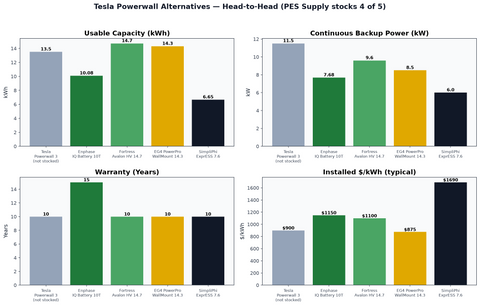
EG4 is the value LFP leader in North America. The PowerPro WallMount 14.3 kWh AllWeather ships in an IP66 outdoor-rated enclosure with self-heating BMS for -20 °C operation, at roughly half the installed cost per kWh of the closest closed-loop competitor. Combined with EG4's own FlexBOSS21 16 kW hybrid inverter or a Sol-Ark 15K, it hits Powerwall-scope resilience at Signature Solar pricing. EG4 is the closest direct competitor to Signature Solar, and PES ships EG4 through the same direct-distributor channel.
The EG4 lineup at PES
- EG4 PowerPro WallMount AllWeather 14.3 kWh — PES-ESS-BTS-0222, $3,124.99
- EG4 FlexBOSS21 16 kW Hybrid Inverter — PES-SPS-SIV-0611, $3,599.99
- EG4 GridBOSS MID V2 200 A Service Entrance — PES-ESS-BTS-0221, $1,799.99
- EG4 LifePower4 — 48 V 100 Ah rackmount LFP for parallel bank builds
- EG4 18kPV — 18 kW split-phase hybrid inverter for larger residential
When EG4 wins
- Value-conscious residential — Powerwall scope, not Powerwall pricing
- Outdoor wall-mount install
- Cold climate — self-heating BMS to -20 °C
- Installer already stocks Sol-Ark inverters
What SimpliPhi is best known for
SimpliPhi (acquired by Briggs & Stratton in 2021) uses A123 LFP cells that deliver 10,000 cycles at 80 % DoD — roughly 2× the cycle life of any other LFP battery in this comparison. That doesn't matter for single-cycle-per-day residential, but it dominates for twice-daily arbitrage, off-grid cabin work, and industrial UPS applications. SimpliPhi also has the widest operating temperature range (-20 to 60 °C) which makes it the pick for extreme-climate installs.
The SimpliPhi lineup at PES
- SimpliPhi PHI 3.8 — 3.5 kWh 48 V module, parallelable to 32 kWh
- SimpliPhi ExprESS 48 V 7.6 kWh ESS — PES-ESS-BTS-0009, $12,827.85 (pre-wired essential-loads cabinet)
- SimpliPhi AccESS 15.2 kWh + 12 kW Inverter — PES-SPS-SIV-0245, $19,850.25
- SimpliPhi AccESS 22.8 kWh + 12 kW Inverter — PES-SPS-SIV-0243, $27,431.25
When SimpliPhi wins
- Twice-daily cycling / arbitrage
- Off-grid cabin with high cycle count
- Extreme-temperature environment (Arizona summers, Maine winters)
- Customer wants a pre-wired cabinet
What Pytes is best known for
Pytes is the open-protocol LFP for installers who don't want to be locked into one inverter ecosystem. E-Box 48100R is 5.12 kWh at 48 V with published CAN and RS485 profiles that any competent hybrid inverter can implement. Sol-Ark, Victron, Deye, Schneider XW Pro all have Pytes closed-loop profiles in their firmware. It's also rack-mount friendly for telecom and industrial applications.
The Pytes lineup at PES
- Pytes E-Box 48100R — 5.12 kWh 48 V rack-mount LFP
- Pytes E-Box 48100R-C — cabinet version with parallel scaling
- Pytes R-Box outdoor cabinet — 2 × E-Box IP64 enclosure
- Pytes communication cable 3.5 m — PES-PA-ELC-0012, $6.00
When Pytes wins
- Sol-Ark or Victron install with battery flexibility priority
- Rack-mount telecom / small commercial
- Off-grid with a preferred inverter that isn't Fortress or EG4 closed-loop
What BYD is best known for
BYD Battery-Box Premium is the European-favorite HV storage platform, and BYD's in-house Blade LFP cell is one of the highest-quality LFP cells shipped anywhere. The Premium HVL and HVM lines run 400–500 VDC and scale to 100+ kWh in a single stack. Closed-loop with SolarEdge Energy Hub, Fronius GEN24, Kostal Plenticore, and Sol-Ark 15K-HV. BYD is the answer for large residential (whole-home + EV + shop) and light C&I where HV bus and mechanical build quality matter.
The BYD lineup at PES
- BYD Battery-Box Premium HVL BCU + Base — PES-PA-ELC-0113, $682.50 (stack head)
- BYD 2.5 kWh HV Battery Module — PES-ESS-BTS-0180, $2,117.32 (B-Plus-H module)
- BYD Battery-Box LV Flex Lite — PES-ESS-BTS-0203, $375.00 (LV/48V option)
When BYD wins
- Whole-home + EV + shop, 40–100 kWh residential
- Light C&I 50–200 kWh
- SolarEdge, Fronius, or Kostal inverter already on the design
- Customer values European mechanical build quality
Closed-loop pairings that ship in matched-firmware profiles as of 2026:
| Battery | Sol-Ark 12K/15K | Sol-Ark 15K-HV | EG4 FlexBOSS21 | Fortress Avalon | Victron MultiPlus-II | Schneider XW Pro | SolarEdge Energy Hub |
|---|---|---|---|---|---|---|---|
| Fortress Avalon HV | — | ✓ | — | ✓ | — | — | — |
| Fortress eVault Max | ✓ | — | — | ✓ (48V mode) | — | — | — |
| EG4 PowerPro WallMount | ✓ | — | ✓ | — | — | — | — |
| SimpliPhi PHI 3.8 | ✓ | — | — | — | — | ✓ | — |
| Pytes E-Box 48100R | ✓ | — | — | — | ✓ | ✓ | — |
| BYD Battery-Box HVL/HVM | — | ✓ | — | — | — | — | ✓ |
| BYD Battery-Box LVS | ✓ | — | — | — | ✓ | — | — |
Which LFP brand has the best cell supplier?
SimpliPhi PHI uses A123 (now Wanxiang A123) LFP cells that are the technical benchmark for cycle life — 10,000 cycles at 80 % DoD, made in the US and Mexico. Fortress Power sources CATL EnerC cells for the Avalon line. EG4 sources EVE Energy LFP cells (widely used across the Chinese storage industry). Pytes uses EVE and REPT cells. BYD uses their own Blade LFP cells manufactured in-house. 'Best' depends on the metric: SimpliPhi for cycle life, BYD for vertical integration, CATL and EVE for volume and price.
What communication protocols do these batteries support?
Fortress Avalon uses CAN bus (proprietary Fortress profile) for closed-loop with Fortress and Sol-Ark inverters. EG4 uses RS485 with EG4/Sol-Ark closed-loop profile. SimpliPhi PHI uses proprietary CAN with SimpliPhi and select Schneider inverters. Pytes E-Box publishes open CAN/RS485 profiles compatible with Sol-Ark, Victron, Schneider, and Deye. BYD Battery-Box uses CAN with SolarEdge, Fronius, and Kostal HV inverters.
Are all these batteries UL 9540 listed?
Yes — every LFP battery in this comparison ships with UL 9540 or UL 9540A listing paperwork. Fortress Avalon (E356254), EG4 PowerPro (E479867), SimpliPhi PHI (E349080), Pytes E-Box (E518764), BYD Battery-Box (E501038). AHJs almost universally require UL 9540 for indoor and garage installs in 2026 — an unlisted battery is not an option for a permitted install.
What is closed-loop vs open-loop battery-to-inverter communication?
Closed-loop means the battery BMS sends full state data (per-cell voltages, temperatures, max charge/discharge current, state of charge) to the inverter over a proprietary protocol, and the inverter obeys the battery's operating envelope directly. This is the accurate, warranty-preserving way to run a battery. Open-loop means the inverter reads only the battery terminal voltage and estimates state of charge from a voltage-to-SoC curve — accurate to +/- 10 % at best, and cell-imbalance events can go undetected. Always spec closed-loop; verify the inverter has a firmware profile loaded for the specific battery model.
Which LFP battery scales best beyond 40 kWh?
BYD Battery-Box Premium HVM at 400–500 VDC scales cleanly to 100+ kWh in a single stack. Fortress Avalon HV Pro Business scales to 200+ kWh in cabinet form. SimpliPhi AccESS scales through parallel cabinets to 40–60 kWh. EG4 PowerPro parallels well to 40 kWh; beyond that, you migrate to the EG4 large-format storage line. For pure 100+ kWh residential-plus-EV builds, BYD or Fortress HV is the answer.
MPPT compatibility — which batteries pair with which solar controllers?
The battery doesn't talk to the MPPT directly — it talks to the hybrid inverter, and the hybrid inverter contains the MPPT. So the question is really 'which hybrid inverter pairs with which battery' — see the comparison table for the certified pairings. On DC-coupled builds: Sol-Ark 12K/15K works with Fortress, EG4, SimpliPhi, Pytes; EG4 FlexBOSS21 works with EG4 and select Sol-Ark; Fortress Avalon inverter is closed-loop with Fortress only; SolarEdge Energy Hub is closed-loop with SolarEdge Home Battery and BYD.
Not all LFP is the same. The cathode formulation, the electrolyte additive package, the separator technology, and the mechanical design of the cell all affect cycle life, calendar life, and safety margin.
Cell format — prismatic vs cylindrical vs pouch
LFP cells ship in three physical formats:
- Prismatic — rectangular hard-shell cells, typically 100–300 Ah each. Used in EG4 PowerPro (EVE prismatic), Pytes (EVE prismatic), and most Chinese residential LFP. Highest energy density per pack, easiest to thermally manage, industry-standard mechanical mounting.
- Cylindrical — 21700 or 32700 form factor, hundreds of cells per pack. Used by Enphase IQ Battery (Enphase moved from NMC prismatic in older IQ 10 to LFP cylindrical in IQ 5P and IQ 10T). Superior thermal isolation between cells — a failed cell can't propagate to neighbors — at some cost to volumetric energy density.
- Pouch — soft-shell laminated cells. SimpliPhi PHI 3.8 historically used A123 pouch cells for the 10,000-cycle chemistry. Highest cycle life but lower mechanical robustness.
Cathode active material grades
LFP cathodes are ostensibly LiFePO₄ but the actual grade varies:
- Standard LFP — 90–120 mAh/g specific capacity, 6,000 cycles at 80 % DoD.
- Nano-structured LFP — 140–160 mAh/g through carbon-coated nano-particulate cathodes. Higher energy density.
- Doped LFP (Mn-LFP) — small manganese doping raises the average discharge voltage from 3.2 V to 3.4 V, giving ~5–10 % more energy density. Emerging in newer BYD and CATL cells.
- A123 nanophosphate — the proprietary A123 chemistry used by SimpliPhi. 10,000-cycle life claim is backed by cell-level testing data.
The BMS is the piece that differentiates a battery ecosystem from a battery commodity. Every brand in this comparison implements its BMS differently:
Fortress Avalon BMS
String-level BMS with per-module slave BMS on the HV Pro. Master BMS talks to the Fortress Avalon inverter over CAN 2.0B. Passive balancing at cell level. Cell-level temperature monitoring on every module. Fault modes: over-voltage, under-voltage, over-current, over-temperature, cell delta > 100 mV.
EG4 PowerPro BMS
Integrated BMS per battery unit. Communicates with EG4/Sol-Ark over RS485 modbus. Self-heating feature — the BMS runs a small resistive heater to keep cells above 0 °C for charge acceptance below freezing. Passive balancing. Diagnostic access via the EG4 mobile app.
SimpliPhi BMS
Per-module BMS in each PHI 3.8. Passive balancing, no active cell-to-cell transfer. Talks to SimpliPhi or Schneider XW Pro over CAN. SimpliPhi's approach is deliberately conservative — the BMS holds cells at moderate cycling voltages to preserve the 10,000-cycle life claim.
Pytes E-Box BMS
Rack-mount BMS with published CAN and RS485 profiles. Wider inverter compatibility than any closed-loop brand because Pytes has made the choice to publish the protocol. Active balancing on newer models.
BYD Battery-Box BMS
Modular BMS — one per HV module, one master BCU (Battery Control Unit) per stack. Talks to SolarEdge Energy Hub, Fronius GEN24, and Kostal Plenticore over CAN. The BYD BCU also implements arc-fault detection and stack-level ground-fault monitoring, which is unusual — those functions are usually in the inverter.
UL 9540 is a system-level safety standard for stationary energy storage. Unlike UL 1973 (which certifies just the battery), UL 9540 certifies the entire system — battery, BMS, inverter, enclosure, and firmware — as a matched, safe-to-install package. Every brand in this comparison holds UL 9540 for specific model+inverter combinations.
UL 9540A — the fire propagation test
UL 9540A is the sister standard that tests thermal runaway propagation between cells, modules, and units. Passing UL 9540A means the manufacturer has demonstrated that a single-cell thermal event will not propagate to neighboring cells within the same module, that a single-module event will not propagate to neighboring modules, and that a single-unit event will not propagate to neighboring units. Every LFP battery in this comparison has UL 9540A pass results — an important AHJ-facing data point.
Why the AHJ cares
NFPA 855, IRC R327, and IFC 1207 all reference UL 9540 as the qualifying listing for permitted ESS installation. Without UL 9540, the install is at best a variance request and at worst a red-tag. Every SKU listed in this guide ships with a UL 9540 listing paperwork packet — request at order time and PES routes the manufacturer copy to the AHJ.
The battery half of the ESS is only half the design — the other half is the hybrid inverter, and the closed-loop pairing is what makes the system a listed system.
Sol-Ark 12K, 15K, and 15K-2P
The most-installed hybrid inverter in North American residential. Closed-loop with Fortress eVault Max, EG4 PowerPro, EG4 LifePower4, SimpliPhi PHI, Pytes E-Box, Discover AES. Sol-Ark's firmware profiles cover more batteries than any competing inverter, which is why Sol-Ark has 40 %+ share of the DIY and semi-pro installer market.
Sol-Ark 15K-HV
High-voltage variant. Closed-loop with Fortress Avalon HV and BYD Battery-Box HVL. Newest addition to the Sol-Ark line, filling the HV band without forcing installers into the Fortress or SolarEdge captive ecosystems.
EG4 FlexBOSS21 and 18kPV
EG4's own hybrid inverters. FlexBOSS21 is 16 kW single-phase, 18kPV is 18 kW split-phase. Closed-loop with EG4 PowerPro, EG4 LifePower4. Value pick for EG4-plus-EG4 stacks.
Fortress Avalon inverter
Fortress's own inverter, closed-loop only with Fortress Avalon HV batteries. Ships as part of the Avalon HV Pro ESS bundle.
SolarEdge Energy Hub
SolarEdge's HV hybrid inverter, closed-loop with SolarEdge Home Battery and BYD Battery-Box HVL/HVM. The captive-ecosystem answer for HV residential and light C&I.
Schneider XW Pro / XW+ 6848
Legacy off-grid inverter still widely used. Closed-loop with SimpliPhi PHI and select 48 V LFP brands.
Victron MultiPlus-II
European off-grid and marine favorite. Closed-loop with Pytes and select open-protocol LFP.
Fortress Power — the pro installer's whole-home platform
Fortress Power was founded in 2018 and rapidly captured the pro-installer segment that wanted a single-vendor UL 9540 whole-home solution. Fortress's value proposition is integration — the Avalon HV Pro ships as one listed system, which cuts permit complexity, cuts installer engineering time, and gives the customer a single warranty contact. Installer margin on Fortress is competitive with Sol-Ark-plus-EG4 stacks and better on labor because the install time is shorter. Fortress is what installers spec when the customer wants "the fanciest system in the neighborhood."
EG4 Electronics — Signature Solar's value flagship
EG4 is functionally the house brand of Signature Solar (the largest DIY-and-semi-pro solar retailer in the US). PES Supply distributes EG4 direct through the same manufacturer channel and offers the same wholesale pricing to installers. The value proposition is cost — EG4 PowerPro WallMount 14.3 at $3,125 street is roughly 60 % of the per-kWh cost of a Fortress or Enphase equivalent. EG4 is what installers spec when the customer is price-shopping and doesn't need whole-home 200 A backup scope.
SimpliPhi — the enterprise-grade LFP
SimpliPhi was founded in 2010 and was acquired by Briggs & Stratton in 2021. Under Briggs, SimpliPhi has been positioned as the enterprise-grade LFP for military, telecom, aviation, and industrial UPS applications, alongside its residential ExprESS and AccESS lines. The A123 pouch cell chemistry is the technical differentiator — 10,000 cycles at 80 % DoD, made in the US and Mexico, and the widest operating temperature range of any residential LFP.
Pytes — the open-protocol option
Pytes is a newer entrant (founded 2020) that carved out share by publishing its BMS communication profile openly. That decision made Pytes the go-to battery for installers using Victron, Schneider XW Pro, or Deye inverters that don't have Fortress or EG4 firmware profiles. Pytes is smaller than the top three but growing fast, especially in the off-grid and marine segments.
BYD — the European-favorite HV platform
BYD (Build Your Dreams) is the largest LFP cell manufacturer in the world by volume — they supply cells to Tesla for the Powerwall 3 as well. BYD's Battery-Box Premium residential and light-C&I line is the European favorite because SolarEdge, Fronius, and Kostal all have closed-loop BYD profiles in their firmware. In North America, BYD's share is growing as SolarEdge Energy Hub deployments increase and as installers move to HV architecture on larger residential.
Whenever you spec a battery-plus-inverter pairing, verify closed-loop compatibility before ordering. The five-point check:
- Firmware profile exists. Log into the inverter's configuration screen (or check the manufacturer's published profile list) and confirm the specific battery model appears in the drop-down. Not the brand — the specific model. "Fortress" is not enough; it must be "Fortress Avalon HV Pro 4.9 kWh module."
- Firmware version matches. The profile may be added in a newer firmware version than the inverter shipped with. Check the release notes.
- Comms cable and pinout. RJ45 pinouts vary by brand. Fortress uses one pinout, EG4 uses another. Order the manufacturer-specified battery-to-inverter cable, not a generic RJ45 patch cable.
- Termination resistor. RS485 comms bus requires a 120 Ω termination resistor at the far end. Some batteries ship with an internal terminator; others require an external plug.
- Warranty terms. Check both the battery and inverter warranty docs — some batteries only warrant the closed-loop cycle count when paired with certain inverters. Fortress Avalon HV, for example, only warrants the 10-year term when paired with the Fortress inverter or the Sol-Ark 15K-HV.
Scenario — Off-grid Arizona cabin, extreme summer heat
Off-grid site with 8 kWh/day summer load, ambient temperatures peaking at 45 °C. LFP derating starts to bite above 45 °C on brands without active thermal management. Best fit: SimpliPhi PHI 3.8 — widest operating range (-20 to +60 °C), 10,000 cycle life for the off-grid cycle count, paired with a Schneider XW Pro inverter for the extreme-temperature system.
Scenario — New residential build with SolarEdge Energy Hub already spec'd
Solar designer already selected SolarEdge Energy Hub inverter for the roof optimizer architecture. Best-fit battery: BYD Battery-Box Premium HVL — the only closed-loop battery in the SolarEdge Energy Hub firmware profile. Alternative if the customer wants captive-brand: SolarEdge Home Battery. BYD offers better $/kWh at the residential scale.
Scenario — Restaurant chain rolling out ESS across 15 sites
Chain wants standardized 100 kWh peak-shaving ESS at every location. Best-fit: Fortress HV Pro Business 100 — matched three-phase inverter, single UL 9540 system, factory commissioning support, and pallet freight consolidation across the 15-site rollout through PES Supply project quotes.
Scenario — DIY-friendly off-grid installer with Sol-Ark ecosystem
Installer's shop already carries Sol-Ark 15K inverters and services the DIY-and-semi-pro market. Best-fit batteries: EG4 PowerPro WallMount 14.3 (closed-loop with both EG4 and Sol-Ark firmware profiles) for value builds, or Pytes E-Box 48100R for open-protocol flexibility on mixed-vendor jobs.
Three trends will shape the LFP battery landscape over the next two years:
- Sodium-ion emerging in low-cost tier. CATL and BYD have both announced sodium-ion (Na-ion) cell platforms targeting stationary storage. Lower energy density than LFP, similar safety, potentially 20–30 % lower cell cost at scale. Watch 2027 for first commercial residential Na-ion storage products.
- Higher DoD warranties. Enphase set the benchmark at 15 years / 100 % usable DoD; Fortress, EG4, and SimpliPhi will likely respond with extended-term warranty options over 2026–2027.
- US LFP manufacturing. IRA domestic-content adder is driving US-manufactured LFP capacity. SimpliPhi already leverages A123 US/Mexico production; other brands are announcing US assembly or partial US content.
Open a Contractor Account
Get trade pricing, freight quotes, and access to the interactive Battery Sizing Calculator on our contractor portal.
Register NowAbout the author: Jennifer Kirstens leads distributor content at PES Supply. Last updated August 2026.