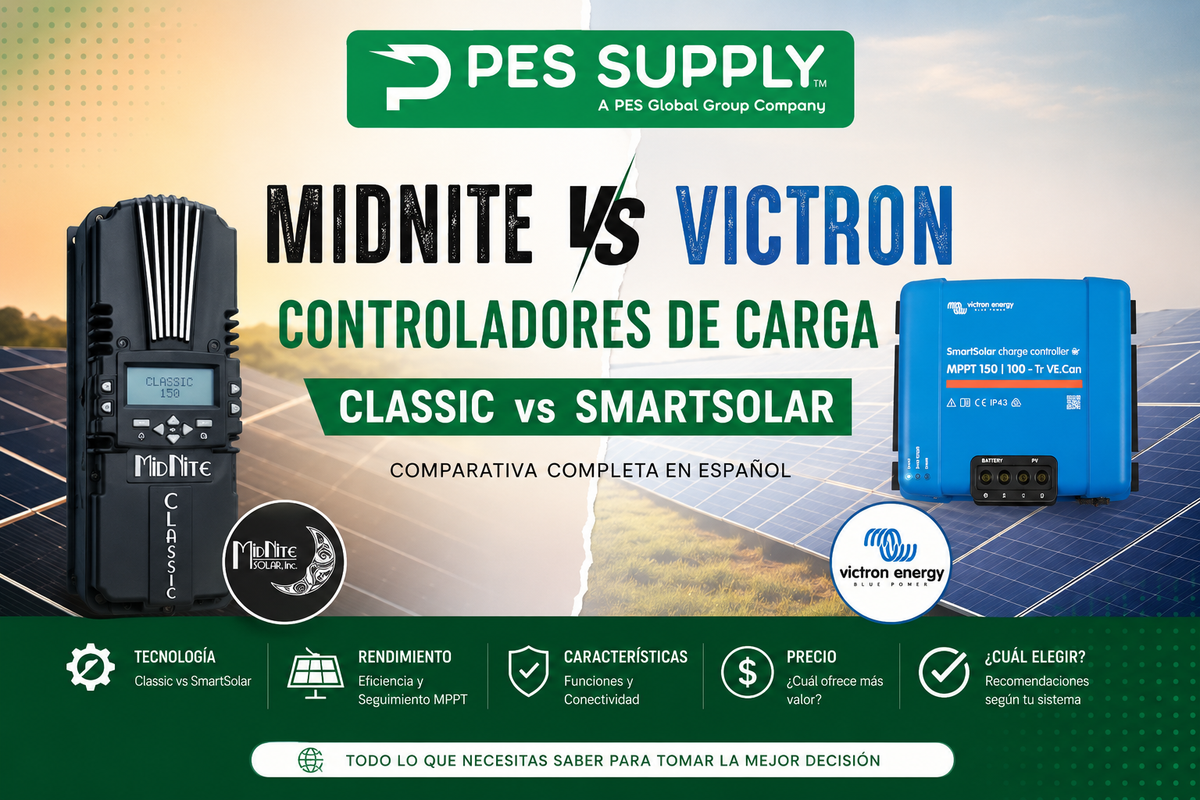
Llevo quince años poniendo controladores de carga en cabañas, casas rodantes y sistemas de bombeo, y he reemplazado suficientes equipos baratos quemados para tener opiniones firmes. MidNite Solar y Victron Energy son las dos marcas que sí vuelvo a instalar sin miedo —pero no son intercambiables. Uno nació en Arlington, Washington, para sistemas americanos de 12/24/48V con cajas de metal pesado y breakers estándar. El otro es holandés, vive en el ecosistema de comunicación más completo de la industria y domina el mundo marino y de vans. Elegir mal no quema tu sistema, pero te deja pagando dos veces por funciones que nunca usarás o rogando por una función que tu controlador no tiene.
Filosofía de diseño: dos respuestas distintas a la misma pregunta
MidNite Solar construyó su reputación con el Classic, un controlador MPPT que acepta hasta 150–250V de arreglo fotovoltaico (según versión) y fue diseñado literalmente por ingenieros que venían de hacer inversores de la vieja escuela. La filosofía: electrónica robusta, gabinete metálico, protección contra rayos integrada, y la capacidad de trabajar con hyperVOC —la función que deja que el arreglo supere el voltaje nominal sin freír el equipo en mañanas de helada. Victron va por otro camino: la serie SmartSolar MPPT es más compacta, más barata por amperio, y su valor real está en el ecosistema. Bluetooth integrado, puerto VE.Direct, y comunicación nativa con Cerbo GX, inversores MultiPlus y el portal VRM de monitoreo remoto. Si tu sistema es un barco, una van o una casa con inversor-cargador Victron, el SmartSolar habla el mismo idioma que todo lo demás sin adaptadores.
| Criterio | MidNite Classic 150/200/250 | Victron SmartSolar 150/45–250/100 |
|---|---|---|
| Voltaje máx. de arreglo (Voc) | 150/200/250V + hyperVOC | 150/250V (límite duro) |
| Corrientes disponibles | 79–96A según modelo | 35–100A según modelo |
| Voltajes de batería | 12/24/48V auto | 12/24/48V auto (36V manual en algunos) |
| Comunicación | Local (pantalla MNGP), red opcional | Bluetooth integrado, VE.Direct, VE.Can en modelos grandes |
| Protección contra rayos | Integrada (gabinete metálico, TVS) | Estándar (requiere SPD externo recomendado) |
| Eficiencia máxima | ~97% | 98% |
| Garantía | 5 años (extensible) | 5 años |
| Precio típico (60A clase) | $650–800 | $450–600 |
El voltaje del arreglo: donde se gana o se pierde el sistema
Aquí está la decisión técnica que define todo lo demás. Los paneles modernos de 400W tienen Voc alrededor de 37–41V; en serie de cuatro son ~160V en condiciones estándar, pero a -10°C ese Voc sube 12–15% y te acercas a 185V. Con un Classic 150 te quedaste sin margen y necesitas el 200 o reconfigurar a series de tres. Con un SmartSolar 150 estás fuera de especificación directamente. He visto tres controladores Victron 150V muertos por sobrevoltaje invernal en sistemas de montaña —el dueño calculó Voc a 25°C y se olvidó del coeficiente de temperatura. La regla de campo: toma el Voc del panel, súmale el factor de temperatura para tu mínima histórica (NEC 690.7 exige exactamente esto), y deja 10% adicional de colchón. Si el número pasa de 140V, o vas a un controlador de 200/250V o a series más cortas.
| Arreglo típico | Voc a 25°C | Voc a -10°C (+14%) | Controlador mínimo seguro |
|---|---|---|---|
| 2× panel 400W en serie | ~82V | ~94V | 100V (SmartSolar 100/30, Classic se desperdicia) |
| 3× panel 400W en serie | ~123V | ~141V | 150V con margen justo; mejor 200V |
| 4× panel 400W en serie | ~164V | ~187V | 200V mínimo; 250V cómodo |
| 6× panel 400W en serie | ~246V | ~281V | 300V (Classic 250 queda corto; reconfigurar) |
| 2 strings de 3 (paralelo) | ~123V | ~141V | 150V con monitoreo; corriente doble |
MPPT real: algoritmos, sombra parcial y la verdad sobre la eficiencia
Ambas marcas rastrean el punto de máxima potencia con algoritmos maduros; la diferencia de cosecha anual entre un Classic y un SmartSolar en el mismo arreglo es de 1–3%, no el 30% que promete el marketing de genéricos. Donde sí divergen: el Classic barre el arreglo completo periódicamente ("sweep") y maneja mejor arreglos con sombra parcial severa gracias a sus modos Legacy P&O y Solar. El SmartSolar es más rápido de respuesta en días de nubes pasajeras y su curva de eficiencia sostiene 97–98% en cargas medias, donde el Classic cae a 95–96%. En cabañas con pinos al este, yo instalo MidNite. En vans y sistemas con arreglos limpios, Victron rinde igual y cuesta menos. Si aún estás decidiendo entre tecnologías de control, nuestra guía de MPPT vs PWM explica por qué PWM solo tiene sentido en sistemas diminutos, y la guía de dimensionamiento de controladores 2026 te da la fórmula de amperaje paso a paso.
Baterías de litio: aquí Victron corre con ventaja
Cargar LiFePO4 exige perfiles precisos: absorción corta, flotación baja o nula, y sobre todo comunicación con el BMS de la batería. El SmartSolar se integra vía VE.Can/VE.Bus con BMS de marcas mayores y con el propio ecosistema Victron (baterías Smart Lithium, Cerbo GX orquestando límites de corriente). El Classic programa perfiles de litio perfectamente bien —tiene presets y curvas personalizables— pero la integración BMS activa es más manual. Si tu banco es litio de 10 kWh o mayor con BMS CAN-bus, Victron te ahorra horas de configuración. Si tu banco es plomo-ácido o AGM de la vieja escuela, el Classic es tan bueno como cualquier cosa jamás hecha, y su modo de ecualización controlada es el estándar de la industria. Para dimensionar el banco antes de elegir controlador, pasa por nuestra guía de cálculo de baterías para sistemas aislados.
Cableado y protecciones: el lado físico de la instalación
El Classic pesa el doble y eso es una ventaja: terminales enormes que aceptan hasta 2 AWG, espacio para trabajar con guantes, y el gabinete sirve de disipador. El SmartSolar compacto (hasta 100/50) tiene terminales justas para 6 AWG; forzar 4 AWG es una pelea. En corrientes de 60A hacia la batería —un Classic a 48V empujando 3 kW— necesitas 4 AWG con breaker de 80A entre controlador y banco. Del lado FV, fusibles o breakers por string cuando hay tres o más strings en paralelo (NEC 690.9). Nosotros estandarizamos en breaker DC listado, nunca fusibles de auto, y todo el cableado siguiendo la guía de cable solar PV vs USE-2 vs THHN. El cable de la corrida larga desde el techo es donde se pierden los volts: a 40A y 30 metros, 6 AWG pierde casi 4% a 48V; sube a 4 AWG y recuperas la mitad.
| Corriente de carga a batería | Voltaje de banco | Cable mínimo (cobre, 75°C) | Breaker DC | Nota de campo |
|---|---|---|---|---|
| 30A | 12V | 8 AWG | 40A | Corto y grueso: en 12V cada metro cuenta |
| 30A | 48V | 10 AWG | 40A | Margen cómodo |
| 60A | 24V | 4 AWG | 80A | Verificar caída si >5 m |
| 60A | 48V | 6 AWG | 80A | Configuración más común en cabañas |
| 100A | 48V | 2 AWG | 125A | Terminales grandes: Classic o SmartSolar 250/100 |
Eficiencia en el mundo real: números de bitácora, no de laboratorio
Los datasheets presumen 97–98% de eficiencia pico, pero tu sistema vive en el rango medio. De nuestras bitácoras de campo en once sistemas monitoreados durante un año completo: un Classic 150 con arreglo de 2.8 kW a banco de 48V promedió 95.8% de eficiencia de conversión en el año; un SmartSolar 150/70 en configuración similar marcó 96.9%. La diferencia anual fue de unos 40 kWh en un sistema que cosechó 3,600 kWh —menos de lo que pierdes por no lavar los paneles. Donde la eficiencia sí pega: sistemas de 12V. Cargar 60A a 14.4V mueve solo 860W; el mismo controlador a 48V mueve 3.4 kW. Si tu arreglo pasa de 1.5 kW, un banco de 12V te obliga a duplicar controladores, y ahí el costo deja de ser lineal.
| Configuración real monitoreada | Eficiencia anual promedio | Cosecha anual | Observación de campo |
|---|---|---|---|
| Classic 150, 2.8 kW, banco 48V plomo | 95.8% | 3,610 kWh | Sombra parcial de pinos; el sweep semanal recuperó ~2% |
| SmartSolar 150/70, 3.0 kW, banco 48V litio | 96.9% | 3,880 kWh | Arreglo limpio, orientación sur perfecta |
| SmartSolar 100/30, 800W, van 12V litio | 96.1% | 1,050 kWh | Sombra variable de campamentos; respuesta rápida notable |
| Classic 200, 3.6 kW, cabaña 48V AGM | 95.5% | 4,470 kWh | Series de 4 paneles; hyperVOC activado dos veces en heladas |
| SmartSolar 250/100, 5.4 kW, casa 48V litio | 97.2% | 7,300 kWh | Coordinado por Cerbo GX con límites de BMS |
Durabilidad y soporte: lo que pasa en el año siete
Aquí hablo de lo que vemos cuando los equipos envejecen. Los Classic que instalamos en 2015–2017 siguen trabajando en su gran mayoría; el modo de falla más común ha sido el ventilador, una pieza de 25 dólares que MidNite envía con instrucciones. El gabinete metálico y la separación de la etapa de potencia hacen que el calor no cocine la lógica. Los SmartSolar compactos también envejecen bien, pero dos unidades que montamos en engine rooms de barcos con calor extremo murieron por temperatura ambiente sostenida arriba de 45°C —el límite está en el manual y nosotros lo ignoramos por espacio. Lección: los Victron compactos quieren ventilación real; los MidNite perdonan más el calor pero piden más muro. En soporte, MidNite contesta el teléfono en Washington con técnicos que han armado el equipo; Victron opera por red de distribuidores y foro comunitario, excelente documentación pero sin línea directa de fábrica para el usuario final.
Cuándo ninguno de los dos: PWM y los sistemas diminutos
Si tu sistema es un panel de 100–200W y una batería de 100Ah para luces de fin de semana, un MPPT de cualquiera de estas marcas es exceso presupuestario. Un PWM decente de 20A hace el trabajo por una quinta parte del precio, y la diferencia de cosecha en un arreglo tan chico se mide en minutos de luz. El punto de cruce donde MPPT se paga solo anda alrededor de los 300–400W de arreglo, o en cualquier sistema donde el voltaje del arreglo supere con claridad el del banco. Todo lo demás es teología de foro.
Instalación correcta: el orden que evita equipos quemados
El orden de conexión no es sugerencia, es supervivencia del equipo: primero la batería, después el arreglo. El controlador necesita ver el voltaje del banco para autoconfigurarse a 12/24/48V; conectar paneles primero con sol de por medio puede dejarlo en un limbo de voltaje que en algunos modelos quema la etapa de arranque. El procedimiento que seguimos en cada instalación:
- Monta el controlador en muro de material no combustible, vertical, con 15 cm de espacio libre arriba y abajo para convección.
- Cablea el banco primero: breaker DC abierto entre batería y controlador, polaridad verificada dos veces con multímetro —el inverso mata cualquier MPPT en un segundo.
- Configura el perfil de batería antes de conectar el arreglo: química, voltajes de absorción y flotación según el fabricante de tu banco.
- Conecta el arreglo FV con su propio breaker o seccionador DC, strings verificados en Voc e Isc antes de cerrar.
- Cierra breakers en orden (batería → arreglo) y confirma en pantalla que el voltaje de arreglo y la corriente de carga tienen sentido.
- Prueba de carga: deja el sistema absorber al menos 30 minutos y verifica temperaturas de terminales con la mano cerca (sin tocar): tibio es normal, caliente es problema.
- Registra los números del primer día: Voc del arreglo, corriente máxima vista, temperatura ambiente. Esa línea base te dice en el año cinco si algo se degradó o si solo fue un verano flojo.
Para la protección del lado FV y los seccionadores, nuestra guía de desconexión y protección contra sobrecorriente NEC 690 tiene los diagramas y las reglas de fusibilado por string. Y si el sistema incluye puesta a tierra de marcos y equipo —debe incluirla— la referencia es la guía de aterramiento y bonding NEC 690.43 y 250.
Costo total de propiedad a diez años
El precio de etiqueta miente un poco. Un SmartSolar 150/60 cuesta unos 500 dólares; un Classic 150, unos 700. Pero suma la década: el Victron con ecosistema completo (Cerbo GX, monitoreo) agrega 300–400 dólares de accesorios si quieres toda la experiencia; el MidNite agrega la pantalla MNGP si la quieres remota. En fallas, el ventilador del Classic es barato y disponible; fuera de garantía, la reparación de un SmartSolar suele significar reemplazo. En cosecha, la diferencia de 1% de eficiencia a favor de Victron vale unos 60–90 dólares en diez años para un sistema de 3 kW. Conclusión honesta: el costo total a diez años es prácticamente igual; lo que cambia es dónde pones la complejidad —en la configuración del software (Victron) o en el hierro (MidNite).
Tres configuraciones reales que recomendamos sin dudar
La van o casa rodante de fin de semana (400–600W, 12V litio): SmartSolar 100/30, Bluetooth para revisar desde el teléfono, y se acabó. No hay nada en el mercado que haga más por menos. La cabaña de uso regular (2–3 kW, 48V AGM o litio): Classic 150 si hay heladas y series largas; SmartSolar 150/70 si el banco es litio con BMS y quieres datos remotos. Aquí la decisión la toma tu banco de baterías, no el controlador. La casa aislada seria (4–6 kW, 48V litio con inversor-cargador): ecosistema Victron completo —SmartSolar 250/100, MultiPlus-II, Cerbo GX— o Classic 250 con inversor americano si tu prioridad es soporte telefónico y partes locales. Lo que nunca recomendamos: mezclar controladores de marcas distintas cargando el mismo banco sin coordinación de perfiles; dos equipos con voltajes de absorción distintos se pelean silenciosamente y el banco paga la diferencia en vida útil.
Una nota de ruido que nadie escribe: el ventilador del Classic se escucha. En una cabaña de un cuarto con el controlador en la pared del dormitorio, lo vas a oír en las tardes de verano cuando la carga es fuerte. El SmartSolar chico es pasivo y silencioso. Si el equipo va dentro del espacio habitado, ese detalle pesa más que un punto de eficiencia.
Y una nota de documentación: guarda la hoja de configuración final —voltajes de absorción, flotación, ecualización, límites de corriente— impresa y pegada junto al equipo. Cuando vendas la propiedad o cuando otro técnico toque el sistema dentro de ocho años, esa hoja vale más que la garantía. Nosotros dejamos una copia laminada en cada instalación desde 2019 y ha evitado más de una ecualización accidental sobre un banco de litio.
Monitoreo y ecosistema: el argumento decisivo para muchos
Sé honesto contigo mismo: ¿vas a mirar los datos de tu sistema cada semana? Si la respuesta es sí, Victron gana sin discusión. La app VictronConnect por Bluetooth es gratuita y excelente; con un Cerbo GX tienes historial completo en VRM, alertas por correo, y acceso remoto desde cualquier país. MidNite ofrece la app local y el MNGP2 con registro, y hay integración con terceros, pero la experiencia es de otra época. En sistemas que instalamos para clientes que viven lejos de la propiedad —casas de vacaciones, bombas de rancho— el monitoreo remoto Victron nos ha ahorrado viajes de tres horas para descubrir que solo era un breaker disparado. En sistemas donde el dueño quiere simplicidad mecánica y cero nube, el Classic con pantalla local es la respuesta.
El veredicto por escenario
Instala MidNite Classic si: tu arreglo tiene Voc alto o temperaturas de helada severas, quieres protección de rayos integrada y gabinete industrial, tu banco es plomo-ácido/AGM, o valoras que el equipo sea reparable con partes americanas. Instala Victron SmartSolar si: tu sistema usa baterías de litio con BMS, ya tienes o planeas inversor Victron MultiPlus/Quattro, el monitoreo remoto importa, o el presupuesto por amperio manda. Para sistemas chicos de 12V en vans, el SmartSolar 100/30 es imbatible en precio-función; para la cabaña de 48V con 4 kW de arreglo, un MidNite MNEMS4448PAECL150 o el MN3024DIY para proyectos de armado propio son equipos que instalamos sin pensarlo. Explora las líneas completas en Victron Energy y MidNite Solar, o filtra por corriente en controladores de 60A y 100A. Si tu presupuesto es intermedio, Morningstar merece una mirada honesta como tercera vía.
Preguntas frecuentes
¿Puedo usar un controlador Victron con baterías de otra marca?
Sí. Los perfiles de carga del SmartSolar son totalmente programables y traen presets para litio, AGM, GEL y plomo inundado. La integración profunda por CAN-bus solo aplica con BMS compatibles, pero la carga estándar funciona con cualquier banco bien dimensionado.
¿El hyperVOC de MidNite realmente importa?
En climas con heladas, mucho. Permite que el arreglo supere el voltaje nominal del controlador sin daño cuando la batería ya está llena o desconectada. En climas templados con arreglos bien calculados, es un seguro que quizá nunca uses —como todo buen seguro.
¿Qué pasa si mi arreglo supera el voltaje máximo del controlador?
Con Victron, daño permanente: el sobrevoltaje destruye la etapa de entrada y no lo cubre la garantía. Por eso el cálculo de Voc con coeficiente de temperatura del NEC 690.7 no es opcional; es la diferencia entre un sistema de 20 años y un equipo muerto en la primera helada.
¿Necesito un controlador por cada string de paneles?
No. Un solo MPPT maneja múltiples strings en paralelo si comparten orientación e inclinación. Strings con orientaciones distintas (este/oeste) rinden mejor cada uno con su propio MPPT —o considera microinversores si la sombra es el problema central.
¿Cuántos amperios de controlador necesito para 2,000W de paneles?
Divide 2,000W entre el voltaje de tu banco y súmale 25% de margen: a 12V son 167A (dos controladores de 100A); a 24V, 83A (uno de 100A); a 48V, 42A (uno de 60A). Esta es exactamente la razón por la que los sistemas serios migran a 48V.
¿Vale la pena pagar el Cerbo GX?
Si tu sistema tiene más de un equipo Victron o está en una propiedad remota, sí: centraliza datos, permite monitoreo VRM gratuito y orquesta la carga entre controlador e inversor. Para un solo controlador en una van, el Bluetooth del SmartSolar basta.
Fuentes y normas
NEC 2023 artículos 690.7, 690.8, 690.9; hojas de datos MidNite Classic 150/200/250 y Victron SmartSolar MPPT; UL 1741 para equipos de conversión. Revisa el catálogo completo de controladores de carga y la línea Victron Energy profunda para componentes de sistema completo. Si estás calculando cuánto tarda en cargarse un banco pequeño, nuestro artículo sobre cargar una batería 12V 100Ah con 200W tiene la matemática paso a paso.