Looking back from 2026, 2023 was the inflection year when the inverter stopped being a commodity and became the brains of the solar system. NEM 3.0 in California rewrote residential economics overnight, UL 1741 SB made grid-support functions mandatory across new installs, and the hybrid inverter — once a niche off-grid product — became the default quote in storage-attached markets. I spent that year explaining the shift to customers at our counter; this is the full picture of what changed, what it means for buyers now, and which technology fits which roof.
The 2023 Snapshot: Three Architectures, One Market
| Inverter Type | 2023 Trend | Best Fit |
|---|---|---|
| Hybrid | Fastest-growing category, driven by NEM 3.0 | Storage-paired residential, backup-focused installs |
| Microinverter | IQ8 expansion; grid-independent operation | Shaded roofs, module-level monitoring, rapid shutdown compliance |
| String | Stable; lowest cost per watt | Unshaded residential, commercial, utility-scale |
That summary table from the original analysis holds up. What deserves expansion is why each trend happened and how the economics settled out, because buyers today are still living in the market structure 2023 created.
Hybrid Inverters Move to the Mainstream
The trigger was California's NEM 3.0, which took effect in April 2023 and cut export compensation for new solar customers by roughly 75% under the avoided-cost calculator. Overnight, exporting midday solar to the grid became nearly worthless, and the economic case shifted to self-consumption: store your own production in a battery and discharge it through the evening peak. Every kWh you self-consume is worth retail rate; every kWh you export is worth a fraction of that. The hardware answer to that math is a hybrid inverter — one box that manages PV, battery, and grid simultaneously — and 2023 is when the category's sales curve bent sharply upward.
Sol-Ark's Rising Popularity
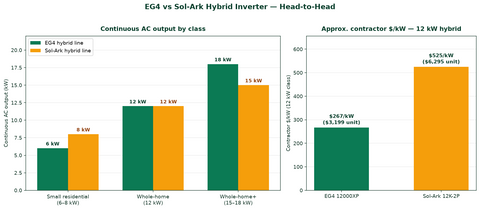
Sol-Ark rode that wave harder than any other brand in our catalog. The 12K and 15K all-in-one hybrids offered something the incumbent residential inverters didn't: a single pre-wired unit that handled whole-home backup, accepted any 48V battery chemistry, and didn't require a battery from the same manufacturer. Installers loved the labor savings; homeowners loved the open battery ecosystem. The Sol-Ark collection and the 8K-48 unit remain among our most-quoted hybrid products, and our broader hybrid inverter collection shows how crowded the category has since become — a crowding that started in 2023.
Enphase IQ8 Microinverter Expansion
Enphase spent 2023 pushing the IQ8 series — its grid-forming microinverter capable of running a home in sunlight without a battery during outages — into broader distribution after its initial rollout. The significance was architectural: previous microinverters were grid-following devices that shut down the instant the grid dropped. A grid-forming microinverter creates its own stable AC waveform, which means "sunlight backup" — real daytime power during an outage with no battery at all. For shaded and complex roofs where module-level electronics already made sense, IQ8 removed the last objection. The Enphase collection and our microinverter category carry the current generation.
UL 1741 SB and Smart Inverter Grid Support
September 2023 marked the effective date when California required UL 1741 SB certification — the "smart inverter" supplement adding mandatory grid-support functions — for new interconnections, with other states following the IEEE 1547-2018 framework on their own schedules. The required functions changed what an inverter does for the grid:
| Grid Support Function | What It Does | Why the Grid Needs It |
|---|---|---|
| Volt-Var | Adjusts reactive power to regulate local voltage | High solar penetration pushes feeder voltage up at midday |
| Frequency-Watt | Reduces output when grid frequency rises | Prevents solar fleets from destabilizing frequency during oversupply |
| Ride-Through | Stays online through brief voltage/frequency disturbances | Old inverters tripped offline en masse, worsening the original disturbance |
| Ramp Rate Control | Limits how fast output changes | Cloud transients no longer cause feeder-scale power swings |
The practical impact on buyers: any inverter you purchase now must carry UL 1741 SB listing to interconnect in most jurisdictions, which has quietly retired a generation of legacy models. When comparing equipment, the certification line on the spec sheet is no longer boilerplate — it's the gate. Our inverter collection lists current-certified models only.
Rapid Shutdown Integration
NEC 690.12's module-level rapid shutdown requirement, fully embedded in the 2020 code cycle adoption wave, continued reshaping hardware choices through 2023. Microinverters and DC optimizers satisfy module-level shutdown inherently; string systems need module-level power electronics (MLPE) add-ons or listed transmitter-receiver pairs. This is one reason the string-versus-micro decision now hinges on roof geometry: a simple unshaded rectangle favors string economics, while complex roofs favor module-level gear that handles both shading and shutdown in one device.
String Inverters Remain Cost Leaders
None of the hybrid and micro excitement changed the fundamental economics of the string inverter for the right applications. On unshaded residential roofs, commercial flat roofs, and utility-scale ground mounts, a string inverter delivers the lowest cost per watt of capacity, the simplest maintenance picture, and — with modern multi-MPPT residential units — enough design flexibility for most sites. SMA, Fronius, Sungrow, and GoodWe all refreshed their residential string lines through 2023 with higher input currents for large-format modules and integrated DC disconnects. Browse the current string inverter lineup, including Fronius, SMA, and GoodWe options.
The Efficiency and Spec Comparison That Actually Matters
Buyers get lost in datasheets; these are the rows that change real outcomes:
| Specification | String (typical 2023-gen) | Hybrid (typical 2023-gen) | Microinverter (IQ8 class) |
|---|---|---|---|
| Peak / CEC efficiency | 97.5–98.4% | 96–97.6% | 97–97.5% per module |
| Cost per watt (hardware) | $0.10–$0.20 | $0.30–$0.50 | $0.25–$0.40 |
| Battery integration | AC-coupled retrofit | Native DC-coupled | AC-coupled (system battery) |
| Shade tolerance | String-level | String-level | Module-level |
| Backup without battery | No | No (battery required) | Yes (sunlight backup, grid-forming) |
| Single point of failure | Yes (whole array) | Yes (whole system) | No (per-module) |
| Typical warranty | 10 years | 10 years | 25 years |
One math check worth doing on any quote: the efficiency differences between modern architectures translate to roughly 1–2% of annual energy. On a 10 kW system making 14,000 kWh a year at $0.16/kWh, 1.5% is about $34 a year — real money, but not the deciding factor. Architecture should be chosen on shading, backup needs, and battery plans, not on the last half-percent of efficiency.
NEC Sizing Math for the 2023-Generation Hardware
Whichever architecture wins the design, the code math is identical. NEC 690.8 sizes conductors and overcurrent devices at 125% of maximum output current, continuous. Verified example with a 10 kW hybrid at 240 V:
| Step | Rule | Calculation |
|---|---|---|
| Output current | P ÷ V | 10,000 W ÷ 240 V = 41.7 A |
| Continuous sizing | NEC 690.8(B) ×1.25 | 41.7 A × 1.25 = 52.1 A |
| Breaker | NEC 240.6(A) standard sizes | Next standard up: 60 A |
| Conductor (Cu, 75 °C) | NEC 310.16 | 6 AWG THHN/THWN-2 (65 A ampacity ≥ 52.1 A ✓) |
| PV string OCPD | NEC 690.8(A)+(B): Isc × 1.56 | Isc 14.0 A → 21.9 A → 25 A fuse/breaker |
Our NEC wire sizing guide with ampacity charts and the NEC 690 disconnect and OCPD guide expand every row of that table, and the inverter sizing calculator automates the design check.
The NEM 3.0 Math That Reshaped the Market
The economics that drove the hybrid surge deserve concrete numbers, because they still govern the California market and preview what other states are adopting. Under NEM 2.0, exported solar earned roughly retail rate; under NEM 3.0's avoided-cost calculator, average export compensation fell to roughly $0.05–$0.08 per kWh against retail import rates of $0.30–$0.45 depending on utility and time-of-use window. A worked annual comparison for a typical 7 kW system producing 10,500 kWh:
| Scenario | Self-Consumed | Exported | Annual Value (approx.) |
|---|---|---|---|
| NEM 2.0, no battery | 35% (3,675 kWh @ $0.35) | 65% (6,825 kWh @ $0.35) | ~$3,675 |
| NEM 3.0, no battery | 35% (3,675 kWh @ $0.35) | 65% (6,825 kWh @ $0.065) | ~$1,730 |
| NEM 3.0, with battery (hybrid) | 80% (8,400 kWh @ $0.35) | 20% (2,100 kWh @ $0.065) | ~$3,075 |
The battery row is why hybrid inverters won the market: adding storage under NEM 3.0 recovers roughly $1,300 per year versus solar alone — a sub-10-year payback on a typical storage increment even before counting backup value. Any state that moves to avoided-cost export rates imports this same math, which is why hybrid-ready designs are now the default recommendation regardless of local policy.
Battery Attach Rates and the DC-Coupling Advantage
Industry reporting through 2023–2024 put the battery attach rate on new California residential installs above 50% and climbing, from under 10% before NEM 3.0. The hardware consequence: DC-coupled hybrids, which route solar to battery through a single conversion, keep roughly 2–4% more energy than AC-coupled retrofits where solar converts to AC, back to DC for the battery, and back to AC for the home. On the 10,500 kWh system above, 3% is about 315 kWh a year — worth $110 annually at $0.35. Over a 20-year system life, that efficiency gap alone approaches the price difference between architectures, which is the technical argument underneath the hybrid trend.
What Happened to Prices Through the Shift
Supply chains normalized through 2023 after the pandemic-era shortage, and inverter pricing fell across all three architectures even as features expanded. Residential string inverters settled into the $0.10–$0.20 per watt band, microinverter systems held a persistent premium justified by the 25-year warranty and module-level value, and hybrids compressed from exotic to merely premium as Sol-Ark, Deye, EG4, and Growatt scaled volume. For buyers, the practical result was that the correct architecture — the one matched to roof, loads, and rate plan — became affordable in nearly every case. The cost of choosing wrong now exceeds the cost of choosing right, which was not always true a decade ago.
Commercial and Utility Inverter Trends from the Same Year
Above the residential market, 2023 continued two structural shifts. First, the 1500V DC standard completed its takeover of utility-scale design — higher string voltages mean fewer strings, less trenching, and fewer combiner boxes per megawatt, and every major central and string manufacturer shipped 1500V-native platforms. Second, string inverters kept eating the central inverter's market share in the 100 kW–5 MW commercial and distributed-utility band: multi-MPPT commercial strings at 100–350 kW offered granularity and shade tolerance that a single central unit couldn't match, at installed cost parity or better. Our commercial inverter collection and the commercial installation cost breakdown track the current state of that segment.
The Module-Level Power Electronics Debate, Settled by Data
The string-versus-micro argument used to be theological; by 2023 the monitoring data had made it empirical. Fleet-level production studies comparing module-level systems against string systems on matched roof types consistently find a single-digit percentage harvest advantage for module-level electronics on shaded or multi-orientation roofs — and near-zero difference on clean, unshaded, single-plane arrays. The economics follow directly: paying the MLPE premium on a perfect south-facing rectangle buys you features you can't use, while skipping it on a dormered, tree-adjacent roof forfeits production you'll never recover. The 2023 hardware generation didn't change that physics; it made both options good enough that the decision is purely about matching the tool to the roof.
The operational corollary that installers internalized that year: module-level monitoring turned warranty and maintenance from truck rolls into screen time. When a fleet dashboard shows one module underperforming its neighbors by 40%, the diagnosis is a soiled or shaded module before anyone climbs a ladder. String systems with MLPE retrofits gained the same visibility, which is why the rapid-shutdown hardware conversation and the monitoring conversation quietly merged into one.
What the 2023 Shift Meant for System Design Practice
Three design habits crossed from best practice to standard practice during this period, and they show up in every well-built proposal since:
- Rate-structure-first design. The inverter and battery choice now follows the utility tariff, not the other way around. A proposal that doesn't model export compensation against time-of-use import windows is missing the number that determines payback.
- Critical-loads panels sized deliberately. As backup went mainstream, the industry learned that a 200A whole-home backup promise from a 10 kW hybrid is marketing, not engineering. The disciplined approach — a documented critical-loads list, a subpanel, and load management for the big motor loads — became the difference between systems that rode out outages and systems that tripped on the first well-pump cycle.
- Future-proofing the conduit and wall space. With battery attach rates climbing, leaving physical room and raceway for a later battery or a second inverter became a line item customers thanked installers for two years later. I've personally done the retrofit version of this twice; both times it cost the homeowner triple what pre-planning would have.
Retrospective: Which 2023 Predictions Aged Well
Honest scorekeeping, three years on. The hybrid-mainstream call was right and then some — storage attachment kept climbing through 2025 in every market that touched avoided-cost export rates. The grid-forming microinverter prediction was right in capability and slower in adoption than expected; sunlight backup turned out to be a feature customers love in theory but size their batteries around in practice. The string-inverter obituary some analysts drafted in 2023 was simply wrong: string volume grew with the overall market, and the architecture keeps the largest installed base by a wide margin. And UL 1741 SB, dismissed by some as paperwork, genuinely improved fleet behavior during grid disturbances — ride-through requirements meant solar capacity stopped cascading offline during the frequency events that followed. The technology evolution of that year didn't produce a winner; it produced a mature menu, and the skill moved from picking the best inverter to specifying the right one.
Sources
This analysis draws on the California Public Utilities Commission's NEM 3.0 decision record, the IEEE 1547-2018 standard and UL 1741 SB certification requirements, CEC equipment listings, Enphase's published IQ8 grid-forming documentation, and NREL's annual market benchmarks for residential storage attachment rates. Equipment specifications reflect manufacturer datasheets current at publication.
Recommendations for Installers and Buyers
The lessons 2023 taught, distilled for projects being designed today:
- Design for storage even if you don't install it yet. NEM 3.0-style rate structures spread beyond California. A hybrid-ready design or a conduit path for a future battery costs almost nothing at install and thousands to retrofit.
- Verify UL 1741 SB listing on the exact SKU. Certifications are per-model and per-firmware in some cases; the datasheet line must match the AHJ's approved list.
- Match architecture to roof, not to marketing. Unshaded simple roof: string. Complex or shaded roof: microinverter or optimizer. Backup priority with battery: hybrid. The top picks guide maps current models to each case.
- Budget rapid shutdown into string designs from day one. Module-level shutdown hardware is a real line item on string systems; microinverter quotes include it inherently. Compare total system cost, not inverter price.
From the counter side: the projects that went smoothest in 2023 and since were the ones where the inverter decision was made on the load list and the roof sketch, not on the brand ad. The equipment across all three architectures is genuinely good now; the failures I see are specification failures, not product failures. A string inverter crammed onto a four-plane roof with a chimney shadow is a bad string install, not a bad string inverter. A hybrid sold to a customer whose utility still pays full retail for exports is a good product bought for the wrong reason. And a microinverter system specified without checking the electrician's familiarity with the trunk cable becomes a commissioning delay that costs everyone a week. Match the architecture to the site, verify the certification on the exact SKU, model the tariff before the hardware, and the technology — whichever one you land on — will do its job for decades. That, more than any single product launch, is the real legacy of the 2023 evolution: the industry stopped arguing about which inverter was best and started asking which inverter was right.
Frequently Asked Questions
What changed about inverters in 2023?
Three shifts converged: California's NEM 3.0 made battery-paired hybrid inverters the economic default for new residential solar; UL 1741 SB made grid-support functions mandatory for new interconnections; and Enphase's IQ8 grid-forming microinverters enabled battery-free backup from sunlight alone.
Is a hybrid inverter worth it without a battery?
A hybrid without a battery is money spent on capability you're not using, but it can be the right choice when a battery is planned within a few years — retrofitting a string system to storage later usually means AC-coupling or replacing the inverter, both more expensive than buying the hybrid up front.
Do microinverters really last 25 years?
Enphase's 25-year warranty reflects the architecture's distributed design: no single point of failure, low-voltage DC on the roof, and electronics running cool relative to a central unit. Field data on earlier generations supports long service life, though like all electronics, individual unit failures occur and are handled under warranty.
Are string inverters obsolete?
No. For unshaded roofs, commercial arrays, and utility-scale projects, string inverters remain the lowest cost per watt with mature reliability. The 2023 advances didn't displace string; they clarified which applications each architecture serves best. Global shipment data since then confirms it — string volume grew with the overall market even as hybrids and micros captured the headline growth rates.
What is UL 1741 SB and do I need it?
UL 1741 SB is the certification supplement requiring smart-inverter grid support functions — volt-var, frequency-watt, ride-through, and ramp control — aligned with IEEE 1547-2018. New interconnections in California and an expanding list of states require it, so verify the listing on any inverter you're purchasing today.
String, hybrid, or micro — which should I choose?
Unshaded simple roof, lowest cost: string. Shaded or complex roof, long warranty, module-level monitoring: microinverter. Backup power and battery storage as priorities: hybrid. When two architectures both fit, compare total installed cost including rapid shutdown hardware and any planned battery.
Ready to Source Your Equipment?
Ready to move from history to hardware? We stock all three architectures from the major brands, with the certifications current for your jurisdiction and the spec sheets to prove it. Browse inverters, microinverters, and hybrids, or send your load list and roof sketch through our quote page for a designed system recommendation from the team that stocks what it specifies.