String Inverter Technology: A Practical Guide for Solar Installers, EPCs, and Project Developers
This guide is built for solar installers, EPCs, and project developers who need a clear, no-nonsense understanding of string inverter technology—from ideal project applications to critical design and NEC compliance considerations.
The outcome:
You’ll be able to confidently specify, design, and deploy cost-effective, high-performance solar projects that maximize ROI and meet all applicable NEC standards.
What Is a String Inverter?
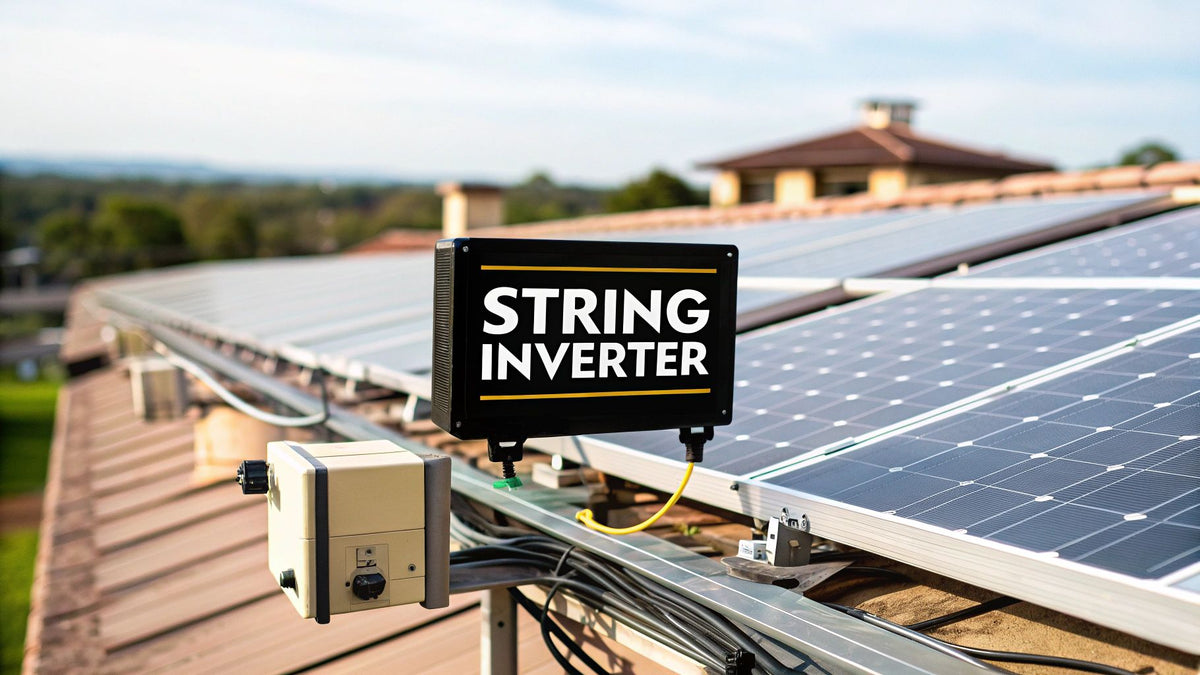
At its core, a string inverter is a centralized device that converts the direct current (DC) power produced by a series-connected group of solar panels—called a string—into usable alternating current (AC) power.
For solar professionals, the string inverter remains the workhorse of residential and commercial solar, valued for:
- Straightforward system design
- Proven long-term reliability
- Industry-leading cost effectiveness
The Core of Conventional Solar Design
For any installer, EPC, or developer, mastering string inverter systems is foundational.
This technology powered the early growth of the solar industry—and it continues to play a critical role in projects where speed, simplicity, and budget control matter most.
While module-level power electronics (MLPE) have expanded design flexibility, string inverters are far from obsolete. Understanding when—and how—to deploy them is essential for maintaining project profitability and long-term reliability.
Market Snapshot
- 40%+ global market share
- USD 17.6B market value (2024)
- Strong adoption across residential and commercial sectors
This is not legacy technology—it’s proven infrastructure that continues to evolve.
String Inverters at a Glance (For Project Planning)
| Attribute | Description |
|---|---|
| Technology | Centralized DC-to-AC conversion for series-connected modules |
| Best-Fit Projects | Unshaded residential roofs, uniform commercial rooftops, ground mounts |
| Cost Profile | Lowest upfront cost per watt |
| Key Advantage | Simple installation, single service point |
| Primary Limitation | Output limited by weakest panel in the string |
| NEC Considerations | Requires rapid shutdown solutions and careful voltage sizing |
How String Inverters Work in a PV System
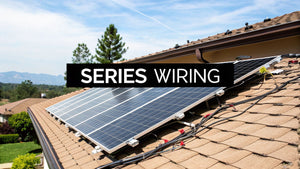
Solar panels are wired in series, increasing voltage to a level the inverter can efficiently process. All DC power flows to a central inverter, typically wall-mounted near the main service panel.
There, DC is converted into grid-compliant AC power for on-site use or export.
The Role of Maximum Power Point Tracking (MPPT)
Every modern string inverter includes one or more MPPTs (Maximum Power Point Trackers). MPPTs continuously adjust voltage and current to extract the maximum possible power from the array under changing conditions.
⚠️ Critical Limitation: The Weakest-Link Effect
Because MPPTs view the entire string as one unit, a single shaded or underperforming module can reduce output across the whole string.
Avoid these common mistakes:
- Mixing orientations on one MPPT
- Combining shaded and unshaded modules
- Ignoring soiling or obstruction risks
Design Best Practices to Maximize Performance
Smart design is non-negotiable for high-performance string inverter systems.
Best Practices Checklist
- Uniform orientation & tilt per string
- Full shade analysis during design
- Multiple MPPT utilization for east/west or multi-plane roofs
When done correctly, string inverters deliver exceptional efficiency at unmatched value.
Comparing Inverter Technologies
Choosing the right inverter directly affects CapEx, energy yield, and long-term O&M costs.
Technology Comparison
| Feature | String Inverter | Microinverter | Power Optimizer |
|---|---|---|---|
| Upfront Cost | Lowest | Highest | Moderate |
| Shade Tolerance | Low | Excellent | Excellent |
| Monitoring | System-level | Module-level | Module-level |
| Maintenance | Centralized | Rooftop | Rooftop |
| NEC Compliance | Add-ons required | Built-in | Built-in |
Best Applications for String Inverters
Residential
- Large, unshaded roof planes
- Single orientation
- Budget-sensitive homeowners
Commercial & Utility-Scale
- Uniform rooftops and ground mounts
- Solar carports
- Distributed inverter architecture for redundancy
Using multiple string inverters instead of one central inverter improves uptime and reduces revenue risk.
Sizing & Installation Best Practices (NEC-Critical)
DC-to-AC Ratio (ILR)
- Recommended: 1.15 – 1.25
- Maximizes annual energy harvest
Mandatory Calculations
- Maximum string voltage (cold weather Voc)
- Maximum string current (Isc adjusted)
Pre-Installation Site Checklist
- Structural integrity of mounting surface
- Adequate ventilation & clearances
- Safe service access
- Minimized wire runs
How PES Supply Supports Your Projects
We’re more than a distributor—we’re a project partner.
What We Provide
- Tier-1 inverter inventory (Fronius, Sungrow, SMA)
- Bundled logistics & job-site delivery
- NABCEP-certified design review
- Contractor matching via PowerLink
Frequently Asked Questions
How many panels per string inverter?
Determined by voltage and current limits, not a fixed panel count.
Can I add batteries?
Not directly. Requires AC-coupled storage or a hybrid inverter.
What happens if one panel is shaded?
The entire string output is reduced—known as the Christmas Light Effect.
Final Takeaway
String inverters remain a cornerstone of cost-effective solar design when applied correctly. With proper sizing, layout, and NEC-compliant engineering, they deliver unmatched ROI and long-term reliability.
At PES Supply, we provide the inventory, expertise, and support to help you execute with confidence.
Related Resources:
- Best Solar Panels 2026 — Buyer's Guide
- EG4 vs Tesla Powerwall
- Qcells vs Trina vs JA
- Solar Inverter Buyer's Guide
- Solar Battery Buyer's Guide
- 5kW Solar Kit
- 10kW Solar + Battery Kit
- Off-Grid Cabin Kit
- EG4 Batteries
- Qcells Solar Panels
- Trina Solar
- JA Solar
- REC Solar
- Mission Solar
- Sol-Ark Inverters
- SolarEdge Inverters
- Generac PWRcell
Calculate how much storage you need with our battery sizing calculator.
Use our free solar system calculator to size your array.
Check out our Solar Panel Comparison Tool. Check out our Inverter Sizing Calculator.
Calculate your solar payback and 25-year savings with our Solar ROI Calculator. Follow our complete DIY solar installation guide for step-by-step instructions. Keep your system running at peak performance with our Solar Maintenance Guide.
Related Products


SMA Solar Sunny Highpower Peak3 (SHP 150-US-20) NEW PRODUCT 150KV 1500V String Inverter - 3-150-1500-2-20
ViewRelated Resources
- Solar System Calculator
- Battery Sizing Calculator
- Solar Panel Comparison Tool
- Inverter Sizing Calculator
- Solar ROI Calculator
- Solar Installation Guide
- Solar Maintenance Guide
- Solar Permitting Guide
- Battery Installation Guide
- NEC Code Compliance Guide
- Solar Panel Mounting Guide
- Grounding & Bonding Guide
- Solar Incentives by State
- Pro Account — Wholesale Pricing
- PowerLink Network — Contractor Program