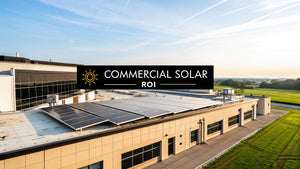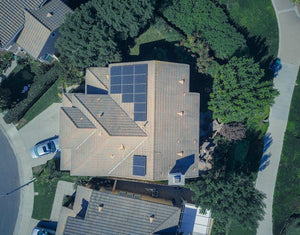
For any commercial solar project, the initial numbers can seem daunting. A typical system costs between $1.80 to $2.60 per watt before incentives. For a standard 100 kW system, that's a gross price of $180,000 to $260,000. But this number is just a starting point.
This guide provides actionable, up-to-date solutions for installers, EPCs, and facility managers navigating commercial solar procurement. We will break down the real-world costs, reveal how incentives can slash your net investment by up to 60%, and provide a clear framework for making smart, profitable decisions. You'll walk away knowing how to calculate the true cost and ROI of your next project.
Decoding Your Initial Investment in Solar
Getting a handle on the true cost of a commercial solar project means looking past that initial number. The gross cost is just a baseline—it’s the net investment that really matters. That’s the number you're left with after you factor in all the tax credits, depreciation benefits, and local rebates available.
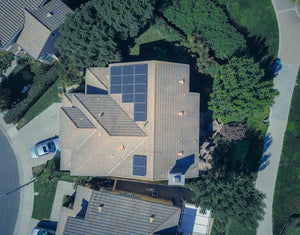
The structure holding up your panels is a big part of the equation, too. The condition and type of your roof play a direct role in the final project cost. Getting familiar with a good metal roof installation cost guide can help you budget for that piece of the puzzle, ensuring there are no surprises down the road.
Baseline Commercial Solar Costs
As we head into 2025, that $1.80 to $2.60 per watt range is a solid benchmark for initial quotes. For a 100 kW system—a common size for a medium-sized business, warehouse, or farm—the gross cost falls somewhere between $180,000 and $260,000.
Again, it's critical to remember that this isn't the final check you'll write. Thanks to some fantastic federal and state programs, your actual out-of-pocket cost will be significantly lower. You can get a deeper dive into these numbers in this 2025 commercial solar costs breakdown on brighteyesolar.com.
To give you a better feel for how these costs scale with different business sizes, let's look at a few common scenarios.
Estimated Commercial Solar Costs Before Incentives
This table gives you a quick snapshot of what to expect for the gross cost based on your facility's needs. Think of this as the "before" picture—we'll get to the "after" in a bit.
| Commercial Application | Typical System Size (kW) | Estimated Gross Cost Range |
|---|---|---|
| Small Retail or Office | 50 kW | $90,000 – $130,000 |
| Medium Warehouse/Mfg | 100 kW | $180,000 – $260,000 |
| Large Commercial Rooftop | 250 kW | $450,000 – $650,000 |
These figures are just the starting point. The real magic happens when you start applying the incentives designed to make solar an easy decision for businesses.
The Bigger Picture: Your Net Investment
Facility managers and business owners need to burn this into their minds: the numbers in that table are almost never what you actually pay. The U.S. has put some incredibly powerful financial tools in place to encourage businesses to go solar.
The biggest game-changer is the federal Investment Tax Credit (ITC). This alone can slash a huge chunk off the system's cost right from the get-go. Combine that with accelerated depreciation (MACRS), and you can often see your net cost drop by 40-60% compared to the gross price.
Understanding this difference is everything when building the business case for solar. Throughout this guide, we’ll pull back the curtain on every single cost component—from the hardware itself to labor, permits, and financing—to give you a crystal-clear view of what you’ll really invest and what you’ll get back.
Breaking Down Your Commercial Solar Quote
When a commercial solar quote lands on your desk, it’s never just a single price-per-watt figure. It’s a complex puzzle of hardware, logistics, and services that all add up to your final investment. For any facility manager, EPC, or developer, knowing how to read between the lines is the first step toward a smart procurement decision.
Think of the total cost as a sum of its parts. Each of those parts is a lever you can pull to optimize the entire project. While the panels and hardware are the most obvious costs, the project's real-world success—and its appeal to investors—hinges just as much on the incentives that slash that initial price tag.
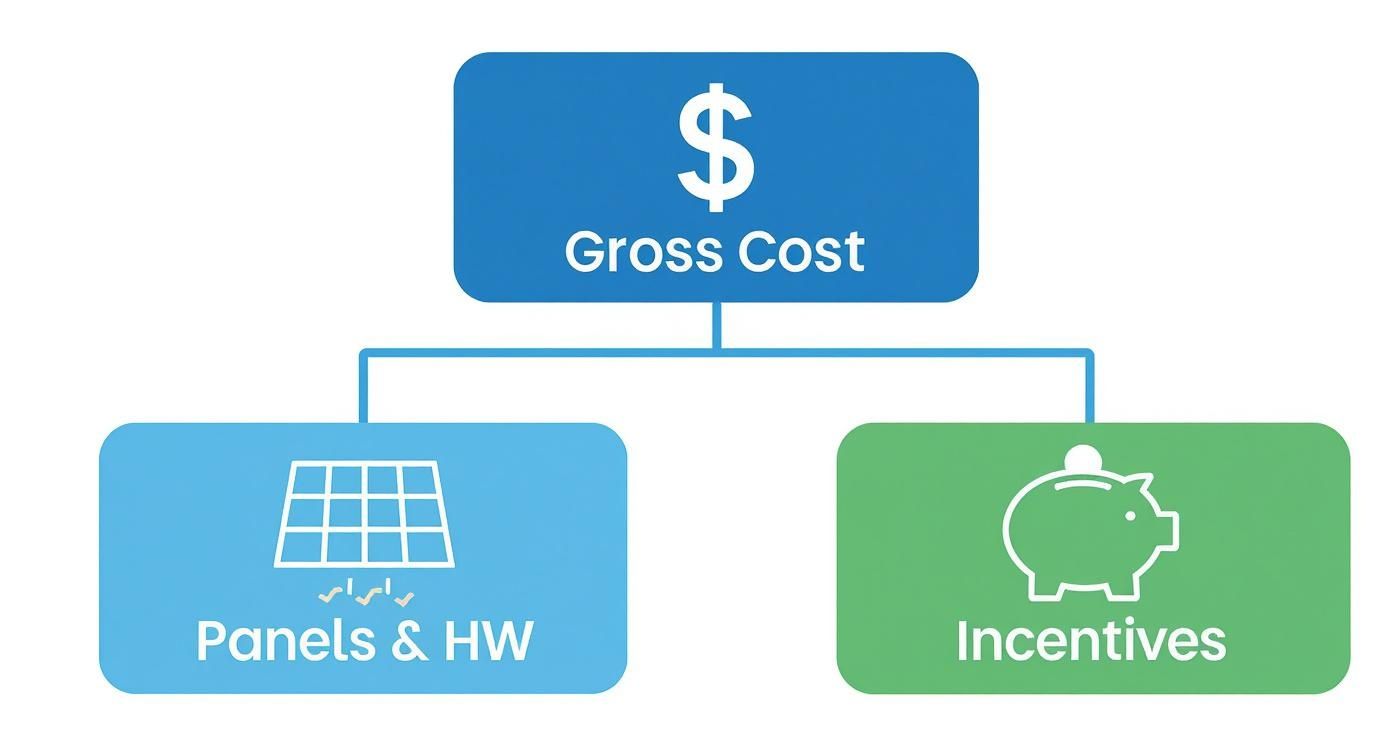
This gives you a clear picture of the two forces at work here: the gross cost driven by all the physical gear, and the powerful downward pressure from financial incentives that gets you to your true net investment.
Core Hardware: The Big Three Components
Every commercial solar project, no matter the size, is built on a foundation of three critical hardware categories. The solar panels get all the glory, but the inverter and the Balance of System (BOS) components are the unsung heroes that dictate performance, safety, and long-term reliability. Getting these procurement calls right is absolutely essential.
- Solar Panels (Modules): This is the face of your system. Panel costs swing based on efficiency, power density, and the manufacturer's reputation. The choice you make here is a constant balancing act between upfront cost, long-term energy yield, and the strength of the warranty backing it up.
- Inverters: You can think of the inverter as the "brains" of the operation. It’s the device that converts the DC power coming off the panels into the usable AC power that runs your facility. Whether you go with a string, micro, or central inverter will come down to the system's scale, site-specific issues like shading, and how granular you want your monitoring to be.
- Balance of System (BOS): This is the catch-all term for everything else required to bring the system to life. We're talking about the racking that holds the panels, all the wiring and conduit, combiner boxes, and crucial safety disconnects. While the individual costs might seem small, they add up fast and are non-negotiable for a safe, code-compliant installation.
A great way to get a handle on all the pieces involved is to review a detailed Solar PV Components Guide, which can help demystify the material costs itemized in your quote.
To give you a clearer picture of where the money goes, here's a typical breakdown for a commercial project.
Commercial Solar Project Cost Breakdown
This table provides a high-level view of how costs are typically allocated across a commercial solar project. Notice how hardware, while significant, is only part of the story; soft costs like labor and permitting make up a huge chunk of the budget.
| Cost Component | Percentage of Total Project Cost (Approx.) | Key Considerations for Procurement |
|---|---|---|
| Solar Panels (Modules) | 25% - 35% | Tier 1 status, efficiency, warranty, and degradation rate are critical. |
| Inverters | 5% - 10% | Match inverter type to site conditions; consider brand bankability. |
| Balance of System (BOS) | 10% - 15% | Don't skimp on quality racking and electricals; it's a safety issue. |
| Labor & Installation | 15% - 20% | Experienced, certified installers reduce risk and ensure quality. |
| Permitting & Inspection | 5% - 10% | Varies widely by jurisdiction; experienced partners can navigate this. |
| Engineering & Design | 5% - 8% | Proper design maximizes output and ensures structural integrity. |
| Overhead & Profit | 10% - 15% | Covers the installer's operational costs and margin. |
Understanding this allocation helps you ask the right questions and identify areas where you can find potential savings without sacrificing quality or long-term performance.
Tier 1 Brands vs. The Field
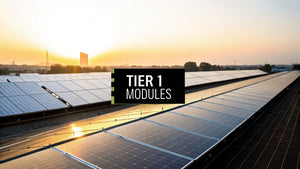
As you start looking at specific panels and inverters, you'll see the term "Tier 1" pop up constantly. This isn't just a marketing buzzword. It's a crucial designation from research firms like BloombergNEF that signals a manufacturer's financial health and production quality. Big names like BYD and Sungrow consistently make this list because they have a proven history of performance and are considered "bankable" by project financiers.
Going with Tier 1 equipment might mean a slightly higher upfront cost, but what you're really buying is peace of mind. Financiers are far more comfortable backing projects built with these components because they trust the warranties will actually be honored over the system's 25- to 30-year lifespan.
Expert Tip for Procurement Managers: While Tier 1 status is a great starting point, always dig into the details. Verify the specific model numbers and read the warranty documents carefully. A good distributor, like PES Supply, can provide the spec sheets and compliance paperwork you need to ensure the gear you're quoting meets every single project and financing requirement.
Hidden Costs Every Project Manager Must Anticipate
Beyond the big-ticket hardware items, a number of "hidden" costs can sneak up on you—things that aren't always clearly itemized on an initial proposal. A savvy project manager or developer plans for these from day one to keep the budget and timeline from spiraling out of control.
Compliance Watchout: Common Hidden Costs
- Structural Engineering Assessments: Your roof wasn't designed to hold a solar array. You'll need a structural engineer to sign off on its ability to handle the extra weight, which is a key step for permitting and can cost several thousand dollars.
- Switchgear and Panel Upgrades: If your facility is older, its electrical infrastructure might not be up to the task of interconnecting with a modern solar system. This could mean costly upgrades to panelboards, transformers, or switchgear—a major expense you didn't see coming.
- Interconnection Fees: Your local utility doesn't just let you plug in for free. They charge fees to study how your system will impact their grid and to formally approve the connection. These costs can vary dramatically depending on where you are.
- Permitting Delays: This isn't a direct line item, but time is money. Unexpected delays in the permitting process can drive up labor and financing costs, throwing your entire project schedule and budget off track.
How Soft Costs and Labor Influence Your Final Price
The hardware gets all the attention, but it’s the “soft costs”—all the essential services and behind-the-scenes work—that really drive the final price of a commercial solar project. These intangibles can easily swallow over 50% of a project's total budget.
For installers and business owners alike, getting a handle on these costs is the difference between a profitable project and an expensive headache. This is where a seasoned project partner proves their worth.
Unlike a solar panel with a clear price tag, soft costs are fluid. They’re shaped by the unique details of your project and the specific rules of your region, covering everything from the first blueprint to the final inspection.
Engineering and Permitting Complexities
Long before a single panel gets hoisted onto the roof, a mountain of prep work has to happen. This foundational phase is non-negotiable for a safe, legal, and effective system.
-
System Design and Engineering: This isn't a back-of-the-napkin sketch. A NABCEP-certified engineer has to draft detailed plans that account for structural loads, electrical safety, and squeezing every possible watt out of your array. It's a comprehensive blueprint ensuring your system is built to last and meets all National Electrical Code (NEC) standards.
-
Permitting Fees: Every town, county, and city has its own rulebook and fee schedule. Navigating the red tape of different Authorities Having Jurisdiction (AHJs) is a job in itself. Getting it wrong can lead to major, costly delays.
-
Utility Interconnection: You can't just plug a commercial solar array into the grid. It’s a formal process with applications, grid impact studies, and sometimes, expensive equipment upgrades demanded by the utility company. These costs can be a nasty surprise if you don't plan for them.
For Commercial Developers: Don't underestimate the domino effect of permitting and interconnection. A delay of just a few weeks can mess up your labor schedule, increase financing costs, and torpedo your project's ROI. Partnering with a distributor who offers compliance support can take a lot of that risk off the table.
The Impact of Labor and Site Conditions
The physical install is where the rubber meets the roof. Labor is a huge cost driver, fluctuating based on regional wages, the crew's experience, and whether you need specialized pros with certifications like NABCEP. A sharp, well-trained crew works faster and safer, preventing mistakes that lead to rework.
But it’s not just about the people—it's about the place. The unique characteristics of your site play a massive role in the final bill.
Project-Specific Cost Factors
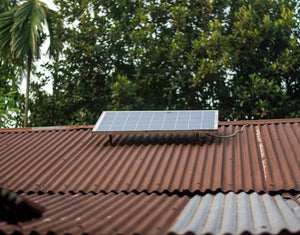
- Roof Type and Condition: Throwing panels on a flat membrane roof is a completely different ballgame than working on a steep, standing-seam metal roof. If the roof is old, it might need structural upgrades just to handle the weight of the array, adding an unexpected line item to the budget.
- Site Accessibility: A wide-open field is an installer’s dream. A five-story building in a cramped downtown core? That means cranes, logistical gymnastics, and higher labor costs to match.
- Regional Labor Markets: The going rate for a certified electrician in California isn't the same as it is in Texas. These prevailing wages directly impact your installation costs.
Every one of these variables has to be sized up during an initial site survey to build a quote you can actually count on.
Pro Tip: Reduce Soft Costs with Smart Procurement
One of the best ways to get a grip on soft costs is by streamlining how you buy and manage materials. When you get everything—panels, inverters, racking, and all the BOS—from a single-source distributor like PES Supply, you cut down on project management overhead. Bundled freight means fewer logistical headaches and less time paying your crew to wait for a truck to show up. That efficiency goes straight to your bottom line.
Maximizing Your ROI Through Incentives and Tax Credits
The gross price tag on a commercial solar quote is just a starting point. It's the number before the real magic happens. This is where a smart project turns into a brilliant investment, all thanks to a savvy strategy of layering financial incentives that can slash the net cost of your system.
For any developer, facility manager, or business owner, getting a handle on these programs isn't just a good idea—it's essential. These incentives are specifically designed to make the financial case for solar impossible to ignore, shrinking your upfront costs, speeding up your payback period, and seriously boosting your overall return.
The Federal Investment Tax Credit (ITC)
The heavyweight champion of solar incentives is, without a doubt, the federal Investment Tax Credit (ITC). This isn't just a deduction that lowers your taxable income; it's a dollar-for-dollar credit that directly reduces what you owe the IRS, making it incredibly powerful.
For commercial solar projects, the baseline credit is a massive 30% of the total project cost. That immediately carves out a huge chunk of your investment. If your system has a gross cost of $250,000, the ITC hands you a $75,000 credit, bringing your effective cost down to $175,000 right off the bat.
For Project Developers & EPCs: The ITC also features several "adders" or "bonus credits" for projects hitting specific benchmarks, like using domestic content or being located in a designated energy community. Stacking these can push the credit to 40%, 50%, or even higher, making your project's financials look that much better to investors.
Accelerated Depreciation (MACRS)
Right behind the ITC is another powerful financial tool: accelerated depreciation. Under the Modified Accelerated Cost Recovery System (MACRS), your business can write off the value of your solar investment on an aggressive five-year schedule.
This creates a substantial tax shield by letting you deduct a huge portion of the system's value from your taxable income each year. The result? Better cash flow during those critical first few years when you're recouping your initial outlay. When you combine MACRS with the ITC, the financial model for going solar becomes almost unbeatable. If you're weighing different financing options, it's crucial to know how these benefits play out; you can dive deeper into how equipment leasing affects tax benefits in our detailed guide.
State and Local Incentives
While federal programs lay the groundwork, state and local incentives add another lucrative layer of savings. These programs are all over the map depending on your location, but they can dramatically improve a project's bottom line.
Common State-Level Incentives Include:
- Rebates: Many states offer straightforward cash rebates, often calculated per watt, to knock down the upfront cost even further.
- Performance-Based Incentives (PBIs): Programs like Solar Renewable Energy Credits (SRECs) actually pay you for the clean power your system produces. This creates a new, ongoing revenue stream that juices your ROI.
- Property and Sales Tax Exemptions: Some states will exempt your solar array's value from property taxes and waive sales tax on the equipment purchase, giving you more savings right away.
Successfully navigating this patchwork of programs takes real expertise. Working with a partner like PES Supply ensures your project is designed and documented to capture every last incentive dollar available—a critical step for hitting your financial targets.
Recent data shows just how powerful this incentive-stacking can be. Numbers from 2025 show that the initial cost for commercial solar systems can range from $140,000 to over $500,000, depending heavily on size and hardware. A 50 kW system might start around $141,700, while a 200 kW system could top $430,600. But after applying federal tax credits and depreciation, those costs can get cut in half. For instance, a 100 kW system can drop from a $238,600 sticker price to an effective cost of just $114,147. You can discover more insights on these post-incentive costs on paradisesolarenergy.com.
Calculating Your Payback Period and Long-Term Value
A solar investment isn't just about the initial price tag—it’s about its long-term financial performance. This is where we stop talking about the cost of commercial solar panels and start talking about lifetime value. For any EPC, developer, or facility manager, building a strong business case means looking past the upfront check you have to write and focusing on the decades of returns that will follow.
The heart of the analysis is simple: how fast does the system pay for itself, and how much money does it make over its 25- to 30-year lifespan? Three key metrics will give you a crystal-clear picture of your project's financial health.
Key Financial Metrics for Solar Projects
To build a case that gets a "yes," you need to speak the language of finance. These three calculations are the bedrock of any solid proposal. They show exactly how and when your solar investment delivers.
-
Simple Payback Period: This one is as straightforward as it gets. It’s the total time it takes for your energy savings and incentive income to add up and equal your net investment. A shorter payback is always better—it means a faster return and less risk.
-
Internal Rate of Return (IRR): A more sophisticated metric, IRR gives you the annualized rate of return your solar project is expected to generate. It’s the perfect tool for comparing a solar investment against other ways you could spend that capital.
-
Levelized Cost of Energy (LCOE): This metric boils it all down to the average cost per kilowatt-hour (kWh) your system will produce over its entire life. It gives you a true apples-to-apples comparison between your solar power and the price you're paying the utility company.
A Real-World Payback Example
Let's make this real. We'll run the numbers for a common 100 kW system.
Imagine a system with a net cost of $115,000 after you’ve claimed all tax credits and incentives. This system saves the business $20,000 a year on its power bills. On top of that, it pulls in another $3,000 a year from Solar Renewable Energy Credit (SREC) sales.
The simple payback formula looks like this: Net Cost / (Annual Savings + SREC Income)
$115,000 / ($20,000 + $3,000) = 5 years
After just five years, the system has completely paid for itself. For the next 20-25 years, every dollar saved and every SREC sold is pure profit. That long-term value creation is what makes a solar investment so powerful, especially when policies like net metering accelerate savings. You can get the full rundown in our guide to what net energy metering is and how it works.
Comparing Financing Options
Not every business has the cash on hand for a large capital purchase. That’s okay. There are several financing models out there that make solar accessible, and each one changes the ownership and return structure.
| Financing Option | How It Works | Best For |
|---|---|---|
| Cash Purchase/Loan | You own the system outright, paying with cash or a standard loan. | Businesses who want to maximize ROI and directly capture every tax credit, depreciation bonus, and cent of energy savings. |
| Solar Lease | A third party owns and maintains the system on your roof; you just pay a fixed monthly fee for the power. | Companies with limited capital or tax appetite who want predictable, lower energy bills without the hassle of ownership. |
| Power Purchase Agreement (PPA) | Similar to a lease, but you pay a pre-negotiated rate per kWh for the actual energy the system generates. | Large energy users like schools or municipalities looking for long-term price certainty with zero upfront cost. |
This kind of financial flexibility, combined with plummeting hardware costs, is making commercial solar a no-brainer for more businesses than ever. Over the past decade, we've watched the cost of commercial solar installations fall steadily. Back around 2013, you were looking at costs north of $4.00 per watt.
Fast forward to 2023, and that figure has dropped dramatically, with typical pre-incentive prices landing between $1.83 and $3.50 per watt. After incentives, you're often in the $1.20 to $1.75 per watt range. This consistent cost reduction is the single biggest driver behind the explosion in commercial solar adoption.
Finding the Right Partner for Your Solar Project
You can have the most dialed-in financial model and the best hardware on the market, but none of it matters if the people executing your project aren't up to snuff. Getting the best possible outcome—from cost and timeline to the system's long-term performance—boils down to choosing the right installer, EPC, and equipment distributor.
This final step is arguably the most critical. It’s where you manage the most risk and truly lock in your return on investment.
A great partner doesn't just sell you panels and parts; they give you a strategic advantage that pays dividends through every single phase of the project.
Vetting Your Installation and EPC Partners
Think of your installer or EPC as your frontline team. Their real-world expertise—or lack of it—will show up directly in your project's final quality and cost. When you’re evaluating potential partners, your checklist needs to be rigorous and focused on what they've actually done.
Don't even consider a team without these qualifications:
- NABCEP Certification: This is the gold standard for solar pros in the U.S. Make sure the key people on the team hold certifications from the North American Board of Certified Energy Practitioners.
- Proven Project Portfolio: Ask to see their work. You want to look at case studies for commercial projects that are similar in size and scope to yours. A solid portfolio proves they have real-world experience, not just textbook knowledge.
- Financial Stability and Insurance: You need to verify their financial health. Just as important, make sure they carry proper liability and workers' compensation insurance. This is what protects your investment if something unexpected happens.
The Distributor's Role in Project Success
Beyond the crew on the roof, your equipment distributor is a silent but incredibly powerful partner. A top-tier distributor does a lot more than just move boxes from a warehouse. They are the logistics and compliance backbone of your project, and a good one will directly slash your soft costs and eliminate friction.
This is exactly where a partner like PES Supply brings immense value to the table.
A trusted distributor should offer more than just a catalog. They provide in-house design and compliance support to ensure your plans meet all local codes and incentive requirements, heading off costly permitting delays before they happen. This expertise is a critical part of a successful project.
A huge benefit here is supply chain reliability. Having in-stock Tier 1 inventory from trusted brands like Sungrow and FranklinWH means your project won't get held hostage by some far-off manufacturing delay.
On top of that, smart services like bundled freight consolidate all your shipments, cutting down on logistical headaches and costs. It ensures everything you need arrives on-site, together and on time.
Choosing a partner who can provide this level of integrated support simplifies the entire procurement process, minimizes your risk, and ultimately keeps your project on budget. To see how we can de-risk your next project, contact one of our experts today.
Frequently Asked Questions
Let's tackle the questions we hear most often from business owners, developers, and facility managers. These are the practical, real-world concerns that come up on just about every project.
How Much Do Commercial Solar Panels Cost Per Month?
This one's a classic "it depends" answer, and it all comes down to your financing.
If you buy the system with a loan, your "monthly cost" is simply your loan payment. A well-structured deal will set this payment lower than your old utility bill, putting cash back in your pocket from day one.
The other route is a Power Purchase Agreement (PPA) or a solar lease. With these, you pay a fixed monthly rate to a third party that owns the system on your roof. The big appeal here? Zero upfront cost to get started.
Do Solar Panels Require a Lot of Maintenance?
Honestly, not really. Compared to almost any other major piece of equipment on your property, solar panels are remarkably hands-off.
The most you'll typically do is an occasional cleaning to wash off dust and grime that might slightly ding your production. For most sites, a good rainstorm does the job just fine.
Otherwise, a quick annual inspection of the wiring and connections is a good idea. The only significant component you'll likely replace over the system's 25- to 30-year life is the inverter, which usually comes with a 10 to 15-year warranty anyway.
Can My Roof Support the Weight of Solar Panels?
This is the big one, and it's a non-negotiable first step. Before a single panel goes up, you need a structural engineer to give the green light.
The good news is that most modern commercial roofs are over-engineered and can easily handle the load. A typical solar array only adds about 2-4 pounds per square foot, which is surprisingly light.
But you can't just assume. An engineer has to perform a full structural assessment to confirm the roof's capacity and make sure everything is up to code. It’s a must-do for safety and for getting your permits approved.
How Does System Size Impact the Cost Per Watt?
This is where economies of scale really kick in. Simply put, bigger is cheaper (on a per-watt basis).
All those soft costs we talked about—engineering, permits, getting the crew to the site—are spread out over more kilowatts on a larger project. The fixed cost to design a 500 kW system isn't ten times the cost of designing a 50 kW system.
That's why developers and large facility owners often get the most competitive pricing. The more watts you install, the more you dilute those fixed project costs, driving down your all-in price per watt.
Ready to get a clear, actionable quote for your project that accounts for every variable? The experts at PES Supply can provide a detailed bill of materials and connect you with certified installers to ensure your project is a financial success from day one. Request a Bulk Quote today.
Related Resources:
- Best Solar Panels 2026 — Buyer's Guide
- EG4 vs Tesla Powerwall
- Qcells vs Trina vs JA
- Solar Inverter Buyer's Guide
- Solar Battery Buyer's Guide
- 5kW Solar Kit
- 10kW Solar + Battery Kit
- Off-Grid Cabin Kit
- EG4 Batteries
- Qcells Solar Panels
- Trina Solar
- JA Solar
- REC Solar
- Mission Solar
- Sol-Ark Inverters
- SolarEdge Inverters
- Generac PWRcell
Calculate how much storage you need with our battery sizing calculator.
Check solar incentives available in your state.
Use our free solar system calculator to size your array.
Check out our Solar Panel Comparison Tool. Check out our Inverter Sizing Calculator.
Calculate your solar payback and 25-year savings with our Solar ROI Calculator. Follow our complete DIY solar installation guide for step-by-step instructions. Keep your system running at peak performance with our Solar Maintenance Guide.
Related Resources
- Solar System Calculator
- Battery Sizing Calculator
- Solar Panel Comparison Tool
- Inverter Sizing Calculator
- Solar ROI Calculator
- Solar Installation Guide
- Solar Maintenance Guide
- Solar Permitting Guide
- Battery Installation Guide
- NEC Code Compliance Guide
- Solar Panel Mounting Guide
- Grounding & Bonding Guide
- Solar Incentives by State
- Pro Account — Wholesale Pricing
- PowerLink Network — Contractor Program