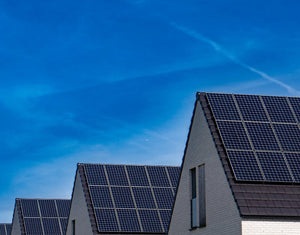
Installing a solar panel commercial building system is a strategic financial decision, not just an environmental one. For facility managers, developers, and building owners, this guide provides an actionable playbook for turning an underutilized rooftop into a profit center that slashes operating costs, boosts property value, and locks in predictable energy rates for decades. This is your roadmap to de-risking the project and maximizing financial returns.
We will cover the critical stages: from initial feasibility and high-performance system design to navigating incentives, permitting, and long-term asset management.
Your Blueprint for Commercial Solar Success
For any facility manager, building owner, or developer, this is a business decision first and foremost. You're moving your property from being just another energy customer to a power producer. This gives you a serious advantage against unpredictable utility rates and makes your operations far more resilient.
Getting to a profitable solar investment requires a clear, step-by-step approach. It's about lining up the financial goals with the technical reality on the ground. This ensures everyone, from the finance team to the C-suite, is on the same page about the scope, timeline, and payoff.
Here’s a look at the typical project lifecycle from start to finish.
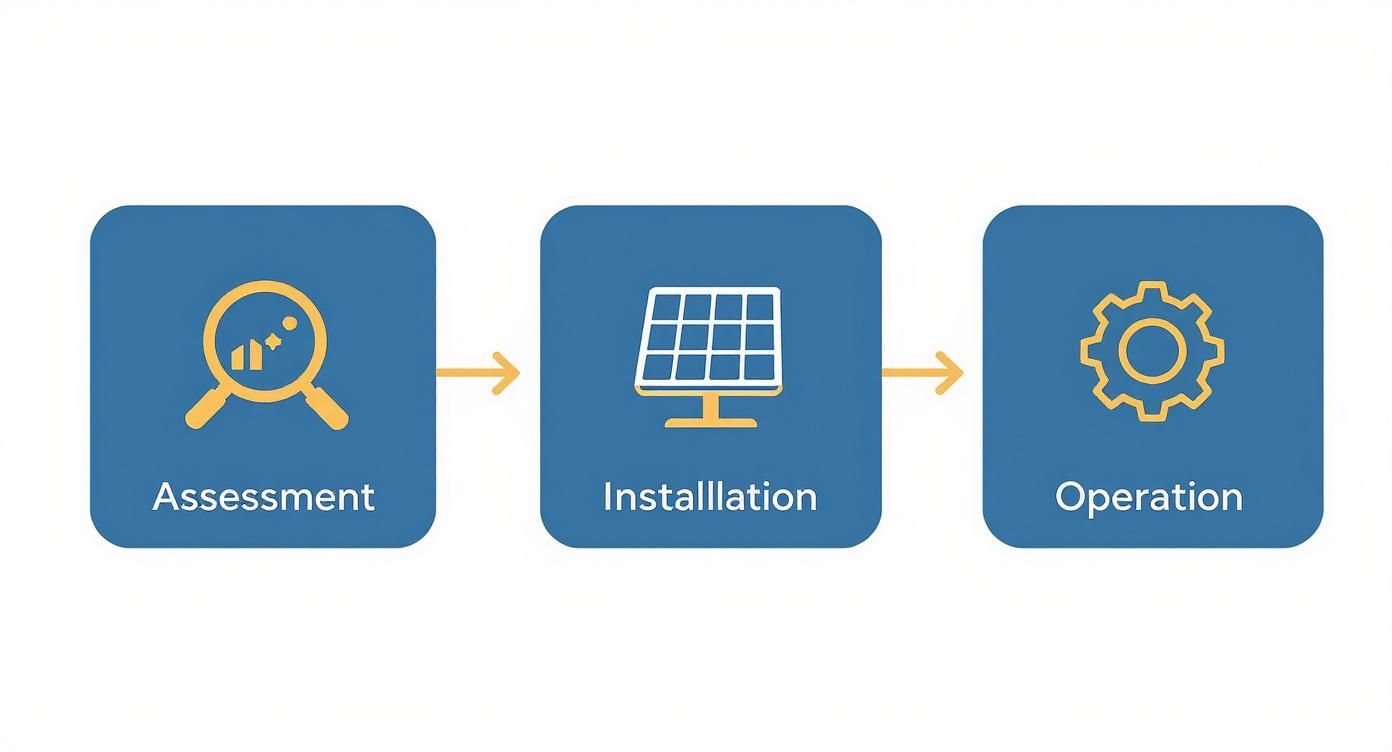
This workflow shows how a project moves from the initial number-crunching and site assessment all the way through installation and long-term performance monitoring—which is absolutely critical for getting the best ROI.
A commercial solar project is a major capital improvement, but a smart one. To help you map out the journey, we've broken down the major stages of a typical installation.
Key Phases of a Commercial Solar Project
This table outlines the high-level stages involved, from the first conversation to decades of operation.
| Project Phase | Key Objective | Primary Stakeholders |
|---|---|---|
| Feasibility & Assessment | Determine if solar is a viable and profitable investment for the property. | Building Owner, Facility Manager, Solar Consultant |
| Design & Engineering | Create detailed system blueprints tailored to the building’s structure and energy needs. | Engineers, Project Manager, Architect |
| Financing & Permitting | Secure project funding and all necessary approvals from local authorities and utilities. | CFO/Finance Team, Legal Counsel, Permitting Specialists |
| Procurement & Installation | Source all equipment and manage the physical construction and grid connection. | General Contractor, Electricians, Installation Crew |
| Commissioning & Operation | Test the system, bring it online, and establish ongoing monitoring and maintenance. | Operations Team, Asset Manager, Maintenance Technicians |
Each of these phases has its own set of challenges and milestones, but a well-managed project moves through them smoothly to deliver a high-performing asset.
Framing the Strategic Value
When you look at solar as a capital upgrade, the benefits go way beyond the monthly electric bill. A properly designed system delivers value across the board:
- Boosts Net Operating Income (NOI): Energy is one of the biggest variable expenses for any commercial building. Cutting it drastically sends profits straight to the bottom line.
- Increases Property Value: A building that generates its own power is a more valuable, modern, and attractive asset for potential tenants and buyers.
- Hits Corporate ESG Targets: It’s a powerful, visible way to show your commitment to sustainability, which is increasingly important to investors and customers.
- Future-Proofs Your Asset: With the rise of commercial EV charging and overall electrification, you’ll be ready for the increased power demands of tomorrow.
The Momentum Is Building
The market is clearly catching on. The push for solar panels on commercial buildings is stronger than ever, thanks to better technology and serious corporate sustainability goals. Projections show that at least 7.1 GWdc of new commercial solar is coming online soon, with a potential for up to 500 GWdc over the next decade.
This boom is being supercharged by the integration of battery storage, the growing need for EV infrastructure, and the corporate race to hit net-zero targets. In the U.S., commercial solar installations are breaking records as businesses move to lock in lower costs and control their energy destiny. You can discover more insights about the surge in commercial solar installations here.
This guide is your playbook. We’ll walk you through the details of system design, financing, compliance, and long-term operations to make sure your project delivers maximum value from day one.
Designing Your High-Performance Commercial Solar System
Turning a great idea into a high-performing asset comes down to a sharp, data-driven design process. For the engineers, EPCs, and procurement officers managing a solar panel commercial building project, this is where the financial model gets real. Getting the technical decisions right long before the first panel hits the roof is what separates a successful project from a costly one.
It all starts with a thorough site assessment. This isn't just about measuring roof space; it’s a deep dive into the building's bones, its electrical system, and the surrounding environment. This evaluation is the bedrock of a design that will perform for decades.
The Essential Site Assessment Checklist
Before a single component is ordered, you need a complete site assessment. This crucial step prevents expensive change orders down the road and guarantees the final design is a perfect fit for the property.
- Structural Integrity: A structural engineer must sign off on the roof's ability to handle the added weight of the solar array, racking, and any ballast—especially under worst-case snow and wind load scenarios.
- Roof Condition: What’s the age and condition of the roof membrane? It’s almost always smarter and cheaper to repair or replace a roof before putting a 25-year solar asset on top of it.
- Available Space & Shading: Get a detailed map of every obstruction—HVAC units, vents, skylights, you name it. A professional shade analysis is non-negotiable to pinpoint how trees or nearby buildings will impact energy production throughout the day and across the seasons.
- Electrical Infrastructure Review: Time to look inside the electrical room. You need to confirm the main service panel, transformers, and switchgear can handle a new power source being tied in. This review tells you exactly what, if any, electrical upgrades are needed.
- Interconnection Point: Find the cleanest, most cost-effective point to connect the solar system to both the building’s electrical panel and the utility grid.
Selecting the Right Core Components
With the site data locked in, it's time to choose the hardware. This is a game of trade-offs between raw performance, upfront cost, and long-term bankability. The decisions made here directly drive the system's energy yield and financial returns for the next 25-plus years.
For large-scale projects, the difference between equipment tiers is everything. For example, Tier 1 solar modules from large, bankable manufacturers like BYD or Sungrow are known for heavy R&D investment and automated production lines. This means better quality control and a warranty you can actually count on. Tier 2 modules might look cheaper on the quote, but they often come from smaller or newer companies, which introduces risk to long-term performance and support.
If you’re working on a larger project, our guide on industrial solar panels offers a deeper look into module selection.
The inverter—the brain of the whole operation—is the other major decision. The right choice depends entirely on the site layout and the project's financial goals.
For the Project Engineer: Choosing between central, string, and microinverters is a classic balancing act. Central inverters are the cheapest per watt and work great for massive, uniform roofs with zero shade. String inverters from brands like Fronius give you more design flexibility for complicated roofs. Microinverters will squeeze every last watt out of a site with serious shading or multiple roof angles, but they come with a higher price tag.
System Sizing and Performance Modeling
You can't hit your financial targets if you don't size the system right. This part of the process uses sophisticated software to build a digital twin of the system and accurately forecast its energy production.
- Analyze Energy Consumption: First, get your hands on at least 12-24 months of the building's utility bills. You need to see the hourly, daily, and seasonal energy patterns to establish the baseline for your design.
- Determine Project Goals: What's the mission? Are you trying to offset 100% of the building’s energy use? Or is the goal to maximize ROI by surgically targeting high-cost peak demand charges? The answer will dictate the final system size.
- Model Production: Using industry-standard tools like PVsyst, engineers model the system’s output. They plug in the exact panels and inverters, site-specific weather files, tilt, and orientation to generate the production estimates that the entire financial pro forma is built on.
Finally, every single commercial design must go through a NABCEP-certified design review. This is the final quality check. It ensures the plans are fully compliant with the NEC and all local codes, are optimized for peak performance, and are ready for the permitting office. It’s the step that de-risks the entire project before the first truck rolls out.
Navigating Incentives and Financing for Maximum ROI
For any developer or financial decision-maker, a solar panel commercial building project lives or dies by its financial strategy. The hardware is just one part of the puzzle. The other, arguably more important part, is structuring a deal that stacks incentives with the right financing to squeeze every drop of value out of the investment. Get this right, and you can slash the payback period and turn your roof into a serious financial asset.
The global solar market is booming as businesses chase energy independence and predictable costs. The industry was valued at around $189.5 billion and is on track to hit a staggering $607.8 billion by 2030, with commercial properties leading the charge. This incredible growth is supercharged by a whole ecosystem of financial perks designed to make solar a no-brainer.
Of course, the solar project's ROI is tied to the initial investment in the building itself. To get a handle on those numbers, you can find detailed guides on commercial metal building costs.
Unlocking Federal Tax Incentives
First things first: the federal government offers some heavy-hitting incentives that are the foundation of any commercial solar deal in the U.S. These are designed to take a huge bite out of the net cost of your system.
- The Investment Tax Credit (ITC): This is the big one. The ITC lets you deduct a massive chunk of your total project cost directly from your federal taxes. The base credit is 30%, which means you can effectively chop nearly a third off the sticker price from day one.
- Accelerated Depreciation (MACRS): The Modified Accelerated Cost-Recovery System (MACRS) is another powerful tool. It allows you to recover the cost of your solar asset through depreciation deductions. Right now, you can depreciate 80% of the system’s value in the very first year, giving you a huge, immediate tax benefit that frees up cash flow.
For the CFO: Think of the ITC and MACRS as a one-two punch. By claiming both, a company can claw back the majority of the solar system's cost within the first year through direct tax savings and deductions. It’s a game-changer for project economics.
State and Local Incentives
On top of the federal benefits, a whole patchwork of state, local, and even utility-specific programs can sweeten the pot even more. These vary wildly depending on where you are, but they often include things like grants, property tax exemptions, or performance-based incentives.
A popular example is Solar Renewable Energy Credits (SRECs). These are tradable credits your system earns just for producing clean energy, creating an entirely new revenue stream for your business.
Comparing Commercial Solar Financing Models
Choosing how to pay for the system is just as crucial as grabbing all the incentives. The right path depends entirely on your company’s capital, tax situation, and long-term goals. Each option strikes a different balance between risk, reward, and ownership.
As you weigh these options, getting a detailed look at commercial solar installation costs can help put the numbers into perspective.
Here’s a quick rundown of the most common financing models to help you decide which lane is right for you.
Comparing Commercial Solar Financing Models
| Financing Model | Upfront Cost | Incentive Ownership | Best For |
|---|---|---|---|
| Direct Purchase (Cash or Loan) | High | You own all tax credits, depreciation, and energy savings. | Companies with available capital and a significant tax liability to offset. |
| Solar Lease | Low to None | The third-party owner claims all incentives. | Businesses seeking predictable, low monthly payments without the responsibility of ownership. |
| Power Purchase Agreement (PPA) | None | The third-party owner claims all incentives. | Tax-exempt entities (like non-profits or schools) or companies focused on a low, fixed electricity rate. |
With a direct purchase, you keep all the financial upside—the tax credits, the depreciation, the energy savings. It delivers the maximum ROI, but it also requires a significant upfront investment.
A solar lease is a lot like renting a car. You pay a fixed monthly fee to use the equipment, and that payment is usually lower than what you were paying the utility. The catch? You don't own the system, and the third-party owner gets to keep those valuable tax benefits.
Finally, a Power Purchase Agreement (PPA) is a popular option where a developer installs, owns, and operates the system on your roof at no cost to you. Your only commitment is to buy the power it generates at a fixed, often discounted, rate for a set term (usually 15-25 years). This is perfect for organizations like non-profits or schools that can't use tax credits themselves.
The Commercial Solar Permitting and Compliance Playbook
You can have the slickest design and a rock-solid financial model, but they’re not worth the paper they're printed on without a permit to build. For the project managers and EPCs steering a solar panel commercial building installation, the permitting and compliance phase is where the rubber truly meets the road. This is your no-nonsense guide to slicing through the red tape that stands between your plans and a fully operational project.
Getting this stage right demands a proactive, almost obsessive attention to detail. One missing signature or a slightly off electrical diagram can trigger a domino effect of costly delays, throwing the entire project schedule into chaos. The goal is simple: submit a package so clean and complete that it sails right through the approval process.

The Permitting Process Step-by-Step
While every town and county has its quirks, the journey to getting a commercial solar project permitted follows a fairly standard path. Each step is a building block for the next, leading up to the final green light from the utility.
-
Initial Zoning and Site Plan Review: Before you even think about detailed electrical plans, you have to make sure the project plays by the local zoning rules. This means checking setback requirements, height restrictions, and any special rules for historic districts. A preliminary site plan usually gets this initial check-off from the planning department.
-
Structural Assessment and Engineering Stamps: As we covered in the design phase, a licensed structural engineer has to sign off on the building. They need to certify that the roof can handle the full load of the solar array, plus whatever wind and snow Mother Nature throws at it. That stamped letter is a non-negotiable ticket to entry for your building permit application.
-
Electrical Plan Submission: This is the technical heart of your submission. It includes your detailed single-line and three-line diagrams, all the component spec sheets (panels, inverters, racking), and the math for wire sizing and overcurrent protection. Every single detail must be buttoned up according to the latest edition of the National Electrical Code (NEC).
-
Building Permit Application: Once you've gathered your arsenal of documents—structural letters, electrical plans, spec sheets, site plans—it's time to formally apply for the building permit with the local Authority Having Jurisdiction (AHJ), which is just the official term for your city or county building department.
-
Utility Interconnection Application: Don't make the mistake of waiting. At the same time you're dealing with the AHJ, you need to submit a separate, highly technical application to the local utility to connect to their grid. Their engineers will pour over your plans to ensure your system won't cause issues for grid safety or stability. Honestly, this step can take longer than the building permit, so start early.
Key U.S. Standards and Certifications
When an inspector or utility engineer walks on-site, they’re looking for specific stamps of approval. Your plans and gear absolutely must meet these critical standards.
- National Electrical Code (NEC): The NEC is the bible for safe electrical work in the U.S. Inspectors will zoom in on articles like NEC 690 (Solar Photovoltaic Systems) and NEC 705 (Interconnected Electric Power Production Sources). Know them inside and out.
- UL Certifications: All your major components—especially inverters and solar panels—must be UL listed. Look for stamps like UL 1741 for inverters and UL 61730 for modules. This proves the equipment has been torture-tested for safety by a trusted lab.
- NABCEP Certification: This isn't a code, but having a NABCEP-certified professional design or lead the project is a huge signal to the AHJ that you know what you're doing. It adds a powerful layer of credibility.
Compliance Watchouts: Common Project Delays
Even the most seasoned teams can get snagged by predictable compliance hurdles. Knowing where the landmines are can save you weeks, if not months, of headaches.
Expert Tip for Project Managers: Treat the utility interconnection process like its own mini-project. Give it a separate timeline, its own milestones, and constant attention. Interconnection is the number one source of delays that can leave an entire install crew sitting on their hands. Keep your utility contact on speed dial.
Here are the issues we see time and time again:
- Incomplete or Incorrect Paperwork: It sounds basic, but a single missing signature or an old version of a form can send your application straight to the bottom of the pile.
- Failing to Meet Utility-Specific Requirements: Every utility is its own kingdom. They often have interconnection standards that go beyond the NEC, demanding specific external disconnect switches, unique metering hardware, or even certain communication protocols.
- Ignoring Local Amendments: Just because a plan was approved in one county doesn't mean it will fly in the one next door. Many local jurisdictions have their own amendments to the NEC or building codes. Do your homework.
- Underestimating Review Timelines: Assuming a quick turnaround from a slammed building department or utility is a rookie mistake. Always build buffer time into your project schedule to account for their review queues.
By treating permitting and compliance with the same focus you give to design and finance, you pave a much smoother road to approval. This is how you keep your solar panel commercial building project on track, on time, and on budget.
Getting Your Solar Gear from the Warehouse to the Rooftop
Alright, your design is locked in and the permit applications are filed. Now comes the real-world test: getting every single nut, bolt, panel, and inverter to the job site. For any project manager, this is where the rubber meets the road—and where project timelines can either stay on track or go completely off the rails.
Sourcing thousands of components for a large solar panel commercial building project is a massive logistical puzzle. We're talking about juggling lead times from multiple factories, navigating fluctuating freight costs, and timing deliveries perfectly with your installation crew.
This phase can easily become a project's biggest bottleneck. But if you handle it strategically, it can become your secret weapon. This is about more than just getting a good price on a pallet of panels; it's about building a rock-solid supply chain that gets the right gear to the right place, at the right time, without blowing your budget.
The Smart Play: Working with a National Distributor
Partnering with a major national distributor completely changes the game. Instead of you or your procurement officer chasing down dozens of purchase orders with separate manufacturers, you get one point of contact, one invoice, and access to a massive inventory. It’s the simplest way to take risk off the table and make your entire operation run smoother.
For example, when you work with a partner like PES Supply, you unlock some serious advantages:
- Real Inventory, Ready to Ship: Get your hands on components from top-tier brands like BYD, Sungrow, and Fronius without waiting weeks for factory production runs. This is your best defense against those unexpected supply chain hiccups that can delay a project for months.
- Smarter Shipping, Lower Costs: Freight costs can be a budget killer. A good distributor can bundle everything you need—panels from one brand, inverters from another—into a single, optimized shipment, which can drastically cut your total shipping bill.
- Unlock Serious Buying Power: You get access to pallet, crate, and even container-level pricing that’s usually reserved for the biggest players. That bulk buying power translates directly to more room in your budget.
Your Checklist for Vetting a Supply Partner
Choosing the right distributor is one of the most important decisions you'll make. Think of them as an extension of your own team—they should be providing support that goes way beyond just taking an order.
Use this checklist to make sure you're picking a partner who can actually deliver.
Key Questions to Ask Potential Suppliers:
- What’s Actually in Your Warehouse? Do they have the specific Tier 1 panels and inverters you need, in stock and ready to go? Get confirmation.
- Can You Get It to My Site? Ask for a detailed freight quote with a firm delivery window to your exact job site location.
- Who Answers the Tough Questions? Is there a NABCEP-certified expert on their team who can help if you run into a design or compatibility issue?
- Have You Done This Before? Ask for case studies or references from projects that are similar in size and scope to yours.
- What Happens When Things Go Wrong? What’s their process for a warranty claim or replacing a panel that got damaged in transit? You need a partner who can solve problems, not create them.
Pro Tip for Procurement Managers: The single most important question you can ask is, "What's my true landed cost?" This cuts through the noise of per-unit pricing and forces a transparent discussion about freight, handling, and any other fees that will hit your final budget.
From Purchase Order to On-Site Delivery
The boom in commercial solar is staggering. Thanks to falling equipment costs and better technology, the industry has been growing at an average annual rate of over 40%. In a recent period, somewhere between 554 GWdc and 602 GWdc of new solar was installed worldwide, pushing the global total past 2.2 TW. Learn more about these global solar energy statistics and trends.
To keep up with this incredible demand, your logistics have to be flawless. A great distributor won't just ship your order and disappear. They'll give you tracking information, coordinate the final delivery with your site supervisor, and provide clear instructions for receiving and inspecting the gear.
This is what a real partnership looks like. It ensures that when your crew is ready to start racking panels, every piece of equipment they need is on-site, in perfect condition, and ready to install.
Maximizing Your System's Long-Term Performance
Getting that "permission to operate" from the utility isn't the finish line—it’s the starting gun. For facility managers and asset owners, this marks day one of a 25-plus-year asset management cycle. Squeezing every last dollar of value out of your solar panel commercial building system comes down to how you approach its long-term health.
It’s a big mental shift, moving from a one-time construction project to a continuous operational mindset. A system that gets regular attention will always outperform one that's left on its own, protecting your investment and ensuring it hits those energy savings targets for decades.
The Foundation of Performance: Operations and Maintenance
A solid Operations & Maintenance (O&M) plan is the bedrock of long-term financial returns. Think of it as a scheduled health checkup for your system, designed to spot the small stuff before it turns into costly downtime.
A smart O&M strategy always includes:
- Routine Visual Inspections: A quick walkthrough quarterly or twice a year to spot obvious issues like damaged panels, sagging wires, or problems with the racking.
- Scheduled Panel Cleaning: Dust, pollen, and grime are silent killers of production. Depending on your local conditions, a good cleaning once or twice a year can bring your output right back up.
- Inverter and Component Checks: This is a job for a qualified tech. They'll need to regularly inspect the inverters, combiners, and disconnects to make sure the brains of the operation are functioning perfectly.
For a more detailed breakdown, our guide on solar panel maintenance gets into the nitty-gritty of best practices.
Using Data to Drive Decisions
Your system’s monitoring platform is your most powerful tool. It's not just a fancy dashboard—it's your eye in the sky, streaming constant performance data that tells you exactly how your asset is doing. By keeping a regular eye on the numbers, you can catch subtle dips in production that point to a failing module, a blown fuse, or even a new tree branch causing shade.
For Facility Managers: Get those automated performance alerts set up. If one string of panels suddenly drops in output compared to its neighbors, the system should tell you immediately. This lets you be a proactive manager, not just a reactive problem-fixer.
And don't forget the roof itself. Implementing robust commercial roof maintenance programs is just as critical as caring for the panels. A healthy roof is the foundation of a healthy solar asset.
Warranty Support and Parts Replacement
Over a 25-year lifespan, things happen. Components will eventually need service or replacement. This is where having a reliable partner for warranty support becomes absolutely crucial. When a panel or inverter goes down, you need a smooth process to identify the issue, file the claim, and get a compatible replacement on-site—fast.
This is why working with a distributor who actually stocks key components from brands like Sungrow or Fronius can save your bacon. Instead of twiddling your thumbs for weeks while a part ships from overseas, a good partner can get you back online in days, cutting your losses and keeping your revenue stream flowing. It’s what keeps your solar system a top-performing asset instead of a maintenance headache.
Answering Your Commercial Solar Questions
Any big capital project like a solar panel commercial building installation is going to come with a lot of questions. For facility managers, building owners, and developers, getting straight answers is the only way to move a project from "maybe" to "let's do this."
We get it. Here are the most common questions we hear from decision-makers, answered directly.
What is the typical payback period for a commercial solar project?
For most commercial solar projects, you're looking at a payback period of 3 to 7 years.
Of course, this isn't a hard and fast rule. The final number really depends on your initial system cost, how much you pay for electricity, and what kind of incentives you can tap into. Things like the 30% Investment Tax Credit (ITC) and accelerated depreciation (MACRS) can seriously cut that timeline down. An accurate forecast really requires a pro to run the numbers for your specific building and energy use.
How much roof space is needed for a commercial solar installation?
As a good starting point, budget about 100 square feet of roof for every 1 kilowatt (kW) of solar you want to install.
But this is just a ballpark number. The real answer comes from a detailed site assessment that maps out every HVAC unit, vent, and potential shadow. That's how you figure out the actual usable space and design a system that squeezes the most power out of every square foot.
A professional site assessment is non-negotiable. It moves your project from a rough estimate to a bankable design by identifying the precise, usable square footage and modeling real-world energy output.
Can solar panels power our entire commercial building?
Absolutely. A solar panel system can be designed to cover 100% of your building's annual electricity needs—that's what's known as achieving 'net-zero'.
Hitting that goal, however, hinges on having enough open space for panels, decent sun exposure, and an energy-efficient building to begin with. Many businesses find the sweet spot for ROI is a system that offsets a huge chunk—say, 50-80%—of their power usage. If you need power around the clock, you'll need to pair your solar array with a battery storage system.
Ready to turn your commercial building into a power-generating asset? The experts at PES Supply can provide the equipment, design support, and logistical expertise to ensure your project's success. Request a Bulk Quote today and get a transparent, landed cost for your entire project.
Related Resources:
- Best Solar Panels 2026 — Buyer's Guide
- EG4 vs Tesla Powerwall
- Qcells vs Trina vs JA
- Solar Inverter Buyer's Guide
- Solar Battery Buyer's Guide
- 5kW Solar Kit
- 10kW Solar + Battery Kit
- Off-Grid Cabin Kit
- EG4 Batteries
- Qcells Solar Panels
- Trina Solar
- JA Solar
- REC Solar
- Mission Solar
- Sol-Ark Inverters
- SolarEdge Inverters
- Generac PWRcell
Calculate how much storage you need with our battery sizing calculator.
Check solar incentives available in your state.
Use our free solar system calculator to size your array.
Check out our Solar Panel Comparison Tool. Check out our Inverter Sizing Calculator.
Calculate your solar payback and 25-year savings with our Solar ROI Calculator. Follow our complete DIY solar installation guide for step-by-step instructions. Keep your system running at peak performance with our Solar Maintenance Guide.
Related Resources
- Solar System Calculator
- Battery Sizing Calculator
- Solar Panel Comparison Tool
- Inverter Sizing Calculator
- Solar ROI Calculator
- Solar Installation Guide
- Solar Maintenance Guide
- Solar Permitting Guide
- Battery Installation Guide
- NEC Code Compliance Guide
- Solar Panel Mounting Guide
- Grounding & Bonding Guide
- Solar Incentives by State
- Pro Account — Wholesale Pricing
- PowerLink Network — Contractor Program