Last Updated: June 2026 • Based on EIA Commercial Energy Data, Lawrence Berkeley National Laboratory Reports, and 2026 Federal Incentive Programs
Electricity is one of the most predictable and fastest-growing operating costs for any commercial business. US commercial electricity rates have risen an average of 2.4% per year for the past decade, and there is no credible scenario where that trend reverses. Every year a business delays going solar, it pays full retail rates for electricity that it could have been generating for nearly free.
The benefits of commercial solar go well beyond the electricity bill. Tax incentives, property value, competitive positioning, resilience, and brand value all contribute to a financial and strategic case that has become one of the most compelling capital investment opportunities available to business owners in 2026. Here are the seven most important benefits, with real numbers behind each one.
⚡ Quick Summary
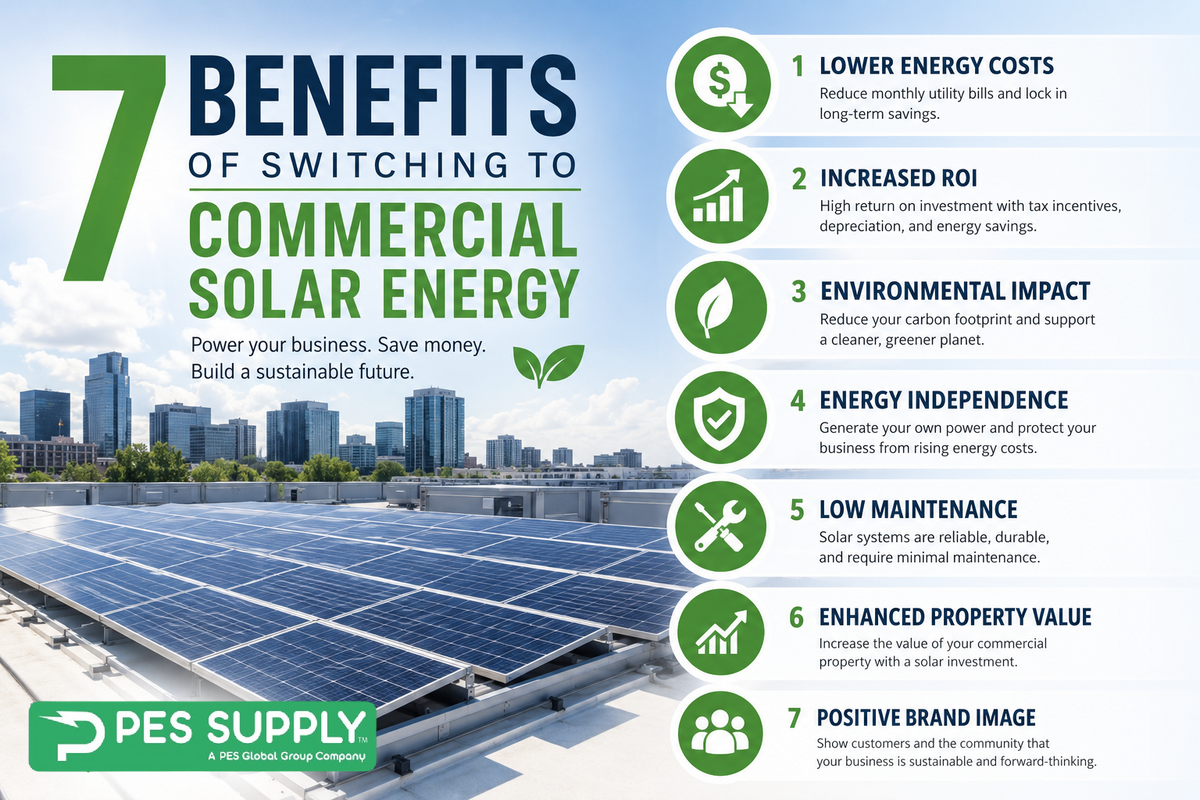
The seven core benefits of switching to commercial solar energy are: (1) significant reduction in electricity operating costs, (2) substantial federal and state tax incentives, (3) protection against rising electricity rates, (4) improved business resilience with battery storage, (5) increased commercial property value, (6) stronger sustainability credentials that attract customers and employees, and (7) reduced carbon footprint and regulatory risk. Together, these benefits typically deliver payback in 4 to 8 years and lifetime savings of $150,000 to over $1 million depending on facility size.
Key Takeaways
- Electricity Cost Savings: Most commercial solar systems reduce electricity bills by 50 to 90% depending on system size relative to consumption and local net metering policy.
- Tax Incentives Are Exceptional: The 30% federal ITC plus MACRS accelerated depreciation can offset 40 to 55% of total system cost in Year 1 taxes alone.
- Rate Lock-In: A solar system locks in a fixed cost per kWh for 25 years. Competing businesses without solar continue to absorb 2 to 4% annual rate increases every year.
- Commercial Property Value: Studies show commercial buildings with solar command higher sale prices and lower vacancy rates than equivalent non-solar properties.
- Resilience: Solar paired with battery storage allows critical operations to continue during grid outages, reducing the financial impact of disruptions.
- Payback Period: Most commercial solar projects achieve full payback in 4 to 8 years, then generate net positive returns for 17 to 21 more years of the system's life.
- ESG and Brand Value: Solar installations provide verifiable, measurable sustainability data that supports ESG reporting, customer acquisition, and employee retention.
In This Article
- Benefit 1: Dramatically Lower Electricity Operating Costs
- Benefit 2: Exceptional Federal and State Tax Incentives
- Benefit 3: Protection Against Rising Electricity Rates
- Benefit 4: Improved Business Resilience and Energy Independence
- Benefit 5: Increased Commercial Property Value
- Benefit 6: Stronger Sustainability Credentials and Brand Value
- Benefit 7: Reduced Carbon Footprint and Lower Regulatory Risk
- Real Numbers: What Commercial Solar Actually Delivers
- Which Businesses Benefit Most from Solar?
- Frequently Asked Questions
Benefit 1: Dramatically Lower Electricity Operating Costs
For most commercial businesses, electricity is one of the top three operating expenses after labor and rent. A properly sized solar system generates electricity on-site, directly offsetting what you would otherwise buy from the utility at full retail rates. Every kilowatt-hour your panels produce is a kilowatt-hour you do not pay for.
The savings go beyond simple energy consumption. Many commercial utility rates include a demand charge, a monthly fee calculated on your highest 15-minute power draw of the month. Demand charges can represent 25 to 45% of a business's total electricity bill. When solar is paired with battery storage, the battery discharges during afternoon peak demand windows, flattening the demand curve and reducing demand charges by 30 to 70%.
What Electricity Cost Savings Look Like by Business Type
| Business Type | Typical Annual Electricity Cost | Typical Solar System Size | Annual Savings Potential |
|---|---|---|---|
| Small retail or office (5,000 sq ft) | $12,000 to $24,000/yr | 25 to 50 kW | $8,000 to $18,000/yr |
| Mid-size warehouse or manufacturing (50,000 sq ft) | $80,000 to $200,000/yr | 200 to 500 kW | $50,000 to $140,000/yr |
| Large distribution center or industrial facility | $300,000 to $1M+/yr | 1 to 5 MW | $180,000 to $700,000/yr |
| Hotel or hospitality property (150 rooms) | $120,000 to $300,000/yr | 150 to 400 kW | $70,000 to $200,000/yr |
Benefit 2: Exceptional Federal and State Tax Incentives
The financial incentives available for commercial solar in 2026 are among the most generous the US government has ever offered for any business capital investment. The combination of the federal Investment Tax Credit, MACRS accelerated depreciation, and potential bonus credits can offset 40 to 55% of total project cost in the year the system is installed.
| Incentive | Value | How It Works | Example: $500,000 System |
|---|---|---|---|
| Federal ITC (30%) | 30% of total installed cost | Dollar-for-dollar reduction in federal tax owed in the year the system is placed in service | -$150,000 in taxes |
| MACRS 5-Year Depreciation | Full cost depreciated over 5 years (basis reduced by 50% of ITC) | $425,000 depreciation basis ($500k minus 50% of ITC), spread over 5 years | $42,500/yr tax deduction over 5 yrs (at 21% corporate rate) |
| 60% Bonus Depreciation (2026) | 60% of depreciable basis deducted in Year 1 | 60% of $425,000 = $255,000 deducted in Year 1 alone | ~$53,550 additional Year 1 tax savings |
| Domestic Content Bonus (+10%) | Additional 10% ITC for qualifying US-made equipment | Stacks with base ITC for total 40% credit on qualifying projects | +$50,000 additional tax credit |
| Energy Community Bonus (+10%) | Additional 10% ITC for projects in energy communities | Can stack with Domestic Content for total 50% ITC in qualifying locations | +$50,000 additional tax credit |
The Year 1 Tax Impact on a $500,000 System: Federal ITC ($150,000) plus first-year bonus depreciation savings (~$53,550) means a business could reduce its federal tax bill by $203,550 in the year it installs solar, covering over 40% of the gross project cost before a single kilowatt-hour has been produced. This is why commercial solar frequently appears as one of the highest-returning investments a profitable business can make in a given year.
Benefit 3: Protection Against Rising Electricity Rates
Solar panels do not just save you money today. They lock in a predictable, near-zero electricity cost for 25 years while your competitors without solar continue absorbing annual rate increases from their utility. This rate escalation protection compounds significantly over a long time horizon.
US commercial electricity rates rose at an average of 2.4% per year from 2015 to 2025. Applying that same trend forward means a business paying $0.14 per kWh today would pay roughly $0.22 per kWh by 2035 and $0.36 per kWh by 2045 for the same electricity a solar owner has been generating for free since installation. The cumulative savings from rate escalation protection can exceed the direct savings from solar generation itself over a 25-year system life.
Rate Escalation Impact: $100,000 Annual Electricity Bill at 2.4% Annual Increase
| Year | Annual Bill (No Solar) | Annual Bill (With Solar - Near Zero) | Annual Savings |
|---|---|---|---|
| Year 1 (2026) | $100,000 | $8,000 (residual grid) | $92,000 |
| Year 5 (2030) | $110,000 | $8,400 | $101,600 |
| Year 10 (2035) | $127,000 | $9,000 | $118,000 |
| Year 20 (2045) | $160,000 | $10,000 | $150,000 |
| 25-Year Total | $3,250,000+ | ~$240,000 | Over $3,000,000 saved |
Benefit 4: Improved Business Resilience and Energy Independence
Grid reliability has deteriorated in many US markets. Extreme weather events, aging infrastructure, and increasing load from EV charging and electrification are causing more frequent and longer grid outages. For businesses whose operations depend on continuous power, an outage is not just an inconvenience. It is a direct financial loss.
Solar paired with battery storage provides a meaningful level of energy independence. During a grid outage, a solar-plus-storage system can island from the grid and continue powering critical loads: refrigeration, point-of-sale systems, manufacturing processes, data infrastructure, lighting, and security systems. For businesses with specific resilience requirements, this capability has real dollar value that goes beyond electricity bill savings.
| Business Type | Cost of a Single 8-Hour Outage | What Battery Storage Protects |
|---|---|---|
| Restaurant or food service | $2,000 to $15,000 (spoiled inventory, lost revenue, staff downtime) | Refrigeration, POS systems, cooking equipment, lighting |
| Retail store | $5,000 to $25,000 (lost sales, spoilage, security risk) | POS systems, lighting, refrigerated products, security |
| Manufacturing facility | $25,000 to $250,000+ (production loss, restart costs, spoiled materials) | Critical process loads, safety systems, HVAC for sensitive materials |
| Cold storage or food distribution | $50,000 to $500,000+ (product loss, liability) | Refrigeration compressors, monitoring systems, loading dock operations |
| Medical or healthcare facility | Patient safety risk and regulatory liability (uncapped) | Life safety systems, specimen storage, HVAC, patient care equipment |
Benefit 5: Increased Commercial Property Value
Solar installations measurably increase commercial property values. Buildings with solar sell at higher prices, lease at higher rates, and experience lower vacancy than equivalent non-solar properties. This represents a real, monetizable return beyond the electricity savings, and it is particularly relevant for property owners and real estate investors making a 10 to 25-year hold decision.
Research from Lawrence Berkeley National Laboratory demonstrates that commercial solar adds between 3 and 6% to property sale prices. A commercial building valued at $3 million with a well-performing solar system could command $90,000 to $180,000 more in a sale transaction. Combined with the energy cost savings, this property value premium significantly strengthens the financial case for solar as a capital investment.
Why Commercial Solar Increases Property Value
- Lower operating expenses improve NOI (Net Operating Income): Commercial property is valued as a multiple of NOI. Reducing electricity operating expenses directly increases the property's income multiple valuation.
- Green building certifications: Solar installations support LEED, ENERGY STAR, and BOMA 360 certifications that improve marketability and tenant quality.
- Tenant attraction and retention: Corporate and institutional tenants increasingly require energy-efficient buildings to meet their own Scope 2 emissions targets. Solar becomes a tenant retention tool.
- Lower vacancy risk: Energy-efficient buildings with documented low operating costs attract better tenants and experience lower vacancy rates in most commercial markets.
Benefit 6: Stronger Sustainability Credentials and Brand Value
Corporate sustainability has moved from a nice-to-have to a competitive requirement in many industries. Major retailers, food manufacturers, and technology companies now require suppliers to demonstrate emissions reductions and renewable energy use as conditions of continued business. A commercial solar installation provides verifiable, auditable data that supports these reporting requirements in a way that purchasing renewable energy credits (RECs) alone cannot match.
Beyond supply chain compliance, solar installations create genuine marketing assets. A visible rooftop array or solar carport communicates environmental commitment to customers, employees, and the community in a tangible, permanent way. Unlike marketing claims that are easy to dismiss, a physical solar installation is credible evidence of action.
Business Benefits of Solar for Sustainability Positioning
- Scope 2 Emissions Reduction: On-site solar directly reduces market-based Scope 2 emissions, supporting GHG reporting to investors, lenders, and customers who require emissions data.
- ESG Reporting: Solar generation data feeds directly into ESG frameworks (GRI, SASB, TCFD). Verified on-site generation is more credible than purchased RECs for disclosure purposes.
- Supply Chain Qualification: Companies like Walmart, Apple, Amazon, and Costco require suppliers to demonstrate renewable energy use. Solar helps suppliers maintain qualification in these programs.
- Employee Recruitment and Retention: Survey data consistently shows that workers, particularly younger employees, prefer employers with demonstrated environmental commitments. Solar is a concrete signal.
- Customer Loyalty: A 2025 Nielsen survey found that 66% of consumers are willing to pay a premium for products from companies with demonstrated sustainability practices.
Benefit 7: Reduced Carbon Footprint and Lower Regulatory Risk
Carbon pricing, emissions reporting mandates, and clean energy standards are expanding across US states and increasingly at the federal level. Businesses that have already reduced their carbon footprint through on-site solar are better positioned for this regulatory environment than those that have not. The cost of regulatory compliance tends to be lower for businesses that have proactively reduced emissions than for those forced to make rushed reactive changes.
A typical 200 kW commercial solar system generates approximately 280,000 kWh per year and avoids roughly 120 to 160 metric tons of CO2 emissions annually, depending on the regional grid emissions factor. Over 25 years, that is 3,000 to 4,000 metric tons of CO2 avoided. For businesses subject to emissions reporting or carbon pricing in their supply chain, this reduction has direct financial value.
| State | Current or Upcoming Carbon Regulation | Solar Benefit |
|---|---|---|
| California | Cap-and-trade program, SB 253 requires large company emissions reporting starting 2026 | Reduces reportable Scope 2 emissions. Avoids potential carbon costs in cap-and-trade program. |
| New York | CLCPA mandates 70% renewable electricity by 2030. Building emissions caps for large buildings. | Solar reduces building emissions toward NYC Local Law 97 compliance, avoiding steep annual penalties. |
| Massachusetts | Clean Energy Standard, building emissions reporting requirements expanding | Demonstrates compliance with clean energy procurement requirements in state contracts and supply chains. |
| Federal (SEC) | SEC climate disclosure rules require public companies to disclose material climate risks and emissions | On-site solar generation provides verifiable, auditable data for SEC climate disclosures. |
Real Numbers: What Commercial Solar Actually Delivers
To bring these seven benefits together, here is a realistic example of what commercial solar delivers for a mid-size business in three different US markets.
| Metric | California (High Rate) | Texas (Moderate Rate) | Ohio (Lower Rate) |
|---|---|---|---|
| System Size | 250 kW | 250 kW | 250 kW |
| Gross System Cost | $775,000 | $675,000 | $700,000 |
| Federal ITC (30%) | -$232,500 | -$202,500 | -$210,000 |
| Net Cost After ITC | $542,500 | $472,500 | $490,000 |
| Year 1 Electricity Savings | $107,500 | $61,250 | $49,000 |
| Simple Payback Period | 5.1 years | 7.7 years | 10.0 years |
| 25-Year Net Savings (2.4% rate escalation) | $2,850,000 | $1,420,000 | $870,000 |
Which Businesses Benefit Most from Solar?
While virtually any business can benefit from solar, the financial case is strongest for businesses that share certain characteristics. Understanding where you fall in this spectrum helps set realistic expectations.
| Strongest Solar Candidates | Why They Benefit Most |
|---|---|
| Businesses in California, New York, Massachusetts, Hawaii, or Connecticut | High electricity rates plus state incentives produce 4 to 6-year payback periods with exceptional lifetime ROI |
| Businesses with large flat commercial rooftops (warehouses, distribution centers, big-box retail) | Maximum surface area for solar installation at lowest per-watt cost. Ballasted flat roof systems are fast and non-invasive. |
| Businesses with daytime operations that align with solar production hours | Maximum direct-use of solar generation without exporting to grid. Higher offset percentage with same system size. |
| Profitable businesses with significant federal tax liability | Can fully utilize the 30% ITC and bonus depreciation in Year 1, dramatically improving first-year financial impact |
| Agricultural operations in rural areas (USDA REAP eligible) | USDA REAP grants of up to 50% of project cost stack with the federal ITC, creating exceptional subsidy depth |
| Businesses with significant demand charges in their utility rate | Solar plus storage reduces demand peaks and delivers bill savings beyond energy offset alone |
Frequently Asked Questions
How quickly does commercial solar pay back?
Most commercial solar systems achieve full payback in 4 to 10 years depending on location, electricity rate, system size, and financing structure. Businesses in high-rate states like California, Hawaii, and Massachusetts with access to state incentives often see payback in 4 to 6 years. Businesses in lower-rate states without state incentives typically see 7 to 10 years. After payback, the system generates electricity at near-zero cost for another 15 to 20 years of its useful life.
Does commercial solar qualify for the 30% federal tax credit?
Yes. The federal Investment Tax Credit (ITC) applies fully to commercial solar systems for any business with federal tax liability. It covers the complete installed system cost including panels, inverter, racking, wiring, installation labor, permitting, and co-installed battery storage. The credit remains at 30% through 2032. Businesses can also claim Domestic Content and Energy Community bonuses that bring the total credit to 40 to 50% for qualifying projects.
Can a nonprofit or tax-exempt organization benefit from commercial solar?
Yes, though the structure is different. Nonprofits and government entities cannot directly use the ITC because they do not have federal tax liability. However, they can access equivalent financial benefits through two paths: a Power Purchase Agreement (PPA) where a tax equity investor captures the ITC and passes through below-market electricity rates to the nonprofit, or a direct pay provision under the Inflation Reduction Act that allows certain tax-exempt entities to receive the ITC value as a direct cash payment from the IRS.
How does solar affect a commercial property's value?
Research from Lawrence Berkeley National Laboratory shows commercial properties with solar sell at 3 to 6% premiums over comparable non-solar properties. The mechanism is straightforward: solar reduces operating expenses, which increases net operating income (NOI), which directly increases the property's income-multiple valuation. A $50,000 annual reduction in electricity operating expenses on a property with a 5% cap rate increases the property's market value by $1,000,000.
What is the best system size for a commercial business?
System size should be based on your actual annual electricity consumption and load profile, not on available roof space. The standard approach is to size the system to offset 70 to 90% of annual consumption. Sizing to 100% or above is sometimes possible but may trigger different utility interconnection requirements and could result in excess generation that provides limited financial value depending on your utility's net metering rate. A professional load analysis is the required starting point for any commercial system sizing decision.
Related Products


Ready to Take the Next Step for Your Business?
Whether you are sourcing equipment for a commercial solar project or building the business case internally, Portlandia Electric Supply provides Tier 1 commercial solar panels, inverters, battery storage, racking, and switchgear at wholesale pricing. Nationwide delivery from 12+ distribution hubs. NABCEP-certified design support. Fast quotes for project-specific bills of materials.
Shop Commercial Solar Equipment Request a Project QuoteRelated Guides
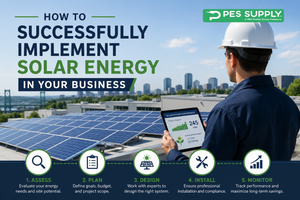
- How to Successfully Implement Solar Energy in Your Business - Step-by-step commercial solar guide
- Solar Panel Cost: What Should I Actually Pay? - 2026 commercial pricing guide
- How Much Can I Save With Solar Panels? - Savings calculator by state and system size
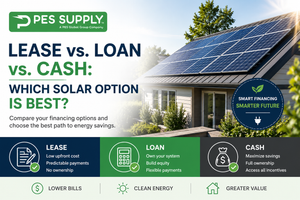
- Lease vs. Loan vs. Cash: Which Option Is Best? - Full commercial financing comparison
- Request a Quote - Wholesale pricing on commercial panels, inverters, and complete project kits
About Portlandia Electric Supply
Portlandia Electric Supply is a nationwide distributor of Tier 1 solar panels, commercial inverters, battery storage systems, EV charging hardware, racking, switchgear, circuit breakers, generators, and complete electrical project kits. With 12+ distribution hubs, 3,800+ in-stock SKUs, NABCEP-certified design support, and a network of 8,500+ solution providers, Portlandia serves contractors, EPCs, developers, and businesses with fast delivery, wholesale pricing, and expert procurement guidance.
Location: 1507 Portland Ave, Louisville, KY, United States | Phone: 1 888-876-0007 | Website: www.portlandiaelectric.supply
Article: 7 Benefits of Switching to Commercial Solar Energy: A Complete Guide for Business Owners and CFOs
Category: Commercial Solar | Business Energy | Solar Benefits | Energy Cost Reduction | Sustainability
Last Updated: June 2026 - Based on EIA Commercial Energy Data, Lawrence Berkeley National Laboratory Reports, and 2026 Federal Incentive Programs
Disclaimer: Financial projections, tax incentive values, and savings estimates are based on national averages and current program rules as of June 2026. Individual results vary based on location, electricity rates, system design, financing structure, and tax situation. Consult a qualified tax advisor and licensed solar professional before making investment decisions.
Related Resources:
- Best Solar Panels 2026 — Buyer's Guide
- EG4 vs Tesla Powerwall
- Qcells vs Trina vs JA
- Solar Inverter Buyer's Guide
- Solar Battery Buyer's Guide
- 5kW Solar Kit
- 10kW Solar + Battery Kit
- Off-Grid Cabin Kit
- EG4 Batteries
- Qcells Solar Panels
- Trina Solar
- JA Solar
- REC Solar
- Mission Solar
- Sol-Ark Inverters
- SolarEdge Inverters
- Generac PWRcell
Calculate how much storage you need with our battery sizing calculator.
Check solar incentives available in your state.
Use our free solar system calculator to size your array.
Check out our Solar Panel Comparison Tool. Check out our Inverter Sizing Calculator.
Calculate your solar payback and 25-year savings with our Solar ROI Calculator. Follow our complete DIY solar installation guide for step-by-step instructions. Keep your system running at peak performance with our Solar Maintenance Guide.
Related Resources
- Solar System Calculator
- Battery Sizing Calculator
- Solar Panel Comparison Tool
- Inverter Sizing Calculator
- Solar ROI Calculator
- Solar Installation Guide
- Solar Maintenance Guide
- Solar Permitting Guide
- Battery Installation Guide
- NEC Code Compliance Guide
- Solar Panel Mounting Guide
- Grounding & Bonding Guide
- Solar Incentives by State
- Pro Account — Wholesale Pricing
- PowerLink Network — Contractor Program
Frequently Asked Questions
What size solar panel do I need?
Sizing depends on your daily energy consumption, available roof space, and peak sun hours in your area. A typical home uses 15-25 panels (400W each) for full offset. Call (502) 790-0600 for a free sizing consultation.
How much do solar panels cost in 2026?
PES Supply distributes panels from major manufacturers including Jinko, Mission Solar, and more. Pricing varies by wattage and quantity. Request a quote for current pricing.
Do you offer BABA-compliant solar panels?
Yes. PES Supply provides BABA documentation at no extra charge. All our solar products meet Build America, Buy America requirements.
Shop Related Products
PES Supply carries 80,000+ products from 300+ manufacturers. One PO, one invoice, every trade covered.
Need help sizing? Our team can calculate loads, select equipment, and source everything from one PO.
Call (502) 790-0600