Battery Bank Sizing Calculator
Daily kWh × autonomy days ÷ depth of discharge ÷ inverter efficiency → bank kWh, amp-hours, and module count
Set inverter efficiency to 100% for DC-only loads; 95% is typical for AC loads through a quality inverter. This sizes energy capacity only — surge power, charge rate (C-rate), and cold-temperature charging limits are checked separately below.
Battery banks fail on paper before they fail in the field. Undersize the bank and the lights die on day two of a storm; oversize it and you spent five figures on capacity that never cycles below 40%. The sizing math is one line long: daily use × days of autonomy, divided by usable depth of discharge, divided by inverter efficiency. The calculator above runs it and converts the answer into the two currencies battery shopping actually uses — kilowatt-hours of nameplate capacity and amp-hours at your system voltage — then rounds up to whole battery modules. Below: how to choose each input honestly, the chemistry and voltage tables, and three worked examples to check the calculator against. For the runtime question that follows this one ("how long will it last?"), the battery backup runtime calculator is the companion tool.
Step 1 — Get Your Real Daily kWh
Everything multiplies from this number, so measure, don't guess. The three honest ways: read a year of utility bills and divide kWh by 365 (grid-tied homes); run a kill-a-watt or smart-plug audit on every load for a week (cabins and RVs); or build a load list — every device, its watts, and its hours per day. A typical efficient off-grid cabin lands at 3–6 kWh/day; a full-time off-grid home with a well pump, fridge, and mini-split lands at 8–15 kWh/day; grid-tied whole-home backup customers routinely discover they use 25–35 kWh/day and immediately start prioritizing critical loads instead. That instinct is correct: backing up everything is a generator's job, not a battery's. The home battery bank sizing guide has the critical-loads worksheet approach, and our off-grid storage calculation guide covers the load-list method line by line.
Step 2 — Days of Autonomy: How Long Without Sun
Autonomy is how many days the bank carries the loads with zero charging — storm days, smoke days, the week the panels are under snow. It is a climate and risk decision, not a chemistry one.
| Application | Recommended autonomy | Why |
|---|---|---|
| Grid-tied backup (critical loads) | 0.5 – 1 day | Outages are hours, not days; the grid returns |
| Weekend cabin / RV | 1 – 2 days | Weekend use pattern tolerates recharge gaps |
| Full-time off-grid, good solar resource | 2 – 3 days | Covers typical storm stretches; generator as backstop |
| Full-time off-grid, northern / cloudy winters | 3 – 5 days | December in Oregon is not December in Arizona |
| Critical infrastructure (medical, comms) | 5+ days plus generator | Autonomy is a life-safety spec, not a budget line |
Step 3 — Depth of Discharge: The Chemistry Tax
Nameplate kWh is not usable kWh. Lead-acid chemistry ages fast below 50% state of charge; lithium iron phosphate shrugs off 80–90% daily cycling. The DoD you choose divides your usable need into a nameplate requirement — halving DoD doubles the bank you must buy.
| Chemistry | Practical max DoD | Cycle life at that DoD | Usable kWh per 10 kWh nameplate |
|---|---|---|---|
| LiFePO4 (rack modules) | 80–90% | 4,000–6,000+ cycles | 8–9 kWh |
| AGM lead-acid | 50% | 500–1,000 cycles | 5 kWh |
| Flooded lead-acid | 50% | 800–1,500 cycles (with watering discipline) | 5 kWh |
| Lead-carbon | 60% | 2,000–3,000 cycles | 6 kWh |
This is why lithium won the market even at a higher sticker price: a 10 kWh LiFePO4 bank delivers roughly the usable energy of a 16–18 kWh AGM bank, in half the weight, with five times the cycle life, and no maintenance. We stock both — LiFePO4 batteries, server-rack modules, and 48V banks on the lithium side; Rolls flooded and AGM for the buy-once-cry-once crowd who already own a hydrometer. The 20-80 rule analysis digs into whether daily deep cycling or conservative cycling wins on lifetime cost (short version: for LiFePO4, cycle deep; the calendar aging dominates anyway).
Step 4 — System Voltage: 12, 24, or 48 V
Voltage is chosen by power, not energy. Amps = watts ÷ volts, and amps are what heat cables and stress BMS FETs. A 3,000 W inverter on 12 V pulls 250+ A continuous — welding-cable territory with real voltage sag. The same load on 48 V pulls 65 A: reasonable cable, reasonable breakers, happy inverter.
| System voltage | Sensible inverter range | Typical bank size | Where it belongs |
|---|---|---|---|
| 12 V | ≤ 1,500 W | 1–5 kWh | RVs, vans, boats, tiny cabins |
| 24 V | 1,500 – 3,500 W | 3–10 kWh | Mid-size cabins, larger RVs |
| 48 V | 3,000 W and up | 5–40+ kWh | Whole-home off-grid, grid-tied backup |
The same energy in amp-hours shrinks as voltage rises — 10 kWh is 833 Ah at 12 V, 417 Ah at 24 V, 208 Ah at 48 V — which is why module shopping is done in kWh, not Ah. If your number lands above 5 kWh, stop fighting it and go 48 V. One more voltage argument that settles it for whole-home builds: every major hybrid and off-grid inverter above 5 kW — and essentially all of the 8–15 kW class that a whole house actually needs — is 48 V native. Choosing 12 or 24 V for a whole-home bank locks you out of the mainstream inverter market before you have bought a single battery. Pair the bank with a matching off-grid inverter and size the recharge side with the charge controller sizing guide and controller lineup.
Worked Examples — Check the Calculator
| Scenario | Daily use | Autonomy | DoD | Inverter eff. | Bank required | Amp-hours |
|---|---|---|---|---|---|---|
| Cabin, LiFePO4, 48 V | 5 kWh | 2 days | 80% | 100% (DC loads) | 12.5 kWh | 260 Ah @ 48 V |
| RV, AGM, 12 V | 3 kWh | 1 day | 50% | 100% | 6.0 kWh | 500 Ah @ 12 V |
| Off-grid home, LiFePO4, 48 V | 10 kWh | 3 days | 90% | 95% | 35.1 kWh | 731 Ah @ 48 V |
Example 1 in modules: 12.5 kWh ÷ 5.12 kWh rack modules = 2.44 → 3 modules (15.4 kWh installed, a healthy 23% margin). Example 3: 35.1 ÷ 5.12 = 6.85 → 7 modules. Always round up to whole modules — the margin absorbs cold-weather capacity loss, aging, and the load you forgot to list.
What This Calculator Doesn't Size (and You Still Must)
- Surge and continuous power (kW, not kWh). A well pump starting surge or a mini-split's locked-rotor amps can exceed a small bank's BMS discharge rating even when energy capacity is ample. Check the bank's continuous/peak discharge amps against your inverter's demand.
- Charge rate. Your array and charge controller must replace daily use in your winter sun hours. A 35 kWh bank behind 2 kW of December solar in the Pacific Northwest is a very expensive paperweight.
- Temperature. LiFePO4 cannot be charged below freezing without heated enclosures or BMS low-temp cutoff; lead-acid loses ~20% capacity at 0°F. Insulate or heat the battery room.
- Aging. Budget 10–20% extra capacity if the bank must still meet spec in year 8, not just year 1.
From Number to Hardware
Take the calculator's kWh and module count to the catalog: EG4 rack batteries for value lithium, the full LiFePO4 shelf, or Rolls for lead. The battery installation guide covers wiring, fusing, and ventilation; off-grid cabin kits bundle matched banks, inverters, and arrays if you would rather buy the system than the spreadsheet. The quote button in the calculator sends your daily kWh, autonomy, DoD, and voltage straight to our design team — bank sizing is free with the hardware.
Series vs. Parallel: Assembling the Bank
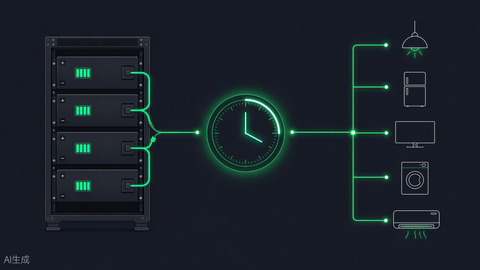
The calculator hands you a kWh target; the wiring diagram turns it into hardware. Batteries in series add voltage at the same amp-hours — four 12 V 100 Ah batteries in series make a 48 V 100 Ah string (4.8 kWh). Batteries in parallel add amp-hours at the same voltage — four 12 V 100 Ah in parallel make 12 V 400 Ah (also 4.8 kWh). Same energy, different delivery. Modern 48 V rack modules shortcut this entirely: each module is internally series-stacked to 51.2 V nominal, and you simply parallel modules to add capacity — three 5.12 kWh modules parallel into a 15.36 kWh, 48 V bank on a common bus. Two rules protect the investment: never mix ages, chemistries, or capacities in one bank (the weakest cell drags the string), and parallel identical modules with equal-length cables so current shares evenly. Most rack batteries cap parallel strings at 6–16 modules per BMS master — check the manual before you order module seventeen.
A Load List You Can Steal
The most common sizing failure is an optimistic load list. These are honest, field-measured daily figures for efficient off-grid equipment — use them as a starting point, then measure your own:
| Load | Typical draw | Hours/day | Daily energy |
|---|---|---|---|
| Refrigerator (modern, 18 cu ft) | 80–120 W cycling | 24 (duty ~35%) | 0.8–1.2 kWh |
| LED lighting (whole cabin) | 60–100 W | 5 | 0.3–0.5 kWh |
| Well pump (1/2 HP, 30 gal/day) | 1,000 W | 0.4 | 0.4 kWh |
| Mini-split heat pump (12k BTU, mild day) | 500–900 W | 6–8 | 3.0–6.0 kWh |
| Laptop + Starlink/router | 60–100 W | 8 | 0.5–0.8 kWh |
| Chest freezer | 60–90 W cycling | 24 (duty ~30%) | 0.5–0.7 kWh |
| TV / entertainment | 80–150 W | 3 | 0.3–0.5 kWh |
| Microwave (1,100 W) | 1,200 W | 0.25 | 0.3 kWh |
Add it up: fridge, lights, pump, internet, freezer, TV, and a microwave total roughly 5.8–8.4 kWh/day before the mini-split — which is why heating and cooling dominate every off-grid energy budget, and why propane or wood heat is the oldest battery-saving technology there is. Phantom loads are the silent bank drain: cable boxes, game consoles, and anything with a wall wart can idle 24 hours a day at 10–30 W each. Put them on a switched strip or pay for their kWh forever.
Frequently Asked Questions
How many kWh of battery do I need to go off-grid?
Daily use × days of autonomy ÷ usable DoD. A home using 10 kWh/day wanting 3 storm days on LiFePO4 at 90% DoD needs about 33–35 kWh of nameplate capacity — seven 5.12 kWh rack modules. Most full-time off-grid homes land between 20 and 40 kWh.
Is 2 days of autonomy enough?
With a generator or grid as backstop, yes — 2 days covers most storm events and keeps the bank affordable. True no-backup off-grid in cloudy northern winters deserves 3–5 days. Grid-tied backup of critical loads can live with half a day to one day.
Why divide by depth of discharge?
Because you cannot use all of a nameplate kWh. Lead-acid batteries deliver long life only when cycled to 50%; LiFePO4 tolerates 80–90% daily. A 10 kWh usable need at 50% DoD requires a 20 kWh bank; at 90% DoD only 11.1 kWh.
Should I build my bank at 12, 24, or 48 volts?
Match voltage to power: 12 V up to ~1,500 W of inverter, 24 V to ~3,500 W, and 48 V for anything larger. Energy above ~5 kWh belongs at 48 V — cable size, voltage drop, and BMS current limits all favor it.
How many amp-hours is a 10 kWh battery bank?
It depends on voltage: 10 kWh is 833 Ah at 12 V, 417 Ah at 24 V, or 208 Ah at 48 V. Divide watt-hours (10,000 Wh) by system voltage. Shop in kWh — amp-hours without a voltage are meaningless.
Does inverter efficiency really change bank size?
Yes — for AC loads. A 95%-efficient inverter wastes 5% of everything the bank discharges, so the bank must be ~5% larger: divide by 0.95. For DC-only systems (lights, USB, 12 V fridge) set efficiency to 100%.
Shop the products mentioned in this guide and get everything you need for your project.


Outback Power Mojave Inverter Off-Grid and Grid-Hybrid 48VDC 120/240VAC - OGHI8048A
OutBack Power
$1,481.29
View Product