R-454B Transition Guide for HVAC Contractors: 2025 AIM Act, R-410A Phasedown, and Equipment Retrofits
The A2L refrigerant reshaping residential and light commercial HVAC -- what changes on your service truck, in your inventory, and in your service pricing.

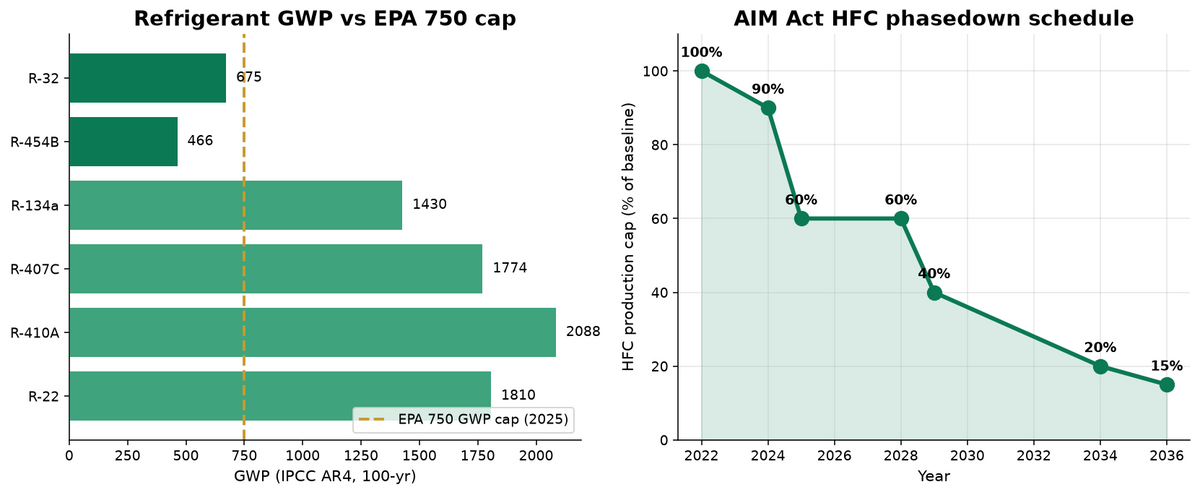
The AIM Act (American Innovation and Manufacturing Act) took a specific and legally binding step on January 1, 2025: all new residential and light commercial air-conditioning equipment manufactured in or imported into the United States must use a refrigerant with a global warming potential (GWP) below 700. R-410A has a GWP of 2088. It failed the test. Overnight, the four major residential OEMs -- Carrier, Trane/American Standard, Lennox, and Rheem/Ruud -- all pivoted primary production from R-410A to R-454B (GWP 466). Goodman/Daikin picked the R-32 path (GWP 675). A handful of niche makers picked R-1234ze or R-290 (propane) for specialty applications.
What this means for contractors is straightforward: every new residential HVAC install you quote in 2026 uses R-454B or R-32. Every service call on a pre-2025 system still uses R-410A. Both refrigerants coexist on your service truck. Both require training. Both require inventory. And the tools that worked for R-410A -- gauges, hoses, recovery machines, leak detectors -- mostly transfer, but every one has a specific R-454B compatibility spec you need to verify before storing it on a truck that will handle both.
This guide covers the technical differences between R-410A and R-454B, the equipment retrofit realities (short answer: retrofits are almost never economic; system replacements are), the tool compatibility matrix, and the pricing/inventory strategy for a shop that will service both refrigerants through 2035.
| Property | R-410A | R-454B | Implication |
|---|---|---|---|
| GWP (100-yr IPCC AR4) | 2088 | 466 | 78% lower climate impact per lb |
| ASHRAE safety class | A1 (non-flammable) | A2L (mildly flammable) | Requires A2L handling protocols |
| Composition | 50% R-32 / 50% R-125 | 68.9% R-32 / 31.1% R-1234yf | Zeotropic blend, small glide |
| Operating pressures | High side ~450 psig | High side ~465 psig | Similar; existing gauges compatible with A2L rating |
| Discharge temp | Higher | 5-10°F lower | Compressor life extended slightly |
| Cooling capacity per lb | 1.00 (baseline) | 1.03 | Slightly less refrigerant per system |
| Contractor price/lb (2026) | $9.96 | $21.48 | 2.2x cost per lb |
| Cylinder classification | DOT 2.2 non-flammable | DOT 2.1 flammable | Requires flammable-storage protocols |
| Leak detection | Halide/ultrasonic | Halide/ultrasonic + LFL-rated | Existing detectors work; new UL 60335-2-40 rated preferred |
| Retrofit into R-410A system | Possible (chemically) | Not recommended | Compressor oil, EEV firmware, safety switches differ |
The temptation to retrofit an existing R-410A system to R-454B is powerful. R-410A is expensive and getting more so; R-454B is the future; and the two refrigerants have similar operating pressures. The reality is that a retrofit is almost never economic, and in most cases it violates UL certification.
The first problem is oil. R-410A systems typically use polyol ester (POE) oil, but the specific viscosity grade is matched to R-410A's solubility. R-454B uses a slightly different POE formulation to accommodate the R-1234yf fraction. A retrofit requires a full oil flush -- typically 3 flushes with fresh POE to remove residual contamination -- adding $180-320 in labor and materials per system.
The second problem is the electronic expansion valve (EEV). Modern variable-capacity R-410A systems use an EEV whose control firmware is calibrated to R-410A's PT curve. R-454B has a different PT relationship. The system will run, but modulation accuracy suffers and cooling capacity drops 4-7% under design conditions. In practice, the customer will call you back complaining the system is under-performing.
The third problem is safety compliance. R-454B is A2L (mildly flammable). Under UL 60335-2-40 3rd edition, an A2L system must have specific charge limits, a leak-detection sensor, an interlocked shutdown, and A2L-rated electrical components. Retrofitting an R-410A system that lacks these components creates an uncertified installation, which voids the equipment warranty and creates liability exposure for the contractor.
The correct guidance to most residential customers: continue servicing the R-410A system with reclaimed R-410A as long as economic (typically until a major component failure), then replace with a new R-454B system.
-
1
Update EPA 608 certification and add A2L training
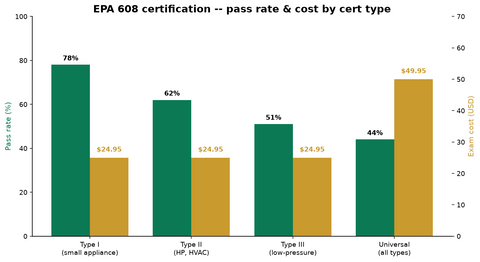
Existing EPA 608 certs are still valid for A2L work -- the EPA has not created a new cert type. However, most OEMs (Carrier, Trane, Lennox, Rheem) now require an A2L-specific factory certification before issuing warranty parts on R-454B equipment. These are typically online 4-6 hour courses at $75-125. Get every field tech through OEM A2L training before Q1 spring rush.
-
2
Inventory the R-454B refillable cylinder in your service trucks
Stock at least one 25 lb R-454B refillable cylinder per truck servicing residential accounts, in addition to your existing R-410A inventory. The A2L flammable classification requires the cylinder to be transported in an upright position with the valve protected -- a 30 lb refillable in a plastic pallet at the rear of a van with tie-downs is compliant.
-
3
Purchase A2L-rated leak detectors and safety equipment
Existing electronic leak detectors work chemically on R-454B, but for A2L work you also need a lower flammability limit (LFL) monitor when charging large systems in enclosed spaces. Fieldpiece SRL8, Bacharach H10G, and Testo 316-4 all have A2L-rated variants at $329-495. Budget one per two techs.
-
4
Update your service pricing and quote templates
R-454B is 2.2x more expensive per lb than R-410A at wholesale. A residential 4-ton system holding 8 lb of R-454B has $172 in refrigerant vs $80 for R-410A. Adjust service pricing on charge-and-recover calls -- most shops now bill R-454B at $85-115/lb retail vs $45-65/lb for R-410A. Your quote template should default to R-454B for any customer whose equipment is 2025+.
-
5
Convert your recovery inventory strategy
Under EPA rules, recovered A2L refrigerant must be stored in cylinders separately from non-flammable refrigerants. If your existing recovery bottles are marked for R-410A/R-22 reclaim, you'll need dedicated A2L recovery bottles. PES stocks 30 lb reclaim cylinders in both classifications; add 2-3 A2L bottles per truck to accommodate mixed-refrigerant service days.
| Task | R-410A protocol | R-454B (A2L) protocol |
|---|---|---|
| Cylinder storage | Any orientation, any temperature | Upright only, <130°F, ventilated |
| Truck transport | Standard hazmat placarding | 2.1 flammable placarding, no smoking area |
| Brazing near charge | Standard | Refrigerant must be recovered before torch use |
| Leak testing | Any electronic detector | LFL monitor in confined spaces >15 lb charge |
| Refrigerant recovery | Any 608-compliant machine | Recovery machine must be A2L-rated (UL 60335-2-40) |
| Charging | Liquid or vapor | Liquid only for zeotropic accuracy |
| Customer disclosure | No specific requirement | Written A2L notice on invoice or work order (best practice) |
The AIM Act phasedown schedule (chart above) sets HFC production caps that step down over the next decade. R-410A production is now at 60% of baseline; it drops to 40% in 2029 and 15% in 2036. Existing production allowances get allocated across manufacturers, and reclaimed refrigerant is exempt from the cap. What this means for a contractor is that R-410A stays available -- but through reclaim, not new production -- and the price will steadily climb.
Practical inventory implications for a 5-truck shop:
- 2026: Carry roughly a 60/40 R-410A/R-454B ratio in service truck inventory. Most service calls still touch existing R-410A systems.
- 2027-2028: Ratio shifts to 45/55 as new installs cross the 3-year mark and existing systems age out.
- 2029: Production cap drops to 40%; R-410A wholesale price expected to climb to $14-17/lb reclaim. Service pricing on R-410A calls should be $75-110/lb retail. Inventory ratio near 30/70.
- 2034-2036: R-410A is service-only, reclaim-only, and expensive. Most residential systems by this point are R-454B or R-32.
The other lever is the PES Refrigerant Subscription program (see the subscription guide), which locks pricing on quarterly pallet deliveries mixed across R-410A, R-454B, and R-32. Subscription contractors have hedged 12-month pricing that decouples from spot-market volatility on the AIM Act cap step-downs.
Is R-454B available for retrofits into old R-410A systems?
Does my EPA 608 cert cover A2L refrigerants?
Can I run R-454B through my existing recovery machine?
What is R-32 and why do some manufacturers choose it over R-454B?
Can I mix R-454B and R-410A in the same recovery cylinder?
How do I dispose of an R-410A system I'm removing?
Is R-454B compatible with existing brazing techniques?
The four major residential HVAC OEMs -- Carrier, Trane/American Standard, Lennox, and Rheem/Ruud -- pivoted their residential lines to R-454B on January 1, 2025 with dedicated model families that are R-454B-only. Goodman/Daikin picked the R-32 path with a separate model line. This creates a two-refrigerant residential OEM ecosystem for the next 12-15 years: R-32 systems from Goodman/Daikin and R-454B systems from everyone else.
For contractors doing residential replacements, this means the refrigerant on the new install is dictated by the OEM chosen. If your business standardizes on Carrier residential, you're installing R-454B. If you standardize on Goodman, you're installing R-32. Both are A2L, both require A2L handling protocols, and both are 2.2-2.5x more expensive per lb than R-410A.
The commercial rooftop unit (RTU) transition is happening on a different timeline. The AIM Act phasedown allows commercial RTUs to continue on R-410A through 2028, with new production requirements shifting to <500 GWP refrigerants (R-454B, R-32, or R-1234ze) in 2029-2030. This means commercial contractors have a longer transition window but face a more complex OEM landscape -- Trane, Carrier, Lennox, Rheem, Goodman, and York have all announced varying paths.
Practical inventory implication for contractors doing both residential and commercial work: through 2028, carry R-410A, R-454B, and (if you're a Goodman/Daikin shop) R-32. From 2029 forward, R-410A becomes reclaim-only and increasingly expensive.
The technical skill gap for A2L work is smaller than most contractors assume, but the specific certifications and safety training create hidden delays if not planned. Three separate credentialing tracks apply.
OEM factory certification. Every major residential OEM (Carrier, Trane, Lennox, Rheem, Goodman) requires a specific A2L training course before your techs can install or service their R-454B or R-32 equipment under warranty. These are 4-8 hour online courses, typically $75-195 per tech, and take 1-3 hours of active review plus a proctored quiz. Each OEM's certification is proprietary and doesn't transfer across brands.
State and municipal building code compliance. Some jurisdictions (California, some cities in Washington and Colorado) require A2L installers to hold specific state-issued endorsements. Check your local AHJ (Authority Having Jurisdiction) before quoting an R-454B or R-32 install. In most states, the OEM factory cert plus EPA 608 is sufficient.
NATE and industry certifications. NATE (North American Technician Excellence) is rolling out A2L-specific certification modules through 2027. HVAC Excellence has similar plans. These are not legally required but are increasingly favored by high-end residential customers and insurance underwriters. Budget these into your training plan as an option, not a requirement.
Most day-to-day service work on an R-454B system is essentially identical to R-410A. The pressure-temperature curves are similar, the superheat/subcool targets are similar, and the diagnostic workflow is identical. Where things diverge is in three specific scenarios.
Charge diagnostic and adjustment. R-454B is a zeotropic blend with a small temperature glide (~1.5°F). This means charging must be done as a liquid to maintain composition. Vapor charging causes fractionation -- the lower-boiling-point component (R-32 fraction) enters the system preferentially and shifts the actual composition away from the specified blend. Best practice: always charge R-454B as a liquid, and if you're uncertain about vapor charging on a low-charge system, use a fresh cylinder rather than a partially-used one.
Leak repair. A2L classification requires the refrigerant to be recovered to a hard vacuum before any torch work. This adds 15-25 minutes to a typical leak repair vs R-410A workflow. Plan service times accordingly.
Refrigerant recovery. A2L refrigerant must be recovered into A2L-rated recovery cylinders and stored separately from non-flammable refrigerants. If your existing recovery bottles are marked for R-410A/R-22 reclaim, you need additional dedicated A2L cylinders for R-454B work. Order 2-3 per truck initially and grow as service volume dictates.
Contractors doing residential replacements in 2026 face a communication challenge that didn't exist in 2020: helping customers understand why their new system uses a different refrigerant and (in many markets) costs more than expected. Well-handled, this is a trust-building conversation that positions your business as knowledgeable and current. Poorly-handled, it becomes a source of customer confusion and price objections.
The right message frame focuses on three points: environmental impact (R-454B is 78% lower GWP than R-410A), regulatory reality (federal law required the change, not the contractor), and long-term value (new systems are more efficient and will remain serviceable for their full lifespan). Avoid the technical detail unless the customer asks -- most homeowners don't need to hear the ASHRAE class discussion or the AIM Act phasedown schedule.
For quoting, be explicit about the refrigerant type on the equipment quote and any material differences in installation practice (flammable-refrigerant handling protocols for A2L). This transparency prevents surprise questions after installation.
For service, prepare a one-page customer handout explaining the A2L transition and what it means for their equipment. PES has a customer education template contractors can co-brand.
Q: When did new R-410A residential production stop? January 1, 2025 for new equipment manufactured or imported into the U.S.
Q: Can I still buy R-410A refrigerant? Yes, but production is capped and pricing is trending up. Reclaimed R-410A is exempt from the production cap and increasingly common.
Q: What's the difference between R-454B and R-32? Both are A2L. R-454B is a blend (68.9% R-32, 31.1% R-1234yf) with 466 GWP. R-32 is a single component with 675 GWP. R-454B is standardized by Carrier, Trane, Lennox, and Rheem. R-32 is standardized by Goodman/Daikin.
Q: Are there specific brazing or welding restrictions for A2L systems? Recover to a hard vacuum before applying torch. No open flames near A2L cylinders. Otherwise standard brazing practice applies.
Q: Does a warranty cover a service tech's mistake on A2L? Warranty covers manufacturing defects, not installer error. This applies whether the refrigerant is R-410A or A2L. Errors during A2L handling that cause equipment damage are typically covered by the installer's general liability policy.
Order R-454B refillable cylinders from PES Supply
A2L-classified handling, DOT flammable-freight routing, and single-source pricing across R-410A, R-454B, and R-32 through the PES subscription program.
Register Now