Last Updated: August 2026 • Solar Cell Technology Comparison for Installers, EPCs & Commercial Buyers
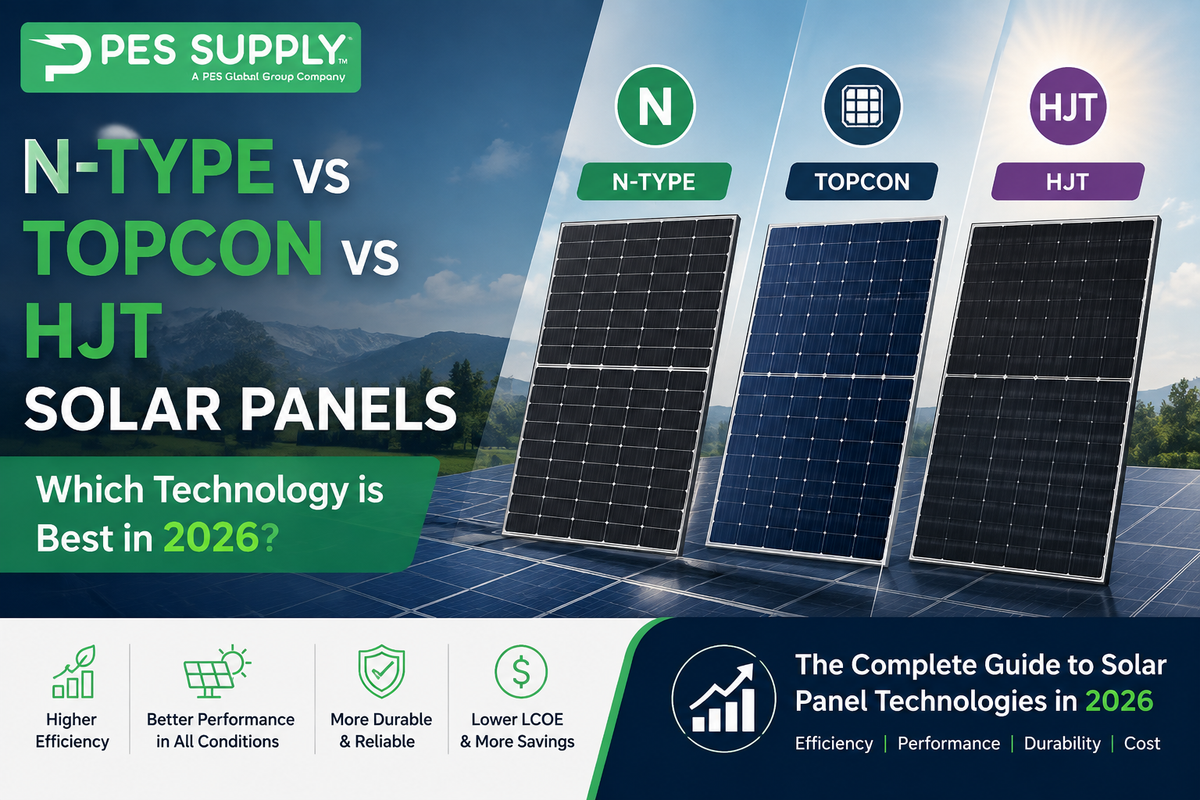
The solar panel market has moved beyond traditional P-type PERC. In 2026, most high-performance modules are built around N-type silicon, with TOPCon and HJT representing two of the most important N-type cell architectures available to installers, developers, and commercial solar buyers.
But there is an important distinction: N-type is not a competing technology to TOPCon or HJT. N-type describes the silicon wafer's doping type, while TOPCon and HJT describe how the solar cell is constructed around that wafer. Most modern TOPCon and HJT panels are therefore N-type panels. The real 2026 purchasing decision is usually mainstream N-type TOPCon versus premium N-type HJT — with efficiency, temperature performance, bifaciality, degradation, price, supply availability, and project type determining the winner.
⚡ Quick Answer
For most solar projects in 2026, N-type TOPCon offers the best overall balance of price, efficiency, availability, bifacial performance, and bankability. HJT remains one of the strongest premium technologies where low temperature coefficients, high bifaciality, low degradation, and maximum lifetime energy yield justify a higher module cost. If a panel is simply labeled "N-type," check the datasheet — it will often use TOPCon, HJT, back-contact, or another N-type architecture.
Key Takeaways for N-Type, TOPCon and HJT
- N-Type Is the Foundation: TOPCon and HJT are generally N-type cell technologies rather than alternatives to N-type silicon.
- TOPCon Is the 2026 Mainstream Winner: It combines high efficiency, strong bifacial performance and relatively low manufacturing cost with enormous global production capacity.
- HJT Wins in Heat: Premium HJT modules can offer temperature coefficients around -0.24% to -0.26%/°C, providing an advantage on very hot roofs and utility-scale projects in high-temperature climates.
- Efficiency Is No Longer a Simple HJT Win: Advanced TOPCon modules have closed much of the historical efficiency gap and some new-generation products now exceed 23% module efficiency.
- Bifacial Performance Is Strong on Both: High-quality TOPCon and HJT modules can deliver excellent rear-side power production when installed over reflective surfaces.
- TOPCon Usually Wins on $/W: Manufacturing compatibility and enormous production scale generally make TOPCon more cost-effective for mainstream residential, commercial and utility installations.
- HJT Remains a Premium Engineering Choice: HJT is especially attractive for heat-sensitive installations, high-value rooftops and projects prioritizing long-term energy yield over lowest initial module cost.
- PES Supply: Contractors and EPCs can source N-type, TOPCon and premium high-efficiency solar modules alongside inverters, racking, storage and complete project equipment through PES Supply.
In This Guide
- First: N-Type, TOPCon and HJT Are Not the Same Category
- The Short Verdict
- How Each Technology Works
- N-Type TOPCon vs HJT Comparison
- Efficiency
- Temperature Performance
- Degradation & Long-Term Output
- Bifacial Performance
- Cost & Manufacturing
- Best Technology by Application
- What to Look for When Buying
- 2026 Decision Framework
- Frequently Asked Questions
- Sources
First: N-Type, TOPCon and HJT Are Not the Same Category
One of the most common mistakes in solar marketing is comparing N-type vs TOPCon vs HJT as though they are three completely separate cell technologies.
They are not.
N-type describes the silicon wafer. TOPCon and HJT describe cell architectures that are commonly built using N-type silicon.
Traditional PERC cells were largely manufactured using P-type silicon. N-type silicon is doped primarily with phosphorus and avoids the boron-oxygen defect historically associated with conventional P-type wafers. That gives modern N-type technologies attractive characteristics including reduced susceptibility to certain forms of light-induced degradation, high carrier lifetime and strong efficiency potential.
TOPCon and HJT then take that N-type wafer and apply different passivation, contact and layer structures to improve how efficiently electrons move through the cell.
The Short Verdict
Choose N-Type TOPCon If…
You want excellent efficiency and bifacial performance at competitive module pricing, broad manufacturer selection, strong commercial availability and a technology proven across residential, commercial and utility-scale projects.
Choose HJT If…
You are optimizing for premium thermal performance, high bifaciality, strong lifetime energy production and low degradation, and the project economics can support a potentially higher module acquisition cost.
⚠ The 2026 Reality
Do not choose a panel based only on the words "N-type," "TOPCon" or "HJT." Manufacturer quality, module design, warranty terms, temperature coefficient, degradation guarantee, glass configuration, bifaciality, certifications, logistics and actual project pricing can matter more than the cell architecture alone.
How the Technologies Work
N-Type Silicon
N-type silicon wafers are doped primarily with phosphorus, making electrons the majority charge carriers. Compared with the P-type wafers that dominated the PERC era, N-type wafers offer high carrier lifetime and avoid the classic boron-oxygen light-induced degradation mechanism associated with conventional P-type silicon.
N-type therefore acts as the foundation for several modern high-efficiency technologies rather than representing one specific panel design.
TOPCon — Tunnel Oxide Passivated Contact
TOPCon adds an ultra-thin tunnel oxide and passivated contact layer to reduce electron recombination at the rear surface of the solar cell. This allows more of the energy captured from sunlight to become usable electrical power.
One reason TOPCon expanded so rapidly is manufacturing compatibility. Producers were able to adapt significant portions of existing crystalline-silicon manufacturing infrastructure instead of replacing the complete production architecture.
That combination of performance and manufacturing economics helped TOPCon become one of the dominant module technologies of the mid-2020s.
HJT — Heterojunction Technology
HJT combines a crystalline silicon wafer with very thin amorphous silicon layers. The resulting heterojunction structure provides excellent surface passivation and can reduce electrical losses inside the cell.
HJT is particularly known for its favorable temperature coefficient, bifacial potential and strong efficiency ceiling. The manufacturing process is also relatively low-temperature compared with some conventional crystalline-silicon cell processes.
The trade-off has historically been production cost, specialized equipment and metallization requirements, although continuing manufacturing innovation is narrowing those disadvantages.
N-Type TOPCon vs HJT: 2026 Comparison
| Factor | N-Type | N-Type TOPCon | N-Type HJT |
|---|---|---|---|
| What is it? | Silicon wafer type | Passivated-contact cell architecture | Crystalline + amorphous silicon heterojunction |
| Market position | Foundation of modern premium cells | Mass-market high efficiency | Premium high-performance segment |
| Typical module efficiency | Depends on architecture | Often ~22–24%+, depending on model | Often ~22–24%+, depending on model |
| Temperature coefficient | Architecture dependent | Commonly around -0.26 to -0.30%/°C | Premium products around -0.24 to -0.26%/°C |
| Bifacial capability | Architecture dependent | Excellent | Excellent / very high potential |
| LID resistance | Generally strong | Strong | Strong |
| Low-light performance | Architecture dependent | Very good | Very good |
| Manufacturing scale | Very large | Extremely large | Smaller than TOPCon |
| Module pricing | Varies | Usually more competitive | Often premium-priced |
| Best use | Depends on cell architecture | Residential, C&I and utility projects | Premium roofs, hot climates and high-value projects |
| 2026 overall verdict | Look deeper than the label | Best overall value | Premium performance choice |
Actual efficiency, temperature coefficient, bifaciality and degradation vary by manufacturer and module model. Always use the current manufacturer datasheet when engineering a system.
1. Efficiency: TOPCon Has Closed the Gap
HJT has historically been associated with some of the highest commercial module efficiencies, but the gap is much smaller in 2026.
New-generation TOPCon modules have pushed well beyond the efficiency levels associated with earlier N-type products. Depending on manufacturer, module size and product class, premium commercial TOPCon products can exceed 23% module efficiency, with some next-generation platforms advertising still higher figures.
HJT continues to compete at the premium end. REC Alpha Pure-RX, for example, combines HJT architecture with up to 22.6% efficiency in a compact residential form factor, while newer large-format HJT modules from other manufacturers can exceed 24%.
2. Temperature Performance: HJT's Traditional Strength
Solar panels are tested at a cell temperature of 25°C, but operating cells on a sunny roof can become much hotter. As temperature rises, module power falls.
The temperature coefficient tells you approximately how much output is lost for every degree Celsius above standard test conditions.
Example:
Premium HJT: approximately -0.24% to -0.26%/°C
Modern TOPCon: approximately -0.26% to -0.30%/°C
Older P-type PERC: often approximately -0.34%/°C or worse
On a very hot roof, a few hundredths of a percent per degree can become meaningful across thousands of operating hours and 25–30 years of system life.
For projects in Arizona, Texas, Nevada, Southern California and other hot environments, temperature coefficient deserves particular attention.
TOPCon performance is also improving. Some current-generation TOPCon platforms are reaching approximately -0.26%/°C, narrowing an advantage that was previously much larger.
3. Degradation & Long-Term Output
The panel with the highest day-one wattage is not necessarily the panel that generates the most electricity over 30 years.
N-type technologies were adopted partly because of their resistance to degradation mechanisms associated with traditional P-type silicon. Premium TOPCon and HJT manufacturers now routinely offer long linear performance warranties.
However, buyers should be careful about declaring one architecture universally superior. Real degradation depends on cell processing, encapsulation, glass, backsheets, metallization, moisture protection, UV stability and overall module manufacturing quality.
Compare the actual manufacturer's first-year degradation allowance, annual degradation guarantee and final warranted output instead of assuming every TOPCon or HJT product performs identically.
4. Bifacial Performance
Both TOPCon and HJT work extremely well in bifacial applications because N-type architectures can achieve strong rear-side response.
That matters for ground mounts, commercial flat roofs with reflective membranes, solar canopies, carports, trackers and installations over high-albedo terrain.
Some current TOPCon platforms advertise bifaciality around 80% or higher, while HJT products can also reach very high bifaciality.
But the module's bifaciality rating is only one part of the equation. Actual rear-side energy depends heavily on:
- Ground reflectivity or roof membrane color
- Module height above the surface
- Row spacing
- Tilt angle
- Racking geometry
- Rear-side shading
- Tracker configuration
5. Low-Light Performance
Modern N-type panels generally perform well under lower irradiance conditions, helping systems produce power during mornings, evenings, cloudy weather and seasonal low-sun conditions.
This is particularly relevant in the Pacific Northwest and other regions where annual irradiance profiles are very different from desert markets.
For buyers comparing low-light claims, standardized manufacturer curves and independent field testing are more meaningful than broad claims that one entire technology always beats another.
6. Cost & Manufacturing: TOPCon's Biggest Advantage
This is where TOPCon changed the global solar market.
TOPCon provides a substantial efficiency improvement over the previous PERC generation while retaining greater compatibility with conventional crystalline-silicon manufacturing infrastructure than HJT.
As production expanded, TOPCon achieved enormous economies of scale. The result is high-efficiency N-type solar panels available at pricing that would previously have been associated with much lower-performance modules.
HJT manufacturing requires a different process flow and specialized equipment. HJT's low-temperature manufacturing can provide important technical and environmental advantages, but manufacturing economics have historically made the technology more expensive.
TOPCon vs HJT: Who Wins Each Category?
| Category | Winner | Why |
|---|---|---|
| Purchase Price | TOPCon | Massive manufacturing scale and competitive $/W. |
| Availability | TOPCon | Very broad manufacturer and distributor availability. |
| Heat Performance | HJT | Premium HJT maintains exceptionally low temperature coefficients. |
| Bifacial Potential | Tie / Model Dependent | Premium versions of both technologies offer excellent bifacial response. |
| Efficiency | Model Dependent | Leading TOPCon and HJT products now overlap substantially. |
| Residential Value | TOPCon | Strong efficiency without requiring premium HJT pricing. |
| Premium Residential | HJT / Premium TOPCon | Depends on roof area, warranty, thermal environment and price. |
| Utility Scale Value | TOPCon | Strong bankability, high bifacial output and competitive procurement economics. |
| Extreme Hot Climate | HJT | Lower power loss as cell temperature increases. |
Best Solar Technology by Application
Residential Rooftops
For most homeowners, a high-quality TOPCon module is likely to offer the best combination of efficiency, aesthetics, warranty and price in 2026.
Premium HJT becomes particularly attractive when usable roof area is constrained, roof temperatures are very high, or the homeowner prioritizes premium lifetime performance.
Commercial & Industrial Roofs
TOPCon is extremely compelling for C&I installations because competitive module cost, high wattage and broad supply can improve project economics.
HJT can still make sense for hot membrane roofs and high-value sites where additional energy yield offsets the initial premium.
Utility-Scale Solar
Utility projects evaluate more than module efficiency. EPCs model module price, bifacial energy gain, degradation, tracker compatibility, shipping density, bankability, balance-of-system costs and long-term LCOE.
TOPCon's manufacturing scale and bifacial characteristics make it one of the strongest utility-scale choices in 2026.
Hot Desert Projects
HJT deserves special attention where operating temperatures remain extremely high because a better temperature coefficient can translate into additional lifetime kilowatt-hours.
However, next-generation TOPCon modules have improved substantially, so actual energy-model results should determine the choice rather than architecture alone.
What to Look for When Buying N-Type Solar Panels
Do not stop at the cell-technology label. Compare these specifications directly:
- Module efficiency
- Watts per square foot / power density
- Pmax temperature coefficient
- First-year degradation
- Annual warranted degradation
- Year-25 or year-30 warranted output
- Bifaciality for bifacial projects
- Snow and wind load ratings
- Hail certification
- Product warranty
- Performance warranty
- Labor coverage, if offered
- Manufacturer bankability
- Domestic-content eligibility, when relevant
- Lead time and replacement availability
- Actual delivered cost per watt
Technology Doesn't Replace Manufacturer Quality
A premium, well-engineered TOPCon module can be a better investment than a poorly manufactured HJT panel, and a premium HJT panel can outperform a commodity TOPCon product. Cell technology matters — but materials, manufacturing quality, quality control, certification, warranty backing and system engineering matter too.
The 2026 Decision Framework
Choose TOPCon When:
- You want the best overall price-to-performance ratio.
- Large-volume availability is important.
- You are building residential, C&I or utility-scale projects.
- Bifacial performance matters.
- You want broad manufacturer choice.
- Initial module $/W is a significant project constraint.
Choose HJT When:
- Temperature coefficient is a major design priority.
- The installation experiences very high module temperatures.
- Maximum lifetime energy yield is more important than lowest initial cost.
- You need premium efficiency or power density.
- High bifaciality is valuable to the system design.
- The module's warranty and manufacturer justify its premium.
If a Panel Only Says "N-Type":
Read the datasheet. Determine whether the cells use TOPCon, HJT, back-contact or another architecture. "N-type" alone does not tell you enough to compare performance.
🏆 Our 2026 Verdict
Best Overall Technology for Most Projects: N-Type TOPCon
TOPCon combines high module efficiency, strong low-light characteristics, excellent bifacial capability, improved temperature behavior, competitive degradation warranties, massive production scale and attractive pricing.
Best Premium Technology for Heat & Lifetime Performance: HJT
HJT remains an outstanding premium platform, particularly where low temperature coefficient and high lifetime energy production create enough value to justify its pricing. The correct decision should ultimately come from comparing actual module datasheets and project economics rather than choosing a cell acronym.
Source Solar Panels & Complete Systems from PES Supply
PES Supply works with contractors, EPCs, installers, developers and commercial buyers sourcing modern high-efficiency solar equipment for projects across the United States.
Our solar procurement capabilities include:
- N-type solar panels
- TOPCon solar panels
- HJT and premium high-efficiency modules
- Bifacial solar modules
- Commercial and utility-scale modules
- Microinverters and string inverters
- Battery energy storage systems
- Solar racking and mounting equipment
- Electrical balance-of-system equipment
- Commercial switchgear and breakers
- EV charging equipment
- Complete project procurement packages
Frequently Asked Questions
Is N-type better than TOPCon?
This is not a direct comparison. TOPCon solar cells are generally built using N-type silicon. N-type describes the silicon wafer, while TOPCon describes the cell architecture applied to it.
Is TOPCon an N-type solar panel?
Yes. Most modern TOPCon modules use N-type silicon wafers. Their tunnel-oxide passivated contact structure improves carrier collection and reduces recombination losses.
Is HJT an N-type technology?
Commercial HJT solar modules are typically based on N-type crystalline silicon wafers combined with thin amorphous-silicon layers that form the heterojunction.
Which is better, TOPCon or HJT solar panels?
TOPCon is generally the better overall value in 2026 because of its combination of high efficiency, large manufacturing scale and competitive pricing. HJT may be better for premium projects where superior temperature behavior and lifetime energy production justify a higher module cost.
Which solar panel technology has the highest efficiency?
There is no single universal winner based only on architecture. Leading commercial TOPCon, HJT and advanced back-contact products can all achieve very high module efficiencies. Compare actual certified module efficiency and power density rather than assuming one technology always leads.
Which solar panels are best for hot climates?
HJT panels are particularly attractive in hot climates because premium modules can have Pmax temperature coefficients around -0.24% to -0.26%/°C. Modern TOPCon products have also improved considerably, with some approaching approximately -0.26%/°C.
Are TOPCon panels better than PERC?
For most new high-performance installations, TOPCon provides advantages over traditional P-type PERC including higher efficiency potential, lower susceptibility to classic LID, improved temperature behavior, strong bifaciality and competitive long-term degradation characteristics.
Are HJT panels worth the extra cost?
They can be. HJT makes the most sense when better temperature performance, premium power density, high bifacial response or additional lifetime energy production has enough financial value to offset a higher upfront module price.
What is the best solar panel technology in 2026?
For most residential, commercial and utility applications, N-type TOPCon offers the strongest overall balance of performance, availability and cost in 2026. HJT remains one of the strongest premium alternatives for applications prioritizing thermal performance and long-term energy yield.
Where can contractors buy N-type, TOPCon and HJT solar panels?
PES Supply serves contractors, installers, EPCs, developers and commercial buyers sourcing solar panels, inverters, battery systems, racking and electrical equipment. Bulk and project pricing can be requested through the PES Supply quote team.
Sources & Technical References
- National Renewable Energy Laboratory (NREL) — research and technology assessments covering the transition from P-type to N-type crystalline-silicon photovoltaic technologies.
- JinkoSolar — Tiger Neo / Tiger Neo 3.0 N-type TOPCon product specifications and technical documentation.
- REC Group — REC Alpha Pure and Alpha Pure-RX heterojunction product datasheets and technical documentation.
- Canadian Solar — TOPCon technical white papers, TOPBiHiKu product documentation and HiHero HJT module datasheets.
- LONGi — crystalline-silicon technology comparisons and technical literature covering PERC, TOPCon, HJT and back-contact architectures.
- Manufacturer warranty documentation and module datasheets available as of August 2026.
Need N-Type, TOPCon or HJT Solar Panels for Your Next Project?
PES Supply helps installers, EPCs, contractors, developers and commercial buyers compare solar modules based on actual project economics — including efficiency, temperature coefficient, bifacial performance, warranty, availability and delivered cost per watt. Request project pricing for panels, inverters, storage, racking and complete electrical packages.
Request a Bulk Quote Shop Solar PanelsRelated Solar Guides
About PES Supply
PES Supply is a nationwide supplier of solar panels, commercial inverters, battery storage systems, EV charging equipment, racking, switchgear, circuit breakers, generators and complete electrical project packages. PES Supply supports contractors, EPCs, developers and businesses with wholesale procurement, equipment sourcing and project support.
Location: 1507 Portland Ave, Louisville, KY, United States | Phone: 1 888-876-0007 | Website: www.portlandiaelectric.supply
Article: N-Type vs TOPCon vs HJT Solar Panels: Which Technology Is Best in 2026?
Category: Solar Panels | Solar Technology | Product Comparison
Last Updated: August 2026
Disclaimer: Solar module specifications, efficiencies, temperature coefficients, warranties, product availability and pricing can change. Values in this guide represent examples and typical ranges based on manufacturer information available as of August 2026. Always verify the current manufacturer datasheet and warranty before finalizing system engineering or procurement.