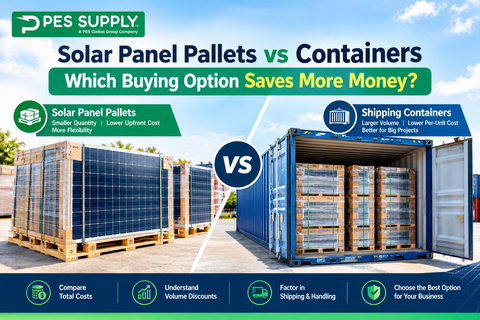
Solar equipment procurement in 2026 is a different discipline than it was even two years ago. Module prices hit historic lows and stayed there, domestic content rules reshuffled supply chains, tariffs moved twice, and the installers who thrived were the ones who treated sourcing as a strategy instead of a series of emergency purchases. We sit in the middle of this market as a wholesale supplier, so we see both sides: the distributors' inventory positions and the contractors' pain. This is the playbook we run ourselves and recommend to every installer and developer we supply.
The 2026 Market Reality in Numbers
Module pricing spent 2025 grinding along the bottom. Chinese TOPCon modules traded around 0.70–0.74 RMB/W through the year, with periodic policy-driven blips as Beijing pushed consolidation among manufacturers. The practical translation for US buyers: global oversupply persists, but the prices you actually pay are dominated less by cell costs and more by tariffs, logistics, and domestic-content premiums.
| Module Category | Price (RMB/W) | Trend |
|---|---|---|
| China TOPCon (average) | 0.72 | −1.1% |
| Ground-mounted TOPCon | 0.70 | −1.4% |
| Distributed-project TOPCon | 0.74 | −0.7% |
| India-assembled TOPCon | Premium 15–25% over China | Stable |
| US-assembled modules | Premium 40–80% over China | Rising demand from domestic-content adders |
The strategic read: commodity TOPCon is cheap and staying cheap, but tariff exposure makes country of origin a financial variable, not a footnote. Section 201 and 301 tariffs, AD/CVD cases on Southeast Asian imports, and the UFLPA's enforcement on polysilicon sourcing all move landed costs by double-digit percentages. A procurement strategy that ignores trade policy is a budget waiting to be ambushed.
Supplier Qualification: The Minimum Bar in 2026
We qualify every product line we stock against a checklist that has saved us from more bad inventory than any price negotiation ever cost:
| Evaluation Criterion | Minimum Standard (2026) | Premium Standard |
|---|---|---|
| BloombergNEF Tier 1 | Yes (current list) | Yes + PVEL Top Performer in relevant categories |
| UL listing | UL 61730 (panels) | UL 61730 + IEC 61215/61730 with published test reports |
| Warranty terms | 12–15 yr product / 25–30 yr performance | 25 yr product / 30 yr performance, insurance-backed |
| Degradation spec | ≤1% year 1, ≤0.45%/yr after (N-type) | ≤1% year 1, ≤0.40%/yr, 87%+ at year 30 |
| Manufacturer financials | Positive operating cash flow | Investment-grade or bankable per independent audit |
| Traceability | UFLPA-compliant polysilicon documentation | Full supply chain mapping published |
| US service presence | Claims process with US contact | US warehouse + dedicated claims staff |
The financial-strength row is the one new buyers skip and experienced buyers check first. A 25-year performance warranty from a manufacturer that won't exist in 2029 is marketing copy. The industry's consolidation wave — with second-tier Chinese makers exiting or merging — made manufacturer survivability analysis part of procurement, like it or not. We track which of our stocked lines carry third-party insured warranties specifically for customers building projects that need financing-grade paper.
Sourcing Routes and Their Real Lead Times
Where you buy determines when you build. The channels, honestly assessed:
| Sourcing Route | Typical Lead Time | Risk Factors |
|---|---|---|
| US warehouse stock (PES Supply and peers) | 7–10 business days | Inventory availability; order early for large quantities |
| Domestic manufacturer direct | 8–16 weeks | Allocation during demand spikes; premium pricing |
| Import direct (container) | 10–16 weeks door-to-door | Tariff shifts, customs holds, minimum order volumes, quality risk without inspection |
| Broker/spot market | 1–4 weeks | Mixed-date-code pallets, gray-market warranty gaps, counterfeit relabeling on premium brands |
A word on the spot market, because we get asked weekly: those "too good" pallet deals on name-brand modules are sometimes legitimate factory overruns and sometimes containers that failed someone else's inspection. If you buy spot, verify serial numbers with the manufacturer before paying, demand date-code consistency within a pallet, and understand that warranty claims on gray-market modules get politely declined more often than not. The savings are real; so is the risk. Price it accordingly.
The Domestic Content Calculus
The 10-point ITC adder for domestic content changed procurement math at the project level. On a $1.80/W commercial install, the adder is worth roughly $0.18/W — which covers a substantial domestic premium on modules and racking. The qualification rules (adjusted percentage method, with the manufactured-products threshold at 40% for projects starting construction in 2025 and rising to 55% by 2027) mean the bill of materials needs planning, not hope. We stock documented domestic-content-eligible options — modules like the Silfab NTC 530W and US-made racking lines — precisely because customers building adder-qualified projects need the paper trail, not just the hardware. Get the manufacturer's domestic content certification letter in the project file before construction starts; retrofitting documentation after the fact ranges from painful to impossible.
Inventory Strategy: What to Stock, What to Order Per-Project
Installers ask us where the stocking line should be. Our answer, refined over years of watching both sides:
| Category | Examples | Stocking Strategy |
|---|---|---|
| Long-lead items | Modules, inverters, batteries | Order per project with 4+ week lead time; maintain 1–2 week buffer on your highest-velocity SKU only |
| Balance of system | Racking, wire, disconnects, breakers, rapid-shutdown devices | Stock 2–4 weeks of standard items; the install that stalls for a $40 fitting loses more than the inventory carrying cost |
| Consumables | Wire management, lugs, sealants, labels | Stock deep; cheap, compact, and universal across jobs |
| Service spares | One spare inverter per fleet platform, spare optimizers/MLPE, spare monitoring gateways | Stock always; a two-week RMA wait costs you a customer relationship |
The discipline that separates profitable shops: inventory is a service tool, not a speculation vehicle. We watched installers load up on commodity modules in early 2025 expecting prices to rebound; prices slid further, and they carried depreciating inventory while competitors bought cheaper every month. In a falling or flat price environment, just-in-time beats warehouse-full. The exception is tariff-driven: when a trade case filing telegraphs a duty increase with an effective date, pre-positioning three months of volume ahead of the date is rational — that's buying insurance with a known premium, not gambling.
Total Landed Cost: The Only Number That Matters
New procurement people compare module prices. Experienced ones compare total landed cost per installed watt. The difference between the two numbers is where margins leak:
| Cost Component | Typical Range (% of module price) | How to Control It |
|---|---|---|
| Module base price | 100% (reference) | Volume commitments, payment terms, off-season ordering |
| Freight to site/warehouse | +4–9% | Full-pallet and full-truck quantities; consolidate SKUs per shipment |
| Tariffs and duties (import direct) | +14–40%+ depending on origin | Origin strategy; buy from US-stock distributors who already absorbed it |
| Damage and shrinkage | +1–3% | Receiving inspection protocol; photograph pallets before signing the BOL |
| Carrying cost | +0.5–1%/month of inventory value | Just-in-time ordering on project items |
| Warranty risk premium | +0–5% | Financial-strength screening; insured warranties for financed projects |
| Payment terms value | −1–3% | Net-30/60 terms from established supplier relationships |
Run every quote through this table. A module priced 4% cheaper that ships in mixed partial pallets with COD terms and no US warranty presence is not 4% cheaper — it's usually 3% more expensive with worse risk. The cheapest watt is the one that arrives on time, undamaged, with paperwork that survives an audit.
Negotiation: What Actually Moves Distributor Pricing
Contractors assume price negotiation with distributors works like car buying — push hard, threaten to walk, get a discount. It doesn't. Distributor margins on commodity modules run low single digits; there's no 15% hiding anywhere. What actually moves your number: committed volume over a quarter (a standing 2-pallet-a-month commitment earns better pricing than a one-time 10-pallet order with no follow-on), payment speed (net-15 payers get better pricing than net-60 payers — the financing cost is priced in), SKU consolidation (one module type across your jobs simplifies the distributor's inventory and earns a break), and freight cooperation (flexible delivery windows that allow full-truck consolidation). The installers who get our best pricing didn't negotiate harder — they made themselves cheaper to serve.
Receiving and Quality Assurance: The Fifteen Minutes That Save Thousands
Every receiving dock should run the same protocol, every time. Photograph the pallet labels and serial-number stickers before the truck leaves — this is your evidence chain for damage claims and your verification for authenticity. Count cartons against the packing list before signing the bill of lading; note any discrepancy on the BOL itself, because "subject to count" notations signed without inspection are claim-killers. Open one carton per pallet for flash-test and visual inspection on project-critical orders. Check date codes: mixed date codes within a pallet are a spot-market red flag and a cosmetic-matching problem on visible arrays. And file the paperwork where a human can find it — the warranty claim you file in 2031 needs the delivery documentation you're generating today.
Flash testing deserves its own sentence for container-scale buyers. A $4,000 flash tester or a third-party inspection at the port catches the 1–2% of modules that arrive below nameplate. On a 500-module order, that's ten modules of guaranteed future dispute — found now, they're the supplier's problem; found at commissioning, they're yours.
Contract Structures for Volatile Markets
Fixed-price-forever contracts are fiction in a market with active trade cases. The structures that work: price-validity windows (quote valid 14–30 days, honestly enforced both directions), tariff pass-through clauses for import-direct purchases (share the risk explicitly rather than letting it nuke a fixed bid), and blanket purchase orders with scheduled releases for multi-project programs (lock volume and pricing framework, release equipment per project schedule). Avoid prepayment beyond standard deposits on import deals with new counterparties; escrow and letter-of-credit structures exist for a reason, and the reason is the container that never shipped. On the distributor side, straightforward honesty does the work: tell us your project pipeline and we'll tell you what's genuinely reservable.
Relationship Strategy: The Unpriced Asset
Here's the part procurement spreadsheets miss. During the 2021–2022 allocation crunch, installers with real supplier relationships got modules; installers who'd spent years squeezing every nickel out of rotating vendors got voicemail. Allocation follows relationship history. Payment behavior, forecast honesty, and repeat volume are the currency — suppliers remember who pays in 30 days and whose "forecast" is fiction.
Practical relationship investments that pay out: share your 90-day demand forecast and update it monthly (even a rough one moves you up the allocation list), consolidate purchases with two primary suppliers instead of five casual ones, pay on time and say something when you can't, and visit — the installers who've walked our warehouse get their emergency orders pulled first, and every distributor we know runs the same way. That's not corruption; it's how humans allocate scarcity.
The 2026 Watchlist: What's Coming
Four trends worth building into your strategy now. First, continued consolidation among module manufacturers — expect two to four more second-tier exits, and re-run financial screening on any supplier annually. Second, the domestic-content threshold climbs again in 2027 (to 55%), so projects with 2027 start dates need their bills of materials planned against the higher bar today. Third, battery storage procurement is converging with module procurement as LFP cell supply normalizes — bundled module-plus-storage deals from single suppliers simplify logistics but concentrate risk; split them unless the bundle pricing is genuinely better. Fourth, trade policy remains the wild card: new AD/CVD petitions and tariff adjustments can move landed costs 15–30% with a few months' notice, which argues for flexible contracts and shorter commitment windows on import-exposed product categories.
Category-Specific Notes: Modules, Inverters, Batteries, Racking
Each equipment category carries its own procurement quirks. Modules: watch wattage-class transitions — as manufacturers shift production lines to new formats, last-generation wattage classes go on sale and then go extinct; buying into a dying format saves money today and complicates matching replacements in five years. Inverters: lead times on commercial three-phase units stretch during construction season, firmware support lifespan matters more than anyone admits (ask how long the manufacturer commits to monitoring-platform support), and one spare unit per platform belongs in every service fleet. Batteries: LFP cell supply normalized through 2025, but pack-level integration quality varies wildly — buy batteries on cycle-life warranty terms and thermal-management design, not nameplate kWh, and see our battery life guide for what the good ones do right. Racking: boring until the wind tunnel report is missing — buy racking with published PE-stamped calculations for your wind zones and never accept "engineered equivalent" without the stamps.
Building Your Procurement Calendar
Seasonality still matters. Module demand peaks in Q3–Q4 as projects race to year-end completion; order Q4 projects by early September. Freight rates soften in late winter — the best shipping economics of the year for import-direct buyers. Trade-case calendars are public: preliminary determination dates, effective dates, comment windows — put them on the same calendar as your project deadlines. And your supplier relationships deserve calendar entries too: quarterly forecast reviews, an annual pricing conversation, and a warehouse visit once a year. Procurement run on a calendar beats procurement run on adrenaline every single quarter.
Five Procurement Mistakes We Watch Installers Repeat
First: buying on sticker price and ignoring landed cost — the freight, terms, and risk math from the table above flips more "deals" than it confirms. Second: mixing module SKUs across a single project to save pennies, then discovering at layout that two wattage classes with different dimensions don't share rows. Third: no receiving protocol — signing clean BOLs on damaged pallets converts supplier liability into installer cost instantly. Fourth: single-sourcing a critical category with no qualified backup; allocation events don't announce themselves in advance. Fifth: treating the distributor relationship as adversarial when the actual leverage comes from volume, payment speed, and forecast honesty. None of these require genius to fix. They require a checklist and the discipline to use it when the schedule is screaming.
The Bottom Line
And a note on documentation culture: the shops that run procurement well keep a simple file per project — quotes, BOLs, serial photos, certification letters. The file feels like overhead until the first warranty audit or insurance claim, when it becomes the whole game.
Procurement strategy in 2026 comes down to five disciplines: qualify suppliers on financial survivability, not just spec sheets; calculate total landed cost on every comparison; match the sourcing channel to the project timeline; stock for service, not speculation; and invest in supplier relationships before you need them. The installers who run these five plays survived every market swing of the past six years — oversupply, shortage, tariff shock, all of it. If you want a supply partner who thinks this way, start a conversation with us. Browse current inventory in solar panels, inverters, battery storage, and charge controllers. Related reading: our installer vetting guide from the customer side, the panel degradation analysis that informs warranty evaluation, and the system components overview for building complete BOMs.