Last Updated: May 2026 • Case Study: Nestlé Agri-PV System, Biessenhofen, Germany
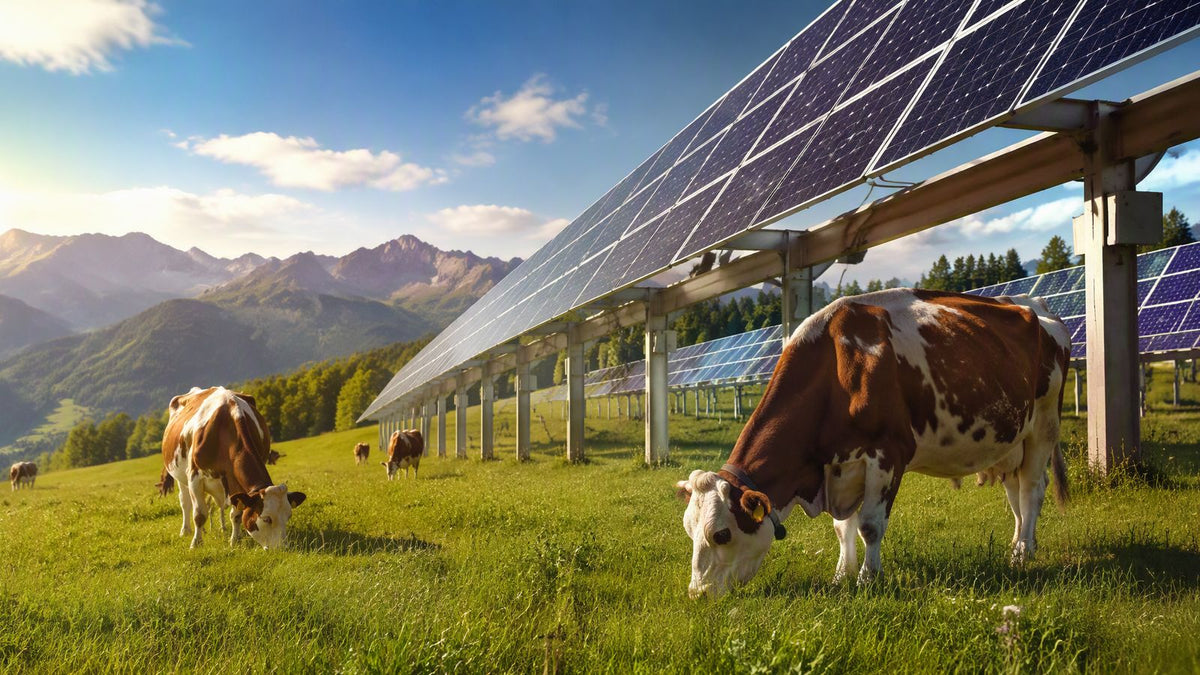
Can cows graze under solar panels while a factory runs on green electricity? In the Allgäu region of Bavaria, Germany, Nestlé has proven that the answer is yes. Together with renewable energy partner BayWa r.e. and local farmer Gerhard Metz, Nestlé has opened a fully operational agri-photovoltaic (Agri-PV) system in Biessenhofen one of the most compelling real-world examples of how solar energy and agricultural land use can coexist productively on the same ground.
This article explores how the Nestlé Biessenhofen Cow-PV system works, what Agri-PV technology means for the future of food production and renewable energy, and how installers, EPCs, and developers can apply the same principles to agricultural solar projects in the United States and globally.
⚡ Quick Summary
Nestlé's Agri-PV system in Biessenhofen, Germany covers the equivalent of ~7 football fields, generates solar electricity covering approximately 25% of the local factory's energy needs, and simultaneously maintains active grazing land for dairy cattle. The "Cow-PV" system combines renewable energy generation with shade provision for livestock a dual-use model that is rapidly gaining adoption across Europe and the US agricultural solar market.
Key Takeaways
- Agri-PV installs solar panels at elevated heights (typically 4–6 meters) over active agricultural land enabling simultaneous energy production and farming below. >
- The Biessenhofen system covers ~25% of the factory's electricity demand, reducing grid dependency and CO₂ emissions. >
- Elevated panels provide natural shade for cows reducing heat stress, improving animal welfare, and in some studies increasing milk yield. >
- The project supports heat pump operation and waste heat reuse compounding the CO₂ reduction beyond direct solar generation. >
- Agri-PV is one of the fastest-growing solar deployment categories globally, with installed capacity expected to exceed 10 GW in Europe by 2030. >
- The project demonstrates how food manufacturers, renewable energy developers (BayWa r.e.), and local farmers can co-develop projects that serve multiple stakeholder interests simultaneously. >
- USDA and DOE programs are actively funding Agri-PV research and deployment creating significant opportunities for US solar installers and EPCs serving agricultural clients.
In This Article
In the Allgäu region of Bavaria one of Germany's most productive dairy farming areas Nestlé has commissioned a solar installation that challenges the traditional assumption that solar panels and farmland are mutually exclusive. The Biessenhofen Cow-PV system was developed in partnership with BayWa r.e., one of Europe's leading renewable energy project developers, and operated in close collaboration with local farmer Gerhard Metz, whose cattle continue to graze the land beneath the elevated solar array.
The system spans an area equivalent to approximately seven football fields and generates enough electricity to cover around 25% of the energy needs of Nestlé's adjacent production facility. As Jörg Schmitt of Nestlé noted at the project opening: "Our Cow-PV system shows how energy generation and agricultural use can work hand in hand. For us, this is more than just an energy project it shows how solutions can tackle multiple challenges at once, together with strong partners and local agriculture."
Project Fast Facts Nestlé Biessenhofen Cow-PV
- Location: Biessenhofen, Allgäu, Bavaria, Germany >
- Nestlé, BayWa r.e., Farmer Gerhard Metz >
- Agri-Photovoltaic (Agri-PV) elevated solar over active grazing land >
- ~7 football fields of panel coverage >
- ~25% of Nestlé Biessenhofen factory electricity demand >
- Active dairy cattle grazing maintained beneath panels >
- Solar panels provide natural shade, reducing heat stress in cattle >
- Heat pump integration and waste heat reuse
Agri-photovoltaics (Agri-PV), also called agrivoltaics, is the simultaneous use of land for both solar photovoltaic energy production and agricultural purposes. Instead of covering productive farmland entirely with ground-mounted panels as a conventional solar farm does, Agri-PV systems elevate the panels on taller structures typically 4–6 meters above ground allowing crops, vegetables, fruit trees, or livestock to continue operating in the same space beneath.
The concept was first demonstrated in 1981 by German researchers Adolf Goetzberger and Armin Zastrow, who identified that the partial shading provided by solar panels could actually benefit certain crops by reducing water stress in hot climates. Modern Agri-PV systems have evolved significantly from that original concept, with purpose-engineered elevated mounting structures, bifacial panels optimized for dual-surface irradiance capture, and sophisticated monitoring systems that track both energy production and agricultural outcomes simultaneously.
The Biessenhofen system is specifically designed for livestock Agri-PV a subtype optimized for grazing animals rather than row crops. Solar panels are mounted on elevated structures at sufficient height to allow cattle to move freely beneath without obstruction. The panel layout is designed to maximize solar energy capture while maintaining sufficient ground-level light penetration to sustain healthy grass growth for grazing.
☀️ Sunlight hits elevated solar panels at 4–6m height
↓
⚡ Panels convert sunlight → DC electricity → inverter → AC for factory use
↓ (simultaneously)
🌿 Partial shade passes through panel gaps → sustains grass growth below
↓
🐄 Cattle graze freely beneath the array panels provide natural shade canopy
↓
🏭 Factory receives ~25% of electricity demand from on-site solar
↓
♻️ Heat pump + waste heat reuse compounds total energy efficiency gains
The elegance of this design is that neither the solar generation nor the farming operation requires the other to stop. Grazing continues uninterrupted and the cattle actively benefit from the shade canopy created by the panels, particularly during the hot summer months that are increasingly severe across Bavaria and Central Europe due to climate change.
The Nestlé Biessenhofen project delivers value across three distinct dimensions simultaneously which is precisely what makes it a model worth replicating. Most energy projects optimize for one outcome. Agri-PV optimizes for three.
| Dimension | Benefit | Who Benefits |
|---|---|---|
| Energy Generation | Covers ~25% of factory electricity demand; reduces grid dependency and CO₂ emissions | Nestlé (cost and carbon reduction) |
| Land Productivity | Agricultural land stays productive no land taken out of food production | Farmer Gerhard Metz (income preserved) |
| Animal Welfare | Panel shade reduces heat stress in cattle; improves comfort and potentially milk yield | Dairy cattle + farmer (productivity) |
| Local Energy Transition | Supports regional grid decarbonization; enables heat pump operation at factory | Allgäu region and local grid |
| Waste Heat Reuse | Factory waste heat is captured and reused, further reducing energy consumption | Nestlé (efficiency gain) |
| Corporate Sustainability | Advances Nestlé's net-zero commitments; demonstrates responsible land stewardship | Nestlé (ESG targets + brand value) |
Understanding how Agri-PV compares to conventional solar deployments helps installers and developers identify the right application for each client and site:
| Attribute | Agri-PV System | Standard Ground-Mount |
|---|---|---|
| Land Use | Dual-use solar AND active farming simultaneously | Single-use land dedicated to solar only |
| Panel Height | 4–6m+ above ground for livestock/crop access | 0.5–1.5m above ground |
| Installation Cost | Higher elevated structures require more steel and engineering | Lower simpler, shorter racking systems |
| Community Acceptance | Higher preserves agricultural character of land | Lower in farming regions seen as land conversion |
| Energy Yield per m² | Slightly lower panels spaced for light transmission below | Higher panels can be packed more densely |
| Farmer Income | Dual income solar lease AND continued farming revenue | Solar lease income only farming stops |
| Permitting Complexity | More complex agricultural land use approvals required | Standard solar permitting process |
| Best Application | Active farms, food manufacturers, agricultural regions with land pressure | Non-agricultural land, brownfields, utility-scale |
What makes the Nestlé Biessenhofen project particularly instructive is that the solar array is not a standalone measure it is integrated into a broader factory energy efficiency strategy that compounds the CO₂ reduction well beyond what the panels alone would deliver.
The Three-Layer Energy Efficiency Strategy
- >
- The Agri-PV array directly supplies ~25% of factory electricity, displacing grid power that would otherwise come from fossil fuel sources. Every kilowatt-hour generated on-site is a kilowatt-hour not purchased from the grid. >
- The solar electricity powers heat pumps, which deliver 3–4 kWh of thermal energy for every 1 kWh of electricity consumed a multiplier effect that makes on-site solar disproportionately valuable for facilities with significant heating loads. >
- Process waste heat from factory operations is captured and recirculated rather than vented to atmosphere further reducing the total energy input required to operate the facility.
This layered approach generate clean energy, use it efficiently in heat pumps, and recover what would otherwise be wasted represents the gold standard for industrial decarbonization. The Biessenhofen site becomes not just more sustainable, but genuinely more energy-independent, buffering the factory against grid price volatility and supply disruptions.
The Nestlé project is not an isolated experiment it is part of a rapidly scaling global movement. Agri-PV installed capacity has grown from less than 5 MW globally in 2012 to over 14 GW by the end of 2024, with the vast majority concentrated in Asia (particularly Japan, South Korea, and China) and a fast-growing European segment led by Germany, France, and the Netherlands. The global Agri-PV market is projected to reach over 100 GW of cumulative installed capacity by 2035, driven by land scarcity, food security concerns, and the need to scale renewable energy without permanently removing productive farmland from agricultural use.
| Region | Agri-PV Status (2025) | Dominant Application |
|---|---|---|
| Japan | World leader; 5,000+ installations; regulatory framework established 2013 | Rice paddies, vegetable crops |
| Germany | Rapid growth; DIN SPEC 91434 standard established; strong EEG incentives | Berry crops, hops, livestock grazing |
| France | Dedicated Agri-PV legislation enacted 2023; fast-growing market | Vineyards, orchards, dairy |
| United States | Emerging; DOE and USDA jointly funding $8M+ in Agri-PV research (2024) | Pollinator habitat, grazing, specialty crops |
| Netherlands | Greenhouse integration leader; vertical Agri-PV systems pioneered | Greenhouse horticulture |
For US solar installers, EPCs, and developers, the Nestlé Biessenhofen project represents a preview of a rapidly emerging domestic market. The United States has approximately 900 million acres of farmland and the tension between solar development and agricultural preservation is a growing political and planning challenge in many states. Agri-PV offers a resolution to this tension that benefits both the energy transition and rural farming communities.
US Agri-PV Market Drivers for Installers and EPCs
- The Inflation Reduction Act's Investment Tax Credit (ITC) applies to Agri-PV systems making the economics comparable to standard commercial solar when combined with dual-use land productivity. >
- The USDA Rural Energy for America Program (REAP) provides grants and loan guarantees to agricultural producers for renewable energy systems, including Agri-PV. >
- Companies with Scope 2 and Scope 3 emissions reduction commitments (like Nestlé) are actively seeking on-site renewable solutions that don't conflict with their agricultural supply chains. >
- "Solar grazing" using sheep to maintain vegetation under utility-scale panels is already widely practiced; full livestock Agri-PV is the natural next step. >
- Farmers earn both solar lease income AND continued agricultural income making Agri-PV significantly more attractive than a standard solar land lease.
⚠️ US Agri-PV Permitting: Know Your State Rules
In the United States, agricultural land zoning varies significantly by state and county. Some jurisdictions restrict solar development on prime farmland regardless of whether farming continues beneath the array. Always conduct a zoning and land-use feasibility study before committing to an Agri-PV project. Several states including Massachusetts, New York, and Minnesota have enacted specific Agri-PV provisions that streamline permitting for demonstrably dual-use systems.
For EPCs and developers approaching their first Agri-PV project, this workflow mirrors the approach used in the Nestlé Biessenhofen development:
① Site Assessment solar resource, soil type, existing agricultural operations, shading
↓
② Agricultural Partner Engagement identify farmer needs, crop/livestock type, land access terms
↓
③ Dual-Use Design specify elevated racking height, panel spacing for light transmission, access pathways
↓
④ Load Analysis size system to target energy coverage (e.g., 25% of facility demand)
↓
⑤ Permitting agricultural land use approval, building permits, utility interconnection
↓
⑥ Procurement Tier 1 bifacial panels, elevated racking system, inverters, monitoring
↓
⑦ Construction elevated structure installation, panel mounting, electrical wiring and commissioning
↓
⑧ Operations dual monitoring of energy output AND agricultural productivity metrics
I've walked more than one farm owner through their first elevated-array quote, and the reaction is always the same: sticker shock at the steel, then relief at the math. Elevated structures cost more per watt than a standard fixed-tilt ground mount — but the land keeps earning. When a dairy operator tells me his herd's summer milk yield held through a heat wave because of panel shade, that's a line item no spreadsheet at the bank had captured.
We also see buyers underestimate the electrical side of dual-use sites. Longer feeder runs across pasture, livestock-proof conduit, and fencing around combiners all add balance-of-system cost. Budget for them up front and the project still pencils; discover them during construction and it doesn't.
My rule of thumb from these jobs: if the agricultural revenue per acre is high — dairy, berries, specialty greens — agri-PV is worth engineering. If the land is cheap and the crop is low-value, standard ground mount wins on simplicity.
Agri-PV engineering trades panel density for agricultural access. The parameters below reflect typical commercial livestock agri-PV design practice — the same trade-offs the Biessenhofen project team balanced for cattle grazing under the array.
| Design Parameter | Standard Ground Mount | Livestock Agri-PV (Elevated) | Design Driver |
|---|---|---|---|
| Low-edge clearance | 0.5 - 1.0 m | 2.5 - 4.0 m | Animal height + equipment access |
| Ground coverage ratio (GCR) | 45 - 65% | 30 - 50% | Forage growth beneath array |
| Row spacing | Minimized for density | Widened for machinery | Tractor/feed wagon passage |
| Post foundations | Driven pile | Driven or bored, deeper | Taller structure, wind sail area |
| Conduit protection | Standard burial | Livestock-rated, deeper burial | Hoof and machinery traffic |
| Land dual-use efficiency | Single use (energy) | 70 - 90% agricultural retention | Spacing + shade tolerance of crop/forage |
The last row is the one that matters to lenders: a well-designed livestock agri-PV site keeps most of its agricultural productivity while adding a full energy revenue stream on top. That's the Biessenhofen model in one line — the farm stays a farm, and the roof over it pays rent.
What is Agri-PV and how is it different from a regular solar farm?
Agri-PV (agrivoltaics) uses elevated solar panel structures that allow agricultural activity crops, vegetables, or livestock grazing to continue beneath the panels on the same land simultaneously. A regular solar farm dedicates the land entirely to energy production, removing it from agricultural use. Agri-PV preserves agricultural productivity while adding solar energy generation, making it a dual-use land solution rather than a land conversion.
How much of Nestlé's energy does the Biessenhofen Agri-PV system cover?
The Biessenhofen Cow-PV system generates enough electricity to cover approximately 25% of the Nestlé factory's energy needs. Combined with heat pump operation and waste heat reuse, the total decarbonization impact of the project is significantly larger than the direct solar generation figure alone suggests.
Do cows actually benefit from being under solar panels?
Yes. Research from agricultural universities in Germany, France, and the US consistently shows that elevated solar panels provide shade that meaningfully reduces heat stress in dairy cattle during summer months. Heat stress reduces milk yield and reproductive performance in dairy herds so effective shading has direct productivity value for farmers. The "Cow-PV" model turns a solar installation into a welfare improvement for the herd rather than an intrusion on their habitat.
Is Agri-PV eligible for solar incentives in the United States?
Yes. Agri-PV systems qualify for the federal Investment Tax Credit (ITC) under the Inflation Reduction Act at the same rate as standard commercial solar (30% base, potentially higher with domestic content and energy community bonuses). The USDA Rural Energy for America Program (REAP) also provides grants of up to 25% of eligible project costs for agricultural producers. Some states offer additional incentives specifically for dual-use agricultural solar systems.
What type of solar panels are best for Agri-PV systems?
Bifacial panels are the preferred choice for most Agri-PV applications. Their ability to capture reflected light from the rear surface is particularly valuable in systems where panel spacing is wider than standard to allow light penetration for crops or grass. Bifacial panels on elevated structures with reflective or grass ground cover can yield 5–15% more energy than monofacial panels of the same rated wattage. High-efficiency N-type TOPCon or HJT panels are ideal for maximizing energy yield in the wider-spaced configurations that Agri-PV requires.
How can food manufacturers replicate the Nestlé Biessenhofen model?
Food manufacturers with agricultural supply chain partnerships or owned/leased farmland adjacent to production facilities are ideal Agri-PV candidates. The key steps are: (1) identifying suitable land with good solar resource and active agricultural use, (2) engaging a renewable energy development partner with Agri-PV experience (such as BayWa r.e. in Europe or US equivalents), (3) securing agricultural land-use approvals, and (4) integrating the system with factory energy management including heat pumps where applicable to maximize the efficiency multiplier effect.
Planning an Agricultural or Commercial Solar Project?
Whether you're developing an Agri-PV system for a food manufacturer, sizing a commercial rooftop installation, or designing an off-grid agricultural power system, PES Supply has the Tier 1 solar panels, bifacial modules, inverters, racking hardware, and in-house design support to bring your project to completion on time and on budget.
Shop Solar PanelsRequest a Project QuoteRelated Guides
- Seasonal production benchmarks for agricultural solar planning >
- Complete system setup from design to commissioning >
- Size breakers and disconnects for agricultural solar systems >
- DC wiring and voltage drop for elevated array runs >
- Agri-PV hardware sourcing, bifacial panels, and elevated racking systems
About PES Supply
PES Supply is a nationwide distributor of Tier 1 solar panels (including bifacial modules ideal for Agri-PV), inverters, battery storage systems, EV charging hardware, racking, circuit breakers, generators, and complete electrical project kits. With a catalog of 50,000+ SKUs spanning 169 authorized brands, full OEM warranties, and nationwide LTL freight delivery from our Louisville, Kentucky supply house, PES Supply serves contractors, EPCs, developers, and facility owners with fast delivery and expert procurement guidance.
Location: 1507 Portland Ave, Louisville, KY, United States | Phone: 1 888-876-0007 | Website: www.portlandiaelectric.supply
Article: Nestlé's Agri-PV "Cow-PV" System in Biessenhofen How Solar Panels and Dairy Farming Share the Same Land
Category: Solar Energy | Agri-PV | Agrivoltaics | Sustainability | Agricultural Solar
Last Updated: May 2026 • Case Study: Nestlé Agri-PV System, Biessenhofen, Germany
Tags: #EnergyTransition #Sustainability #Innovation #AgriPV #Agrivoltaics #Nestlé #BayWarE #SolarFarming
Disclaimer: Project data and statistics referenced in this article are based on publicly available information from Nestlé and BayWa r.e. communications. Market projections are sourced from industry research and may vary. Always verify local permitting and incentive requirements with relevant authorities before commencing agricultural solar development.
Related Resources:
- Best Solar Panels 2026 — Buyer's Guide
- EG4 vs Tesla Powerwall
- Qcells vs Trina vs JA
- Solar Inverter Buyer's Guide
- Solar Battery Buyer's Guide
- 5kW Solar Kit
- 10kW Solar + Battery Kit
- Off-Grid Cabin Kit
- EG4 Batteries
- Qcells Solar Panels
- Trina Solar
- JA Solar
- REC Solar
- Mission Solar
- Sol-Ark Inverters
- SolarEdge Inverters
- Generac PWRcell
Calculate how much storage you need with our battery sizing calculator.
Check solar incentives available in your state.
Use our free solar system calculator to size your array.
Check out our Solar Panel Comparison Tool. Check out our Inverter Sizing Calculator.
Calculate your solar payback and 25-year savings with our Solar ROI Calculator. Follow our complete DIY solar installation guide for step-by-step instructions. For more tips on keeping your system in top shape, check out our Solar Maintenance Guide.
Related Resources
- Solar System Calculator
- Battery Sizing Calculator
- Solar Panel Comparison Tool
- Inverter Sizing Calculator
- Solar ROI Calculator
- Solar Installation Guide
- Solar Maintenance Guide
- Solar Permitting Guide
- Battery Installation Guide
- NEC Code Compliance Guide
- Solar Panel Mounting Guide
- Grounding & Bonding Guide
- Solar Incentives by State
- Pro Account — Wholesale Pricing
- PowerLink Network — Contractor Program