Back in 2023, most of the agrivoltaics jobs that crossed my desk were pilots — a university plot here, a sheep-grazing demo there. By the time we closed out 2025, that had flipped. We were quoting elevated racking for working farms on a weekly basis, and the conversation had changed from "what is agrivoltaics?" to "how fast can you get the BOM out?" This guide is where the market actually stands, what the 2025 momentum means for 2026 projects, and the numbers I use when a grower or an EPC asks whether dual-use solar pencils out.
Agrivoltaics — sometimes written agrophotovoltaics or APV — is the deliberate co-location of photovoltaic generation and active agriculture on the same parcel. Not solar instead of farming. Solar with farming. Panels go up, crops or livestock stay in production underneath or between the rows, and the land produces two revenue streams off the same fence line.
One more calibration note before the deep dive: everything below assumes you are designing for a working farm, not a photo op. I've specced enough of these to know that the pretty rendering with the waist-high wheat and the pristine panels is never the job you get. The job you get has manure splash on the low row, a center pivot that needs four more feet of clearance than the brochure said, and a grower who wants to know whether the racking survives a disc harrow clipping a pile cap. That's the standard this guide is written to.
Why 2025 Was the Year Agrivoltaics Stopped Being a Side Project
Three forces converged. First, module pricing stabilized after the post-IRA turbulence, and bifacial modules — the natural fit for dual-use sites — became standard fare rather than special order. We covered that shift in detail in our 2025 H2 solar industry retrospective, and the pricing floor it set is a big reason farm-scale projects started passing pro formas. Second, state-level agrivoltaic incentive programs moved from white papers to funded line items, especially in the Northeast and Midwest, where farmland preservation and renewable targets collide head-on. Third, insurers and lenders finally built underwriting templates for dual-use sites, which mattered more than any press release — capital follows paperwork.
I've watched developers abandon perfectly good greenfield sites because interconnection queues stalled, then resurrect the same megawatts on farmland where the local utility actually wanted the load diversity. That story repeated all year. Our 2025 H1 retrospective flagged the NEC 2026 prep work and market consolidation behind it, and both trends carried straight into this year's pipeline.
The result: agrivoltaics is no longer a research category. It is a procurement category. And procurement categories get built on spec sheets, spacing tables, and torque wrenches — which is where we live.
The Four Configurations That Actually Get Built
Every agrivoltaic project I've priced falls into one of four structural patterns. The crop decides the pattern, not the other way around.
| Configuration | Typical Clearance | Row Spacing | Best-Fit Agriculture | CapEx Premium vs. Standard Ground Mount |
|---|---|---|---|---|
| Elevated fixed-tilt | 8–14 ft to lowest edge | Standard pitch, taller posts | Row crops, orchards, equipment access underneath | High (steel and labor drive it) |
| Inter-row (wide-pitch ground mount) | 4–6 ft to lowest edge | 2–4× standard row pitch | Hay, pasture, grazing, pollinator habitat | Low to moderate |
| Vertical bifacial (fence-style) | Modules run E-W vertical | 30+ ft equipment lanes | Grains, pasture, machinery-intensive operations | Moderate (structure) with bifacial yield offset |
| Single-axis tracking, raised | 8–10 ft in stow | Standard tracker pitch | High-value vegetables needing dynamic shade | High (tracker + elevation) |
Inter-row is the workhorse of 2025's momentum because it costs the least extra. You spread a conventional array, lose some density, and keep 70–90% of the field farmable. Elevated designs are the premium play — the racking hardware and pile embedment costs climb fast when the low edge sits at ten feet — but they unlock full mechanized farming underneath. Vertical bifacial, popularized by European builds, is still the smallest slice here but grew the fastest off a tiny base, because it barely touches tillable area at all.
Crop Shade Tolerance: The Table Every Design Meeting Needs
The single most common design error I see is treating shade as the enemy. Partial shade is the product for half the crops in North America. University of Arizona field trials led by Greg Barron-Gafford's group — the study everyone in this niche cites, because it earned it — found cherry tomato fruit production roughly doubled under panel shade, jalapeño yields rose about a third, and water demand per unit of yield dropped hard. Shade is a feature. You just have to match the shade fraction to the crop.
| Crop / Use | Comfortable Shade Fraction | Notes from the Field |
|---|---|---|
| Lettuce, spinach, leafy greens | 30–50% | Shade delays bolting; yield per acre often holds or improves in hot regions |
| Peppers (jalapeño, chiltepin) | 25–40% | Documented yield gains in Arizona trials; fruit quality improves with less sunscald |
| Tomatoes (cherry, fresh market) | 25–40% | The headline crop of agrivoltaics research; strong water savings |
| Pasture grasses / sheep grazing | 40–60% | Sheep are the industry default; they mow the array and earn grazing leases |
| Pollinator habitat | Any | Native seed mixes under arrays support apiaries; low maintenance, high PR value |
| Corn, wheat (grain) | 10–25% | Light-demanding; pair with vertical bifacial or very wide pitch, expect yield trade-offs |
| Orchard / vineyard | Varies by variety | Grape and berry pilots show promise; frost protection from panels is a bonus effect |
Notice what is not on that table: turf farms and sod. They work fine, but they don't make headlines, so growers forget them. Don't. A sod farm under an inter-row array is one of the easiest dual-use permits you'll ever pull.
Land Math: Acres, Megawatts, and What Fits
Here is the arithmetic I run on the back of a napkin before any site visit. Utility fixed-tilt solar typically needs five to eight acres per megawatt DC. Agrivoltaic designs trade density for farmability, so plan on the wide end of that range, and wider still for elevated or vertical builds.
| Design | Acres per MW (DC) | Land Remaining Farmable | Example: 40-Acre Block |
|---|---|---|---|
| Conventional fixed-tilt (reference) | 5–6 | ~0% (gravel or low ground cover) | ~7 MW, farmland retired |
| Inter-row agrivoltaic | 7–10 | 70–90% | ~4–5.5 MW, most of field stays in production |
| Elevated fixed-tilt | 6–8 | ~95% (full equipment access) | ~5–6.5 MW, near-normal farming |
| Vertical bifacial | 10–15 | ~95–98% | ~2.7–4 MW, farming essentially untouched |
Run the module count on that 40-acre elevated example: 5.5 MW DC ÷ 450 W per module ≈ 12,200 modules. That is roughly 340 pallets, 25–30 truckloads of panels, and a racking BOM heavy enough that I tell every grower the same thing: your racking vendor matters more on an agrivoltaic job than on any other build type, because the steel is the project. For commercial-scale modules that hold up in these environments, we stock and ship from our commercial solar panel inventory, including bifacial panels that pick up real gains over vegetation — vegetated ground gives you a few points of albedo that gravel never will.
Module and Racking Selection for Farm Duty
Farm environments are harsher than they look. Ammonia from livestock operations corrodes unprotected aluminum and cheap coatings. Dust from tilling coats glass in a way rain never fully cleans. Equipment strike risk is real — I've seen a skid steer take out a ground lug at full carry. Spec accordingly:
- Glass-glass bifacial modules for vertical and elevated builds. Polymer backsheets and fertilizer vapors are not friends. The REC Alpha Pro M 630W and the JA Solar 595W bifacial are two commercial-grade glass-glass options we move regularly, and the BYD 555–580W bifacial line fills out value-tier BOMs. Our TOPCon n-type collection is worth a look for the hot-climate derate advantage alone.
- Galvanized or coated steel piles, deeper embedment, and torque values verified per geotech report — farm soils vary more within one parcel than most commercial rooftops vary across a city. For pre-engineered kits, our IronRidge 12-panel racking hardware kit and tilt leg brackets handle smaller elevated sections and pump arrays; the full IronRidge line covers ground-mount frames, and our broader racking hardware kits round out the BOS.
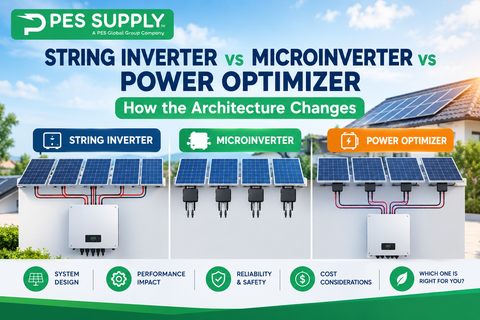
- String inverters at row end or microinverters for small elevated blocks. For farm-scale string architecture, Fronius inverters have a long track record in agricultural electrification; for anything near livestock buildings, I prefer designs that keep DC homeruns short and conduit runs in schedule 80 where hooves and loaders can reach. The electrical components bin — grounding lugs, bonding jumpers, stainless hardware — is where these jobs are won or lost five years in.
NEC and Permitting Notes Specific to Agrivoltaics
Nothing in Article 690 cares that crops grow under your array, but your AHJ and your fire marshal care plenty about access. A few hard-won points:
- NEC 691 (large-scale PV electric supply stations) may apply on bigger farm builds — it changes your engineering documentation burden, so flag it in the first permit meeting, not the third.
- Vegetation management is a code issue now. NEC 2023 and the 2026 cycle both tightened expectations around maintaining clearances at equipment pads. A grazing lease is literally a vegetation management plan with teeth — or rather, with sheep.
- Rapid shutdown and access aisles: elevated arrays over crops still need fire-service access lanes. Design the farm lanes and the fire lanes as the same lanes and everybody wins.
- Grounding in agricultural soil: freeze-thaw cycles in tilled ground will walk a poorly set ground rod right out of spec. Drive rods below tillage depth or bond to pile foundations per the geotech.
End-of-life planning belongs in the permit set too, because several states now ask for it up front. Our rundown of 2025 state EPR laws and solar recycling mandates covers which jurisdictions want a decommissioning bond — and farmland deals almost always trigger the strictest version, because the whole point is that the land goes back to farming.
The Economics: Why Farmers Say Yes in 2026
The pitch that closes is not "save the planet." It is this: a grazing lease or elevated-array land payment typically pays several times what commodity crops net per acre, with a 25–30 year escalator, while the farm keeps farming. Add USDA REAP grant eligibility on the agricultural side, the federal ITC on the energy side, and — where applicable — state agrivoltaic adders, and the stacked return is why 2025's project pipeline looked nothing like 2022's.
Two warnings from the field. First, interconnection is still the schedule killer; nothing about crops fixes a three-year queue. Second, put the soil-compaction remediation clause in the lease before the first pile driver arrives. Construction traffic compacts, and "we'll till it after" is a promise that needs a dollar figure attached or it evaporates.
Water: The Quiet Superpower of Dual-Use Land
Everybody talks about electrons. The growers who sign 30-year leases talk about water. Partial panel shade lowers soil temperature and cuts evapotranspiration, which in the Southwest and the Central Valley is worth more per acre than the electricity on marginal ground. I watched a lettuce operation outside Yuma stretch its irrigation cycle by two full days after an elevated array went in over half a block — same seed, same crew, measurably less pumping. The Arizona trials put numbers behind it: crops under panels used dramatically less water per pound of yield, and soil moisture under arrays stayed measurably higher between irrigation events.
| Factor | Open Field | Under-Array (Elevated) | Practical Impact |
|---|---|---|---|
| Midday soil temperature | Full sun load | Reduced (shade fraction dependent) | Less heat stress, slower bolting in greens |
| Evapotranspiration | Baseline | Measurably lower | Longer irrigation intervals; pumping cost drops |
| Wind exposure at canopy | Unbroken fetch | Reduced by module rows | Less physical crop damage; drier microclimate edges near rows |
| Frost events | Full radiative loss | Slightly moderated under modules | Marginal season extension on shoulder weeks |
| Rainfall distribution | Even | Drip lines form at module edges | Design irrigation around edge drip or use it deliberately |
That last row bites people. Rain sheets off a tilted module and concentrates along the low edge, creating a wet strip and a dry strip. Smart designers either run drip irrigation to compensate or plant the edge strip to something that wants the extra water. Dumb designers find out in July.
Livestock: Sheep Are the Gateway Crop
If a grower asks me where to start, I say sheep, and I say it every time. Solar grazing is the most proven, most insurable, most AHJ-friendly form of agrivoltaics in North America. The sheep keep vegetation below the modules — which satisfies the vegetation-management language your AHJ wants to see anyway — and the operator pays the grazier instead of a mowing contractor. Cattle need elevated structures and tougher BOS because a 1,200-pound steer treats a cable tray like a scratching post. Poultry works under elevated arrays. Bees work anywhere.
Design rules for grazed arrays: bury or armor every cable run a lamb can reach, spec weed-trimmer-proof post wraps, raise the low edge to at least 30 inches for sheep — more for cattle — and assume every junction box at ground level will eventually be headbutted. We keep grazing-duty cable and accessory stock — UV-rated PV wire, stainless lugs, armored conduit fittings — specifically because farm jobs eat standard residential BOS alive.
A Worked Sizing Example: 40-Acre Vegetable Operation
Let me run the numbers the way I do on a first call. Grower has 40 acres of mixed vegetables, drip irrigated, and wants elevated fixed-tilt over the production blocks with a 12-foot low edge for tractor clearance.
| Step | Math | Result |
|---|---|---|
| Usable array area (setbacks, lanes, wells) | 40 acres × 0.75 usable | 30 acres |
| Density at elevated fixed-tilt | 6–8 acres per MW DC; use 7 | ~4.3 MW DC |
| Module count | 4,300,000 W ÷ 450 W/module | ~9,560 modules |
| AC capacity at 1.3 DC:AC ratio | 4.3 MW ÷ 1.3 | ~3.3 MW AC |
| Annual production (Southwest, 1,700 kWh/kW DC-yr) | 4,300 kW × 1,700 | ~7.3 GWh/yr |
| Farm load offset (packing shed + pumps) | Typical 0.3–0.8 GWh/yr | 5–15% self-consumed; rest exports |
Two things fall out of that table immediately. The array dwarfs the farm's own load — this is an export project with a farming co-benefit, not a net-metering play. And at roughly 9,500 modules, procurement lead time and staging logistics matter as much as design. When we quote jobs this size, module availability by the truckload is the first filter, which is why our solar panel catalog is organized around shippable volume, not brochureware.
Failure Modes I Keep Seeing (So You Don't Have To)
Four patterns wreck agrivoltaic projects, and none of them are exotic. First, clearance drift: the design says 10-foot low edge, the value-engineered racking quote says 8, and the combine cab says no. Lock clearance in the structural drawings and refuse the VE downgrade unless the grower's tallest machine signs off in writing. Second, unpriced wire: wide-pitch layouts double or triple your homerun footage versus a dense array, and I've watched that line item erase a project's margin after award. Price the trenching and PV wire per acre, not per megawatt. Third, the forgotten wash: arrays over crops still need cleaning, and now your wash water lands on produce, which means food-safety questions if you're upstream of a packing shed. Plan deionized or reclaimed water and document it. Fourth, handshake agronomy: if the lease says "grower maintains vegetation" but nobody budgeted the labor, you get knee-high foxtails shading the bottom row by August. Put the grazing contract or the mowing budget in the financial model, not in a side letter.
The upside of writing all that down: every one of those failure modes is solved with paper and planning, not new technology. That's what "gaining momentum" actually means in this sector — the risk is now boring enough to finance.
What I'm Watching in 2026
Three things. NEC 2026 adoption timelines, because the cycle's wiring-method and rapid-shutdown refinements hit farm-scale BOS design first, and our H1 retrospective already mapped which states are moving early. Second, module mix: TOPCon's share of the commercial bin keeps climbing, and its temperature coefficient suits hot farmland better than the PERC stock it is replacing. Third, insurance pricing on grazing operations — as loss-history data accumulates, expect the premium gap between grazed and mowed arrays to widen in the grazed arrays' favor. Momentum, in practice, is just the compounding of a thousand small paperwork victories, and 2025 banked more of them than the previous five years combined.
Frequently Asked Questions
Does farming under solar panels actually work commercially, or is it still experimental?
It works commercially, with sheep grazing leading by a mile. The American Solar Grazing Association tracks thousands of grazed acres under arrays. Crop production under elevated panels is newer but has real university field data behind yield and water-savings claims — the Arizona tomato and pepper trials are the benchmark.
How much land does a 1 MW agrivoltaic array need?
Plan on 7–10 acres per MW DC for inter-row designs and 6–8 acres for elevated fixed-tilt, versus 5–6 acres for conventional ground mount. You give up density to keep 70–95% of the land farmable — that trade is the entire point.
What panels are best for agrivoltaics?
Glass-glass bifacial modules for elevated and vertical builds — they resist ammonia exposure and harvest reflected light off vegetation. Hot-climate sites should also weigh TOPCon or HJT modules for their gentler temperature coefficients.
Do solar panels help or hurt crop yields?
Both, depending on the crop and climate. Shade-tolerant greens, peppers, and tomatoes have shown yield gains in hot, high-insolation trials. Light-hungry grains lose yield under anything but very sparse layouts. Match shade fraction to crop before you finalize row spacing.
What does agrivoltaics cost compared to a standard ground mount?
Inter-row designs add a modest premium driven by wider spacing and longer wire runs. Elevated structures add substantially more in steel and labor. Vertical bifacial sits in between. The land-lease and agricultural-revenue side of the ledger usually decides the business case, not the CapEx delta alone.
Bottom line: the 2025 momentum was real because the paperwork finally caught up with the agronomy. If you're speccing a dual-use build for 2026, start with the crop's shade tolerance, let that set the row geometry, and size the steel like you mean it. We ship farm-duty modules, racking, and BOS nationwide — bring us the site plan and we'll build the BOM.