APsystems QS1: The Complete Buyer's Guide to Features, Installation, and Performance
By the PES Supply Editorial Team

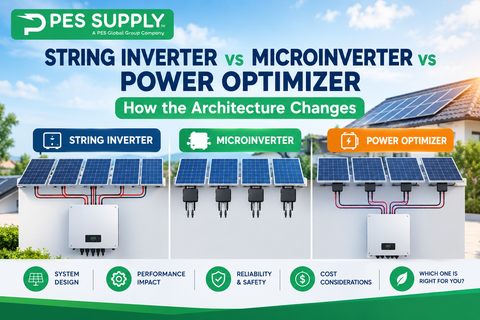
The APsystems QS1 is the quad microinverter that changed the economics of module-level power electronics. Where first-generation microinverters put one inverter behind every module, the QS1 puts one unit behind four modules with four independent MPPT inputs — which cuts inverter hardware cost per module roughly in half against dual units and by three-quarters against single-module designs, while keeping the panel-level monitoring and shade tolerance that make microinverters worth specifying in the first place. For residential installers building a repeatable, nationwide product stack, that cost architecture is the whole story.
I've pulled QS1 systems through commissioning on tract-home developments and custom shade-heavy roofs alike, and the pattern holds: where roofs are simple, string inverters still pencil; where roofs have dormers, trees, multiple azimuths, or a customer who wants per-panel data, the QS1 quad is usually the cheapest way to get there. This guide covers what the QS1 actually is, verified specifications, the AC branch-circuit math that sizes your subpanel, monitoring through the ECU and EMA platform, installation and rapid-shutdown compliance, warranty terms, and when the QS1 beats its siblings and competitors. Cross-shop against the competition in our APsystems vs Enphase microinverter comparison and the broader solar inverter buyer's guide.
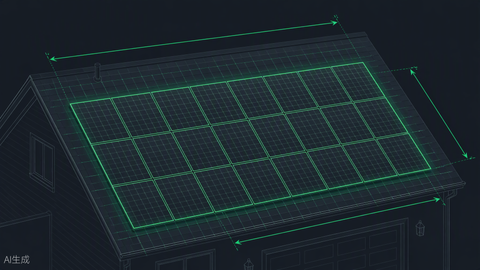
The QS1 is APsystems' quad-input microinverter for residential and light commercial rooftop solar. Each unit mounts on the racking beneath the array and converts DC to AC at the module level for up to four PV modules, with an independent maximum power point tracker per input. Four modules share one AC trunk-cable connection and one wireless node, but shade, soiling, or a failure on one module never drags down the other three — that's the entire value proposition of module-level power electronics, delivered at a per-watt price string inverters used to own.
APsystems positions the QS1 between the dual-input DS3 family (two modules per unit) and the QT2 (quad, 3-phase, for commercial rooftops). All of them report to the same ECU gateway family and the EMA (Energy Monitoring & Analysis) platform — note for the record: APsystems' monitoring is EMA, not to be confused with Enphase's Enlighten, which we see mixed up in proposals constantly.
| Specification | QS1 Value | Field Note |
|---|---|---|
| PV module inputs | 4, each with independent MPPT | Mix orientations freely across the four inputs |
| Max continuous AC output | 1,200 VA (≈300 W per channel) | Matches modules up to ~540 W with sensible clipping |
| Peak / CEC efficiency | 97.3% / ≈96.5% | Class-competitive with dual microinverters |
| AC output | 208/240 V split-phase | Trunk cable, two-wire plus ground |
| Communication | 2.4 GHz ZigBee mesh | No signal on power lines; ECU gateway required |
| Rapid shutdown | NEC 690.12 compliant at module level | Listed with APsystems RSD solution |
| Safety listings | UL 1741 SA / IEEE 1547 | Rule 21 and HECO compliant grid functions |
| Enclosure rating | NEMA 6 / IP67 class | Rooftop-rated for the life of the array |
| Warranty | 10 years standard, extendable to 25 | Registration drives the term — register at commissioning |
Verify all values against the current APsystems QS1 datasheet before permitting; regional SKUs differ in output rating and connector options.
Quad architecture economics. One QS1 replaces what used to take two dual microinverters or four singles. Fewer units means fewer trunk connections, fewer terminations, fewer nodes to commission, and a meaningfully lower equipment line on the BOM — while keeping four independent MPPTs, so nothing is given up on the production side.
Module-level shade tolerance. Each input tracks independently, so the west-facing module under the chimney at 4 p.m. costs you one module's output, not a whole string's. On the complex roofs where we spec microinverters, that independence is worth real kWh every single afternoon.
ZigBee mesh instead of powerline. The QS1 talks to the ECU gateway over 2.4 GHz ZigBee — each unit relays for its neighbors, so long roofs self-heal their mesh. No powerline carrier means no interference mysteries on shared services and no coupling filters to install.
Inherent NEC 690.12 rapid shutdown. Module-level conversion is module-level shutdown: kill AC at the ECU or the service disconnect and every conductor inside the array boundary drops to module voltage. On 2023 NEC jurisdictions with the array-boundary rules, that's the compliance answer without a separate RSD box per module.
Here's the arithmetic that sells the QS1, run on a typical 24-module residential system:
| Architecture | Units Required (24 modules) | Trunk/Branch Connections | Relative Inverter Hardware Cost | Module-Level Monitoring |
|---|---|---|---|---|
| Single-module microinverters | 24 | 24 taps | 100% (baseline) | Yes |
| Dual microinverters (DS3 class) | 12 | 12 taps | ≈ 60% | Yes |
| Quad QS1 | 6 | 6 taps | ≈ 35–40% | Yes |
| String inverter + optimizers | 1 + 24 devices | Home-run strings | ≈ 45–55% | Yes (with optimizers) |
| String inverter, no MLPE | 1 | Home-run strings | ≈ 25–30% | No |
Percentages are directional, from distributor pricing we've quoted across 2025–2026; your numbers will move with volume, but the ranking doesn't. The QS1 lands within striking distance of string-plus-optimizer economics while keeping the install simplicity of a pure AC trunk system — no home-run DC, no DC arc-fault exposure in the attic, no string-voltage calculations beyond the module itself.
The design calculation that matters on QS1 jobs is how many units land on each AC branch circuit. Each QS1 outputs a maximum of 1,200 VA continuous. On a 240 V circuit that's 5.0 A per unit. NEC treats inverter output as continuous, so conductors and overcurrent devices size at 125% of maximum continuous output current:
| Breaker (2-pole, 240 V) | Continuous Capacity (×0.8) | Max QS1 Units | Max AC per Circuit | Modules Served |
|---|---|---|---|---|
| 15 A | 12 A | 2 (10 A) | 2.4 kVA | 8 |
| 20 A | 16 A | 3 (15 A) | 3.6 kVA | 12 |
| 30 A | 24 A | 4 (20 A) | 4.8 kVA | 16 |
| 40 A | 32 A | 6 (30 A) | 7.2 kVA | 24 |
So that 24-module system lands on six QS1 units and a single 40 A 2-pole breaker with 10 AWG trunk-end conductors — clean, one circuit, done. For the conductor ampacity tables behind that math, keep our NEC ampacity chart and NEC wire sizing guide open during design, and size the upstream interconnection with the inverter sizing calculator.
Watch the 120% rule on the main panel
Six QS1 units backfeeding 30 A continuous through a 40 A breaker still have to pass NEC 705.12 bus loading on the service panel. A 200 A panel with a 200 A main allows 40 A of solar backfeed at the opposite end of the bus — exactly one full QS1 circuit. Bigger systems need a supply-side tap or a panel de-rate. I've red-tagged exactly this oversight on a competitor's rough-in; check it at design, not at inspection.
6. Monitoring and Software: Getting the Most from EMA

Every QS1 fleet reports through an ECU gateway — the ECU-R for residential, ECU-C for larger sites — into APsystems' EMA platform. The gateway polls the ZigBee mesh, stores locally, and pushes to the cloud. What we tell every installer setting up their first QS1 fleet:
- Mount the ECU where the mesh can reach it. ZigBee at 2.4 GHz doesn't love stucco-with-lath walls and metal panels. An attic-mounted ECU directly below the array outperforms a pretty install in the garage two walls away. Add a repeater rather than fighting a marginal link.
- Commission with the installer app, module by module. Scan each unit's serial map against the roof layout while you're still on the roof — rebuilding the array map from the office a week later is an hour you'll never bill.
- Set the grid profile before energizing. IEEE 1547 / UL 1741 SA regional profiles (Rule 21, HECO, default) are selectable at the ECU; the AHJ's permission-to-operate letter often names the profile. Get it right the first time.
- Hand the homeowner the EMA view, not your installer view. Panel-level production graphs sell referrals; alarm queues do not.
Physically, the QS1 bolts to the rail beneath the center of its four modules — plan the layout so the four inputs land within cable reach, roughly a 2×2 module cluster. Trunk cable runs daisy-chain units down the row with a single run back to the junction box. Practical notes from the roofs we've supported:
- Module compatibility: Each input accepts modern high-power modules; verify the module's Isc and Voc against the datasheet input limits — 550 W-class modules pair cleanly with the ≈300 W per-channel continuous rating, with modest midday clipping in cool, clear conditions that's economically irrelevant.
- DC connectors: Match the module's connector brand at the inverter input or use listed compatible pairs — mixing unlisted connector brands on the same mated pair is an arc-fault invitation and a code violation.
- Trunk cable management: Clip every 24 inches, keep the trunk off the roof membrane, and terminate end caps on unused drops. Water in an open trunk port is the most common QS1 warranty conversation we field.
- Torque: Mounting hardware to the rail manufacturer's spec — typically 10–12 ft·lb on M8 flange bolts — and re-check after the first module row takes wind load.
- Racking: Compatible with all standard rail systems; see our racking and mounting inventory and the panel mounting guide for rail selection.
| Model | Inputs | Max AC Output | Service Type | Best Fit |
|---|---|---|---|---|
| DS3 | 2 | ≈ 880 VA class | Single-phase 208/240 V | Small roofs, odd module counts, expansions |
| QS1 | 4 | 1,200 VA | Single-phase 208/240 V | Mainstream residential, 12–40 modules |
| QT2 | 4 | ≈ 2,000 VA class | 3-phase 208/480 V | Commercial rooftops, 3-phase services |
The QS1 is the volume answer for single-phase residential. Step down to DS3 when the module count or roof geometry leaves orphans a quad can't absorb; step up to QT2 the moment the service is 3-phase. All three share the ECU/EMA stack, so mixed fleets monitor as one system. Browse current APsystems inventory in our APsystems collection and the wider microinverter catalog.
Compliance-wise the QS1 checks the boxes that matter at permitting: UL 1741 SA listing with IEEE 1547 grid functions, NEC 690.12 module-level rapid shutdown inherent to the architecture, and NEMA 6-class environmental sealing for permanent rooftop mounting. Ground-fault and arc-fault protection live in the unit, satisfying NEC 690.5/690.11 without external devices.
Warranty runs 10 years standard, extendable to 25 years — the extension pricing is per-unit and must be registered at or near commissioning. Keep the ECU's serial map export in your project file; it's the document that makes a year-nine warranty claim a five-minute email instead of a truck roll. APsystems processes RMAs through the distribution channel — which, if you bought from us, means we handle it.
Contractor pricing on QS1 moves with volume bands and allocation cycles, so quote current — but as a planning anchor, quad microinverter hardware lands around $0.30–$0.40 per module-watt-equivalent lower than single-micro architectures on the same roof, and the labor savings from six trunk taps instead of twenty-four is real money at any crew rate. Incentive-wise, module-level systems qualify identically to string systems under the commercial credit structures and state programs — check current program rules in our solar incentives by state reference before proposal pricing.
PES Supply stocks APsystems QS1 units, ECU gateways, trunk cable, and termination accessories with 7–10 business day delivery from 12+ U.S. warehouses. Request a project quote with your module count and roof plan and we'll return the full BOM — inverters, ECU, trunk, and the racking to hang it on.
Strong fit
- Complex roofs: multiple azimuths, dormers, vent stacks, partial shade
- Customers who want per-panel monitoring and production guarantees
- Phased expansions — add four modules and one QS1 at a time
- 2023 NEC jurisdictions with strict array-boundary rapid shutdown
- Any residential job where DC in the attic is a liability you don't want
Weaker fit
- Dead-simple south-facing rectangle roofs where a string inverter's price wins
- 3-phase commercial services (that's the QT2's job)
- Battery-DC-coupled designs — microinverters are AC-coupled by nature; see our battery sizing guide for how AC coupling changes the storage math
Confirm module compatibility
Module Voc/Isc against the QS1 input limits, connector brand matched or listed-compatible, and a 2×2 cluster layout that keeps all four leads in reach.
Run the branch-circuit math
Units per breaker from the table above, trunk-end conductor size per NEC 690.8, and the 120% rule check on the service panel before you price the job.
Plan the ECU location
Within ZigBee range of the mesh, on reliable internet, with the grid profile set to your AHJ's requirement before energization.
Price the warranty extension
25-year coverage is a closing tool against string-inverter bids — put the number in the proposal instead of leaving it as an afterthought.
Order the full BOM from one source
Inverters, ECU, trunk cable, end caps, breakers, racking. One PO, one freight shipment, one throat to choke if anything's short. That's us: get the quote.
How many solar panels does one APsystems QS1 handle?
Four. Each QS1 has four independent DC inputs, each with its own MPPT tracker, converting up to 1,200 VA continuous AC output (≈300 W per channel). Four modules share one AC trunk connection and one wireless node, but shade or failure on one module never affects the other three.
Is the APsystems QS1 compatible with my solar panels?
With virtually any modern 60/120-cell or 66/132-half-cell residential module, including 540 W-class high-power panels. Verify your module's Voc and Isc against the current QS1 datasheet input limits, and match or list-pair the DC connectors.
Does the QS1 meet NEC 690.12 rapid shutdown requirements?
Yes — module-level conversion is inherently module-level shutdown. Removing AC at the ECU or service disconnect drops every conductor inside the array boundary to module voltage, satisfying NEC 690.12 without separate per-module RSD devices.
How many QS1 units can go on one breaker?
At 240 V each QS1 outputs a maximum of 5.0 A continuous. After the NEC 125% continuous-load factor: 2 units on a 15 A breaker, 3 on a 20 A, 4 on a 30 A, and 6 on a 40 A 2-pole breaker. Confirm the service panel's 120% rule for the backfeed breaker.
What monitoring platform does the QS1 use?
APsystems' EMA (Energy Monitoring & Analysis) platform, fed by an ECU gateway over 2.4 GHz ZigBee mesh — not powerline carrier. Homeowners get per-panel production views; installers get fleet-level alarms and diagnostics.
What warranty does the QS1 carry?
10 years standard, extendable to 25 years with registration at commissioning. RMAs process through the distribution channel — purchases through PES Supply are handled by our warranty desk with the ECU serial map as the claim document.
PES Supply (https://www.portlandiaelectric.supply) is a B2B electrical and solar distributor stocking 50,000+ SKUs from 169 authorized brands, including the full APsystems microinverter line. Verify all specifications against the current manufacturer datasheet before final design and permitting.