We field tariff questions from installers every single week, and the honest summary for 2026 is this: the policy stack around solar imports and tax credits has never been more complex, and the penalty for guessing wrong has never been higher. Modules bought on stale assumptions can land with duties that erase a project's margin; credits claimed on ineligible equipment invite recapture. This is the briefing we give our contractor customers — what's in force, what's under review, what it does to panel pricing, and how to buy defensibly this year.
For the equipment side once policy is settled, browse current panel inventory including US-made panels, and track incentive interactions on our state incentives page. The project-economics side is covered by commercial installation costs and the ROI calculator.
Section 201 Safeguard Tariffs: Expired but Not Forgotten
The Section 201 safeguard tariffs on imported crystalline silicon cells and modules — originally imposed in 2018 at 30%, stepping down 5% per year — expired on schedule in February 2022 and were not renewed for modules. The separate bifacial exclusion fight ended with bifacial panels remaining covered while 201 was alive, but with the safeguard itself lapsed, that distinction is now historical.
What matters today is not the lapsed tariff but the precedent: the International Trade Commission's 2024–2025 review activity around cell supply and the possibility of new safeguard or Section 301 expansions keeps module supply chains nervous. For procurement, the lesson of the 201 era stands: tariff exposure is a contract term, not a surprise. Every module purchase order should state explicitly which party bears duty changes between PO and delivery.
AD/CVD: The Southeast Asia Cases Reshaped the Market
The anti-dumping and countervailing duty cases against Cambodia, Malaysia, Thailand, and Vietnam — filed in 2024, finalized through 2025 — are the dominant cost driver on imported modules in 2026. Commerce's final determinations set company-specific and country-wide rates that vary enormously by manufacturer and by documented supply chain. The practical outcomes:
| Module Origin | Approximate Cost/W (FOB) | Compliance Status (2026) |
|---|---|---|
| China (direct import) | $0.085–$0.095 | Not FEOC-compliant; subject to layered Section 301 + AD/CVD exposure; effectively closed for credit-seeking projects |
| Southeast Asia (AD/CVD-affected countries) | ~$0.18–$0.24 landed, depending on company rate | Viable where the producer's final rate is low and cell origin is documented; carry duty-deposit risk |
| Southeast Asia (non-Chinese polysilicon/wafer chain) | ~$0.20–$0.26 | May qualify depending on cell origin and FEOC analysis; documentation is everything |
| US-assembled (imported cells) | $0.28–$0.33 | FEOC-manageable; partial domestic content credit eligibility depending on cell source |
| Fully domestic (US cells + assembly) | $0.38–$0.47 | Fully FEOC-compliant; maximum domestic-content bonus eligibility |
Two field notes. First, "ASEAN module" is no longer a safe shorthand — the country-wide rates for producers that didn't cooperate with Commerce investigations are punitive, while cooperative producers in the same countries carry manageable rates. Ask for the producer's specific final rate, in writing. Second, duty deposits are estimates liquidated later; retroactive adjustments have historically moved both directions. Anyone quoting you an exact landed duty a year in advance is guessing.
FEOC Rules: The New Compliance Frontier
The Foreign Entity of Concern restrictions — expanded through 2025 guidance implementing the credit statutes — now gate access to the major tax credits for projects with material ties to specified foreign entities. For solar procurement, FEOC analysis touches polysilicon source, wafer production, cell manufacturing, and module assembly, plus licensing and ownership structures upstream.
What this means in practice for an installer or EPC:
- Get supply-chain attestations from the manufacturer, not the distributor's marketing sheet. A module brand headquartered in a friendly country can still sit on a Chinese-controlled polysilicon chain.
- Document at the PO stage. FEOC status and domestic-content qualification need to be contractually warranted, with remedies, before deposit — not discovered at commissioning.
- Watch the guidance cadence. Treasury and DOE issued multiple rounds of FEOC guidance through 2025; safe-harbor reliance on prior guidance has explicit windows. Compliance is a date-stamped snapshot, not a permanent state.
Domestic Content Bonus: The 10-Point ITC Adder
For projects claiming the commercial ITC (Section 48/48E), meeting the domestic content requirement adds a 10-percentage-point bonus — a 40% credit becoming 50% changes project economics more than any racking or labor optimization. The manufactured-products adjusted percentage thresholds phase up:
| Construction Start Year | PV-Only Projects | PV + Battery or Battery-Only |
|---|---|---|
| 2026 | 40% | 55% |
| 2027 | 45% | 60% |
| 2028 and later | +5% per year | +5% per year |
The 2026 wrinkle: with domestic cell capacity still ramping, many "US-assembled" modules don't move a project's adjusted percentage as much as buyers assume — the imported cell inside is the single largest cost component and counts against domestic share. Run the manufacturer's published domestic-content certification (the safe-harbor tables help) rather than assuming "assembled in USA" clears the bar. Racking, trackers, and US-made inverters like some models in our inverter inventory contribute meaningfully to the percentage — stack them deliberately.
Impact on Panel Pricing and Procurement in 2026
The landed-cost spread in the table above translates to system-level math like this: on a 500 kW commercial array, the gap between a compliant mid-tier import at $0.22/W and a fully domestic module at $0.45/W is roughly $115,000 in module cost. The 10-point domestic content bonus on a $1.1M project is $110,000. The two numbers sit close enough that the domestic decision hinges on module price negotiations, FEOC risk tolerance, and bonus certainty — which is exactly why procurement strategy in 2026 is a spreadsheet exercise, not a brand loyalty exercise.
What we're telling buying customers:
- Lock pricing with duty-change clauses. 90-day price holds without duty-sharing language are quotes you can't bank.
- Dual-source modules per project. Qualify a domestic option and a compliant import option at design; swap at procurement based on the current rate sheet and bonus math.
- Buy ahead on long-lead projects, but inventory intelligently. Module prices in the US have been roughly flat-to-up through the AD/CVD transition, unlike the global spot price, which fell. Carrying 60–90 days of module inventory for booked work is insurance, not speculation.
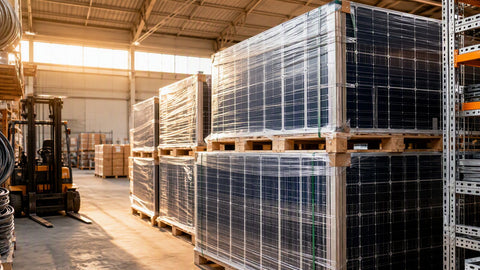
- Consider pallet and volume programs. Our panel pallet bundles and pallet deals exist precisely because per-watt pricing at volume absorbs policy turbulence better than spot buys.
ITC Landscape After OBBBA
The 2025 budget reconciliation legislation (the "One Big Beautiful Bill Act") restructured the credit landscape. The headline changes that affect 2026 procurement: the residential Section 25D credit terminated for expenditures after December 31, 2025 — residential installers have felt that pipeline shift already. Commercial credits under the technology-neutral 48E structure persist with construction-start deadlines, begin-construction safe harbors, and the FEOC and domestic-content overlays described above. Placed-in-service versus begin-construction timing now carries more dollars than any other scheduling decision on a commercial project.
Practical consequence: residential sales conversations pivot to state incentives, utility rebates, and bill-savings math (use our ROI calculator with zero federal credit assumed), while commercial deals live or die on start-of-construction documentation. If you're advising homeowners, our installation guide reflects the post-25D reality.
Safe Harbor Deadlines and Construction Start
"Begin construction" for credit purposes is established either by starting physical work of a significant nature (on-site racking installation counts; site clearing generally doesn't) or by incurring 5% of total project cost — the five-percent safe harbor that drives Q4 module purchasing every year. Buying modules to safe-harbor a project works only if the purchase is a binding, non-refundable obligation for specified equipment, delivered or paid within the required window. We've seen safe-harbor claims collapse because the PO was cancellable. Make the paper trail boring and airtight: binding PO, deposit wire records, delivery documentation, and a cost ledger that reconciles to the 5% threshold.
Practical Guidance for Installers in 2026
- Quote with a policy-validity date. Every proposal should state the tariff, duty, and credit assumptions it's built on and when they expire. This protects you and educates the customer.
- Collect manufacturer compliance documents at PO. AD/CVD producer rate, FEOC attestation, domestic-content certification — file them per project.
- Track begin-construction evidence like a lawyer. Photos with dates, delivery tickets, payment records, subcontractor mobilization invoices.
- Re-model economics at each policy milestone. A project modeled in Q1 can be worth materially more or less by Q3 procurement; don't let stale assumptions ride.
- Diversify supply relationships. The customers who weathered the AD/CVD transition best had both domestic and compliant-import channels warm. We're happy to be either one — our panel inventory spans both.
The Bottom Line
The 2026 solar policy environment rewards contractors who treat procurement as compliance work and punishes everyone buying on 2023 assumptions. Lapsed safeguards, live AD/CVD orders, FEOC gating, and a restructured credit map all point the same direction: document your supply chain, lock your contract terms, model the domestic-content math per project, and never let a module price quote outlive its assumptions.
The Trade-Action Timeline: How We Got Here
Context matters because today's rates stack on yesterday's actions. The compressed history:
| Year | Action | Lasting Effect on 2026 Procurement |
|---|---|---|
| 2012 / 2015 | First AD/CVD orders on Chinese cells and modules | Pushed cell production to Taiwan, then SEA — the origin-hopping pattern was set |
| 2018 | Section 201 safeguard tariffs (30% declining); Section 301 tariffs on Chinese goods | 201 lapsed in 2022; 301 duties persist on China-origin product |
| 2021–2022 | UFLPA enforcement begins (Xinjiang polysilicon) | Supply-chain traceability documentation became standard at the border |
| 2022 | IRA passes: 30% ITC, domestic content adder, manufacturing credits (45X) | Triggered the US module/cell factory buildout now coming online |
| 2024–2025 | AD/CVD petitions and final determinations on Cambodia, Malaysia, Thailand, Vietnam | The current dominant landed-cost variable for imported modules |
| 2025 | OBBBA: residential 25D terminated, commercial credits restructured, FEOC expanded | Residential economics reset; commercial compliance burden increased |
| 2026 | US cell capacity ramping; AD/CVD administrative reviews begin | Producer rates can change at annual review — quotes need validity dates |
Section 301 and the Polysilicon Question
Separate from AD/CVD, Section 301 duties on Chinese-origin goods remain in force and hit China-direct solar components hard enough that direct import is effectively dead for credit-seeking projects. The subtler issue sits upstream: polysilicon and wafers. Even modules assembled in compliant countries need documented non-FEOC polysilicon chains for credit purposes, and UFLPA detention risk at the border still applies to products with Xinjiang-linked inputs. The documentation package that clears both regimes — full supply-chain mapping from quartz to module — is what separates serious manufacturers from brochure operations. Ask for it by name.
Manufacturer Origin Snapshot: What We're Actually Seeing in 2026
| Supply Channel | 2026 Availability | Credit/Compliance Position | Typical Buyer |
|---|---|---|---|
| US-assembled, imported cells | Growing steadily; lead times 4–10 weeks | Strong FEOC position; partial domestic content contribution | Commercial ITC projects balancing cost and bonus |
| Fully domestic (US cells) | Limited but ramping; allocation common | Maximum domestic content; cleanest FEOC file | Projects where the 10-point bonus decides economics |
| SEA, low-rate cooperative producers | Available; pricing stable | Viable with documented cell origin; deposit-adjustment risk at liquidation | Cost-driven C&I and residential |
| SEA, country-wide-rate producers | Technically available, economically dead | Punitive deposit rates | Nobody, knowingly |
| Other emerging origins (India, Turkey, Indonesia) | Growing share | Watch this space — petition activity historically follows volume | Early adopters comfortable with first-mover risk |
Brand-level shopping against this landscape: our panel category spans domestic lines (Silfab, Mission Solar, Solar4America) and import channels (Jinko, Trina, Canadian Solar, Qcells), and we can pull origin documentation per PO.
What to Watch Through the Rest of 2026
- AD/CVD administrative reviews: First annual reviews of the SEA orders can move producer rates materially in either direction. A producer at a low rate today is not guaranteed that rate at liquidation.
- New petition risk: As module volume shifts to India, Turkey, and Indonesia, watch for the next petition cycle. Volume above a few GW from any single new origin has historically attracted cases.
- FEOC guidance rounds: Treasury's phased guidance has specific effective dates; projects spanning guidance windows need a compliance memo tied to their construction-start date.
- Domestic cell capacity: Every GW of US cell capacity that commissions loosens the domestic-content constraint that's currently binding module choice. By late 2026 the fully-domestic premium should narrow — track it quarterly if you have 2027 projects.
- State-level fills: With the residential federal credit gone, several states expanded rebates and tax treatment for residential solar and storage. Our state incentives tracker reflects changes as they're enacted.
The Installer's 2026 Procurement Checklist
| Step | Document / Action | Why It Matters |
|---|---|---|
| Design | Two qualified module options (domestic + compliant import) with pricing validity dates | Procurement flexibility when rates or allocations move |
| Quote | Written policy assumptions: credit %, bonus eligibility, duty treatment | Protects both parties when the ground shifts mid-project |
| PO | Duty-change clause, FEOC warranty, domestic-content certification attached | Transfers compliance risk to the party who controls the supply chain |
| Deposit | Wire/ledger records reconciling to any safe-harbor threshold claimed | The 5% safe harbor lives or dies on paper |
| Delivery | Delivery tickets, serial ranges, and origin documentation filed per project | Liquidation reviews and credit audits ask for exactly this |
| Construction start | Dated photos, mobilization invoices, permit filings | Begin-construction evidence under both physical-work and cost tests |
| Closeout | Compliance binder: attestations, certifications, inspection sign-offs, PTO letter | Recapture windows outlast warranties; the binder is the defense |
What Residential Installers Do Without 25D
The termination of the residential credit after 2025 is the biggest demand-side shift in this entire briefing, and the shops adapting fastest share a pattern. They've re-anchored sales conversations to bill-savings payback (still 6–10 years in high-rate states even without any federal credit), they've gotten fluent in state and utility programs that partially backfill the gap, and they've moved storage attach rates up — self-consumption economics now carry the pitch where the credit used to. Financing structure matters more than it did: third-party-owned (lease/PPA) products, where the credit survived under commercial rules, have regained share against cash and loan deals. None of that is spin — it's arithmetic, and the shops that show customers the real post-2025 math are closing at higher rates than the ones hedging around it.
Contract Language That Protects the Project
The legal side of 2026 procurement comes down to a handful of clauses that either exist in your contracts or don't. Module supply agreements should carry: an explicit duty-allocation clause (who absorbs AD/CVD liquidation adjustments between deposit and delivery — a number that has historically moved by five figures on container-scale orders); a compliance warranty covering FEOC status and domestic-content representation with stated remedies (replacement supply or credit support, not just refund-of-deposit); and a delivery-window commitment with consequences, because credit deadlines make a late module delivery a tax event, not just a schedule slip. On the customer side, proposals should state the credit percentage assumed, the domestic-content treatment, and an expiration date on policy assumptions. We've reviewed too many disputes that trace back to a proposal that promised "30% federal credit" in a year when the answer depended on construction-start timing the sales rep never documented. The paperwork is the product at this point — the panels are almost incidental.
Two more habits separate the shops that glide through audits from the ones that white-knuckle them. First, version-control your assumptions: keep a simple policy log per project noting which guidance documents, rate sheets, and credit rules were in force at contract signing, with PDFs archived. Guidance gets revised and rates get reviewed; being able to show what you reasonably relied on, dated, is worth more in an audit than being retroactively right. Second, brief your sales team quarterly — not annually — on the incentive and tariff picture. The gap between what the estimator modeled and what the rep promised in the kitchen is where the margin leaks and the reviews turn ugly. Fifteen minutes a quarter keeps the whole pipeline quoting from the same reality.
Finally, a note on communicating all this to customers without losing the sale: lead with what's stable, not what's turbulent. Panel supply is healthy, equipment quality is up, financing exists, and the projects that pencil are penciling well. Policy friction is a procurement and documentation problem for you to manage professionally — that's literally what they're hiring you for. The shops losing deals to tariff anxiety in 2026 are mostly losing them to their own uncertainty, not to the duties themselves. Keep buying well, keep documenting everything, and the policy noise becomes a competitive moat rather than a threat. We'll keep this page updated as reviews, guidance rounds, and capacity announcements land — bookmark it and check back before your next major procurement cycle — the next administrative-review results and guidance round will both move real dollars.
Frequently Asked Questions
Are solar tariffs still in effect in 2026? Section 201 expired in 2022; the live cost drivers are AD/CVD orders on Southeast Asian modules and cells plus Section 301 duties on Chinese-origin product. Producer-specific rates vary — get them in writing.
Is the federal tax credit still available? Residential 25D ended after 2025. Commercial 48E credits continue with construction-start deadlines, FEOC rules, and domestic content bonuses.
What is the domestic content bonus? A 10-point ITC adder for meeting manufactured-product domestic thresholds — 40% for PV starting construction in 2026, stepping up annually.
What are FEOC rules? Credit-eligibility restrictions on projects with material supply-chain or ownership ties to specified foreign entities. Document compliance at PO stage with manufacturer attestations.
How do AD/CVD cases change panel pricing? SEA modules land around $0.18–$0.26/W depending on producer rate; US-assembled $0.28–$0.33; fully domestic up to ~$0.47/W, partially offset by the bonus.
What is the 5% safe harbor? Beginning construction by incurring 5% of project cost under binding obligations — valid only with airtight documentation and non-cancellable POs.
Shop Related Products
- Solar panels — all brands and wattages
- US-made solar panels
- Panel pallet bundles
- Commercial solar panels
- Solar inverters
Sources
- US Department of Commerce — AD/CVD final determinations on crystalline silicon photovoltaic cells and modules from Cambodia, Malaysia, Thailand, and Vietnam (2024–2025)
- US Treasury / IRS — guidance on Sections 48/48E, domestic content bonus, and FEOC implementation
- USTR — Section 301 actions and exclusions
- 2025 budget reconciliation legislation (OBBBA) — credit restructuring provisions
Policy in this space moves fast. Figures and statuses reflect early-2026 conditions; verify current rates and guidance before committing to project economics.