After a week-long ice-storm outage, nobody cares what their generator cost. They care whether it started at 2 a.m., whether the fuel held out, and whether the furnace stayed lit. Fuel choice decides all three, and it's the decision buyers think about least — right up until the first extended outage teaches the lesson. We've spec'd standby systems on all three fuels for years, and each one has a failure mode that only shows up in bad weather, which is exactly when you can't afford surprises.
This guide compares natural gas, propane (LP), and diesel standby generators on energy content, real consumption rates, cold-weather behavior, storage logistics, maintenance, and true cost per outage-hour. Every number is computed from published fuel data or manufacturer consumption specs, with assumptions stated so you can re-run the math for your own fuel prices.
How the Three Fuel Types Actually Differ
Start with energy density, because it drives everything downstream — tank sizes, runtime, and cost:
| Fuel | Energy Content | Storage Form | Shelf Life | Delivery |
|---|---|---|---|---|
| Natural gas | ~1,030 BTU per cubic foot (100,000 BTU per therm ≈ 97 ft³) | None on site — utility pipeline | Infinite (piped) | Utility meter |
| Propane (LP) | ~91,500 BTU per gallon | Pressure vessel, liquid under ~120–200 psi | Indefinite (does not degrade) | Truck delivery to on-site tank |
| Diesel | ~137,000 BTU per gallon | Vented tank, liquid at atmospheric pressure | 6–12 months untreated; 18–24+ months with stabilizer and biocide | Truck delivery or self-hauled cans |
Diesel packs roughly 50% more BTU per gallon than propane, and diesel engines extract work more efficiently than spark-ignited engines — compression ignition at 17:1-plus compression ratios simply wastes less heat. That's why a diesel sips while a propane unit gulps. Natural gas is the weak sister on energy per volume, but it arrives in an endless pipe, which changes the whole conversation from "how much can I store" to "will the utility keep pressure during a disaster."
Natural Gas Generators
The case for: Unlimited runtime. No tank, no deliveries, no fuel going stale in year three. If you already have gas service, the install adds a plumbed line and a shutoff, and the generator sips from the same pipe as your furnace. For multi-day outages — the kind that follow hurricanes and ice storms — NG is the only fuel you cannot run out of while the grid is down.
The case against: You're betting on utility infrastructure staying pressurized during the exact disaster that took the power out. Earthquake zones are the obvious worry, but we've also seen municipal pressure sag during regional cold snaps when every furnace and generator in the county fires simultaneously. NG also makes marginally less power: most dual-fuel standby units are rated about 8–10% lower on NG than on LP because of the lower BTU density. And no gas service at the property means no NG generator, period — running a new lateral can cost more than the generator.
Consumption reference for the popular 20–22kW air-cooled class (published figures for the Generac Guardian family, typical for the class):
| Load | NG Consumption | Propane Consumption | Notes |
|---|---|---|---|
| 25% load (~5.5kW) | ~140 ft³/hr (~1.4 therms/hr) | ~1.5 gal/hr | Efficient cruise; lights, fridge, furnace blower |
| 50% load (~11kW) | ~203 ft³/hr (~2.1 therms/hr) | ~2.1 gal/hr | Typical outage average for a managed home |
| 100% load (~22kW) | ~306 ft³/hr (~3.2 therms/hr) | ~3.6 gal/hr | Central AC plus everything else running |
Read that middle row against your gas bill: at $1.20/therm, an outage day at half load costs about $60 in fuel. Two gallons of propane an hour at $2.50/gal is $126 for the same day. The pipe wins on operating cost if it stays pressurized.
Propane Generators
The case for: Propane stores forever. No varnish, no algae, no phase separation — a bottle filled in 2016 runs fine in 2026. It burns clean enough that oil stays amber longer and spark plugs outlast their gasoline equivalents, and the same tank can feed the generator, a range, a water heater, and a garage heater. For rural properties beyond the gas main, LP is the default standby fuel, and the big air-cooled units from Generac, Kohler, and Briggs & Stratton all ship in LP/NG dual-fuel configurations. See our Generac vs Kohler standby comparison and Briggs & Stratton brand guide for how the majors spec their LP ratings.
The case against: Consumption is brutal at high load — a 22kW unit at full chat drinks 3.6 gallons an hour, which empties a 500-gallon tank (400 usable gallons; you fill to 80% for expansion) in about 4.5 days of continuous full-load running. Cold weather adds a second problem: propane vaporizes off the liquid surface, and vaporization rate falls with temperature. A 500-gallon tank at 20°F can only support roughly 50,000–75,000 BTU/hr of continuous draw before pressure sags — well under the 300,000+ BTU/hr a loaded 22kW unit demands. Below-freezing standby installs need big tanks (1,000 gal), tank heaters, or multiple manifolded cylinders. We cover the winter angle in depth in our winter generator guide.
Diesel Generators
The case for: Efficiency and durability. Diesel engines run 30–40% more fuel-efficient per kWh than spark-ignited engines, shrug off continuous full-load duty that would kill an air-cooled NG/LP unit in days, and routinely log 15,000–30,000 hours before major overhaul — three to five times the lifespan of air-cooled gaseous engines. Commercial sites, hospitals, and cell towers run diesel for a reason. If your outage profile is "long, hot, and heavily loaded," diesel is the professional answer, which is why our Cummins standby lineup and the liquid-cooled generator guide lean diesel at the large end.
The case against: Fuel management becomes a hobby. Diesel grows algae at the water interface, oxidizes, and turns to varnish; a neglected tank kills an injection pump ($1,500+ lesson). You need stabilizer, biocide, annual polishing or rotation, and a strict no-load prohibition — diesels run below 30% load wet-stack, glazing cylinders with unburned fuel. Cold is the other enemy: #2 diesel clouds around 15°F and gels not far below that; winter operation needs blended #1 diesel, anti-gel additive, a block heater, and a battery warmer. Budget for all of it or the cold snap wins.
| Class | 25% Load | 50% Load | 100% Load |
|---|---|---|---|
| 12kW diesel (air/liquid-cooled) | ~0.45 gal/hr | ~0.75 gal/hr | ~1.2 gal/hr |
| 20kW diesel (liquid-cooled) | ~0.6 gal/hr | ~0.95 gal/hr | ~1.6 gal/hr |
| 48kW diesel (commercial) | ~1.3 gal/hr | ~2.2 gal/hr | ~3.7 gal/hr |
Compare the 20kW row to propane: 0.95 gal/hr of diesel versus 2.1 gal/hr of LP at half load — and diesel carries 50% more BTU per gallon. That's the compression-ignition advantage in one line.
Full Comparison Table
| Factor | Natural Gas | Propane | Diesel |
|---|---|---|---|
| Runtime limit | Unlimited (if utility holds pressure) | Tank size (days to ~2 weeks) | Tank size (days to weeks) |
| Fuel shelf life | N/A — piped | Indefinite | 6–24 months, treated |
| Fuel efficiency per kWh | Lowest | Low | Highest by 30–40% |
| Engine lifespan | ~3,000–5,000 hr (air-cooled) | ~3,000–5,000 hr (air-cooled) | 15,000–30,000 hr (liquid-cooled) |
| Cold-weather risk | Utility pressure sag | Tank vaporization limits below 20°F | Fuel gelling below ~15°F untreated |
| Power derate vs nameplate | ~8–10% on dual-fuel units | 0% (usually the rated fuel) | 0% |
| Fuel cost per outage-day (20kW class, half load)* | ~$60 | ~$126 | ~$87 |
| Storage infrastructure cost | ~$0 (existing service) | $1,500–$3,500 (500–1,000 gal tank, set + plumb) | $800–$2,500 (100–300 gal tank) |
| Maintenance burden | Lowest | Low | Highest (fuel polishing, wet-stack management) |
| Typical install code refs | NEC 702, NFPA 37, gas plumbing code | NFPA 58 tank setbacks (10 ft from ignition sources/property line for 500–2,000 gal) | NFPA 37, local fire marshal for tank size |
*Assumes NG $1.20/therm, LP $2.50/gal, diesel $3.80/gal, 24 hr at 50% load. Re-run with your local prices — the relationships are what matter.
The Storage Math: How Long Can You Actually Run?
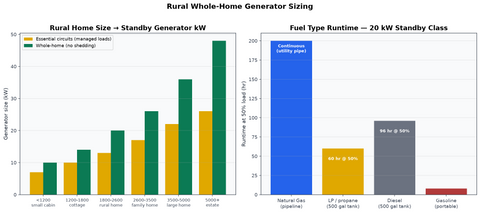
Runtime is where fuel choice stops being theoretical. Here's the 20–22kW class at 50% load — the realistic duty for a home with load management:
| Fuel / Storage | Usable Fuel | Burn Rate @ 50% | Continuous Runtime |
|---|---|---|---|
| Natural gas | Unlimited | ~2.1 therms/hr | Unlimited (subject to utility pressure) |
| Propane, two 120-gal cylinders | ~192 gal | 2.1 gal/hr | ~91 hr (under 4 days) |
| Propane, 500-gal tank | 400 gal | 2.1 gal/hr | ~190 hr (~8 days) |
| Propane, 1,000-gal tank | 800 gal | 2.1 gal/hr | ~381 hr (~16 days) |
| Diesel, 100-gal tank | ~95 gal | 0.95 gal/hr | ~100 hr (~4 days) |
| Diesel, 275-gal tank | ~260 gal | 0.95 gal/hr | ~274 hr (~11 days) |
Two lessons from that table. First, gallon for gallon, diesel roughly doubles propane's runtime — energy density plus engine efficiency. Second, the standard 500-gallon LP tank that installers love is a one-week solution at best, and less in real cold when vaporization limits force load shedding. If your outage history includes multi-week events, either plumb NG or buy tankage. Our generator sizing guide helps right-size the unit so you're not burning premium fuel on excess capacity, and battery backup vs generator covers the hybrid approach that slashes fuel burn for partial loads.
Winter: Where Each Fuel Fails
| Temperature | Natural Gas | Propane | Diesel |
|---|---|---|---|
| 40°F | No issues | No issues | Starts fine with healthy battery |
| 20°F | No issues (pressure normal) | 500-gal tank vaporization marginal at high load | Block heater recommended; battery capacity falls ~20% |
| 0°F | Regional pressure sag possible in extreme events | Vaporization fails at high load on single small tanks — generator starves mid-outage | #2 diesel clouding; anti-gel required, winter blend preferred |
| −20°F | Rare pressure events | Requires 1,000-gal tank, tank heater, or vaporizer | #1 diesel or 50/50 blend, block heater mandatory, battery warmer mandatory |
I've fielded the 3 a.m. call for every one of those failure modes: the propane unit that quit on hour thirty because the tank couldn't boil off fast enough at 5°F, and the diesel that cranked over gelled fuel and never lit. Both were preventable with twenty minutes of cold-weather planning — right-sized LP tankage or winterized diesel, plus a battery warmer, which is the cheapest insurance in the whole system.
Maintenance Reality Check
| Task | NG / Propane | Diesel |
|---|---|---|
| Oil change | Every 100–200 hr or annually | Every 250–500 hr per manufacturer |
| Fuel system | Annual regulator/mixer inspection | Stabilizer + biocide every fill; polish or rotate fuel annually; drain water separator monthly |
| Exercise schedule | Weekly 12-min self-test (factory default) | Weekly, ideally under some load to avoid wet stacking |
| Load banking | Not required | Annually if it never sees 30%+ load in service |
| Spark/ignition service | Plugs ~every 2–3 yr (LP runs cleanest) | N/A — compression ignition |
Which Fuel Should You Actually Choose?
- You have city gas and suburban outage risk: natural gas, no debate. Unlimited runtime at the lowest operating cost, and the 22kW class covers most managed homes. Confirm your meter's capacity (many homes need a meter upgrade for a 22kW draw of ~300+ ft³/hr).
- Rural, no gas main, outages measured in days: propane with at least a 500-gallon tank, 1,000 gallons if you're serious about week-plus autonomy or your winters drop below 20°F. Units from the Kohler/REHLKO line and Champion's value standby series all run LP natively.
- Commercial duty, heavy loads, week-plus events, or off-grid prime power: diesel, liquid-cooled, with a fuel-management calendar you'll actually follow. The Kohler vs Cummins comparison covers the premium end.
- Torn between storage anxiety and pipe anxiety: consider the hybrid path — a modest standby unit plus battery storage for overnight loads, covered in battery backup vs generator. Cutting overnight generator hours roughly halves fuel consumption per outage.
Fifteen-Year Ownership Cost: The Full Picture
Purchase price is the smallest line item over a standby generator's life. Here's the realistic 15-year ledger for a 20–22kW residential unit in a region averaging 100 outage-hours per year (storm-belt Southeast or ice-prone Midwest):
| Line Item (15 yr) | Natural Gas | Propane | Diesel |
|---|---|---|---|
| Unit + transfer switch installed | $9,000–13,000 | $9,000–13,000 | $12,000–18,000 (liquid-cooled) |
| Fuel storage infrastructure | $0–800 (meter upgrade) | $1,500–3,500 (tank set/plumb) | $800–2,500 (tank) |
| Fuel, 1,500 outage-hr @ 50% load | ~$3,750 @ $1.20/therm | ~$7,900 @ $2.50/gal | ~$5,400 @ $3.80/gal |
| Annual service (15 yr) | ~$3,000 | ~$3,000 | ~$4,500 (fuel mgmt incl.) |
| Mid-life repairs (starter, battery, regulator) | ~$1,200 | ~$1,200 | ~$1,500 |
| 15-year total | ~$17–21K | ~$23–29K | ~$24–32K |
Propane's fuel bill roughly doubles NG's over the period — that $4,000 gap is the tank, plus the burn rate, plus delivery minimums. Diesel's premium is upfront and in maintenance discipline, not fuel. If your outage profile is genuinely 100+ hours a year, fuel math should drive the decision more than sticker price; if you see 15 outage-hours a year, all three converge and you should pick on infrastructure convenience instead.
Transfer Switch, Siting, and the Install Nobody Budgets For
Fuel choice also shapes the install. A few field notes that don't make the brochures. First, the automatic transfer switch is fuel-agnostic, but gas plumbing isn't: a 22kW NG unit drawing 300+ ft³/hr often forces a gas-meter upgrade, and we've seen utilities take six weeks to schedule one. Order the meter work the day you buy the generator. Second, NFPA 37 siting (typically 5 ft from operable windows and doors, 18 inches off the wall for air-cooled service clearance) applies to all three fuels, but propane adds NFPA 58 tank setbacks that can squeeze tight lots — the 10-foot tank-to-property-line rule has killed more than one layout we've drawn. Third, diesel's exhaust runs hotter and sootier; give the stack more clearance from combustibles and expect the neighbors to smell it.
One more: whatever fuel you pick, the electrical side follows NEC 702 — optional standby systems need a listed transfer means, and a 200A service-rated ATS is the clean answer for whole-house coverage. Our NEC wire sizing guide covers conductor and breaker selection for the generator feed, and portable vs whole-house generator walks through whether you need the ATS at all.
Noise, Emissions, and Neighbors
Air-cooled NG/LP units in the 20kW class run 63–67 dB at 23 feet — conversation-plus volume, like a loud central AC condenser. Liquid-cooled diesels of similar output actually run quieter at the property line (60–65 dB) because 1,800 rpm beats 3,600 rpm acoustically, though diesel exhaust odor announces itself regardless. Emissions paperwork matters more than it used to: diesels above small-portable classes carry EPA Tier ratings, and some air districts restrict diesel exercise hours — California buyers know this drill. Natural gas burns cleanest of the three, which is one more reason urban installs default to the pipe.
If noise is your deciding factor, remember that runtime dominates: the quietest generator is the one that runs four hours a day instead of twenty-four. Pairing any standby unit with a battery bank for overnight silence is covered in battery backup vs generator, and the whole-house generator overview frames the complete system.
Worked Example: Re-Running the Math for Your Zip Code
Say your co-op sells propane at $2.10/gal, diesel at $3.60/gal, and your NG tariff is $0.95/therm. Your typical outage runs 36 hours at an honest 50% load on a 22kW-class unit. The fuel ledger:
| Fuel | Burn @ 50% Load | 36-hr Outage Consumption | Your Fuel Cost | Cost per Outage |
|---|---|---|---|---|
| Natural gas | 2.1 therms/hr | 75.6 therms | $0.95/therm | ~$72 |
| Propane | 2.1 gal/hr | 75.6 gal | $2.10/gal | ~$159 |
| Diesel | 0.95 gal/hr | 34.2 gal | $3.60/gal | ~$123 |
Five outages a year makes that a $435 annual spread between NG and propane — $6,500 over the unit's life, which exceeds the price gap between the generator options themselves. That's why we ask for a fuel bill before we quote hardware. Bring your last winter utility statement and your outage history to the conversation and the right fuel usually picks itself inside five minutes.
Frequently Asked Questions
What size generator do I need before fuel even matters?
Fuel choice comes second to capacity. Add your starting watts for the largest motor (central AC compressor typically wants 3–5× its running watts to start), layer in the continuous loads you refuse to shed — refrigerator, furnace blower, sump pump, well pump — and you usually land between 14kW and 22kW for a managed whole house. Our 12/16/20/24kW sizing guide walks the worksheet. Oversizing wastes fuel every hour it runs; undersizing trips breakers in the middle of dinner.
Which fuel is cheapest to run during an outage?
Natural gas, by a wide margin — roughly half the per-day fuel cost of propane at typical prices, with diesel in between. At $1.20/therm, a 22kW unit at half load burns about $60 of NG per day versus ~$126 of propane at $2.50/gal. Re-run the numbers with your local rates, but NG wins the operating-cost argument almost everywhere it's available.
How big a propane tank do I need for a standby generator?
For a 20–22kW unit: 500 gallons minimum for multi-day outages (about 8 days at half load), 1,000 gallons if you want two weeks of autonomy or your winters run below 20°F. Cold weather cuts vaporization rate, so tank sizing in the North is about pressure, not just gallons. NFPA 58 sets a 10-foot setback from ignition sources and property lines for tanks in this size class.
Does diesel really last longer than natural gas or propane engines?
Dramatically. Liquid-cooled diesels commonly log 15,000–30,000 hours before major overhaul because they run slower (1,800 rpm vs 3,600), run cooler, and build heavier internals. Air-cooled NG/LP standby units are 3,000–5,000-hour machines. For weekly-outage backup duty both outlive their owners; for daily prime power, diesel is the only serious option.
Will my natural gas generator work during a disaster?
Usually, yes — gas pipelines have independent compression and often keep pressure when the grid fails. The exceptions are earthquakes (automatic shutoff valves), regional cold snaps with extreme coincident demand, and flood-damaged infrastructure. If your hazard profile is seismic, store fuel on site instead.
Can I convert my generator from one fuel to another?
Most air-cooled standby units ship dual-fuel (NG/LP) and convert with a regulator or mixer adjustment — a ten-minute job for a technician, and required to be done per the manual to keep the UL listing. Converting to or from diesel is a different engine entirely; don't go there.
How long does diesel fuel actually last in the tank?
Six to twelve months untreated, 18–24 months or more with stabilizer, biocide, and a clean, full, vented tank kept out of temperature swings. Annual fuel polishing extends it further. The enemies are water (which grows microbial "algae" at the interface) and oxidation; both are managed, not eliminated.