Multi-Brand Heat Pump Distributor Guide: Carrier, Trane, Mitsubishi, Bosch, Rheem
How a serious HVAC + electrical distributor evaluates, stocks, and supports five heat pump lines — and how contractors should pick a distribution partner for the electrification decade.

For twenty years, heat pumps were a mechanical-only sale. The refrigerant loop lived inside the HVAC channel — traditional two-step distributors (Carrier bought Watsco, Trane bought its own network) locked the product behind branded counters, and the electrician showed up after the equipment was set to run a 240 V circuit. That model is dead.
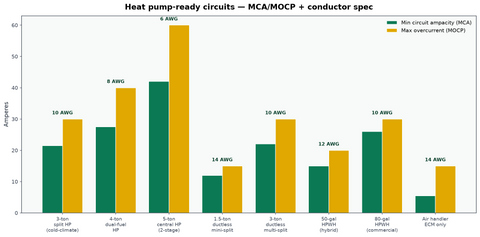
Three shifts blew it apart. First, the Inflation Reduction Act made the electrical service the choke point of every retrofit — every 4-ton cold-climate heat pump comes with a 60 A circuit, and half of the homes it's landing in have 100 A panels that will not accept it without a load calculation or a panel swap. Second, the geographic center of heat pump demand moved north into cold-climate territory (Maine, Minnesota, upstate New York) where the Mitsubishi Hyper-Heat and Bosch IDS 2.0 platforms carry the load — brands the incumbent gas-HVAC distributor has never stocked. Third, the multi-brand contractor emerged. The installer who used to sell one line now needs Carrier for the equity build, Mitsubishi for the cold-climate retrofit, and Rheem for the heat pump water heater — and they need one distributor that can quote the whole package on Tuesday and stage it on the pallet Friday.
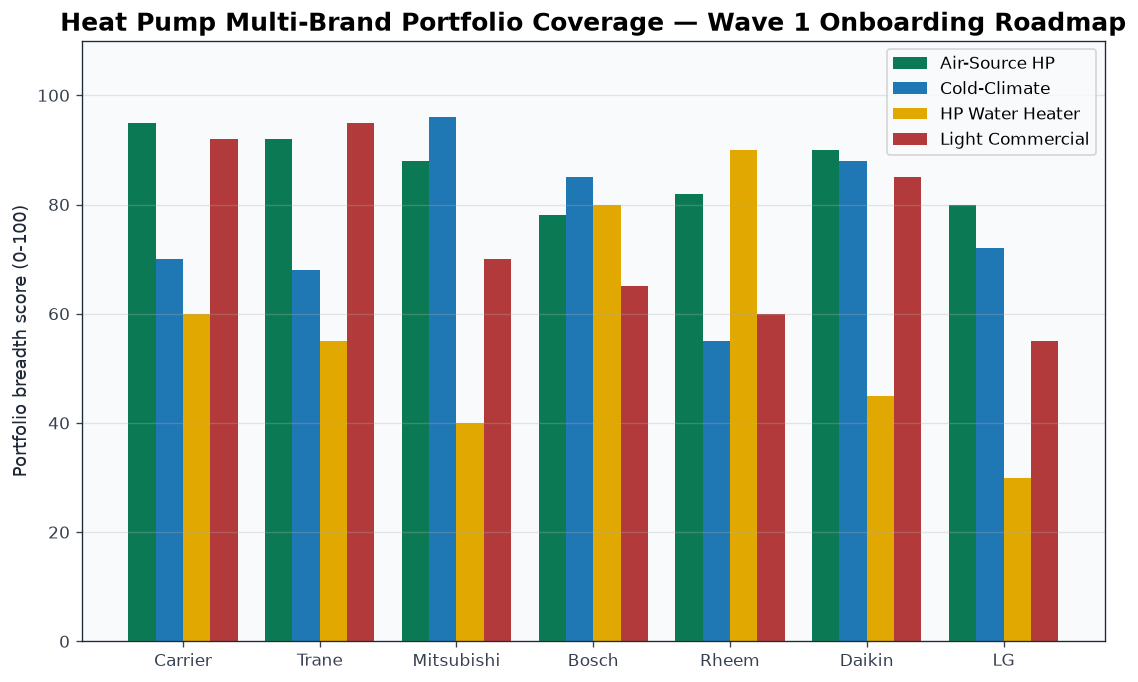
PES Supply is building that distribution stack. Wave 1 — the guide you are reading — is the public-facing roadmap for how we evaluate five heat pump manufacturers (Carrier, Trane, Mitsubishi, Bosch, Rheem) across four product tiers (residential air-source, cold-climate, heat pump water heater, light commercial VRF), and the contractor-side sourcing rules that come out the other end.
What this article is: the master pillar for how contractors should evaluate a multi-brand heat pump distributor — supply reliability, warranty backing, freight economics, IRA compliance documentation, and channel exclusivity. If you install more than one brand or you are about to, this is the framework.
Carrier Infinity 24VNA6. The channel benchmark. Variable-speed inverter compressor, 24 SEER2, 10 HSPF2, communicating thermostat ecosystem locked to Carrier equipment. Deep contractor training network, mature warranty rail. Weakness: cold-climate capacity retention drops below 5°F — Carrier does not have a factory hyper-heat variant, so it competes on comfort and staged capacity, not on cold-climate raw output.
Trane XV20i / XL18i. Ingersoll Rand chassis with the "spine fin" all-aluminum outdoor coil (better in coastal + salt-air). Trane's warranty tail is the longest of the group — 12 years on the compressor as standard. It is the fleet-truck of residential heat pumps: parts everywhere, the technician has seen every failure mode, and the homeowner recognizes the name.
Mitsubishi Hyper-Heat H2i / H2i plus. The cold-climate king. Rated to deliver 100% of nameplate capacity down to 5°F and 76% at -13°F. The Hyper-Heat H2i plus (introduced 2023) extends the capacity floor to -22°F for northern New England and Canada. Multi-position (ducted, ducted+ductless hybrid, and mini-split) with the deepest zoning ecosystem of the five brands.
Bosch IDS 2.0 Premium. The value-engineered contender. Inverter-driven, integrates natively with any 24 V thermostat (no proprietary comms lock-in), and the outdoor coil footprint is 30% smaller than Carrier's equivalent. Weakness: cold-climate spec sheet drops off harder than Mitsubishi below 17°F. Strength: contractor net cost that lands 10–15% under Carrier for the same nominal tonnage.
Rheem Endeavor / Prestige. The plumbing-channel play. Rheem's real distribution power in the heat pump conversation is not the Prestige air-source unit — it is the ProTerra Plus heat pump water heater (4.05 UEF, 50/65/80 gal). Contractors who install ductless mini-splits and want to bundle the DHW upgrade in the same visit reach for Rheem because it slots into an existing plumbing SKU list.
None of these brands is a wrong answer. The distributor's job is to make sure the contractor can source any of the five without switching accounts, warranty rails, or freight lanes.
| Brand | Residential ASHP | Cold-Climate | HP Water Heater | Light Commercial VRF | Warranty (compressor) |
|---|---|---|---|---|---|
| Carrier | Infinity 24VNA6 (24 SEER2) | Performance HP (limited) | Not primary | Toshiba-Carrier VRF | 10 yr |
| Trane | XV20i / XL18i | XV20i cold-climate | Not primary | Trane VRF (Toshiba OEM) | 12 yr |
| Mitsubishi | M-Series ducted | Hyper-Heat H2i / H2i plus | Ecodan (limited US) | CITY MULTI VRF | 10 yr |
| Bosch | IDS 2.0 Premium | IDS 2.0 cold-climate | Compress 4000 AWHP + HPWH | Climate 5000 (limited) | 10 yr |
| Rheem | Endeavor Prestige | Prestige cold-climate | ProTerra Plus (4.05 UEF) | Not primary | 10 yr |
Not every brand that wants distribution earns it. We run five gates before a manufacturer moves onto the PES stocking sheet:
Gate 1 — Contractor demand density. We map installed-base data by ZIP against our contractor account roster. A brand needs to already be on the truck for at least 40% of our installers in a target region before we bring it in. That threshold keeps us from stocking dead SKUs.
Gate 2 — Warranty and parts rail. Manufacturer must maintain a two-day parts SLA from a regional warehouse and honor labor claims through the installing contractor, not just the homeowner. Carrier and Trane pass this by default. Newer entrants (some Asian OEMs) fail here — great equipment, brutal warranty logistics.
Gate 3 — IRA and utility rebate documentation. Every SKU we stock must ship with AHRI certificate, ENERGY STAR label, and CEE Tier 2 or Tier 3 rating documentation in the box. If the contractor has to hunt for the certificate to file a 25C credit or a utility rebate, we lose the reorder.
Gate 4 — Freight class and pallet economics. Heat pumps are Class 92-125 LTL freight. A brand that ships in an oversized crate that ratchets us into Class 175 kills the freight math. We negotiate crate dimensions and freight class at the master agreement stage, not after the first pallet lands.
Gate 5 — Channel exclusivity. If a manufacturer is also selling through a big-box DIY channel at retail, we won't stock the same SKU. Contractors do not want to compete with the homeowner walking into Lowe's with the equipment their neighbor bought last weekend.
-
1
Confirm multi-brand stocking, not single-brand exclusivity
The right distributor sells you Carrier, Trane, and Mitsubishi without asking you to pick a lane. Single-brand distributors will steer you to their manufacturer's margin, not your job's fit.
-
2
Ask for pallet freight economics in writing
Request the freight class, dim-weight, and average LTL cost per pallet for a 3-ton condenser + air handler. If they can't produce it, they don't stock enough volume.
-
3
Verify AHRI documentation ships in the box
25C tax credit filings, utility rebate applications, and ENERGY STAR verification all depend on AHRI matching. If the distributor does not print AHRI certificates for every combined system quote, walk.
-
4
Check cold-climate depth if you install above the 35th parallel
For any market with sustained sub-25°F winter design temperatures, you need Mitsubishi Hyper-Heat and Bosch IDS 2.0 cold-climate stock — not just Carrier and Trane.
-
5
Test the warranty escalation path
Call the distributor's tech line before you place your first order. Ask what happens when a compressor fails in year 8. If they route you to a manufacturer 800 number, they are a box-mover, not a distributor.
-
6
Verify portal calculators and design tools
A modern heat pump distributor provides Manual J short-form, load calculators, wire-sizing calculators, and voltage-drop tools inside the buying portal. That is table stakes in 2026.
Heat pump freight is where two-thirds of the contractor's total-cost delta hides. A 4-ton Carrier Infinity condenser ships as Class 92 in a 42 × 42 × 42 crate — one pallet, LTL-friendly. Add the matched air handler and you're at two pallets. Add a Mitsubishi Hyper-Heat multi-zone package (one outdoor + three heads + line-sets + condensate pumps) and you're at three pallets plus a small-parts box. If the distributor can't consolidate that to one shipment, the contractor pays LTL minimums twice and the job margin evaporates.
PES stages by contractor-week. Every account has a weekly delivery day, every ordered SKU that clears cutoff by the cutoff time lands on that day, and the delivery ticket reconciles against the open jobs list. That model comes from our solar and battery experience — heat pumps just move into the same pallet lane.
For contractors moving 20+ heat pump installs a month, we set up bulk-drop staging: full truckload deliveries to a contractor yard once a week, contractor pulls from stock, invoices reconcile at month-end. That model is standard in the solar module world and it works identically for heat pump equipment.
The warranty conversation is where distributors either earn their keep or expose their thinness. Every one of the five brands we track offers a 10 or 12-year compressor warranty and a 10-year parts warranty on registered equipment — but the mechanics of getting a claim honored differ by an order of magnitude between manufacturers.
Carrier and Trane run mature warranty rails through their two-step distribution networks. The distributor pre-approves the claim, ships the replacement part, and files the paperwork on the contractor's behalf. Turnaround: 48 hours for a compressor swap in most markets.
Mitsubishi runs a factory-direct warranty program tied to the Diamond Contractor certification. Contractors without the certification file claims through the distributor and see 4–7 day turnaround; Diamond Contractors get direct factory access and 24-hour turnaround.
Bosch uses an authorized service network model. Warranty flows through the installing contractor if they hold Bosch certification; otherwise the homeowner is routed to a service partner. This is the weakest of the five rails and one of the reasons Bosch's contractor net cost has to run 10–15% below Carrier to earn shelf space.
Rheem handles heat pump water heater warranties through the plumbing channel — very fast for the ProTerra Plus (the plumbing distributor holds spare tanks), slower for the air-source Prestige units where the plumbing distributor is stocking outside its comfort zone.
PES's rule: the contractor should never file a warranty claim with a manufacturer directly. That's what we're here for. If the compressor drops in year 8, you call us, we file the claim, we ship the part, and you keep working. That's the distribution promise. If your current supplier makes you call an 800 number, they are not a distributor — they are a warehouse.
Every heat pump quote a contractor sends now has three cost columns: sticker, after 25C federal credit, and after utility + state rebate stacking. Getting the math right is table-stakes; helping the homeowner see it in the quote is where contractors win jobs against competitors who still hand-write invoices.
25C Residential Energy Efficient Property Credit. $2,000 cap for heat pumps meeting CEE Tier 2 (most Mitsubishi Hyper-Heat, Bosch IDS 2.0 Premium, Carrier Infinity, Trane XV20i models qualify). $2,000 additional for heat pump water heaters (Rheem ProTerra Plus qualifies at 4.05 UEF). $600 for panel upgrades performed as part of the electrification retrofit.
HEEHRA point-of-sale rebate. Up to $8,000 for a qualifying heat pump install, income-tested (up to 80% of area median income = 100% rebate; 80–150% AMI = 50% rebate). Rolls out state-by-state in 2024–2026. Contractors need to be enrolled in the state administrator's program to redeem at point of sale.
Utility rebates. Vary wildly by jurisdiction. Mass Save (Massachusetts) pays $10,000+ per whole-home heat pump conversion. Xcel Energy (Colorado, Minnesota) pays $1,500–3,000. PG&E and SCE (California) pay $1,000–3,000. The distributor's job is to keep a live utility rebate database inside the portal so quotes come out with the local number pre-populated.
PES's IRA + rebate module (rolling out with our heat pump onboarding) will pre-populate every quote with the federal + state + utility stack for the install address. That's the difference between a distributor and a warehouse.
Heat pump distribution is not national in the way solar module distribution is national. Each of the five brands runs a regional footprint that reflects historical HVAC market share. Understanding that map is how a multi-brand distributor decides where to invest inventory dollars first.
Carrier has the deepest national footprint through the Watsco distribution network (Gemaire, Carrier Enterprise, ACR Group, others). Contractor accounts exist in every major U.S. metro. Strongest markets: Southeast (Florida, Georgia, Texas), where Carrier's SEER-optimized platforms won the cooling-dominant market decades ago.
Trane is strongest in the Midwest and Mid-Atlantic — Ohio, Pennsylvania, upstate New York, Ontario. Trane's "spine fin" outdoor coil design was popularized in coastal and salt-air markets, giving them a foothold in mid-Atlantic coastal territory.
Mitsubishi dominates the Northeast and Pacific Northwest — Massachusetts, Maine, Vermont, Washington, Oregon. Cold-climate performance and ductless-friendly retrofit economics carried Mitsubishi into these markets ahead of Carrier and Trane.
Bosch has a scattered regional presence — strongest in Texas, Arizona, and California where the smaller outdoor footprint and 24V thermostat compatibility play well with production-builder specifications. Also emerging in the Midwest as contractors look for a Carrier alternative with better contractor net.
Rheem is uniformly distributed nationally through plumbing supply houses (Ferguson, Winsupply, Hajoca), which is why the ProTerra HPWH has the highest install rate of any HPWH brand — plumbers already had it on the truck when the electrification wave hit.
PES's onboarding strategy follows the regional map: Rheem HPWH first (nationwide plumbing distribution overlap), then Mitsubishi (Northeast + Pacific Northwest contractor demand), then Carrier and Trane simultaneously (broadest contractor base), then Bosch (production builder + margin-hunting contractor segments).
Every heat pump distributor is navigating the R-410A phaseout. EPA's AIM Act (Technology Transitions Rule, finalized October 2023) requires all new residential heat pump equipment sold after January 1, 2025 to use refrigerants with a Global Warming Potential (GWP) below 700. R-410A has a GWP of 2,088; it does not comply. The industry is bifurcating into two replacement refrigerants:
R-454B (GWP 466) — Chosen by Carrier, Trane, Rheem, and most U.S. manufacturers. Blended refrigerant with pressures 5-10% higher than R-410A. Copper piping and brazing techniques are similar; expansion valves and metering devices are the same. Line-set flush required when converting R-410A systems.
R-32 (GWP 675) — Chosen by Mitsubishi, Daikin, and most Asian manufacturers. Single-component refrigerant, higher efficiency ratings than R-454B in most testing, higher operating pressures. Requires updated technician training (single-component means no glide/fractionation concerns, but higher pressures require attention).
Both are A2L refrigerants — mildly flammable per ASHRAE Standard 34. This is the first flammable refrigerant class in mainstream residential HVAC in 40 years, and it changes the following practical realities for contractors and distributors:
- Refrigerant leak detectors on indoor coils are now required in most equipment.
- Line-set brazing requires ventilation and elimination of open flame near the charged system.
- Charge quantity limits per space apply — 1.84 kg for R-32, similar for R-454B — which forces multi-zone systems in larger homes.
- Existing R-410A recovery machines can be reused; A2L-rated recovery machines are recommended for new purchases.
Distributors must maintain separate SKU lines for A2L equipment vs legacy R-410A parts. PES's onboarding plan calls for A2L-native SKUs from day one, with legacy R-410A parts stocked only as needed for warranty replacement on installed base.
A serious multi-brand distributor invests in contractor training. Manufacturer factory programs exist for each of the five brands, and they matter to installed-base warranty economics:
Carrier Factory Authorized Dealer (FAD). Multi-tier program (Presidents Award, Factory Authorized). Requires annual continuing education, quality customer surveys, and business practices. Grants access to co-op marketing, extended warranty on Infinity systems, and priority allocation during shortages.
Trane Comfort Specialist (TCS). Requires factory training on Trane platforms, annual customer satisfaction surveys, and business practice reviews. Similar to Carrier FAD.
Mitsubishi Diamond Contractor. The most rigorous of the five — Elite, Preferred, and Diamond tiers based on annual training completion, install volume, and customer satisfaction. Diamond status unlocks 12-year extended compressor warranty (vs 10-year standard), factory tech support access, and co-op marketing dollars.
Bosch Authorized Contractor. Lighter-weight program; annual online training plus install portfolio requirement. Grants access to marketing materials and factory rebates.
Rheem Pro Partner. Focused on plumbing + heat pump water heater installs. Grants access to homeowner referral network and co-op marketing.
A multi-brand distributor's job is to make it easy for a contractor to hold certification on 2-3 brands simultaneously — the training programs are compatible in the sense that they don't conflict, but keeping up with continuing education across three manufacturers requires scheduling discipline. PES's contractor portal will maintain a certification-status tracker per account.
Heat pump inventory is expensive on a per-pallet basis. A 3-ton Carrier Infinity condenser is $2,500 wholesale; a full pallet of 4 condensers is $10,000. A distributor stocking three brands across three tonnage bins across residential + commercial classes is holding $500K-$2M in heat pump inventory alone. Working capital math matters.
Two financing structures dominate the industry:
Manufacturer floor plan financing. Carrier, Trane, and Mitsubishi all offer 30-90 day payment terms on qualified distributor accounts, with interest-free carrying costs. The distributor buys inventory, receives 30-90 days to sell it, and pays the manufacturer on the due date. This is how most two-step distributors carry inventory.
Asset-based lending against inventory. Larger distributors (and multi-vendor distributors like PES) use ABL facilities from commercial banks — inventory is the collateral, borrowing base is a percentage of eligible inventory value, and interest is the market rate for secured lending. This structure gives the distributor multi-vendor flexibility that manufacturer floor plans don't provide (Carrier's floor plan only finances Carrier inventory).
PES operates on an ABL-plus-vendor-terms hybrid: vendor terms wherever possible, ABL for the multi-vendor working capital that lets us stock Rheem HPWH next to Mitsubishi Hyper-Heat next to Carrier Infinity on the same warehouse floor.
Onboarding a heat pump manufacturer as a new distribution partner takes 4-9 months from initial contact to first pallet on the shelf. The process is more rigorous than solar module onboarding because heat pumps carry warranty labor obligations and refrigerant handling requirements.
Month 1 — Initial meetings and NDA. Sales meetings with manufacturer regional sales manager and channel director. NDA signed to review pricing, discount tiers, and channel policies. Distributor demonstrates existing contractor account base, freight capabilities, and warehouse capacity.
Month 2-3 — Master distribution agreement negotiation. Terms include: territory (usually multi-state, sometimes exclusive within specific zip codes), minimum annual purchase commitments, discount tiers based on volume, freight terms (FOB origin vs FOB destination), payment terms (30/60/90 net), warranty administration responsibilities, marketing co-op contribution, and stocking requirements (which SKUs must be stocked, minimum inventory levels per SKU).
Month 3-4 — Warehouse setup and IT integration. Distributor sets up racking for the manufacturer's crate dimensions (heat pump crates are heavier and taller than solar module pallets). ERP integration for SKU catalog import, price sync, and warranty claim submission. Manufacturer's technical documentation library integrated into distributor's contractor portal.
Month 4-5 — Contractor training. Manufacturer sends factory trainer to distributor's location for a 2-3 day contractor training event. Certifications issued to attending contractors. Distributor's inside sales team certified on product line, configurator tool, and warranty procedures.
Month 5-6 — First stock order and market launch. Distributor places first master stock order (typically $250K-$1M depending on brand and territory). Manufacturer ships in 4-6 weeks. Distributor announces the new line to contractor base with 30-90 day introductory pricing.
Month 7-9 — Ramp and reorder cadence. Reorder frequency stabilizes based on actual sell-through. Manufacturer's regional sales manager visits monthly to help work sell-in on target account list. Warranty claims start flowing through the two-step rail.
PES has completed initial contact meetings with Rheem (HPWH), Mitsubishi (residential and light commercial), Carrier, Trane, and Bosch. Rheem HPWH is furthest along the onboarding path due to the plumbing-channel distribution overlap PES already operates in through solar and electrical hard-goods distribution.
Coming Soon: PES Multi-Brand Heat Pump Distribution
PES is onboarding Carrier, Trane, Mitsubishi, Bosch, and Rheem heat pump lines. Register at axis.pesdistribution.com for early access — contractor pricing, freight quotes, and portal-only calculators the moment stock lands.
Register for Early AccessDoes PES currently stock heat pumps from Carrier, Trane, Mitsubishi, Bosch, and Rheem?
What's the difference between a two-step distributor and a multi-brand distributor?
Can I get IRA 25C credit documentation from PES?
How does freight work for heat pump equipment?
Do I need Diamond Contractor certification to install Mitsubishi Hyper-Heat?
What about warranty on the compressor after year 10?
Will PES have portal calculators for heat pump load and wire sizing?
Open a PES Contractor Account — Reserve Heat Pump Access
Register at axis.pesdistribution.com for early heat-pump distribution access, trade pricing, and portal calculators.
Register Now