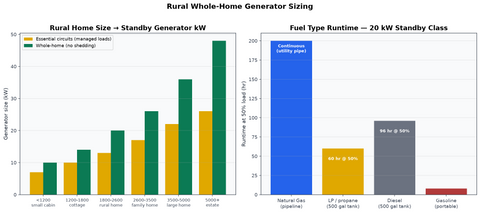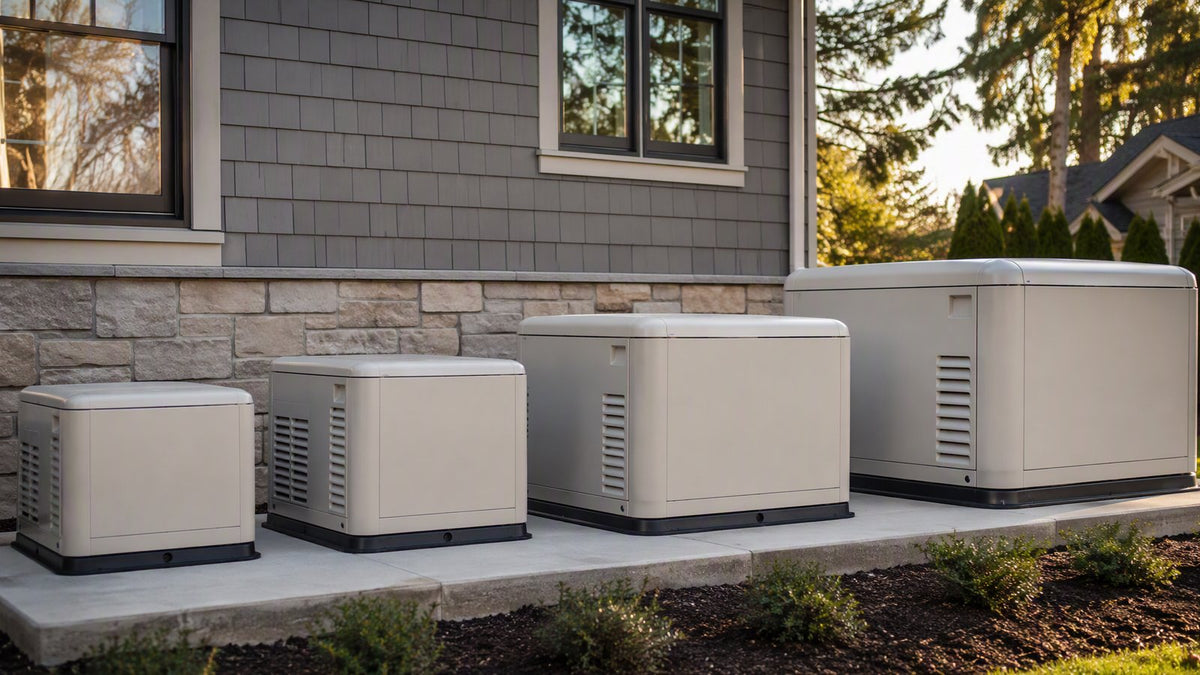
The four most-quoted standby generator sizes — 12, 16, 20, and 24 kW — differ by about $1,000–$1,500 per step on the equipment, and by a great deal more in what your house feels like during a week-long outage. Choose too small and you are managing loads by flashlight, deciding between the AC and the dryer. Choose too big and you spent $4,000 extra on an alternator that loafs at 30% load, wet-stacks its valves, and drinks fuel your family did not need burned. We size and supply standby systems across the country at PES Supply, and the right answer is almost never "the biggest one" or "the cheapest one" — it is the one that matches a real load calculation. This guide walks that calculation, then compares all four sizes honestly: coverage, amps, fuel burn, installed cost, and the specific house each size actually fits.
Key Takeaways
- 12 kW covers essentials for homes up to ~2,500 sq ft with gas heat: fridge, furnace blower, sump, lights, outlets — no central AC.
- 16 kW adds a soft-started central AC up to ~3 tons and most kitchen appliances; the sweet spot for 2,000–3,500 sq ft homes.
- 20 kW runs near-whole-house for 3,000–4,500 sq ft, including AC, range, and laundry with light management.
- 24 kW is true unmanaged whole-home coverage: multi-zone HVAC, electric water heater, EV charging headroom.
- The deciding factor is always the largest motor's starting surge versus the generator's surge rating — not the running-watts total.
In This Guide
We will cover how sizing actually works (running watts, starting watts, diversity), what each of the four sizes covers, a step-by-step load calculation you can do with a notepad, full comparison tables including fuel consumption and amps, installed costs, and a decision framework at the end. If you already know you are shopping, the 10–14 kW, 14–17 kW, 22 kW, and 26 kW collections bracket these four sizes with current inventory.
How Generator Sizing Actually Works
Generator sizing is two calculations, not one. The first is the energy calculation: total the running watts of everything that must operate during an outage, apply a diversity factor (0.6–0.7 for homes, because not everything runs simultaneously), and confirm the result sits under 80% of the generator's rated output — continuous duty at 100% shortens air-cooled engine life. The second is the surge calculation: find the largest motor load, multiply its running watts by 3–5 for starting surge (locked-rotor amperage), add it to whatever else is already running, and confirm the sum fits under the generator's surge rating, typically 120–130% of rated output for a few seconds.
The surge calculation is where sizing decisions are actually made. A 3-ton central air conditioner runs at 3,500 W — well inside even a 12 kW unit's capability — but starts at 8,000–10,000 W without a soft-start kit. On a 12 kW generator with ~14 kW of surge, that compressor starting while 4 kW of other loads run is a 12–14 kW spike: borderline at best, a stalled compressor and a tripped generator at worst. A $300–$500 soft-start module cuts that inrush 60–70% and single-handedly moves a house down an entire generator size class. We have sold hundreds of soft-starts to customers who were quoted a 20 kW unit by someone who never asked about their AC — the math changed, the quote changed, and the check they wrote changed with it.
12kW vs 16kW vs 20kW vs 24kW: What Each Covers
| Size | Best For | Typically Covers |
|---|---|---|
| 12 kW | Small to mid-size homes, essential-circuit backup | Refrigerator, sump pump, furnace blower, lights, outlets, Wi-Fi/router, garage freezer |
| 16 kW | Mid-size homes adding comfort systems | Everything in 12 kW plus central AC (up to ~3 tons, soft-started) and most kitchen appliances |
| 20 kW | Larger homes wanting near-whole-house coverage | Central AC, electric range, washer/dryer, well pump, most simultaneous loads |
| 24 kW | Large homes, multiple HVAC zones, high-demand appliances | Full whole-home backup including multiple AC units, electric water heater, EV charger headroom |
Three loads break these categories regardless of square footage. Tankless electric water heaters (18–27 kW) do not run on any generator in this table — they need 30 kW-class commercial units or, more sensibly, a swap to a tank unit. Electric vehicle charging at 40–48 A adds 9.6–11.5 kW continuous — possible on a 24 kW with management, impractical below it. And electric heat strips (10–15 kW) in heat-pump systems turn any outage into a sizing crisis; if your air handler has strips, either the generator grows or the strips get locked out on generator power via the ATS.
Step-by-Step Load Calculation
- List the must-run loads. Walk the house. Refrigerator (150 W running), furnace blower (600 W), sump pump (800 W), lights (400 W), kitchen receptacles (1,000 W), internet (50 W), garage freezer (300 W). Write real nameplate numbers where you can.
- Add the comfort loads. Central AC (3,500 W for 3-ton), microwave (1,200 W), dryer (5,000 W), range element (2,500 W), well pump (1,000 W) — whichever your household refuses to lose.
- Apply diversity. Multiply the running total by 0.6–0.7. Twelve kilowatts of nameplate behaves like 7–8 kW in practice.
- Check the surge event. Largest motor's starting watts plus everything else running. This is the pass/fail test for each generator size.
- Apply the 80% rule. Your expected operating load should sit at or under 80% of rated output: 9.6 kW on a 12, 12.8 kW on a 16, 16 kW on a 20, 19.2 kW on a 24.
- Decide with fuel in mind. Every step up burns more fuel per hour at partial load — Section 5 quantifies that.
Worked example: a 2,800 sq ft home with gas heat, a 3-ton AC with soft-start, electric dryer, and well pump. Must-run list totals 3,300 W; comfort additions push nameplate to 11,100 W; diversity brings expected operating load to ~7.2 kW. Surge test: soft-started AC (~3,000 W effective inrush) plus 5 kW running = 8 kW spike. A 12 kW unit passes the surge test but runs at 75% of rating continuously — too hot for a week-long outage. A 16 kW unit runs at 45% and passes everything with margin. Verdict: 16 kW, which is exactly why 16 kW outsells the other three sizes in suburbs with gas heat.
Full Comparison Tables
Coverage, Homes, and Cost
| Size | Typical Home Size | Circuit Shedding Needed? | Installed Cost (2026) |
|---|---|---|---|
| 12 kW | Up to ~2,500 sq ft | Often, via managed transfer switch | $8,000–$11,000 |
| 16 kW | ~2,000–3,500 sq ft | Occasionally, for heavy simultaneous loads | $9,500–$13,000 |
| 20 kW | ~3,000–4,500 sq ft | Rarely | $11,000–$15,000 |
| 24 kW | 4,000+ sq ft or multi-zone HVAC | No — full whole-home coverage | $13,000–$18,000+ |
Installed cost includes the unit, automatic transfer switch, pad, gas plumbing, electrical work, and permits. The spread inside each range is mostly site work: a gas meter 40 feet from the pad and a panel in the finished basement cost more than a meter beside the pad and a panel in the garage. Get the site assessed before comparing equipment quotes — the quote desk prices the full BOM so the comparison is apples to apples.
Electrical Output: Amps by Size (240 V Single-Phase)
| Size | Full-Load Amps | 80% Continuous Amps | Min. Conductor (NEC 445.13, 115%) | Generator Breaker (240.6) | Typical ATS |
|---|---|---|---|---|---|
| 12 kW | 50.0 A | 40.0 A | #6 AWG Cu (65 A) | 60 A | 100 A, load-managed |
| 16 kW | 66.7 A | 53.3 A | #4 AWG Cu (85 A) | 80 A | 100 A or 200 A |
| 20 kW | 83.3 A | 66.7 A | #3 AWG Cu (100 A) | 100 A | 200 A service-rated |
| 24 kW | 100.0 A | 80.0 A | #1 AWG Cu (110 A) | 110 A or 125 A | 200 A service-rated |
This table is the one your electrician actually needs. The conductor column comes from NEC 445.13 (115% of nameplate current) applied against NEC 310.16's 75°C copper ampacities, and the breaker column picks standard NEC 240.6 sizes. Note the 24 kW row: 100 A of generator output is why whole-home units pair with 200 A service-entrance-rated transfer switches — the switch must carry the full utility service, not just the generator. Our transfer switch explainer covers that equipment class, and the transfer switch collection stocks both ratings. The deep amp-and-wire walkthrough for the 10 kW class — same math, one size down — is in our 10 kW generator amps guide.
Fuel Consumption by Size (Propane, at 50% Load)
| Size | Propane at 25% Load | Propane at 50% Load | Propane at 100% Load | Est. Runtime, 500-gal Tank (400 gal usable) at 50% |
|---|---|---|---|---|
| 12 kW | ~0.7 gal/hr | ~1.1 gal/hr | ~1.6 gal/hr | ~364 hours (15 days) |
| 16 kW | ~0.9 gal/hr | ~1.4 gal/hr | ~2.1 gal/hr | ~286 hours (12 days) |
| 20 kW | ~1.1 gal/hr | ~1.7 gal/hr | ~2.6 gal/hr | ~235 hours (9.8 days) |
| 24 kW | ~1.3 gal/hr | ~2.0 gal/hr | ~3.0 gal/hr | ~200 hours (8.3 days) |
Oversizing has a fuel price. A 24 kW unit running a 6 kW average load burns roughly 80% more propane per hour than a 12 kW unit running the same load — over a ten-day outage, that is hundreds of gallons of difference. Right-sizing is not just about the purchase price; it is the operating cost of every future outage. Natural gas removes the tank constraint but applies a roughly 10% power derate on most air-cooled units, so a "20 kW" unit on NG behaves like an 18 kW — check the fuel-specific rating on the spec sheet, not the brochure cover.
Which Size Should You Actually Choose?
The decision framework our team uses at the counter:
- Gas heat + no central AC (or AC you can live without) + under 2,500 sq ft: 12 kW with a managed ATS. Essentials secured, fuel stretched, budget preserved.
- Gas heat + one central AC you refuse to lose + 2,000–3,500 sq ft: 16 kW plus a soft-start on the compressor. This is the modal American answer.
- Electric dryer/range in regular use during outages, or a well pump plus AC together: 20 kW. The step from 16 to 20 is where "managed" becomes "unmanaged" for most households.
- Multi-zone HVAC, electric water heating, EV charging, or 4,000+ sq ft: 24 kW, service-rated 200 A ATS, and no apologies. The Champion 22 kW splits the difference if the load calc lands between sizes.
- Load calc lands exactly on the boundary: go up one size. The $1,000–$1,500 step is cheap insurance against the load you forgot — the hot tub, the future EV, the mother-in-law suite.
For homes pairing solar with backup, the calculus shifts: a battery handles overnight and short outages silently, and the generator becomes the multi-day backstop at a smaller size. Our whole-home generator sizing guide runs the generator-only version of this analysis, and the battery storage collection covers the hybrid path that more of our customers choose every quarter.
Field Notes from Outage Season
We have answered the phone during ice storms, and the calls sort into two piles: people whose generators are too small, and people whose generators will not start. The too-small pile is why this article exists — a family in Tigard ran a 12 kW against a 4-ton heat pump with 15 kW of strip heat, and the strips won. Lockout relay, one hour, problem gone; the generator had been fine all along. The won't-start pile is almost always a three-year-old battery that passed the weekly test and failed the real one — replace it on a schedule, not on evidence. And the sizing mistake with the longest tail: I have seen exactly one customer regret buying the next size up, and that regret lasted until the first summer outage, when the AC, the freezer, and the fish tank all stayed on.
Frequently Asked Questions
Is it better to oversize a standby generator?
Slightly, yes — targeting 60–80% of rated output at your expected load is ideal for engine life and headroom. Massively oversizing hurts: a 24 kW unit loafing at 25% load burns roughly double the propane of a right-sized unit, and chronic light loading is hard on air-cooled engines. Go one size up from your calculated need, not three.
Can a 12 kW generator run central air conditioning?
A 12 kW can run a soft-started AC up to about 2.5 tons, provided other loads stay modest. A 3-ton unit's 8,000–10,000 W starting surge without a soft-start exceeds the generator's surge capability — the compressor stalls or the generator trips. Add a $300–$500 soft-start module and the math changes completely.
Does home square footage determine generator size?
Only loosely. Square footage correlates with HVAC tonnage and appliance count, but the real drivers are heating fuel (gas versus electric), AC size and soft-start status, water heating type, and well/sump pumps. A 3,500 sq ft gas-heated home can run on 16 kW while an 1,800 sq ft all-electric home with strips cannot run on 20 kW. Do the load calculation; the tape measure is not a sizing tool.
Why do starting watts matter so much for sizing?
Induction motors demand 3–5× their running current for a fraction of a second at start. If the generator cannot supply that spike, the motor stalls and drags voltage down for everything else. The largest motor's starting surge, added to already-running loads, must fit under the generator's surge rating — that single test eliminates more generator sizes than any running-watts total.
What's the price difference between a 12 kW and 24 kW installed system?
Roughly $5,000–$7,000 installed: $8,000–$11,000 for a typical 12 kW versus $13,000–$18,000+ for a 24 kW. The equipment step is only part of it — the 24 kW class usually triggers a 200 A service-rated transfer switch, heavier conductors (#1 AWG versus #6), and larger gas plumbing, all of which add labor and material.
How long will these generators run on propane?
At 50% load from a 500-gallon tank (400 gallons usable): about 15 days for a 12 kW, 12 for a 16 kW, 10 for a 20 kW, and 8 for a 24 kW. Natural gas removes the runtime limit entirely at the cost of a ~10% output derate and dependence on gas utility pressure during disasters.
Get the Right Generator Sized for Your Home
Bring us your load list — or just your square footage, heating fuel, and AC tonnage — and the PES quote desk will size the unit, the transfer switch, and the fuel line as one BOM. Shop the size classes directly: 10–14 kW standby, 14–17 kW standby, 22 kW, and 26 kW, or browse the full generator collection.