IECC 2024 Electrical Compliance for Homebuilders: R404, R408, and the ERI Path Explained
Section-by-section walkthrough of the IECC 2024 electrical mandates — high-efficacy lighting (R404.1), electric-ready outlets (R404.4), and the R408 series (solar-ready, EV-ready, HP-ready, HPWH-ready) — with the exact plan-review checklist.

IECC 2024, published by the ICC in June 2024 and adopted by 32 states as of Q3 2026, tightened the residential electrical provisions in six areas relative to the 2021 cycle. The changes are meaningful for production builders because two provisions (R404.1 lighting and R404.4 electric-ready outlets) are mandatory on every new home, and four provisions (R408.1–R408.5 series) offer ERI compliance credits worth 2–5 points each that can offset envelope upgrades.
The 16-point stack is significant. A typical builder using the ERI compliance path (ERI target ranges from 51 in Zone 6 to 65 in Zone 2) needs to hit that target through a combination of envelope, HVAC efficiency, and mechanical provisions. Every R408 credit banked is a point that can come off the envelope — the difference between spec'ing R-19 batts vs R-30 in the wall cavity, or between a 14 SEER heat pump vs a 16 SEER unit. On a 3,000-home division running at $85–$140 per point-of-envelope, banking 16 R408 credits per home is worth $4.1M to $6.7M annually.
R404.1 requires a minimum 90% of permanently installed lighting fixtures to be "high-efficacy" — defined as at least 45 lm/W. This is unchanged from IECC 2021 in principle, but IECC 2024 tightened the definition by removing the exception for closets, pantries, hall linens, and utility rooms. Every fixture, in every space, counts toward the 90% total. The lookup for lm/W is straightforward: any DOE-listed LED fixture manufactured after 2020 exceeds 45 lm/W by a comfortable margin (typical values are 80–120 lm/W). Incandescent, halogen, and pre-2015 CFLs do not.
Plan-review checklist — R404.1
- Fixture schedule on the electrical plan shows lm/W and DLC listing number for every fixture
- No incandescent or halogen fixtures in any space including closets, pantries, and mechanical rooms
- Chandeliers, decorative fixtures, and accent lighting all use LED bulbs; medium base sockets acceptable if paired with a listed LED bulb at time of CO
- Exempted fixtures (per R404.1 exception): appliance lighting (fridge, oven), and any fixture powered by a floor plug (not "permanently installed")
Almost every 2026 production builder is already at 100% LED on the base plan, so R404.1 is a documentation exercise rather than a design change. The failure mode is the buyer-option catalog — decorative pendant fixtures over kitchen islands often ship from vendors as "medium base with incandescent" and require the sales center to attach a bag of LED bulbs at closing to keep the plan compliant.
R404.4 is new in IECC 2024 and requires "electric-ready" outlets at three specific locations: (1) at the electric or gas cooktop location, an electric-ready 40 A / 240 V circuit must be installed even if a gas cooktop is initially specified; (2) at the dryer location, an electric-ready 30 A / 240 V circuit; (3) at the water heater location, an electric-ready 30 A / 240 V circuit. In each case, "electric-ready" means the raceway, wire, breaker, and receptacle or junction box are all installed — the appliance itself does not have to be electric.
This provision closes the "gas-only" builder loophole
Under IECC 2021, a builder using gas appliances at initial CO could omit the 240 V circuits and the buyer would pay $800–$1,400 later to add each one. R404.4 in the 2024 cycle mandates the circuits regardless of initial appliance choice — closing the retrofit gap and adding ~$260 to the base plan electrical BOM.
The three R404.4 circuits align precisely with the electrification package described in Whole-Home Electrification Package. If you spec the electrified plan, R404.4 compliance is free. If you spec a mixed-fuel plan (gas HVAC + gas water heater + gas cooktop + gas dryer), R404.4 adds three empty 240 V circuits (~$260 in wire + breakers + boxes + labor) that terminate at capped J-boxes behind the appliance location — code-compliant, and future-proofing the home for buyer-driven electrification.
The R408 series is where builders using the ERI (Energy Rating Index) compliance path bank credits. All five provisions are optional in the ERI path (mandatory in the prescriptive path); most builders adopt the ERI path specifically to unlock the R408 credits and offset envelope costs.
R408.1 — Battery-ready wiring (2 pts)
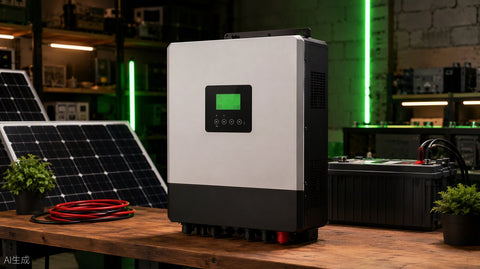
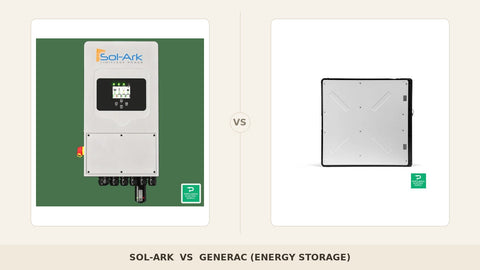
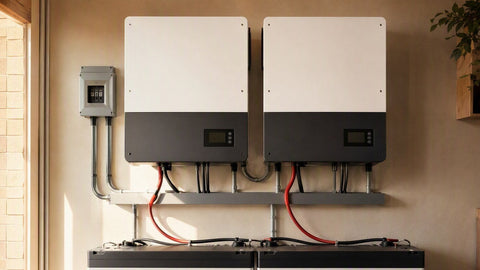
A dedicated 60 A raceway from the exterior wall of the garage or utility room to the main service panel, labeled "BATTERY STORAGE." Sized to accommodate a future 5–15 kWh battery installation (Tesla Powerwall 3, Enphase IQ Battery 10T, Fortress Avalon HV Pro). The raceway is 1" EMT or Sch 40 PVC; termination is a listed disconnect (Eaton BR160 or Square D DU223 in general use) or a J-box for hardwired battery output. Verification: photograph of the labeled raceway plus panel-schedule notation.
R408.2 — Solar-ready zone (5 pts)
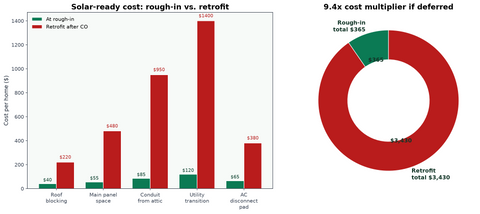
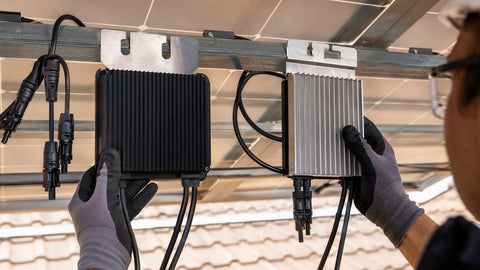
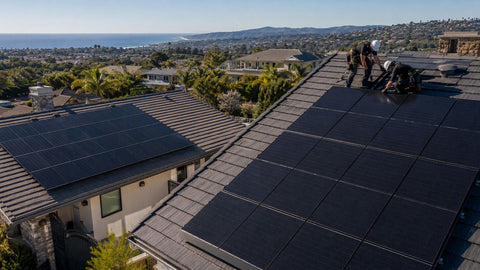
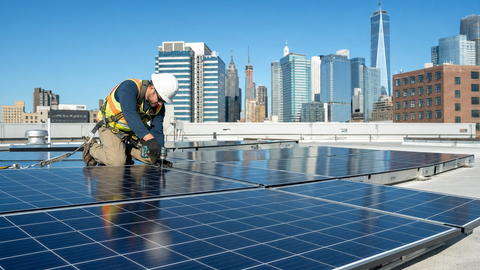
Covered in depth in the Solar-Ready New Construction Guide. Highest single point-value in the R408 series. Requires the 400 sq ft solar-ready roof zone, 5 psf dead-load allowance on trusses, and 1" EMT raceway to the main panel with reserved bus space.
R408.3 — EVSE-ready circuit (3 pts)
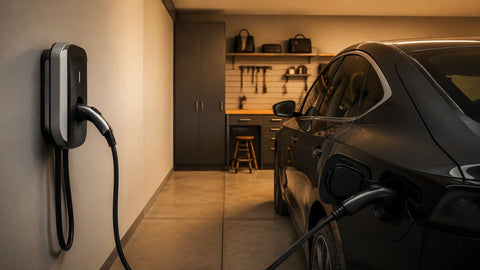
A 40 A / 240 V circuit installed to the garage with a terminated NEMA 14-50 receptacle or hardwired J-box, labeled "EVSE READY." The circuit must be sized for continuous 32 A load (which is the effective Level 2 charging speed of a 40 A circuit under NEC 625.42's 125% derating). Some jurisdictions accept a 60 A circuit for R408.3 credit at 48 A hardwired chargers — see the EV-Ready Wiring Guide for the raceway spec.
R408.4 — Heat pump-ready HVAC (4 pts)
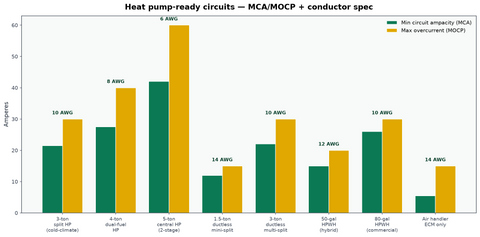
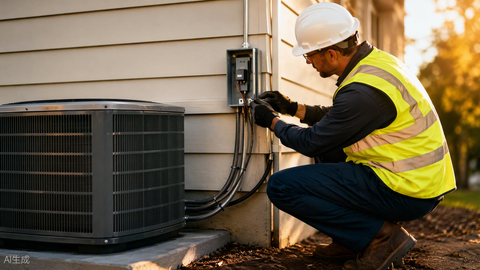
The condenser location has a 60 A / 240 V disconnect installed on the exterior wall, the air handler location has a 15 A / 120 V circuit with ECM-rated wiring, and both circuits terminate at the panel with appropriately sized breakers reserved and labeled. Verification: nameplate photos of the disconnect and air-handler J-box plus panel-schedule notation.
R408.5 — Heat-pump water-heater-ready (2 pts)
A 30 A / 240 V circuit at the water heater location, GFCI protected per NEC 2023 210.8(F), terminated at a J-box with a labeled disconnect. Verification: photo of the disconnect plus panel-schedule notation.
Total stackable credits from R408.1 + R408.2 + R408.3 + R408.4 + R408.5 = 16 ERI points. The credit values are set by ICC and integrated into REM/Rate and Ekotrope rating software as of the March 2026 releases.
The compliance packet that lands on the plans examiner's desk should be exactly one page. Any longer and the plan review turns into a discovery exercise; any shorter and the required documentation is missing. This is the template used by the 8 reference builders — copy it into your standard plan-set.
| Item | Section | Documentation on plan sheet | Verification at CO |
|---|---|---|---|
| High-efficacy lighting ≥90% | R404.1 | Fixture schedule with lm/W | Fixture install photos |
| Cooktop 40A/240V | R404.4 | Circuit CT-1 on panel schedule | J-box photo behind cooktop |
| Dryer 30A/240V | R404.4 | Circuit CT-2 on panel schedule | J-box photo behind dryer |
| Water heater 30A/240V | R404.4 | Circuit CT-3 on panel schedule | J-box photo at WH location |
| Battery-ready raceway | R408.1 (2 pts) | Raceway route on plan | Photo of labeled raceway |
| Solar-ready zone | R408.2 (5 pts) | Roof plan callout + truss stamp | Zone + raceway photos |
| EVSE-ready circuit | R408.3 (3 pts) | Circuit EV-1 on panel schedule | NEMA 14-50 or J-box photo |
| HVAC HP-ready | R408.4 (4 pts) | HVAC circuits on panel schedule | Disconnect + AH J-box photo |
| HPWH-ready | R408.5 (2 pts) | Circuit WH-1 on panel schedule | Disconnect at WH location |
| ERI target compliance | R405 | ERI report from HERS rater | HERS rater sign-off |
| Panel schedule complete | R405/R408 | All circuits labeled | Panel photo, all breakers labeled |
| Close-out photo package | R408.2.3.4 | Not required on plan | Bundle attached to CO request |
The reason production builders adopt the ERI path (as opposed to the prescriptive path) is that ERI is a total-home score — you can trade envelope points for mechanical points for R408 points as long as the total score meets the target. IECC 2024 climate-zone targets are: Zone 2 = 65, Zone 3 = 60, Zone 4 = 58, Zone 5 = 55, Zone 6 = 52, Zone 7 = 51.
A typical Zone 4 production plan without any R408 credits scores 62–65 on the ERI (using IECC 2024 baseline envelope + 14 SEER heat pump + gas HPWH). Adopting the electrification package (moving to HPWH) drops the score to 55–58, which hits the target. Adopting the electrification package + all four R408 provisions drops the score to 44–48 — well below the target, and freeing 7–14 points of envelope reduction. Those envelope points, at $95–$140 per point of ERI improvement, are worth $665–$1,960 per home in avoided cost.
ERI score walk — 2,400 sq ft Zone 4 plan
- Baseline (IECC 2024 min envelope, gas HVAC, gas WH): 62
- + Heat pump HVAC (16 SEER): -6 points → 56
- + HPWH: -3 points → 53
- + Solar-ready (R408.2): -2 points → 51
- + EV-ready (R408.3): -1 point → 50
- + HP-ready HVAC (R408.4): -2 points → 48
- + HPWH-ready (R408.5): -1 point → 47
- Target for Zone 4: 58 → surplus of 11 points, banked for envelope reduction
Adoption of IECC 2024 varies by state and, within states, by local amendment. Homebuilders operating across multiple states need to track the exact code version and any amendments at each local building department. The rough map (verified via DOE's Code Adoption Status database):
| State | Code version | Effective date | Notable amendments |
|---|---|---|---|
| California | Title 24 Part 6 (2025) | Jan 2026 | Mandatory solar; exceeds IECC 2024 in almost every provision |
| Colorado | IECC 2024 + amendments | Jul 2025 | R408.3 mandatory in Denver, Boulder |
| Washington | WSEC-R 2024 | Mar 2026 | R408 series mandatory statewide |
| Oregon | ORSC 2023 (based on IECC 2021 + amendments) | Oct 2024 | Adopting IECC 2024 in 2027 cycle |
| New York | NYSECC 2020 + amendments | May 2020 | IECC 2024 adoption pending, expected 2027; NYC has separate LL97 |
| Texas | IECC 2021 + amendments | Sep 2022 | IECC 2024 not adopted statewide; Austin, Dallas, Houston may amend locally |
| Florida | Florida Building Code 2023 (based on IECC 2021) | Dec 2023 | IECC 2024 not on adoption path |
| Georgia | IECC 2015 + amendments | Jan 2020 | IECC 2024 not adopted; Atlanta has separate amendments |
| Arizona | Home-rule state; each city | Varies | Phoenix, Tucson using IECC 2018 as of 2026 |
| North Carolina | NC Energy Code 2018 (based on IECC 2015) | Jan 2019 | Legislature blocked IECC 2024 update |
The takeaway: if you build in California, Colorado, or Washington, your plans need R408 compliance today. If you build in Texas, Florida, Georgia, or North Carolina, R408 is a marketing story ("energy-ready") but not a mandate. In the middle states (Illinois, Ohio, Michigan, Virginia), local jurisdictions vary widely — do a code review by county before committing your plan library.
The IECC 2024 is not a single national rollout. The code is developed by the ICC on a three-year cycle, then adopted state-by-state (and in some cases city-by-city) with amendments. Understanding the adoption calendar is critical for production builders working in multiple states — the same plan can be code-compliant in Tennessee and non-compliant in Colorado on the same day. Below is the adoption status as of Q3 2026 for the states where production homebuilding volume is concentrated.
| State | Current adopted code | IECC 2024 status | Homebuilder deadline |
|---|---|---|---|
| Texas | IECC 2015 + TX amendments | No adoption planned | N/A — remains 2015 |
| Florida | FBC 2023 Energy (based on IECC 2021) | Under review — expected Q2 2027 | Prep for 2027 |
| California | Title 24 2022 (exceeds IECC 2024) | Own code — no adoption | Title 24 2025 effective 1/1/2026 |
| Georgia | IECC 2015 + GA amendments | Reviewing 2024 for 2027 | N/A — remains 2015 |
| North Carolina | 2018 NC ECC (IECC 2015-based) | Rulemaking initiated — target 2028 | Long horizon |
| Colorado | IECC 2021 + electrification amendments | Adopting 2024 — 1/1/2027 | Permit before 1/1/27 or comply |
| Washington | WSEC 2021 (exceeds IECC 2021) | Adopting 2024 base — 7/1/2027 | Prep for 7/1/2027 |
| Massachusetts | Stretch Energy Code (IECC 2021 base) | 2024 stretch update — 7/1/2027 | Prep for 7/1/2027 |
| Illinois | 2021 IL Energy Cons. Code | 2024 adoption — 1/1/2026 (statewide) | Already active |
| Minnesota | MN 1322 (IECC 2018-based) | Reviewing 2024 — target 2028 | Long horizon |
| Arizona | Municipal adoption — varies | Phoenix / Tucson reviewing 2024 | Municipal — check jurisdiction |
| Utah | IECC 2015 + UT amendments | No adoption planned | N/A — remains 2015 |
Two takeaways for national builders. First, the compliance burden is concentrated in Colorado, Illinois, Washington, and Massachusetts through 2027 — these are the states where solar-ready, EV-ready, and heat pump-ready rough-in are already mandatory or become mandatory within the plan cycle. If your Colorado division is on the 2027 adoption date, any permit you pull after 12/31/2026 is subject to IECC 2024 R408.
Second, the "prescriptive vs. performance path" choice matters differently in each state. Colorado and Illinois amended IECC 2024 to make R408 mandatory regardless of compliance path — you cannot performance-out of solar-ready, EV-ready, or heat pump-ready. Washington and Massachusetts allow the performance path to trade R408 credits against envelope improvements. This is a material design decision for production builders — a Colorado plan must include R408 rough-in on every home; a Washington plan can drop R408 in exchange for R-30 walls if the total ERI comes in under target.
The practical implication for master plan development: standardize the R408 rough-in package across your national plan library. Even in states where R408 is not yet mandatory, the plan is code-neutral (the rough-in is invisible after drywall) and locks in future compliance without a mid-year plan revision. The BOM cost of standard R408 rough-in — solar conduit, EV-ready circuit, heat pump-ready lug space, HPWH circuit rough-in — is $487 to $612 per home across all four elements. That's the price of insurance against a state-by-state code adoption calendar you don't control.
Do R408 credits apply if I use the prescriptive compliance path?
How does IECC 2024 interact with Zero Energy Ready Home (ZERH) v2?
Does R404.4 apply to attached ADUs?
What if my jurisdiction amended R408 out?
Do I need a separate inspection for R408 items?
How does an IECC 2024 R408 compliance package impact my ENERGY STAR SFNH v3.2 certification?
Can I comply with R404.1 using dimmable LEDs?
IECC 2024 compliance packet — hardware, disconnects, and labeling
Register on the PES Axis contractor portal for the full R408-series hardware kit, IECC 2024 compliance labels, and pre-cut whip assemblies for HVAC, HPWH, and EVSE ready circuits.
Register Now