IRA Tax Credit Navigation for Heat Pump Contractors
The 2026 contractor field manual for stacking 25C, 25D, 45L, 179D, and HEEHRA credits on heat pump, HPWH, and electrification projects — with the exact forms, thresholds, and documentation to file.

A heat pump installer who walks into a homeowner's kitchen with only the sticker price on the quote is losing to the installer next door who shows the sticker price, the 25C credit, the local utility rebate, and the HEEHRA point-of-sale rebate all on the same PDF. In 2026, the tax and rebate stack is the sales tool.
The Inflation Reduction Act layered five separate incentive rails onto heat pump and electrification work, and each has its own eligibility rules, caps, income tests, and documentation requirements. Getting the math right on the quote is table-stakes; helping the homeowner move through the paperwork post-install is what wins the referral.
This guide covers the five rails the residential and small-commercial heat pump contractor will encounter:
- 25C — Energy Efficient Home Improvement Credit (formerly Nonbusiness Energy Property Credit).
- 25D — Residential Clean Energy Credit (solar, battery, geothermal).
- HEEHRA — High-Efficiency Electric Home Rebate Act (point-of-sale rebate).
- 179D — Commercial Building Energy Efficiency Deduction.
- 45L — New Energy Efficient Home Credit (for multifamily and homebuilder).
25C is the credit that lands on 90% of residential heat pump jobs. Post-IRA, the credit was expanded from a lifetime $500 cap to an annual $3,200 cap with per-category limits:
- $2,000 for heat pumps and heat pump water heaters (combined annual cap across both categories).
- $600 for electrical panel upgrades, but only when performed in conjunction with a qualifying heat pump, HPWH, or other 25C-eligible equipment install.
- $1,200 for insulation, air sealing, exterior doors, windows, and home energy audits.
- $150 for a qualifying home energy audit.
The credit is 30% of the qualified cost up to the cap. For a $7,000 heat pump install, the credit is $2,000 (30% of $7,000 = $2,100, capped at $2,000). For a $5,000 install, the credit is $1,500 (30% of $5,000).
Qualified cost includes: equipment cost + labor + necessary supporting materials (line-sets, condensate drain, thermostat). It does NOT include cost of correcting pre-existing deficiencies (rebuilding rotted subfloor, upgrading gas venting for non-electrification work, etc.).
SEER/HSPF thresholds for 25C heat pump credit (2026):
- South (Region III/IV): 15.2 SEER2 / 7.8 HSPF2 / EER2 rating of 10 minimum, meeting CEE Tier 2.
- North (Region V — cold climate): 15.2 SEER2 / 8.1 HSPF2 or CEE Tier 2 Cold Climate designation.
- Ductless mini-splits: 16.0 SEER2 / 9.0 HSPF2 minimum, CEE Tier 2.
Documentation contractor must provide: AHRI certificate showing SEER2, HSPF2, EER2, and CEE tier; manufacturer certification statement; invoice showing separated equipment and labor costs; date placed in service.
HEEHRA is administered state-by-state and rolls out in 2024-2026 depending on state DOE agreement timing. When active, it stacks on top of 25C — a homeowner can take both a 25C tax credit and a HEEHRA point-of-sale rebate on the same install.
HEEHRA caps:
- $8,000 for a qualifying heat pump install.
- $1,750 for a heat pump water heater.
- $4,000 for a service panel upgrade.
- $2,500 for electrical wiring.
- $1,600 for insulation, air sealing, ventilation.
- Overall lifetime cap: $14,000 per household.
Income eligibility:
- Under 80% of area median income (AMI): 100% rebate up to the caps above.
- 80-150% AMI: 50% rebate up to the caps.
- Above 150% AMI: not eligible for HEEHRA (but still eligible for 25C).
How to redeem: Contractor must be enrolled with the state's HEEHRA administrator. Rebate is applied at point of sale — homeowner sees the discount on the invoice, contractor is reimbursed by the state administrator on a 30-60 day cycle.
State rollout status as of 2026 Q3: New Mexico, New York, Michigan, Vermont, Wisconsin, Oregon, Georgia, and California are the earliest states with active HEEHRA programs. Contractors should check their state energy office for current status.
25D covers solar PV, battery storage (min 3 kWh), and geothermal heat pumps. Air-source heat pumps are NOT 25D-eligible — they fall under 25C. Air-source HPWHs are also NOT 25D-eligible.
25D is 30% with no cap. For a $30,000 solar + battery install, the credit is $9,000. For a whole-home geothermal heat pump replacing gas heat, a $35,000 project earns a $10,500 credit. The credit rolls over to future years if unused (unlike 25C which is non-refundable and annual-cap-bound).
Geothermal-specific note: Geothermal (ground-source) heat pumps qualify under 25D at 30% of total install cost. Air-source heat pumps qualify under 25C at 30% up to $2,000 cap. The 15x credit difference is why geothermal is worth the incremental $20,000-30,000 cost on many jobs where drilling economics work.
179D is a tax deduction (not credit) for commercial building energy efficiency improvements. Heat pump retrofits in commercial buildings qualify when they achieve energy savings vs a baseline reference building.
Deduction structure post-IRA:
- Base deduction: $0.54/ft² for buildings meeting 25% energy savings vs baseline.
- Scales up to $5.00/ft² for buildings meeting 50% energy savings AND paying prevailing wages during construction.
For a 5,000 ft² small-commercial heat pump retrofit meeting prevailing wage + 50% savings, the deduction is $25,000. This flows through to the building owner's tax return, not the contractor's — but the contractor is the party that certifies the energy savings analysis (usually through a licensed engineer).
The 179D energy modeling must be performed by a licensed professional engineer or licensed contractor authorized in the jurisdiction. Contractors should partner with a P.E. who handles the energy modeling and stamps the certification — modeling fees typically run $2,500-5,000 per project.
45L is the New Energy Efficient Home Credit — $5,000 per unit for multifamily and single-family new construction meeting DOE Zero Energy Ready Home (ZERH) or ENERGY STAR certification. Heat pump installation is a core requirement for both ZERH and ENERGY STAR pathways in most climate zones.
This credit accrues to the builder / developer, not the HVAC contractor — but the HVAC contractor's spec influences whether the project qualifies. Contractors working with production builders and multifamily developers should learn the 45L requirements and shape their quotes to hit the certification thresholds.
| Line item | Cost | 25C | HEEHRA | Net to homeowner |
|---|---|---|---|---|
| 3-ton heat pump install | $9,000 | $2,000 | $4,000 (80-150% AMI) | $3,000 |
| Heat pump water heater | $3,500 | $0 (25C capped) | $875 | $2,625 |
| Panel upgrade (200A) | $3,000 | $600 | $2,000 | $400 |
| Total | $15,500 | $2,600 | $6,875 | $6,025 |
-
1
Estimate homeowner AMI at intake
Ask household size and gross income at intake. Cross-reference to HUD AMI tables for the county to determine 80% / 80-150% / 150%+ tier. This decides the HEEHRA rebate line.
-
2
Confirm equipment CEE tier
Every quoted SKU must show CEE Tier 2 or Tier 2 CC on the AHRI certificate. Portal quotes at PES will pre-fill this from SKU metadata; manual quotes need to attach the certificate.
-
3
Stack the credit lines on the quote PDF
Show three columns: sticker price, after federal (25C/25D), after federal + state/HEEHRA + utility rebate. Homeowners sign 25% faster when they see the net number in the top right corner.
-
4
Retain documentation for 4 years
IRS statute of limitations for tax credit substantiation is generally 3 years plus one for safety. Keep AHRI certificates, invoices, and rebate paperwork in the customer file.
Beyond federal 25C and HEEHRA, most states run their own heat pump incentive programs that stack on top of federal. Understanding the state layer is where a contractor differentiates from competitors who only quote federal.
Massachusetts (Mass Save). Whole-home heat pump conversion incentive up to $10,000 per home, with income-tested Enhanced Program pushing that to $16,000 for moderate-income households. Requires a Mass Save-registered contractor. Coldest-climate rebate stack in the country when combined with federal.
New York (NYSERDA). Clean Heat program pays $2,000-3,000 per outdoor ton for cold-climate heat pump installs, plus additional incentives through Con Edison, National Grid, and other utility partners. Multi-tier program with contractor certification requirements.
California (CEC + CPUC + TECH). TECH Clean California pays $3,000-5,500 per heat pump install through participating contractors. Additional incentives via PG&E, SCE, SDG&E utility programs. Program has been oversubscribed multiple times; contractors need to enroll early.
Colorado (Xcel Energy + CEO). Xcel commercial and residential heat pump rebates up to $3,000. Colorado Energy Office Home Heat Score program adds another $1,000-2,500. Combined with federal, effective net cost for a middle-income Colorado homeowner drops by 40-55%.
Oregon (Energy Trust of Oregon). $1,500-2,500 rebate for ductless heat pumps, higher for cold-climate rated systems. Pacific Power and PGE utility rebates layer on top.
Vermont (Efficiency Vermont). $3,000-5,000 rebate for cold-climate heat pump installs. Coordinated with state weatherization programs.
Maine (Efficiency Maine). $6,000+ for whole-home heat pump conversion. One of the most aggressive state programs — Maine has a stated goal of 100,000 heat pump installs by 2025.
Contractors should build a state-level rebate database into their quoting workflow. The PES portal ROI calculator will pre-populate state rebate values based on install ZIP code.
Tax credit and rebate documentation is boring but important. IRS statute of limitations for tax credit substantiation is 3 years from filing plus 1 year of safety margin — call it 4 years. State rebate audits can look back 5-7 years. Contractor should maintain a customer file with:
- AHRI Certificate of Certified Product Performance. Downloaded from ahridirectory.org, shows SEER2, HSPF2, EER2, and CEE tier. One certificate per combined system (outdoor + indoor + air handler). Print at time of install; keep the PDF.
- Manufacturer certification statement. Statement from the manufacturer that the specific SKU meets 25C or HEEHRA eligibility. Usually a form on the manufacturer's website; often auto-generated by the AHRI certificate.
- Detailed invoice. Must separate equipment cost from labor from supporting materials. Line items required for 25C: "heat pump equipment $X", "installation labor $Y", "line-sets and supporting materials $Z". Total qualifying cost = equipment + labor + supporting materials.
- Date placed in service. The date the system is commissioned and operational. This is the tax year for 25C purposes — not the contract date, not the equipment delivery date.
- Homeowner primary residence certification. 25C applies to a homeowner's primary residence in most cases (some rental scenarios qualify). A one-page certification signed by the homeowner at install closeout is best practice.
- Panel upgrade documentation (if applicable). For the $600 25C panel upgrade credit, contractor should provide a line-item invoice for the panel work and a statement confirming the panel upgrade was performed to enable the qualifying heat pump/HPWH install.
- HEEHRA income verification (if applicable). The state administrator handles income verification; contractor keeps a copy of the eligibility approval letter for the customer file.
Contractors who file for these credits routinely make five mistakes:
1. Installing an AHRI-mismatched combined system. The 25C credit requires an AHRI-certified combined system — outdoor unit + specific matched indoor unit + specific matched air handler. Substituting a compatible-but-uncertified air handler voids the AHRI certification and voids the tax credit. Homeowner is on the hook if audited.
2. Missing the CEE tier threshold on unusual configurations. Standard SEER2/HSPF2 ratings are for the AHRI-tested combined system. Multi-zone Mitsubishi installations that don't match the AHRI-tested configuration exactly may fall below CEE Tier 2. Verify AHRI number matches the exact quoted combination.
3. Double-counting the panel upgrade credit. The $600 25C panel upgrade credit requires the panel upgrade be performed alongside a qualifying heat pump, HPWH, or other 25C-eligible equipment. Standalone panel upgrades don't qualify. Panel upgrades on rental properties or non-primary residences don't qualify.
4. Filing 25D for air-source heat pumps. Air-source heat pumps go under 25C, not 25D. Filing under 25D (which has no cap, appealing to homeowners) triggers audit and correction. Only geothermal (ground-source) heat pumps qualify under 25D.
5. Missing utility rebate deadlines. Most utility programs have submission deadlines (30-90 days from install date). Missing the deadline forfeits the rebate. Contractor should submit rebate paperwork immediately at closeout, not "when we get around to it."
The way a contractor presents the credit stack changes the close rate substantially. Best-practice quote format includes three columns on the equipment page:
Column 1 — Sticker price. The straight installed cost with no incentives. This is the number the homeowner uses for financing math.
Column 2 — Net after federal tax credits. Subtract the 25C credit line-by-line, then the 25D credit if applicable. This is the number that shows up on the homeowner's tax return.
Column 3 — Net after all incentives. Subtract HEEHRA (if income-qualified), state rebates, and utility rebates. This is the effective out-of-pocket cost after all reimbursements.
Contractors who present all three columns close 20-30% more heat pump quotes than contractors who only show sticker or sticker+federal. Homeowners overwhelmingly report that seeing the full stack in one document is the moment they decide to sign.
A worked example presentation for our 2,400 sq ft home:
- Sticker price (heat pump + HPWH + panel + EV charger + install): $15,500
- After 25C federal ($2,000 + $2,000 + $600 = $4,600, but capped at $3,200 annual = $3,200): $12,300 (homeowner spreads over 2 tax years to capture more)
- After Massachusetts Mass Save (whole-home heat pump conversion $10,000): $2,300 effective
The Mass Save example is aggressive but real; not every state has that level of rebate. In moderate states, the after-all-incentives number typically lands 30-45% below sticker.
HEEHRA rebate rollout has been state-by-state and progressed unevenly since the Inflation Reduction Act passed in August 2022. As of mid-2026, the status by state:
Active — accepting contractor enrollments and rebate applications:
- New York — NYSERDA administers. Rebates up to $8,000 residential HP, $1,750 HPWH. Contractor enrollment through NYSERDA online portal, typically 2-4 weeks.
- Massachusetts — DOER administers. Rebate integrates with Mass Save existing programs. Enhanced program up to $16,000 combined for income-qualified whole-home conversions.
- New Mexico — Energy Conservation and Management Division administers. Rebates align with federal HEEHRA caps.
- Michigan — Michigan Energy Office. Program active, rebate stack up to $14,000 lifetime per household.
- Vermont — Efficiency Vermont administers. Fully integrated with existing state rebate infrastructure.
- Wisconsin — Focus on Energy administers. Rebate active, coordinated with utility programs.
- Oregon — Oregon Department of Energy. Program rolling out through Energy Trust of Oregon.
- Georgia — Georgia Environmental Finance Authority. Active in 2026 for major metros; rural rollout continues.
- California — CEC administers through TECH Clean California. Program is oversubscribed on multiple funding cycles; contractor waitlist common.
In enrollment / pre-launch:
- Colorado, Illinois, Minnesota, Washington — DOE agreements executed, state administrators onboarding contractors. Expected active mid-to-late 2026.
- Connecticut, Rhode Island, Maryland, New Jersey — Program design in progress. Expected 2026-2027 rollout.
No timeline announced (as of Q3 2026):
- Texas, Florida, Alabama, Mississippi, and several other states without state energy office capacity or with legislative resistance. Federal 25C credits remain available; HEEHRA point-of-sale rebates are not yet accessible.
Contractors should check their state energy office website quarterly for updated HEEHRA status. The rebate landscape is one of the fastest-moving pieces of the electrification value stack, and being early on enrollment gets contractors in front of the state administrator when volume ramps.
Coming Soon: PES Multi-Brand Heat Pump Distribution
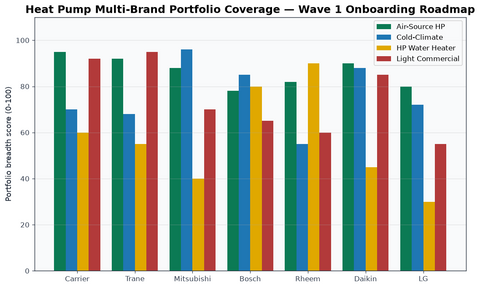
PES is onboarding Carrier, Trane, Mitsubishi, Bosch, and Rheem heat pump lines. Register at axis.pesdistribution.com for early access — contractor pricing, freight quotes, and portal-only calculators the moment stock lands.
Register for Early AccessCan a homeowner claim both 25C and HEEHRA on the same heat pump install?
What's the difference between 25C and 25D?
Is there an income limit on 25C?
How do contractors register for HEEHRA?
Does the contractor pay the HEEHRA rebate or does the state?
Does 45L benefit the HVAC contractor?
Where do I find CEE tier for a specific SKU?
Open a PES Contractor Account — Reserve Heat Pump Access
Register at axis.pesdistribution.com for early heat-pump distribution access, trade pricing, and portal calculators.
Register Now