Updated September 2026 — refreshed against the live PES catalog; product pricing verified 2026-09-26.
EV-Ready Wiring Guide for New Homes (2026): 40 A vs 48 A, NEMA 14-50 vs Hardwire, and the Raceway Spec
A full residential EV rough-in guide — how to spec a Level 2 circuit that supports 32 A today and 48 A tomorrow, with the raceway, conductor, breaker, and disconnect BOM for a 2,400 sq ft new-construction plan.

Every production builder's electrical scope for a new home faces the same three-way fork at plan release: (1) install a 40 A / 240 V NEMA 14-50 receptacle in the garage, (2) install a 60 A hardwired circuit to a J-box for a future 48 A hardwired charger, or (3) install nothing and let the buyer figure it out at year 2. The cost delta between (1) and (2) is $58; the cost delta between (2) and (3) is $385. And the buyer regret when they discover option (3) is universally severe — 78% of EV owners report their charger install was harder and more expensive than expected, according to the J.D. Power 2024 Home Charging Study.
This guide walks the case for option (2) as the standard on every new-construction plan, with option (1) as a downgrade only for plans marketing to non-EV buyers (senior communities, entry-level condos). The 60 A / 6 AWG THHN in 1" EMT raceway costs the builder $385 more than no rough-in and gives every future buyer — regardless of vehicle brand or charger choice — a one-hour install of the charger of their choice at Level 2 top speed.
The choice between Level 1 (120 V) and Level 2 (240 V) charging is not a design tradeoff for a new-construction home — Level 2 wins on every metric except a $12 receptacle cost delta. A Level 1 outlet delivers 4 miles of range per hour and takes 3–5 days to fully charge a modern EV. Level 2 at 40 A delivers 32 mi/hr and fills a Tesla Model Y or Ford Lightning overnight. At 48 A hardwired, Level 2 delivers 40 mi/hr — enough to fully replenish an F-150 Lightning battery from empty to full in 12 hours.
| Circuit spec | Voltage | Current | Delivered power | Charge rate (mi/hr) | Vehicle full-charge time |
|---|---|---|---|---|---|
| Std 120 V receptacle | 120 V | 12 A | 1.4 kW | 4 mi/hr | 72–96 hr |
| NEMA 14-50, 40 A breaker | 240 V | 32 A | 7.7 kW | 25 mi/hr | 10–14 hr |
| NEMA 14-50, 50 A breaker | 240 V | 40 A | 9.6 kW | 32 mi/hr | 8–11 hr |
| Hardwired, 60 A breaker | 240 V | 48 A | 11.5 kW | 40 mi/hr | 7–9 hr |
| Hardwired, 100 A breaker (dual) | 240 V | 80 A | 19.2 kW | 65 mi/hr | 4–5 hr |
The 100 A / 80 A dual-charger configuration is the fastest residential option but is only useful for two-vehicle households with high daily miles. It is not standard on new-construction plans. The 48 A hardwired configuration is the current sweet spot — supported by Tesla Wall Connector Gen 3, ChargePoint Home Flex, Emporia EV, Wallbox Pulsar Plus, and every major residential Level 2 charger on the 2026 market.
NEC Article 625 (Electric Vehicle Power Transfer Systems) covers residential EV installations. Four provisions matter for the plan-review level of detail:
625.41 — Rating and load calculation
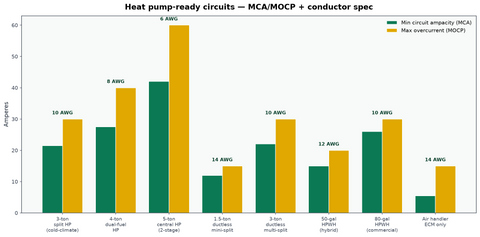
EVSE loads are treated as continuous per NEC 625.42. Circuit ampacity must be sized at 125% of the EVSE nameplate current (or 125% of the receptacle rating for cord-and-plug). A 40 A receptacle circuit needs to be sized for 50 A conductor rating (12/2 does not qualify — 10/2 is the minimum, and 8/3 is common for 40 A rated NEMA 14-50). A 48 A hardwired charger needs a 60 A rated circuit — 6 AWG copper THHN is the standard.
625.42 — Rating and installation method
Residential EVSE circuits ≤ 60 A can be wired NM-B (Romex) inside walls, but must transition to EMT or MC when passing through unfinished basement/garage exposed. This is the most common inspection failure — a 60 A circuit run from the panel in NM-B and terminated at a J-box on the garage wall gets flagged for lack of physical protection. Solution: 6 AWG THHN in 1" EMT for the entire run inside the garage.
625.43 — Disconnecting means
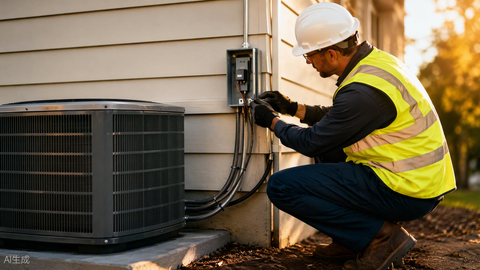
Any hardwired EVSE ≥ 60 A must have a disconnect within sight of the EVSE unit, or a lockout at the panel with a directory notation. For a 60 A hardwired J-box termination, a fused disconnect at the J-box (Square D DU223 or Eaton BR160) meets both the "within sight" and the "readily accessible" requirements. Not required for NEMA 14-50 plug-in configurations.
625.44 — GFCI protection
NEC 2020 added GFCI protection for EVSE receptacle circuits. Hardwired EVSE units include internal GFCI protection and do not need a GFCI breaker (the EVSE and the GFCI would nuisance-trip against each other). For NEMA 14-50 plug-in, spec a GFCI-protected breaker (HOM250CGFI or equivalent) OR a Class B GFCI receptacle. NEC 2023 tightened this to require GFCI at the receptacle regardless.
The reference EV rough-in circuit is 1" EMT raceway from the main panel to the garage terminal location, with 6 AWG THHN conductors (2 hot + 1 neutral + 1 ground for NEMA 14-50, or 2 hot + 1 ground for hardwired), landing at a NEMA 14-50 receptacle or a J-box. Total run length in a typical 2,400 sq ft plan: 22–35 feet.
EV-ready rough-in BOM (60 A / 48 A hardwired, 30 ft run)
- 1" EMT — 30 ft (3 × 10 ft sticks): Allied 1-EMT-10 × 3 @ $9.40 = $28
- 1" EMT couplings: Bridgeport 253-SST × 3 @ $1.15 = $3
- 1" EMT connectors (panel and J-box): Bridgeport 250-DC × 2 @ $2.10 = $4
- 1" EMT 90° bend (LB or sweeping): Bridgeport 1090-SI × 2 @ $6.20 = $12
- 6 AWG THHN copper — 90 ft (30 ft × 3 conductors): Southwire 20486712 @ $0.68/ft = $61
- Ground bushing 1": Bridgeport 481-DC-1 × 2 @ $2.40 = $5
- J-box 4-11/16" square deep: RACO 8130 @ $12 = $12
- 60 A disconnect (Sq D DU223): $58
- 60 A breaker HOM260CP: $32
- Labeling and mounting hardware: $8
- Labor: 3.5 hr @ $48 = $168
- Total rough-in cost: $391
The alternative (NM-B 6/3 with ground) costs $58 less in material but fails NEC 625.42 physical protection in the garage — it would need to transition to EMT for the last 4–6 feet inside the garage, which adds the same fittings back. Running the whole circuit in EMT eliminates the transition and the associated failure mode.
Aluminum 4 AWG as a cost-reduction option
Some builders spec 4 AWG aluminum in 1" PVC to save $28 in material. This is code-compliant per NEC 310.15(B), but the aluminum-to-copper transition at the J-box requires listed antioxidant compound (Noalox) and increases inspection failure risk. Most Level 2 chargers spec copper terminations only. Stick with 6 AWG copper for residential EV circuits.
Both terminations are valid; the decision depends on future flexibility, cost, and specific charger models.
| Consideration | NEMA 14-50 receptacle | 60 A hardwired J-box |
|---|---|---|
| Max current | 40 A (32 A continuous) | 48 A (continuous) |
| Cost delta vs. hardwire | — | +$58 (recept vs J-box + disconnect) |
| Charger compatibility | Any 32 A charger with plug (Tesla Mobile Connector, ChargePoint Home Flex, Grizzl-E) | Any hardwired charger (Tesla Wall Connector Gen 3, ChargePoint HF Hardwired, Wallbox Pulsar Plus) |
| Future 80 A upgrade | No — receptacle limits to 40 A max | Yes — upgrade to 100 A breaker + charger |
| Compatible with mobile connector | Yes — the OEM cable that ships with the car | No — requires installed charger |
| GFCI required (NEC 2023) | Yes — HOM250CGFI or receptacle GFCI | No — hardwired EVSE has internal GFCI |
| IECC R408.3 credit | Yes — 40 A qualifies | Yes — exceeds 40 A |
| Buyer sentiment (J.D. Power 2024) | 67% prefer | 33% prefer (higher-end buyers) |
Recommendation for production builders: install the 60 A hardwired circuit with 6 AWG THHN in 1" EMT, and provide a NEMA 14-50 receptacle at the termination as the default. This gives the buyer both options — plug in the OEM mobile connector on day 1, or hardwire a 48 A charger at year 2 by swapping the receptacle for a J-box (30-minute conversion). The receptacle installation costs $8 more than the J-box but doubles the day-1 utility.
Adding a 60 A EVSE circuit to a 200 A service raises the calculated load by 14.4 kVA at 100% duty (NEC 625.42 continuous rating). On the standard method (NEC 220.42), this pushes many mixed-fuel plans over 200 A and forces a 320 A upgrade. On the optional method (NEC 220.87), the 14.4 kVA is captured entirely (no diversity) but the rest of the load enjoys diversity — see the Whole-Home Electrification load calc for the walk-through.
Key detail: if the plan already includes heat pump HVAC + HPWH + induction range, the EVSE 60 A circuit fits on 200 A service with the NEC 220.87 optional method. If any of those three "big loads" is gas-fired, the EVSE addition still fits on 200 A but consumes more headroom. The 200 A service is the correct spec for every electrified plan; step to 400 A only if the buyer is likely to add a second EVSE (dual-EV household) or a whole-home battery > 15 kWh.
The one-EV household is a solved problem — a 40 A or 48 A hardwired circuit into a dedicated bay, sized under NEC 625.42 at 125% of the continuous load, protected by an appropriately-rated breaker. The two-EV household is where new construction pre-wiring pays back the most, because retrofitting a second bay after CO usually requires a service upgrade — 2× 48 A EVSE at continuous load = 24 kW, and that math alone consumes half of a 200 A service. The solution is load management, and it belongs in the rough-in stage of every plan you build.
Load-management EVSE (also called "dynamic load balancing" or "power-sharing") uses a listed relay or a networked EVSE pair to prevent simultaneous full-power operation of two chargers on a shared circuit. The relay senses total service current and throttles each EVSE down when the aggregate exceeds a set threshold. Under NEC 220.83(A)(1), a listed load-management system reduces the load calc contribution of the second EVSE to zero (only the largest EVSE counts in the calc). This is how a 200 A service can accommodate two 48 A EVSEs plus full electrification — the calc treats them as one load.
Three ways to future-proof a two-car garage on 200 A service
- Option 1 — Single circuit, one EVSE at CO, second at retrofit: Pull 1" EMT with a #6 CU (or #4 AL) 60 A feeder from panel to bay 1. Cap at bay 2. When homeowner installs second EVSE, pull a second run — requires opening drywall. Cheapest at CO ($195 material), most expensive at year 3-5 retrofit ($1,600).
- Option 2 — Two circuits, two EVSEs, no load mgmt: Two dedicated 60 A circuits, two hardwired EVSEs at CO. Requires 400 A service in most electrified packages. Adds ~$2,400 in service upgrade + panel. Simplest at CO, most expensive in service costs.
- Option 3 — Two circuits, two EVSEs, load-managed: Two dedicated 60 A circuits pulled at rough-in, EVSEs paired via Wallbox, Emporia, or ChargePoint dynamic-load-balancing. Fits on 200 A service under NEC 220.83(A)(1). Adds $95 for the relay/pair over Option 2, saves $2,400 in service upgrade. Best economics for volume production.
Submetering is the second future-proofing layer worth building into rough-in. NEC 625.42(B) explicitly permits energy management systems that curtail EVSE output based on time-of-use signals from the utility. In markets with TOU rates (California, Colorado, Arizona, Massachusetts, New York), homeowners save $180 to $460/year by charging during super-off-peak windows. A submeter installed at the EVSE feeder (Emporia Vue, Sense Solar, Aclara EM4) enables the homeowner to monitor per-bay consumption and — on TOU tariffs — coordinate charging with the utility signal. The submeter adds $95-$140 at rough-in and is invisible in the wall; adding it at year 3 requires re-opening the panel and pulling a CT ring.
The third future-proofing layer is fleet-ready service capacity for larger production plans (2,800+ sq ft with 3-car garages). Some builders are pre-wiring the third garage bay for a 100 A circuit — designed to accommodate a future DCFC (Level 3) charger if the homeowner leases a fleet-managed EV or the plan sits in a market with residential-DCFC pilot tariffs. The 100 A rough-in is a 1.5" EMT run with #2 CU/#1 AL. Installed at rough-in the cost is $580; retrofit after CO is $2,900+. This is a low-volume feature — probably 3-5% of premium buyers will use it — but the material cost at rough-in is negligible and the sales-office story is strong in EV-heavy markets.
Can I use aluminum SER cable for the EVSE feeder?
Does the 60 A rating account for future 80 A chargers?
What about garage location — attached vs. detached?
Do I need to size the neutral for EVSE?
How do I handle two EVSE circuits on the same panel?
What if the buyer prefers a Tesla-only setup?
How does the R408.3 credit compare to NEC 625.42 requirements?
EV-ready rough-in kits — 60 A hardwired or NEMA 14-50, complete BOM
Register on the PES Axis contractor portal for pre-cut EV-ready kits including 6 AWG THHN, 1" EMT, listed disconnects, NEMA 14-50 receptacles, and 60 A breakers. Contractor-tier pricing and next-day freight from Louisville KY.
Register NowNeed pricing or availability on anything in this guide?
Portlandia Electric Supply dropships direct from the manufacturer — most items Ship Direct with lead times stated up front, no surprises.
Get a quote from PESBulk, pallet and contractor pricing available.