Heat Pump Water Heater Multi-Brand Guide: Rheem, Bradford White, AO Smith, Bosch, Stiebel Eltron
The plumbing-channel side of the electrification wave — 5 heat pump water heater brands compared on UEF, first-hour rating, warranty, and IRA/utility rebate documentation.

The heat pump water heater (HPWH) is the sneakiest electrification win in the residential retrofit stack. A 50-gallon HPWH replaces a gas water heater at a comparable purchase price ($1,800–2,400 contractor net, $2,800–3,800 installed), delivers 300–400% efficiency vs the 80% best-case of a gas tank, drops the home's gas load by roughly 20%, and qualifies for a $2,000 federal tax credit plus utility rebates that often run $500–2,000.
Five brands own the U.S. HPWH market. Each takes a different design approach and lands in a different plumber-contractor's line card. Understanding which brand fits which install profile is how distributors and contractors earn their margin here — the HPWH is not the equivalent-swap for a gas tank that some homeowners assume.
| Model | Capacity | UEF | First-Hour Rating | Warranty (tank/parts) | 25C Eligible |
|---|---|---|---|---|---|
| Rheem ProTerra Plus | 50 / 65 / 80 gal | 4.05 | 67 gal (65gal model) | 10 yr / 6 yr | Yes |
| Bradford White AeroTherm | 50 / 66 / 80 gal | 3.75 | 74 gal (66gal model) | 10 yr / 6 yr | Yes |
| AO Smith Voltex | 50 / 66 / 80 gal | 3.88 | 70 gal (66gal model) | 10 yr / 6 yr | Yes |
| Bosch Compress 4000 | 50 / 65 gal | 3.9 | 72 gal (65gal model) | 10 yr / 5 yr | Yes |
| Stiebel Eltron Accelera 300E | 80 gal | 3.05 | 78 gal | 10 yr / 5 yr | Yes |
Rheem's ProTerra Plus is the volume-share leader in the U.S. HPWH market. Reasons: highest UEF in class (4.05), the deepest contractor distribution network through plumbing channels (Ferguson, Winsupply, HD Supply all stock it), and Rheem's ecosystem of smart controls (EcoNet app, leak detection, learning schedule) that upsell well to consumers.
The ProTerra Plus is available in 50, 65, and 80 gallon variants. The 65-gallon is the sweet spot for 3-4 bedroom homes — 67-gallon first-hour rating (FHR) handles two back-to-back showers and a dishwasher without dropping to electric-only mode. The 80-gallon variant is for larger homes or when the contractor wants to prevent hybrid-mode fallback during winter cold-inlet-water conditions.
Weakness: Rheem's compressor is louder than Bradford White and Stiebel Eltron (approximately 49 dB vs 45 dB). In basements this is a non-issue; in first-floor utility closets it can be a homeowner complaint.
Bradford White has one distribution rule: they only sell through professional plumbing distribution channels, never retail. That commitment to the contractor channel is why AeroTherm has a devoted installer base. UEF is a touch below Rheem (3.75 vs 4.05) but Bradford White's tank build quality — thicker stainless dip tube, better anode isolation, higher-quality glass lining — historically outlives the compressor.
Bradford White does not sell HPWH SKUs to Home Depot or Lowe's, which means the contractor's price positioning is protected from DIY comparison shopping. For plumbers whose customer base does not want to see the same model on the retail shelf, Bradford White is the answer.
Warranty is standard — 10 year tank, 6 year parts. The AeroTherm ecosystem is not as smart-app-heavy as Rheem or AO Smith; the wall interface is functional and the wire-in options are straightforward for plumbers who don't want to configure a Wi-Fi bridge on every install.
AO Smith is the closest competitor to Rheem in scale and channel depth. The Voltex product line is intentionally positioned as the middle ground — slightly lower UEF than Rheem's ProTerra, comparable to Bradford White's AeroTherm, with a smart-controls story that sits between Rheem's aggressive EcoNet ecosystem and Bradford White's minimalist approach.
Voltex is available in 50, 66, and 80 gallon variants. The 66-gallon FHR of 70 gallons is competitive. AO Smith's key differentiator is the integrated leak detection + automatic water shutoff (ALDT), which is starting to appear on state insurance discounts (some homeowner policies discount 5% for water heaters with auto-shutoff).
AO Smith also owns the commercial HPWH market with the CHP and HPTU lines — a distributor that stocks AO Smith residential can extend to commercial without adding another vendor.
Bosch's Compress 4000 is the newest entrant among the U.S. HPWH brands and takes a different architectural approach — the compressor and evaporator can be installed as an integrated unit or split from the tank, allowing the noisy hot components to sit in a garage or utility room while the tank sits in a closet. This split-system flexibility is unique in the U.S. market.
UEF of 3.9 puts Bosch in the top tier. Bosch's warranty runs 10 year tank / 5 year parts (one year shorter on parts than Rheem, AO Smith, or Bradford White). The trade-off is the installation flexibility — for retrofits where the water heater location is constrained (small closet, low ceiling), Bosch's split option opens installation paths the other brands can't.
Distribution: Bosch's HPWH distribution overlaps with their heat pump line (through PES's upcoming onboarding, among others). Plumbing-channel distribution is thinner than Rheem or Bradford White.
Stiebel Eltron is the German engineering choice. The Accelera 300E is 80 gallons, has the highest first-hour rating (78 gal), and is the quietest unit in class (43 dB). UEF of 3.05 is the lowest of the five — Stiebel's approach is not maximum efficiency but maximum FHR and minimum noise.
Why pick it: high-hot-water-demand households (4+ bedroom homes, teenagers, back-to-back showers) where the priority is uninterrupted hot water rather than lowest kWh. The 78-gallon FHR handles a five-shower morning without triggering electric backup.
Contractor net cost is 15–25% above Rheem or Bradford White. Warranty is 10 year tank / 5 year parts. Distribution in the U.S. is regional; primarily Northeast and West Coast where Stiebel has a service technician network. In the Midwest and South, Stiebel Eltron requires factory-direct support routing.
-
1
Right-size FHR to bedrooms
Rule of thumb: 50 gal for 1-2 bedrooms, 65-66 gal for 3-4 bedrooms, 80 gal for 4+ bedrooms with high demand. FHR is the number, not tank capacity.
-
2
Check ambient install temperature
HPWHs derate below 45°F ambient air. If installing in an unconditioned garage in a cold climate, consider a hybrid unit with resistance backup and confirm ambient rating.
-
3
Confirm 15A dedicated circuit availability
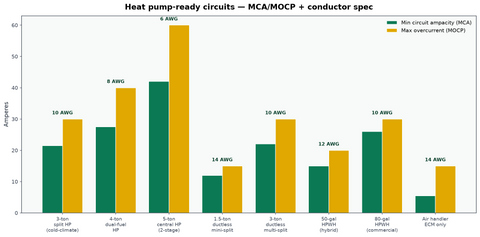
All HPWHs need a 15 or 20A 240 V circuit. Check panel space and consider if the install triggers a panel upgrade — cost impact is real.
-
4
File for 25C + utility rebate
$2,000 federal 25C for UEF ≥3.75. Add utility rebate ($500-2,000 depending on utility). AHRI documentation must be filed with the credit — check that the SKU ships with paperwork in the box.
The single most common HPWH performance failure is undersized ambient air volume. Every HPWH datasheet specifies a minimum ambient air volume (typically 700-1,000 cubic feet) and a temperature range for full-heat-pump-mode operation (typically 45-120°F). Fall outside these envelopes and the unit runs in hybrid mode with resistance backup, cutting UEF from 4.0 to 2.0.
Common failure scenarios:
- Utility closet install without ducting. A 6' × 6' × 8' closet (288 cu ft) is under one-third of the required ambient volume. The unit will operate in hybrid mode most of the year. Solution: cut a return-air grille into the closet door (typically 100-in² net free area minimum), duct outside air intake, or install a split-system HPWH (Bosch Compress 4000).
- Cold basement install (35-45°F winter). Below 45°F ambient, the HPWH derates and the resistance element supplements heat pump operation. In an unfinished Minnesota basement running 40°F in January, expect 40-60% loss of the annual UEF. Solution: insulate the basement, add a low-temperature-capable model (Rheem ProTerra Plus has a 37°F ambient lower limit vs 45°F standard), or accept the winter derate.
- Cooling the space you're trying to heat. An HPWH in a conditioned space cools the air by 5-15°F during operation. In summer, this reduces AC load — a small bonus. In winter, this increases heating load and can cancel out much of the HPWH efficiency gain. Best installations are in unconditioned or semi-conditioned spaces (garage, basement, mechanical room).
Contractor rule of thumb: measure the install location's cubic foot volume and lowest annual temperature BEFORE quoting the HPWH. If either is out of spec, quote a ducted or split-system solution.
HPWH tanks use the same sacrificial anode rod technology as gas tanks — a magnesium or aluminum rod screwed into the top of the tank that corrodes preferentially to protect the tank lining. Anode inspection every 3-5 years and replacement every 5-7 years is standard maintenance that extends tank life from 8-10 years to 15-20 years.
Practical differences by brand:
Rheem ProTerra Plus — anode rod is accessible under a factory service cover on top of the unit. Replacement is a 15-minute job with basic tools.
Bradford White AeroTherm — anode rod is under an insulation panel; access requires unbolting and re-sealing the panel. 30-45 minute job. Bradford White also offers a powered anode option (electrical anode, replaces the sacrificial rod, indefinite lifetime).
AO Smith Voltex — anode rod is under the top cover with the heat pump compressor. Access requires temporary compressor removal. 60-90 minute job. AO Smith offers powered anode as a factory option.
Bosch Compress 4000 — anode rod accessible via a screw-in fitting on the tank top. Split-system variant has separate access from the compressor unit.
Stiebel Eltron Accelera 300E — designed for the European market; the tank uses a coated-glass lining that is more corrosion-resistant than U.S. tanks and reduces anode dependency. Anode is present and should still be inspected on the same schedule.
The maintenance conversation is a real driver of HPWH lifetime cost. A homeowner who never inspects the anode will see the tank fail at year 8-10 (same as gas tanks). A homeowner who follows the maintenance schedule can push tank life to 15-20 years — which is where the HPWH's total cost of ownership pulls ahead of gas tanks decisively.
An HPWH can be the largest single load on a home's electrical panel in daytime hours — 2-3 kW during heat pump operation, up to 4.5 kW when the resistance backup kicks in. This makes it a perfect candidate for solar self-consumption timing.
Rheem's EcoNet ecosystem and AO Smith's Vertex controls both offer schedule programming — set the unit to prioritize heat pump mode during daytime solar hours, minimize operation during evening peak. A homeowner with a 6 kW solar array can push 50-70% of HPWH annual kWh onto solar production, reducing utility bill impact of the electrification retrofit by another 30-40%.
Bradford White AeroTherm supports basic scheduling. Bosch Compress 4000 has scheduling via the ES Home app. Stiebel Eltron Accelera offers time-of-use scheduling in software but requires the Wi-Fi module (sold separately).
For homeowners already installing solar, adding an HPWH is a compelling next-step electrification move — the marginal cost is $1,500-2,500 after 25C credit, and the marginal operating cost on solar is near zero.
An emerging HPWH application is combined domestic hot water plus low-temperature hydronic space heating — an 80-gallon HPWH driving a radiant floor loop plus domestic hot water. This works best in tight, well-insulated homes where the space heating load is low enough that the HPWH can meet it.
Stiebel Eltron Accelera 300E is the U.S. product most commonly used for this combined application — 80 gal capacity, 4.5 kW peak heat pump output, and the European heritage of hydronic integration. AO Smith Voltex 80 gal is a distant second.
Typical sizing rule: HPWH-plus-radiant works for homes with heating load under 15,000 BTU/hr (approximately 1,000-1,500 sq ft, tight envelope, mild climate). Above that, a dedicated air-to-water heat pump (Bosch Compress 6000 AWHP, SpacePak, Chiltrix) is the right architecture.
The HPWH's material cost story is well-documented. The install labor story is less-well-covered and it's often 40-60% of total install cost for a retrofit HPWH replacement.
Standard HPWH swap (like-for-like replacement of an existing electric or gas water heater):
- Basic swap: 4-6 hours labor. Drain and remove old tank, install pan, position new HPWH, reconnect water lines, install condensate drain, connect electrical, commission. If everything lines up, this is a half-day plumber-plus-electrician job.
- Complexity adders: dedicated 240 V circuit (existing gas tank had no electrical) = +2-3 hours electrician time. Condensate pump install (basement without gravity drain) = +1 hour. Panel space unavailable, needs sub-panel = +3-4 hours.
- Total labor: 4-12 hours depending on complexity. At typical shop rates ($150-250/hr all-in), labor cost runs $600-3,000.
New construction install:
- Rough-in during framing phase: 2 hours to set the pad, run water lines, run electrical.
- Trim-out at commissioning: 2-3 hours to set the tank, connect final plumbing, wire electrical, commission.
- Total labor: 4-5 hours. Cheaper than retrofit because everything is accessible during construction.
Condensate management is the sneakiest cost:
- Gravity drain to a floor drain within 10 feet: no additional cost.
- Condensate pump (basement floor drain 20+ feet away, or no floor drain): $80-150 pump + 1 hour labor.
- Condensate discharge to laundry standpipe: usually free, but check local plumbing code — some jurisdictions require indirect discharge with air gap.
- Freeze-protection on the condensate line (unconditioned space): heat trace or insulated line, adds $50-150.
Contractor best practice: photograph the install location and quote the labor hours honestly. HPWH quotes that assume "same labor as a gas tank swap" routinely under-quote by 3-6 hours because the electrical work is usually new.
Coming Soon: PES Multi-Brand Heat Pump Distribution
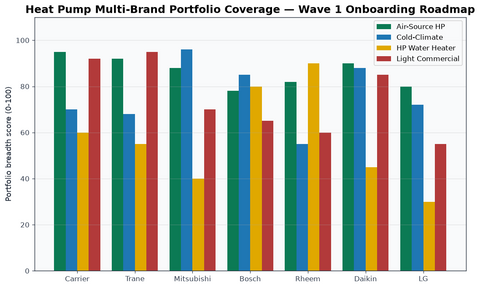
PES is onboarding Carrier, Trane, Mitsubishi, Bosch, and Rheem heat pump lines. Register at axis.pesdistribution.com for early access — contractor pricing, freight quotes, and portal-only calculators the moment stock lands.
Register for Early AccessWhich HPWH has the highest UEF?
Do all these qualify for the 25C tax credit?
Can an HPWH replace a gas water heater 1:1?
How much space around the unit does it need?
How loud is the compressor?
Which brand has the best warranty?
When will PES stock heat pump water heaters?
Open a PES Contractor Account — Reserve Heat Pump Access
Register at axis.pesdistribution.com for early heat-pump distribution access, trade pricing, and portal calculators.
Register Now