Whole-Home Electrification Bundle: Solar + Battery + Heat Pump + EV Charger
The 5-system bundle that turns a fossil-fuel home into a net-zero-ready home — how to sequence, size, quote, and stack incentives across solar PV, battery storage, air-source heat pump, HPWH, and Level 2 EV charging.

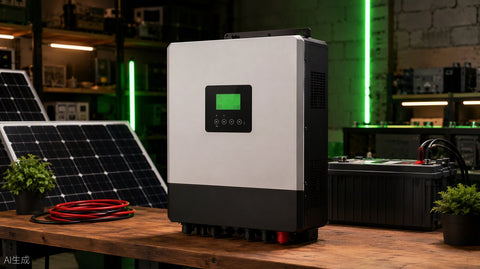
A "whole-home electrification bundle" is not marketing language — it's an actual sequence of five interlocking systems that transform a fossil-fueled home into a home that can run entirely off the grid tie plus onsite solar and battery. The five systems, in the order they should be sized and quoted:
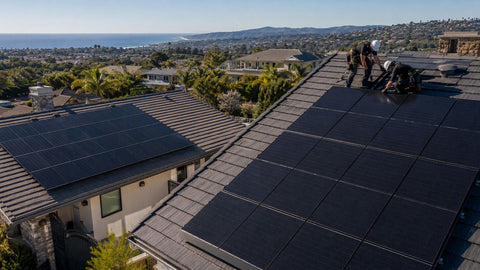
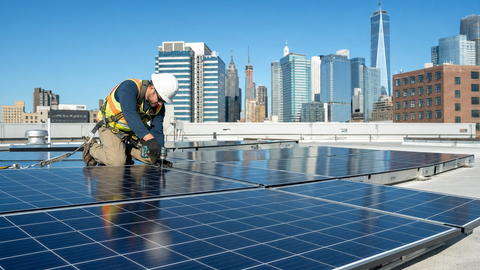
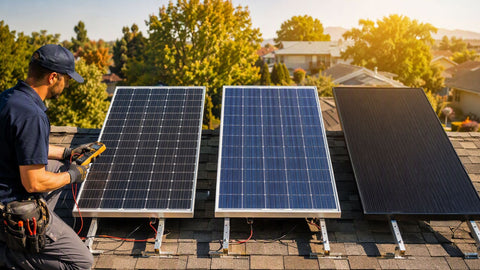
- Solar PV — sized to annual kWh consumption, accounting for the added electric load from heat pump + HPWH + EV.
- Battery storage — sized to critical-load resiliency + solar self-consumption.
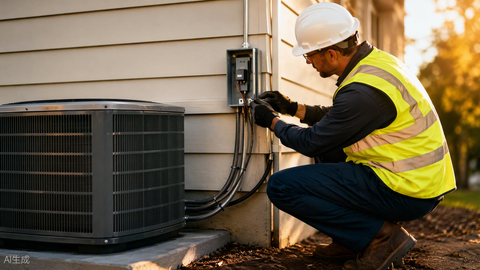
- Air-source heat pump — sized per Manual J after any envelope upgrades.
- Heat pump water heater — sized per household hot water demand.
- Level 2 EV charger — sized to EV battery capacity and daily driving pattern.
Plus one enabling system that runs alongside all five: the service panel and (often) a service upgrade to 200 A or 400 A.
The order matters because each downstream system's sizing depends on the load calculation the previous one added to. Solar sized before the heat pump is undersized. HPWH sized before the panel is under-planned. EV charger installed after the panel is filled with strip-heat breakers has to wait for a panel swap.
| System | Sizing | Installed Cost | IRA/State Incentive | Net Cost |
|---|---|---|---|---|
| Solar PV | 8 kW (24 panels × 400W) | $24,000 | 30% ITC ($7,200) | $16,800 |
| Battery Storage | 13.5 kWh (Powerwall equiv) | $14,000 | 30% ITC ($4,200) | $9,800 |
| Air-Source HP | 4-ton cold-climate | $12,000 | 25C $2,000 + rebate | $8,000-9,000 |
| HPWH | 65-gal Rheem ProTerra | $3,800 | 25C $2,000 + rebate | $1,300-1,800 |
| EV Charger + circuit | 48A hardwired L2 | $1,200 | 25C $300 | $900 |
| Panel Upgrade to 200A | Full swap | $3,500 | 25C $600 + HEEHRA $4,000 | -$1,100 (net rebate) |
| Bundle Total | $58,500 | $18,000-24,000 | $36,000-40,000 |
Traditional solar sizing looks at the previous 12 months of electric bills, applies a target offset percentage (usually 100%), and specs the panels. That's fine if the electric load isn't changing.
Electrification bundles break that assumption. Adding a 4-ton heat pump can add 6,000–12,000 kWh/year of load. HPWH adds 1,500–2,500 kWh/year. EV charging adds 3,000–5,000 kWh/year depending on driving pattern. If the pre-electrification bill was 8,000 kWh/year, the post-electrification consumption might be 20,000–25,000 kWh/year — nearly 3x.
Correct sizing method: start with the pre-electrification kWh baseline, add estimated new loads from each electrification system, apply the target offset. For our 2,400 ft² example with pre-electrification 9,000 kWh/year:
- Pre-electrification: 9,000 kWh/year
- Add heat pump load: +9,000 (assuming gas-to-HP conversion)
- Add HPWH: +1,800
- Add EV (12,000 miles/year, 3 mi/kWh): +4,000
- Post-electrification: ~24,000 kWh/year
At 1,200 kWh/kW annual production (typical mid-latitude, unshaded), that's 20 kW of PV. Most residential rooftops max out at 8-12 kW. The bundle is designed knowing solar will only offset 40-60% of post-electrification load, with the balance drawn from the grid — and battery storage smooths self-consumption to 60-70%.
Two purposes drive battery sizing: resiliency (running critical loads during a grid outage) and self-consumption (using more of your own solar rather than exporting).
For resiliency, size the battery to the critical-loads panel: refrigerator (150 W × 24h = 3.6 kWh), freezer (100 × 24 = 2.4), a few LED lights (100 × 6 = 0.6), well pump if applicable (500 W intermittent, ~1 kWh/day), Wi-Fi and communication (50 × 24 = 1.2). Total: ~9 kWh/day of critical load. A 13.5 kWh Powerwall or Enphase IQ Battery 10T runs 1.5 days.
Adding heat pump backup to the critical-loads panel is the aggressive move — a 4-ton heat pump running for 8 hours in a mild winter day pulls ~24 kWh, which requires multiple stacked batteries or a hybrid strategy (heat pump runs while sun is up, resistive strip heat only during outages at night).
For self-consumption, the rule of thumb is: battery kWh capacity ≈ 20% of daily kWh consumption. A home consuming 60 kWh/day post-electrification uses a 12–14 kWh battery to boost self-consumption from 30% (solar only) to 65-70%.
A common mistake in electrification bundles: replacing an oversized gas furnace with an equally oversized heat pump. Gas furnaces get sized 30-50% oversized because they cycle short with no efficiency penalty. Heat pumps sized 30% oversized will short-cycle, wear out the compressor, and fail the SEER/HSPF ratings that assumed proper sizing.
Correct sizing method: perform a Manual J calculation with the envelope evaluated AFTER any planned insulation and air sealing improvements. If the homeowner is adding blown-in attic insulation and sealing rim joists as part of the bundle, do the Manual J assuming those improvements.
A properly sized heat pump for our 2,400 ft² example in Zone 4 (moderate climate): approximately 3.5-4.0 tons. Oversizing to 5 tons because "gas furnace was 100k BTU" is the wrong instinct — the 5-ton heat pump will run at 40% capacity most of the year, short-cycle, and dehumidify poorly.
HPWH sizing follows first-hour rating (FHR), not tank capacity. For a 2-bathroom, 3-4 person household, a 65-66 gallon HPWH with 67-70 gal FHR handles morning peak without dropping to resistive-only mode. For a 4-BR high-demand household, step to 80 gal with 74-78 gal FHR.
Space check: HPWHs need 1,000 cubic feet of ambient air minimum. A 6' × 6' × 8' utility closet (288 cu ft) does not meet this — the unit will run in hybrid mode with resistive backup, cutting UEF from 4.0 to 2.5. Ducted intake/exhaust options are available on Rheem and AO Smith models; a split-system Bosch unit is an alternative when space is tight.
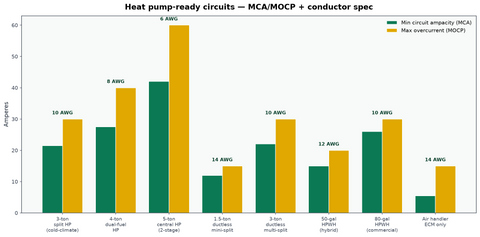
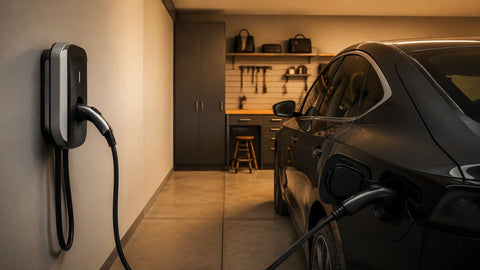
Level 2 EV chargers are 240 V single-phase at 16 A (basic) to 80 A (Tesla Wall Connector, hardwired). The 48 A hardwired charger is the modern sweet spot — 11.5 kW continuous, adds roughly 40 miles of range per hour of charging, and fits most home service panels without triggering a service upgrade.
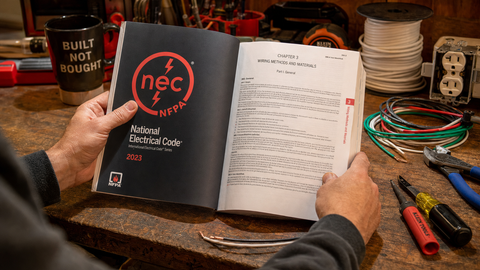
Circuit sizing: 48 A charger draws 48 A continuous per NEC 625. NEC 625.42 requires the branch circuit to be sized at 125% of continuous load = 60 A. Wire per NEC 310.16 for 60 A at 75°C = #6 AWG copper. Voltage drop check for typical 40 ft run: comfortable at #6.
Panel-side: 60 A breaker in a 200 A panel is standard. In a 100 A panel with existing heat pump + HPWH + range load, the 60 A EV charger circuit is the trigger for a panel upgrade.
Recommended install sequence:
- Envelope upgrades (insulation, air sealing). Before heat pump sizing. Reduces the Manual J load and lets you spec a smaller (cheaper, better-modulating) heat pump.
- Service panel upgrade to 200 A. Everything else assumes 200 A capacity. Do this first if the calc requires it.
- Solar PV + battery. Roof work and battery installation are big single-day jobs; get them in the ground before the more disruptive heat pump/HPWH work.
- Heat pump install. Requires HVAC contractor + electrician coordination. Schedule during shoulder season when possible.
- HPWH install. Plumbing-side work, quick job (2-4 hours).
- EV charger install. Electrician job, 4-6 hours.
Alternative: batch all electrical work (panel + heat pump circuit + HPWH circuit + EV charger circuit) into a single electrician mobilization to save labor. Then bring HVAC and plumbing contractors for their trade-specific work in phases.
-
1
Baseline audit
Pull 12 months of gas + electric bills, energy audit report if available, existing HVAC system age, and driving pattern for EV load estimate.
-
2
Envelope plan
Insulation and air sealing improvements sized before heat pump Manual J. IRA 25C provides up to $1,200/year for these upgrades separately.
-
3
Whole-home load calc
NEC 220.83 with the new equipment. Determines whether panel upgrade is needed.
-
4
System-by-system sizing
Solar to post-electrification kWh × target offset. Battery to critical loads + self-consumption. Heat pump to Manual J. HPWH to FHR. EV charger to daily driving.
-
5
Incentive stack
25D for solar + battery (30% no cap). 25C for HP + HPWH + panel (30% with caps). HEEHRA for income-qualified. State + utility rebates. Portal ROI calculator handles the math.
Every whole-home electrification bundle should start with an envelope evaluation. Two systems benefit most from tighter envelope: the heat pump (smaller size, less runtime) and the solar array (less kWh consumption, higher offset percentage).
Three envelope upgrades pay back within the electrification budget:
1. Attic insulation to R-49 or R-60. Most 1970s-1990s homes have R-19 or R-30 attic insulation. Adding R-30 blown-in cellulose or fiberglass to bring the attic to R-49/R-60 costs $1,500-3,000 depending on square footage and existing insulation depth. Payback is typically 4-6 years standalone; in the context of an electrification bundle, the payback is faster because the smaller Manual J load allows a smaller (cheaper) heat pump.
2. Air sealing at attic and basement. Air infiltration through attic bypasses, rim joists, and top plates is often the largest single source of heat loss in older homes. A blower door test identifies the leaks; sealing with foam and caulk costs $500-1,500 for typical homes. Reduces Manual J load by 10-25%.
3. Duct sealing and insulation. If the electrification retrofit is keeping existing ductwork, duct leakage in attic or crawlspace ducts is often 25-40%. Mastic sealing at every joint and R-8 insulation on exterior-exposed ducts recovers most of the lost capacity. Cost: $500-2,000.
Combined envelope package: $2,500-6,500. IRA 25C provides 30% credit up to $1,200/year for these improvements — real cost after federal credit is $2,000-5,000.
Doing envelope BEFORE the heat pump sizing lets the contractor spec a 3-ton unit instead of a 4-ton unit, saving $2,000-3,500 on the heat pump alone. Envelope pays for itself just through equipment downsizing.
Home battery choices in 2026 are dominated by LFP (lithium iron phosphate) chemistry — Tesla Powerwall 3 (LFP), Enphase IQ Battery 10T (LFP), FranklinWH aPower 2 (LFP), Fortress Avalon (LFP), EG4 PowerPro (LFP). LFP replaced NMC (nickel manganese cobalt) chemistry for residential applications in 2022-2024 because of better thermal safety and longer cycle life.
LFP cold-weather behavior: LFP capacity drops meaningfully below 32°F ambient. A 13.5 kWh Powerwall 3 (LFP) at 20°F delivers approximately 11 kWh usable — an 18% capacity loss. Most battery manufacturers include heating pads or thermal management systems, but they draw parasitic power from the battery itself, reducing net usable capacity.
Practical implications for cold-climate installs:
- Install the battery indoors (garage, basement, mechanical room) rather than outdoors — even NEMA 4 rated batteries lose capacity in outdoor cold. Garage installation on an inside wall (shared with heated space) is often the sweet spot.
- Size battery capacity 15-20% larger than warm-weather calculations to account for cold-weather derating.
- Verify manufacturer's cold-weather operating range. Enphase IQ Battery 10T operates -4°F to 122°F. Tesla Powerwall 3 operates -4°F to 122°F. Franklin aPower 2 operates -4°F to 113°F. All three support garage installations in most U.S. climates.
The solar inverter choice in a bundle context is not a standalone decision — it interacts with battery selection and future expandability.
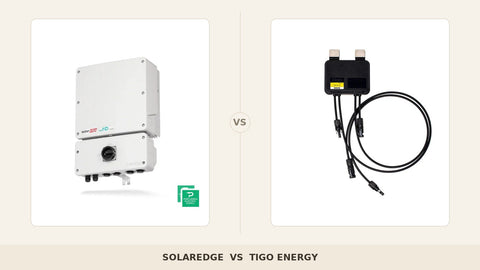
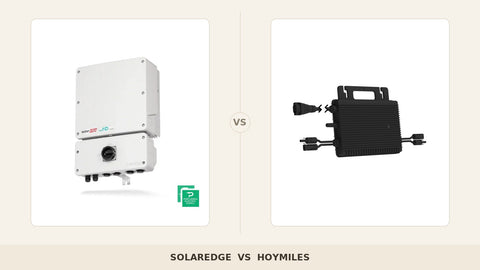
String inverter (Fronius, SolarEdge HD-Wave, SMA Sunny Boy): Single central inverter converts DC from panels to AC. Battery couples on AC or DC bus depending on inverter and battery. Lower installed cost (~$0.50-0.75/W less than microinverter), less shading tolerance, simpler troubleshooting. Best for: unshaded roofs, simple bundle where solar and battery are same-brand ecosystem.
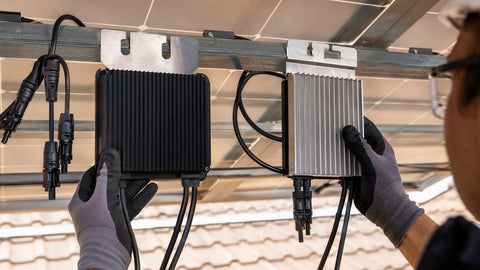
Microinverter (Enphase IQ8): Each panel has its own inverter, DC-to-AC conversion at the panel. Superior shade tolerance, per-panel monitoring, safer (no high-voltage DC on the roof). Battery must be AC-coupled. Best for: shaded roofs, future-proofing (adding panels later is easy), homeowners who want per-panel visibility. Enphase IQ Battery 10T is the natural fit — same ecosystem, same monitoring app.
DC optimizer (SolarEdge HD-Wave with optimizers): Central inverter plus per-panel DC optimizers. Middle ground between string and microinverter — per-panel MPPT tracking, high-voltage DC on the roof (with rapid shutdown per NEC 690.12), monitoring at the optimizer level. Best for: partial shade situations, budget-conscious jobs where full microinverter cost is too high.
For whole-home electrification bundles, the microinverter (Enphase) is often the recommendation because it grows with the household — additional panels can be added later without swapping the central inverter. This flexibility matters when the homeowner adds an EV charger or a second EV and needs more solar capacity in year 3-5 of ownership.
The whole-home electrification bundle typically pushes the service panel to its limit. Options:
Standard 200 A panel upgrade. The default. Utility upgrade to 200 A service, new 200 A main breaker panel, all branch circuits reterminated. Cost: $3,000-5,500. Time: full-day electrician plus utility coordination.
Smart panel (Span, Lumin, Savant Panel): Replaces the standard panel with a network-connected panel that provides per-circuit monitoring, remote control, and load management. Software-driven load prioritization means the panel can operate at 100% capacity without tripping — non-critical loads (dryer, EV charger, HPWH) are shed dynamically when total demand would exceed capacity. Cost: $4,500-7,500. Time: full-day install.
The smart panel adds $1,500-3,000 vs a standard 200 A upgrade but provides:
- Load management to avoid a service upgrade (some homes stay at 100 A service with a smart panel and load management, saving the utility upgrade cost).
- Per-circuit energy monitoring integrated with solar production and battery state-of-charge.
- Backup power management — during grid outages, the smart panel prioritizes critical loads and sheds non-essentials automatically.
- Remote control — turn off the EV charger, water heater, or HVAC from a smartphone.
For homes doing the full bundle, the smart panel is often the right pick because it provides visibility into the electrification story that homeowners want to see. "How much did the heat pump use last month? What's my solar self-consumption rate? When does my battery hit low state of charge?" — all answered in the smart panel app.
The utility rate structure the homeowner is on has a dramatic effect on electrification economics — often more than the equipment choices themselves. Four rate structures matter:
Flat rate (traditional tiered residential rate). Rate per kWh is roughly the same all day. Battery storage provides no arbitrage value. Solar provides straight net-metering credit (or net-billing, depending on state). Heat pump economics are simplest: total kWh consumption × rate = bill impact.
Time-of-use (TOU). Peak-hour rates (typically 4-9 PM) are 2-4x off-peak rates. Battery storage provides real arbitrage: charge from solar or off-peak grid during the day, discharge during peak hours. Heat pump operation shifted to off-peak reduces bill impact. Common TOU tariffs: PG&E E-TOU-C (California), Xcel Energy TOU (Colorado, Minnesota), NYSEG SC-1 TOU (New York).
Time-of-use with export tariff (net billing). California NEM 3.0 is the archetype. Solar export is credited at avoided-cost rates (much lower than retail). Battery storage becomes essential to solar economics — export goes to battery, self-consumption during peak displaces high-rate import. Bundle math heavily favors battery.
Demand charges (rare on residential, common on small commercial). Peak 15-minute kW demand in the billing period drives 30-50% of the bill. Battery storage that shaves peak demand pays back very quickly. Heat pump compressor startup can trigger demand-charge spikes; inverter-driven heat pumps with soft-start don't.
For a whole-home electrification bundle, the ROI calculation must be done against the specific rate structure the customer is on (or will be on after the retrofit). Some states require solar customers to move to TOU; some require battery-equipped customers to move to specific export tariffs.
PES's ROI calculator ingests the utility rate structure (uploaded as a utility bill PDF or entered from a lookup table) and produces an install-by-install economic analysis with year-1, year-5, year-10, and year-25 net-present-value estimates. The output pdf becomes part of the quote package.
Real-world example — moderate-income California household, PG&E NEM 3.0 tariff:
- Solar 8 kW, no battery: 65% of energy exported at avoided-cost rates. Effective offset: 40%. Payback: 12-15 years.
- Solar 8 kW + 13.5 kWh battery: 30% of energy exported at avoided-cost rates, 70% self-consumed during peak. Effective offset: 75%. Payback: 8-10 years.
- Adding heat pump + HPWH shifts kWh consumption up but doesn't change the battery arbitrage math meaningfully — the battery is sized for critical loads and evening peak, not for full-house heating.
This tariff-specific analysis is where the bundle sale often lives or dies. Contractors who present the numbers with the right tariff assumptions close 25-40% more deals than contractors who quote against a generic flat rate.
Coming Soon: PES Multi-Brand Heat Pump Distribution
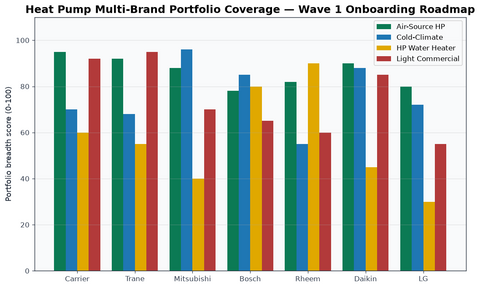
PES is onboarding Carrier, Trane, Mitsubishi, Bosch, and Rheem heat pump lines. Register at axis.pesdistribution.com for early access — contractor pricing, freight quotes, and portal-only calculators the moment stock lands.
Register for Early AccessCan this bundle really zero out utility bills?
How long does the whole bundle take to install?
What's the total federal tax credit on a $60k bundle?
Do I need a general contractor to run all this?
Can I finance the bundle?
What if my home doesn't qualify for solar?
Where do I get load and ROI calculators?
Open a PES Contractor Account — Reserve Heat Pump Access
Register at axis.pesdistribution.com for early heat-pump distribution access, trade pricing, and portal calculators.
Register Now