Commercial Heat Pump for Small Business: VRF, RTU, and Split-System Guide
The small-commercial HVAC upgrade playbook — sizing, installed cost, and payback for VRF and packaged-heat-pump retrofits in restaurants, retail, office, warehouse, and clinic space.

Small-commercial buildings (2,000-25,000 sq ft) are 45% of U.S. commercial floor space but receive a fraction of the electrification attention that goes to residential retrofits or large-commercial deep retrofits. The equipment is dominated by 20-year-old gas rooftop units (RTUs) that are simple, reliable, and burning natural gas at 78-82% AFUE while the electric grid is decarbonizing around them.
The heat pump alternatives are mature and commercially proven, but the small business owner rarely sees them because their local HVAC contractor is trained on Carrier and Trane packaged gas RTUs, not on VRF (variable refrigerant flow) or heat pump packaged units. The distributor has an outsized role in this transition — the contractor buys what the distributor stocks.
This guide walks through the three heat pump architectures for small commercial:
- Packaged Heat Pump RTU — direct swap for a gas RTU, roof-mounted, single-stage or two-stage.
- VRF (Variable Refrigerant Flow) — Mitsubishi CITY MULTI, Trane VRF, Daikin VRV — multi-zone, inverter-driven, more capex, better long-term performance.
- Ductless Split Systems — Mitsubishi M-Series, LG Multi V, Bosch Climate 5000 — smaller footprint, retrofit-friendly for buildings without existing duct.
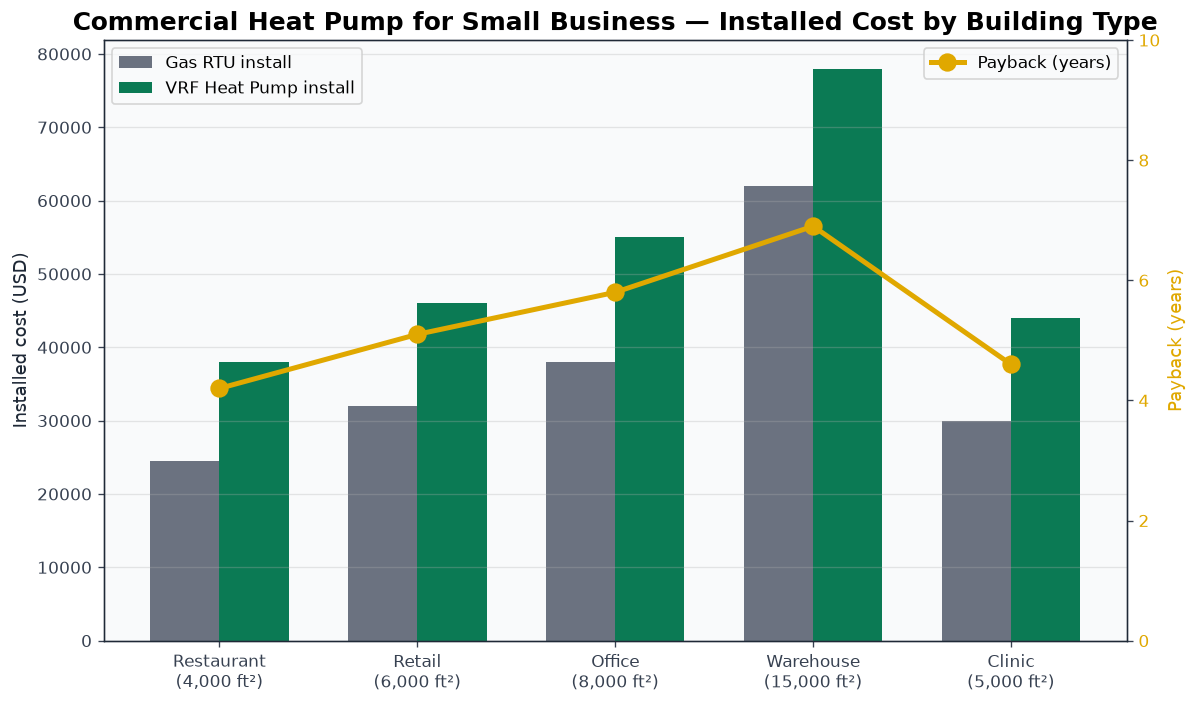
| Building Type | Sq Ft | Gas RTU Install | VRF Heat Pump | Payback (yrs) |
|---|---|---|---|---|
| Restaurant | 4,000 | $24,500 | $38,000 | 4.2 |
| Retail | 6,000 | $32,000 | $46,000 | 5.1 |
| Office | 8,000 | $38,000 | $55,000 | 5.8 |
| Warehouse | 15,000 | $62,000 | $78,000 | 6.9 |
| Clinic / Medical | 5,000 | $30,000 | $44,000 | 4.6 |
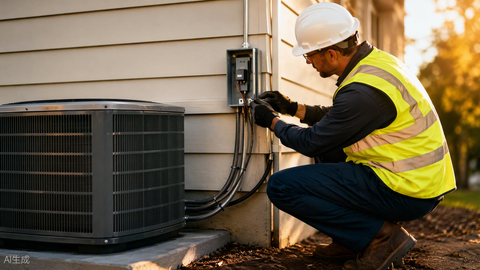
A packaged heat pump RTU is a single roof-mounted unit that combines compressor, condenser, evaporator, and blower in one cabinet. Ductwork is the same as a gas RTU install. The only architectural difference from a gas RTU is the electric refrigerant loop replacing the gas burner.
Brands: Carrier WeatherMaker heat pump variants, Trane Voyager heat pump, Bosch light-commercial packaged heat pump, Daikin Rebel heat pump. Sizes run 3-25 tons. Installed cost is 20-40% higher than gas RTU equivalent — mostly due to larger electrical service requirements and higher unit cost.
Best fit: Buildings with an existing gas RTU that is at end of life (15+ years old), buildings with sufficient electrical service capacity, and building owners who want the simplest one-for-one swap without touching the interior duct system.
Cold-climate: Packaged heat pump RTUs are not typically cold-climate-rated. Below 30°F outdoor, most run auxiliary gas or resistive strip heat. For buildings above the 40th parallel with sustained cold winters, VRF is often the better answer despite the higher capex.
VRF systems use a single outdoor condenser to drive multiple indoor fan-coil units through a refrigerant line network. The inverter-driven compressor modulates capacity to match the total zone demand, and each indoor unit has its own thermostat. Zoning is deep — 4, 8, 16, or 32 indoor units off a single outdoor condenser depending on the manufacturer's system architecture.
Why VRF wins on 5,000-15,000 sq ft commercial:
- Better part-load efficiency — inverter modulation keeps the compressor at 20-60% capacity for most operating hours, where COP is highest.
- Independent zone control — kitchen, dining room, and office spaces run at different setpoints without ductwork zoning dampers.
- Simultaneous heating and cooling (heat recovery variant) — the kitchen area can be cooling while the entry vestibule is heating, and the system moves heat between zones instead of rejecting it to outdoors.
- Cold-climate performance — VRF platforms from Mitsubishi (CITY MULTI H2i), Daikin (VRV IV), and LG (Multi V S) are rated to hold capacity down to -13°F.
Installed cost: $10-15 per sq ft for typical 5,000-15,000 sq ft commercial. Compared to a packaged RTU at $6-9 per sq ft, VRF is a 40-60% capex premium — recovered through 8-12% annual operating cost savings in most climates, translating to 4-7 year payback.
When the building is too small for VRF economics (under 3,000 sq ft) or has no existing ductwork, ductless split-system heat pumps are the answer. A 2,500 sq ft restaurant or a 1,800 sq ft retail store can be zoned with 3-5 ductless heads driven from a single outdoor multi-zone condenser, delivering VRF-like zoning at ductless-like installed cost.
Brands: Mitsubishi Multi-Split (up to 8 heads per outdoor), LG Multi F Max, Daikin Aurora, Bosch Climate 5000. Installed cost per zone runs $2,500-4,500 depending on head style (wall-mount cheapest, ceiling cassette or ducted mid-static most expensive).
Best fit: Retail spaces without drop ceilings suitable for concealed duct, restaurants with open kitchens where distributed cooling is a comfort feature, medical clinics with separate exam rooms.
The commercial building incentive stack is different from residential. There is no 25C credit for commercial. Instead, the tools are 179D deduction, 45L (multifamily new construction), and utility rebates.
179D deduction is $0.54–$5.00 per sq ft depending on the energy savings tier and whether prevailing wage was paid during construction. For a 10,000 sq ft heat pump retrofit meeting the 50% savings threshold plus prevailing wage, the deduction is $50,000 — deducted from the building owner's tax return, real dollars.
Utility rebates for commercial heat pump retrofits often exceed residential in absolute terms. Xcel Energy pays up to $75,000 for a small-commercial heat pump conversion. National Grid (Massachusetts, New York) runs commercial heat pump incentive programs with per-ton payments. NYSERDA runs the Empire Building Challenge for medium commercial.
Utility rate design impact: Small-commercial customers on demand-based rate schedules can see very large operating cost savings from heat pumps — because inverter-driven VRF avoids the peak demand charge that a single-stage gas RTU would trigger during compressor startup. Building owners on demand rates often see payback in 3-4 years vs the 5-7 year "sticker" payback.
Small-commercial HVAC sizing uses ASHRAE 62.1 (ventilation) and Manual N (small commercial load calc). Manual N is the commercial analog to Manual J residential — it accounts for internal gains (people, lights, equipment), infiltration, and envelope loads on an hour-by-hour basis.
For a restaurant, the internal loads dominate — kitchen equipment can add 100-300 BTU/sq ft of sensible load, and dishwasher plus 3-compartment sink adds substantial latent load. A generic tons-per-sq-ft rule fails badly on restaurants; a proper Manual N is essential.
For retail, the load is more evenly distributed — glazing solar gain, lights, and moderate occupancy. Rules of thumb: 350-500 sq ft per ton for well-glazed retail, up to 600 sq ft per ton for warehouse-adjacent retail with high ceilings and less glazing.
For office, occupancy schedule matters — high daytime occupancy with computers and lights generates significant internal loads. Office typically runs 300-400 sq ft per ton.
-
1
Site walk with existing HVAC inventory
Document existing RTUs, indoor equipment, ducted vs ductless zones, electrical service capacity, roof structural capacity for new units, and gas piping abandonment plan.
-
2
Manual N load calculation
Never size by rule of thumb on commercial. Manual N accounts for internal gains, occupancy schedule, and process loads (kitchen, medical equipment). Software: Wrightsoft Right-N, ACCA Manual N compliant packages.
-
3
Architecture selection — RTU, VRF, or ductless
Building size, existing ductwork, zoning needs, and cold-climate performance drive the choice. Under 3,000 sq ft or no ductwork: ductless. 3,000-15,000 with zoning needs: VRF. Simple swap on existing duct: packaged RTU.
-
4
Electrical service capacity check
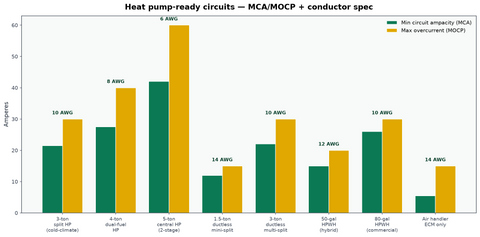
VRF and packaged heat pumps often need 3-phase 208 V or 480 V service. Verify service capacity, panel space, and any utility upgrade required.
-
5
Incentive stack and financing
179D deduction (up to $5/sq ft), utility rebates (variable by jurisdiction), and 45L if multifamily new construction. Green banks and PACE financing available in many states.
Commercial heat pump installs face refrigerant compliance requirements that residential installs don't. Buildings above certain thresholds must comply with EPA's Refrigerant Management program (40 CFR Part 82), which requires:
- Leak repair within 30 days of detection for any refrigerant loss above 20% annualized on systems containing more than 50 lbs of refrigerant.
- Record keeping of refrigerant purchase, install, service, and disposal for the life of the equipment.
- Recovery of refrigerant during service or decommissioning to prevent atmospheric release.
Small-commercial buildings under the 50-lb threshold (typical for buildings under 15,000 sq ft with packaged heat pump RTUs) face lighter compliance burden. Buildings with larger VRF systems (light commercial CITY MULTI installations up to 25 refrigerant tons) can exceed 50 lb charge thresholds and require formal refrigerant management programs.
The A2L transition (R-454B, R-32) adds additional considerations for commercial:
- Charge limit per space (1.84 kg for R-32) — VRF systems with long refrigerant runs may exceed this in specific zone spaces, requiring leak detection systems.
- Refrigerant detection systems (RDS) integrated with mechanical ventilation — some manufacturers embed this in the equipment.
- Technician certification updated for A2L handling (EPA 608 remains valid; supplemental A2L training required by most manufacturers for warranty coverage).
Small-business owners rarely pay cash for a $50,000+ HVAC retrofit. Understanding the financing structures that work is a real skill for the commercial heat pump contractor.
PACE financing (Property Assessed Clean Energy). C-PACE (Commercial PACE) is available in 30+ states. Loan is secured by a property tax assessment, transfers with the property on sale, and typically 15-25 year term at 5-7% interest. No cash down. Eligibility varies by state — most C-PACE programs cover heat pump retrofits, HVAC upgrades, and solar. Best for: property owners who intend to sell within the loan term (loan transfers to buyer), or who want off-balance-sheet financing.
Green bank loans. Several states have green banks (Connecticut Green Bank, NY Green Bank, Rhode Island Infrastructure Bank) that finance commercial energy efficiency projects at below-market rates. Typical terms: 3-7 year, 4-6% interest, 100% financing. Best for: smaller retrofits (under $250K) where PACE overhead isn't justified.
Manufacturer/distributor lease. Some manufacturers (Mitsubishi Trane Ductless Group, Daikin Applied) offer equipment lease programs for commercial installs. Monthly lease payment, buyout at term end. Best for: property owners who prefer OpEx to CapEx accounting treatment.
SBA 504 loan (for building purchases + retrofits). Small Business Administration 504 program can finance building acquisition plus energy efficiency retrofit. 10-25 year term, 4-6% interest, 10% down. Best for: business owners buying a building and simultaneously retrofitting HVAC.
The contractor doesn't originate the financing but should know which programs the customer qualifies for and how to route the intake. A referral relationship with a PACE administrator or a green bank turns the financing question from a job-killer to a value-add.
Commercial buildings must comply with ASHRAE 62.1 (or state code equivalent) for outside air ventilation rates. A restaurant seats 100 people; ASHRAE 62.1 requires 7.5 CFM/person + 0.18 CFM/sq ft — approximately 1,470 CFM outside air continuous.
Traditional gas RTUs provide outside air through economizer dampers and dedicated outside air (DOAS) systems. Heat pump architectures must handle the same ventilation load — and this is where heat pump retrofits get expensive if the existing ventilation is inadequate.
Three approaches:
1. Heat pump RTU with economizer + ERV. The packaged RTU includes an economizer damper and an energy recovery ventilator (ERV) that recovers heat/cool from exhaust air. Adds 15-25% to unit cost vs a basic RTU but pays back through reduced heating/cooling load on ventilation air.
2. VRF + dedicated outdoor air system (DOAS). The VRF handles space conditioning; a separate DOAS unit conditions the outside air and delivers it to spaces. Highest capital cost, best energy performance, most zoning flexibility. Best for: complex buildings, medical clinics, multi-tenant spaces.
3. Ductless multi-split + minimal ventilation upgrade. For buildings that already have adequate exhaust and passive infiltration (older warehouses, some retail), the ductless heat pump handles conditioning without a major ventilation redesign. Cheapest option; only works where existing IAQ is acceptable.
Demand-controlled ventilation (DCV) — CO2 sensors that modulate outside air based on occupancy — is standard on modern commercial installs and saves 20-40% on ventilation heating/cooling load. Contractors should quote DCV integration on every commercial heat pump retrofit.
Small-commercial buildings often have multiple tenants — retail strip malls, medical office buildings, small mixed-use developments. Heat pump retrofits in multi-tenant contexts add metering and cost-allocation complexity.
Standard approach: each tenant space has a dedicated heat pump or dedicated zone off a shared VRF. Each unit has its own electric sub-meter (utility or private). Utility bills flow to tenants; landlord bills common-area HVAC.
The private-metering option: Landlord owns the HVAC system, allocates energy cost to tenants through a private sub-meter or a proration formula (typically square footage-based). Simpler to install but requires clear lease language on how HVAC energy is billed.
For VRF systems, most manufacturers offer built-in per-zone energy monitoring — Mitsubishi's Melcloud, Daikin's Cloud, Trane's Air-Fi Wireless — that provides usage data per indoor unit. This data supports both private-metering allocation and tenant-facing energy dashboards.
Contractor should ask early: is this landlord-controlled central HVAC, or tenant-controlled dedicated systems? The answer shapes system architecture, permit requirements, and cost allocation.
To ground the small-commercial heat pump conversation in a real-world install, consider the anonymized case study below. Numbers are indicative of a typical Midwest retail retrofit and are based on multiple similar projects the PES team has participated in.
Building: 6,000 sq ft freestanding retail, single-story, built 1995. Existing HVAC: two 5-ton packaged gas RTUs, both 22 years old, one already failed and shut off from service. Existing service: 400 A 3-phase 208 V, ample capacity.
Options considered:
- Replace like-for-like with new gas RTUs: $32,000 installed. Continued gas bill exposure.
- Replace with packaged heat pump RTUs (same-size Carrier WeatherMaker heat pump 5-ton × 2): $46,000 installed. Simple ductwork reuse.
- VRF conversion with 3 zones: $58,000 installed. Better part-load performance, more zoning flexibility, higher capex.
Recommendation: Packaged heat pump RTU replacement. Reasoning: existing ductwork was in good condition, zoning was adequate for the retail floor plan (open plan retail with two zones — sales floor and back-of-house), simpler technician support in the local market, and installed cost delta vs gas RTU was manageable with utility rebate.
Incentives captured:
- 179D deduction: 40% energy savings vs baseline model = $2.16/sq ft = $12,960 deduction (owner's tax return, real value ~$3,500 at 27% effective rate).
- AEP Ohio commercial heat pump rebate: $500/ton × 10 tons = $5,000.
- Federal Investment Tax Credit — not applicable to standalone heat pump (only geothermal). Commercial heat pump does not qualify for 25C or 25D.
Net cost math:
- Installed cost: $46,000
- Utility rebate: -$5,000
- 179D deduction after-tax value: -$3,500
- Net after-incentive cost: $37,500
- Additional vs gas RTU replacement: $5,500 (about 17% premium)
Operating cost impact:
- Baseline gas RTU annual energy cost: ~$8,500/year (natural gas + electricity for blower and controls).
- Heat pump RTU annual energy cost: ~$5,600/year (electricity only, benefits from lower cooling cost and comparable heating cost after full-year modeling).
- Annual savings: ~$2,900/year.
- Payback on the $5,500 incremental cost: 1.9 years.
- Payback on total install (vs the fully-failed alternative): 6-7 years.
This case study is one of the reasons commercial heat pump conversions are accelerating. The math works even before considering carbon-related regulation (which is beginning to appear in some markets — Boston's building emissions performance standards, New York City's Local Law 97). For building owners looking at 15-25 year holding periods, the case is straightforward.
Coming Soon: PES Multi-Brand Heat Pump Distribution
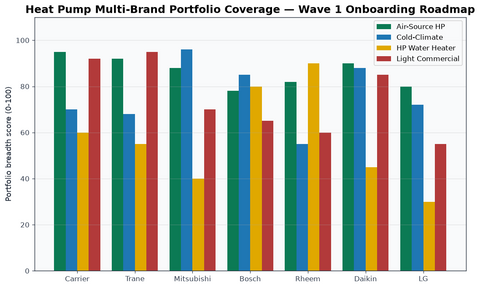
PES is onboarding Carrier, Trane, Mitsubishi, Bosch, and Rheem heat pump lines. Register at axis.pesdistribution.com for early access — contractor pricing, freight quotes, and portal-only calculators the moment stock lands.
Register for Early AccessIs a heat pump RTU direct-replacement for a gas RTU?
How much does small-commercial VRF cost?
What's the payback vs a gas RTU?
Does 179D apply to a leased building?
Can I use residential heat pumps for a small commercial building?
How do I handle a restaurant's kitchen ventilation with a heat pump?
Does PES stock commercial heat pump brands?
Open a PES Contractor Account — Reserve Heat Pump Access
Register at axis.pesdistribution.com for early heat-pump distribution access, trade pricing, and portal calculators.
Register Now