Carrier vs Trane vs Mitsubishi Air-Source Heat Pump Comparison (2026 Contractor Guide)
Head-to-head across efficiency, cold-climate capacity, warranty, contractor net cost, and warranty rail — the three brands most contractors will actually pick between.

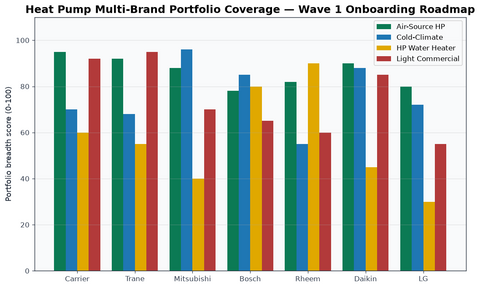
In every residential heat pump quote a contractor sends in the U.S., one of three brands sits on the cover page 80% of the time: Carrier, Trane, or Mitsubishi. Bosch, Rheem, Daikin, and LG each command meaningful share, but the three-way race between the U.S. incumbents (Carrier and Trane) and the Japanese cold-climate specialist (Mitsubishi) is where most contractors spend the bulk of their equipment-selection energy.
This is the head-to-head. We are not comparing marketing tiers ("Premium vs Deluxe vs Standard"). We are comparing the three flagship inverter heat pumps that these brands push to their high-volume contractors:
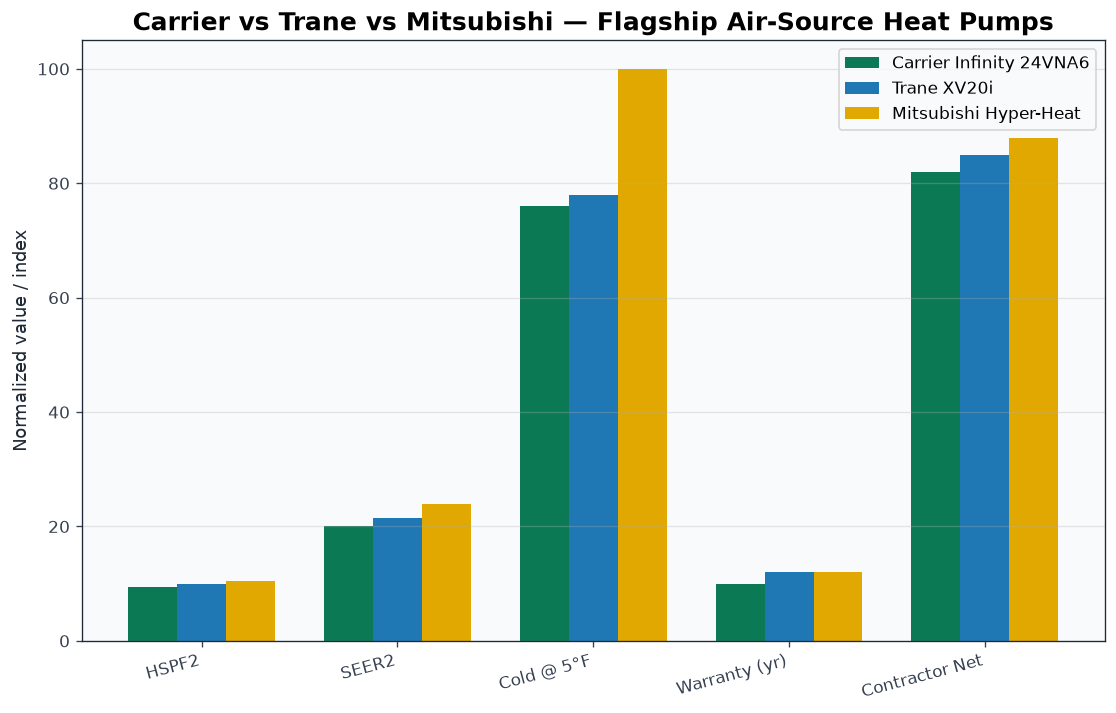
- Carrier Infinity 24VNA6 — 24 SEER2, 10 HSPF2, variable-speed, communicating.
- Trane XV20i — 21.5 SEER2, 10 HSPF2, variable-speed, communicating.
- Mitsubishi PUZ-HA (Hyper-Heat H2i) — 20 SEER2 in ducted form, 100% capacity to 5°F.
All three deliver 24 SEER-equivalent efficiency in optimal conditions. The differences show up in cold-climate capacity retention, warranty rail, communicating thermostat lock-in, and contractor net cost. Job fit determines the answer — none of these is universally right.
| Metric | Carrier Infinity 24VNA6 | Trane XV20i | Mitsubishi Hyper-Heat H2i |
|---|---|---|---|
| SEER2 (rated) | 24.0 | 21.5 | 20.0 (ducted) / 24 (mini) |
| HSPF2 | 10.0 | 10.0 | 10.5 |
| Cold-climate cert | CEE Tier 3 | CEE Tier 2 | CEE Tier 3 CC |
| Capacity at 5°F | 76% of nameplate | 78% of nameplate | 100% of nameplate |
| Capacity at -13°F | Not rated / off | Not rated / off | 76% of nameplate |
| Compressor warranty | 10 yr registered | 12 yr standard | 10 yr / 12 yr Diamond |
| Parts warranty | 10 yr registered | 10 yr registered | 10 yr / 12 yr Diamond |
| Refrigerant | R-410A → R-454B (2026) | R-410A → R-454B (2026) | R-410A → R-32 (2026) |
| Comms protocol | Infinity comms (proprietary) | ComfortLink II (proprietary) | M-NET / 24V-compatible |
| 3-ton contractor net (indicative) | $4,900 | $5,050 | $5,400 |
| Field-service commonality | Very high | Very high | Regional (Diamond network) |
SEER2 is a cooling-season metric — total cooling BTU divided by total watt-hours over the cooling season, computed against a standard climate profile. Carrier's Infinity 24VNA6 nails 24.0 SEER2 on the 2-ton and 3-ton chassis, the highest in the ducted-inverter residential class. Trane's XV20i lands at 21.5, and Mitsubishi's PUZ-HA runs 20.0 in ducted form and 24+ in mini-split configurations.
For cooling-dominant climates (Phoenix, Miami, Dallas, Atlanta), the Carrier SEER advantage translates to real dollars on the electric bill — approximately $80–120 per year vs the Trane XV20i for a typical 2,000 sq ft home. Trane closes some of that gap with a slightly larger evaporator coil that improves latent-load performance (Southeast humidity), but the raw energy math favors Carrier.
HSPF2 flips the story. Mitsubishi's Hyper-Heat H2i is the heating-season efficiency leader — 10.5 HSPF2, and more importantly, HSPF numbers that hold up in real-world cold climates because the compressor maintains capacity where Carrier and Trane derate. Trane and Carrier both hit 10.0 HSPF2 in Region IV testing, but their real-world HSPF drops to 8.5–9.0 in Region V (cold climate) because they run auxiliary heat below 25°F. Mitsubishi runs its compressor.
Verdict. Carrier for cooling-dominant markets, Mitsubishi for heating-dominant markets, Trane for mixed climates where the warranty length matters more than the last SEER point.
Below 25°F, all three brands work. Below 5°F, only Mitsubishi delivers full capacity without auxiliary heat. This is not marketing — it is factory-published capacity data cross-checked against NEEP's Cold Climate Air Source Heat Pump list, which contractors should treat as gospel for cold-climate spec-checking.
Carrier Infinity 24VNA6 delivers about 76% of nameplate capacity at 5°F and does not carry a factory rating below -5°F. In a New Hampshire winter with 5°F design temps, a 3-ton Infinity delivers roughly 27,000 BTU/hr of the 36,000 rated — enough for most well-insulated homes, but you'll want a strip-heat backup above 5 kW.
Trane XV20i in cold-climate configuration performs marginally better — 78% at 5°F — and is rated to operate down to -10°F. Still not the peer of Mitsubishi.
Mitsubishi Hyper-Heat H2i is the undisputed cold-climate leader: 100% capacity at 5°F, 87% at -5°F, 76% at -13°F, and the newer H2i plus variant holds 65% at -22°F. In the Northeast, upper Midwest, and Mountain West, the Hyper-Heat spec sheet is why 60% of new residential heat pump installs above the 42nd parallel come out of Mitsubishi's channel.
The rule of thumb: if your job's ASHRAE 99% winter design temperature is above 20°F, all three brands work. Between 5°F and 20°F, Carrier and Trane work but you'll want strip-heat backup. Below 5°F design, Mitsubishi is the answer unless your homeowner accepts backup heat every cold snap.
Trane wins the warranty fight on paper — 12-year compressor warranty is standard, no registration required. Carrier's 10-year compressor warranty and Mitsubishi's 10-year (with 12 available for Diamond Contractors) are the industry norm; Trane's extra two years is genuine differentiation.
In practice, the warranty conversation is not "how many years" — it is "how fast does the part show up when it fails?" Here Carrier and Trane are peers, with mature two-step distribution networks in every U.S. metro that can turn a compressor swap in 48 hours. Mitsubishi's warranty rail runs through the Diamond Contractor certification — Diamond installers get 24-hour turnaround; non-Diamond installers see 4–7 day turnaround as parts route through regional distributors.
For a high-volume installer, the Mitsubishi Diamond program is worth pursuing — the training investment (2-day factory class plus annual continuing education) unlocks not just warranty speed but co-op marketing dollars, rebate co-marketing, and priority allocation during shortage windows. For a low-volume contractor doing 5–10 Mitsubishi jobs a year, non-Diamond service is workable but slower.
Every one of these systems runs best on the manufacturer's proprietary communicating thermostat — Carrier Infinity Touch, Trane ComfortLink II, Mitsubishi kumo cloud / MHK2. Substitute a 3rd-party thermostat and you lose staged capacity modulation, dehumidification override, and cold-weather compressor protection features. The equipment still works; it just runs as a two-stage instead of variable-speed.
Carrier and Trane's ecosystems are the most locked-in — swapping the thermostat means losing outdoor-temperature-linked staging, which is core to how their variable-speed inverters modulate. Mitsubishi is the most flexible: the MHK2 wall control is proprietary but the PUZ-HA outdoor unit accepts standard 24 V thermostat signals in emergency mode, and the kumo cloud gateway lets any Wi-Fi thermostat send high-level commands.
Practical rule: on a Carrier or Trane job, quote the matching thermostat. On a Mitsubishi job, quote MHK2 if the homeowner wants the ecosystem, or default to a 3rd-party smart thermostat if they don't care about the app.
Indicative contractor net for a 3-ton condenser + matched variable-speed air handler + line-set kit:
- Carrier Infinity 24VNA6: ~$4,900
- Trane XV20i: ~$5,050
- Mitsubishi PUZ-HA + PVA-A air handler: ~$5,400
Mitsubishi's premium is real — you're paying for the cold-climate capacity and the deeper zoning ecosystem. In markets where cold-climate spec is not the driver, Carrier is the volume winner because contractors clear an extra $300–500 of margin per job vs Mitsubishi at the same installed price to the homeowner.
The exception: Mitsubishi's ductless mini-split configurations run cheaper per zone than the ducted equivalent from Carrier or Trane. If the job is 3–4 zones with no ductwork, Mitsubishi wins on both spec and cost.
-
1
What's the ASHRAE 99% winter design temperature?
Above 20°F: any brand works. 5–20°F: Carrier or Trane with strip-heat, or Mitsubishi without. Below 5°F: Mitsubishi Hyper-Heat is the default.
-
2
Is this a ductless retrofit or a full-duct system?
Full duct: Carrier, Trane, or Mitsubishi PVA-A ducted air handler all work. Ductless or hybrid: Mitsubishi's mini-split ecosystem is 2 years ahead of Carrier and Trane on zoning depth.
-
3
Does the homeowner care about the brand name?
Trane and Carrier carry retail recognition (Trane's 'Nothing stops a Trane' campaign is 30 years old). Mitsubishi's brand recognition is stronger in electronics than HVAC — the ductless is the sale.
-
4
How much cooling-season electricity do you save?
Carrier's 24 SEER2 saves an estimated $80–120/year vs Trane in cooling-dominant markets. In heating-dominant markets, Mitsubishi's real-world HSPF advantage saves $150–300/year.
-
5
What's your service capability?
If you have a Diamond Contractor certification, Mitsubishi's warranty rail is the fastest. Without it, Trane's 12-year standard compressor coverage is the safest for the homeowner.
The communicating thermostat is where the three ecosystems either lock the contractor in or set them free. Understanding what each ecosystem does — and does not — do is worth an install-time conversation with every homeowner.
Carrier Infinity Touch (with Cor / Ecobee compatibility). The Infinity Touch is a proprietary 7-inch touchscreen thermostat that communicates with Infinity equipment via a 4-wire ABCD comms bus. It handles staged capacity commands, humidity control, outdoor temperature-based staging, and zone control (up to 8 zones with the SYSTXCC + Damper Control Module). Substitute a 3rd-party thermostat and the system reverts to 2-stage operation (high or low), losing the variable-speed advantage that justified the price premium.
Carrier also supports "Cor" and "Ecobee" branded thermostats that speak the Infinity comms protocol. These are less capable than the flagship Infinity Touch but more affordable — a reasonable option for jobs where the homeowner doesn't want the flagship price.
Trane ComfortLink II (with XL824/XL850). Trane's proprietary communicating thermostat runs a 4-wire ABCD bus similar to Carrier. The XL850 flagship offers 7-inch color touchscreen, Nexia remote access (Trane's smart-home platform), and multi-zone support. Substitute a 3rd-party thermostat and the XV20i reverts to 2-stage. Trane's ecosystem is more Nexia-integrated than Carrier's — z-wave for door locks, cameras, lighting — which appeals to homeowners already invested in smart-home hardware.
Mitsubishi kumo cloud / MHK2. Mitsubishi runs a two-tier control ecosystem. The MHK2 is a physical wall thermostat that speaks Mitsubishi's M-NET protocol (proprietary) and provides full staged capacity control. The kumo cloud is a Wi-Fi gateway that lets any 3rd-party smart thermostat (Nest, Ecobee, Honeywell) send high-level commands to the Mitsubishi system through the cloud. The gateway also enables voice control through Alexa, Google Home, and Apple HomeKit.
Mitsubishi's approach is the most flexible — you can run the MHK2 wall control for full performance, or run a 3rd-party smart thermostat through kumo cloud with slightly reduced staging fidelity. Neither Carrier nor Trane offers this flexibility.
All three brands offer zoning, but the architecture is different:
Carrier uses a bypass damper system with the Infinity Zone Board. Up to 8 zones per outdoor unit; each zone gets its own thermostat wired back to the zone board. Works well for ducted retrofits where the ductwork is being repurposed to serve multiple zones.
Trane uses the ComfortLink II Zoning Module with similar 8-zone capacity. Compatible with variable-speed XV20i for zone-by-zone capacity modulation.
Mitsubishi uses a fundamentally different architecture — multi-zone outdoor units drive multiple indoor units directly, with each indoor unit having its own refrigerant flow control (electronic expansion valve at the indoor unit). No bypass dampers, no zone boards. Up to 8 indoor units per outdoor for the MXZ multi-zone platforms; up to 32 for CITY MULTI VRF light-commercial.
For ducted retrofits, Carrier and Trane's zoning approach is the retrofit-friendly option. For ductless or mixed ducted/ductless systems, Mitsubishi's architecture is superior — each zone gets exactly the capacity it needs without wasting energy on bypass damper losses.
Field service data is where the three brands separate. Consumer Reports, HVAC service company internal databases, and manufacturer warranty claim data (rarely public but sometimes shared with two-step distributors) all point to a similar ranking of long-term reliability among the top-tier inverter heat pumps:
Trane XV20i — best-in-class outdoor coil durability due to the spine-fin all-aluminum design. Ten-year field reliability data shows fewer coil replacements than Carrier or Mitsubishi in coastal / salt-air installations. Compressor reliability is on par with Carrier.
Carrier Infinity 24VNA6 — solid across the board. Compressor reliability at 10+ years is excellent. Weakness: the communicating thermostat and comms boards fail at somewhat higher rates than mechanical components — a $600 board replacement in year 8 is not unusual.
Mitsubishi PUZ-HA — inverter reliability is very good, but the outdoor unit is more mechanically complex than Carrier or Trane (multiple electronic expansion valves, more sensors, more control logic). More failure modes, but individual failure rates are low. Field service technicians need Mitsubishi-specific training to diagnose.
Compressor warranty claims in years 8-12 are the real long-term reliability test. Anecdotal contractor reports (not audited manufacturer data) suggest similar claim rates across all three brands — about 3-5% of installed units file a compressor claim by year 10. Trane's 12-year warranty covers year 11-12 claims; Carrier and Mitsubishi's 10-year does not.
Scenario A — 2,400 sq ft home in Atlanta, Georgia (cooling-dominant, 25°F design temp). All three brands work at design temp. Cooling season dominates. Homeowner cares about efficiency and the electric bill. Recommendation: Carrier Infinity 24VNA6 — highest SEER2 wins the operating-cost math over 15 years.
Scenario B — 2,000 sq ft home in Cleveland, Ohio (mixed climate, 5°F design temp). Below 5°F, Carrier and Trane rely on strip heat. Mitsubishi maintains 100% capacity. Homeowner wants heat pump as primary source with minimal aux. Recommendation: Mitsubishi Hyper-Heat — the cold-climate performance is the reason to pay the premium.
Scenario C — 3,000 sq ft home in Washington DC (mixed climate, 15°F design temp). All three work at design temp. Homeowner is planning to stay 15+ years and cares about warranty. Recommendation: Trane XV20i — 12-year compressor warranty is the differentiator over 15-year ownership horizon.
Scenario D — 1,800 sq ft ductless retrofit in Portland, Oregon (moderate climate, 25°F design temp). No existing ductwork. Three zones needed (upstairs, downstairs, home office). Recommendation: Mitsubishi M-Series multi-zone — ductless ecosystem depth wins by 2 years vs Carrier or Trane ductless offerings.
Scenario E — production builder, 60 homes in Dallas subdivision, 2,200 sq ft plan. Volume matters, tract-home pallet economics matter. Recommendation: Carrier Infinity 24VNA6 with builder-tier pricing — Carrier's builder programs are the deepest and freight economics are optimized for tract housing.
Modern inverter heat pumps are meaningfully quieter than the single-stage units they replaced, but sound levels still matter for outdoor unit placement. Municipal noise ordinances typically require 55-60 dBA at the property line during daytime hours and 45-50 dBA overnight. In dense residential neighborhoods (attached townhouses, small-lot single family) the outdoor unit becomes a placement puzzle.
Sound levels at 3 feet from the outdoor unit — 3-ton chassis, low-fan mode:
- Carrier Infinity 24VNA6: 55 dBA (nighttime low-fan), 68 dBA (daytime high-fan)
- Trane XV20i: 54 dBA (nighttime), 66 dBA (daytime)
- Mitsubishi PUZ-HA36: 51 dBA (nighttime), 63 dBA (daytime)
Sound falls off at 6 dB per doubling of distance. A unit rated 55 dBA at 3 feet drops to 49 dBA at 6 feet, 43 dBA at 12 feet — well under most nighttime ordinances at that distance. But at 3 feet (the neighbor's bedroom window), 55 dBA is above the 50 dBA overnight limit in most ordinances.
Mitigations:
- Sound-dampening blankets on the outdoor unit cabinet. Add 3-5 dB attenuation. Cost: $200-400 per unit.
- Vibration isolation pads under the unit. Reduces structure-borne vibration transmission to walls. Cost: $50-100.
- Acoustic fence between the unit and the property line. 5-6 ft high solid fence adds 8-15 dB attenuation. Cost: $500-1,500.
- Distance — move the unit to the far side of the house from the neighbor's bedroom.
Mitsubishi's lower sound level is a real placement advantage on dense residential lots. Contractors doing New England townhouse retrofits or Bay Area attached-housing installs default to Mitsubishi partly for the acoustics.
Sound-related warranty considerations. Manufacturers do not warrant against sound-related nuisance complaints. If the installed unit generates a neighbor complaint that leads to a municipal citation, the resolution (adding sound-dampening blankets, moving the unit, or replacing it) is the homeowner's expense. Best practice: quote sound-dampening blankets by default on any unit within 10 ft of a property line in a residential zone.
Coming Soon: PES Multi-Brand Heat Pump Distribution
PES is onboarding Carrier, Trane, Mitsubishi, Bosch, and Rheem heat pump lines. Register at axis.pesdistribution.com for early access — contractor pricing, freight quotes, and portal-only calculators the moment stock lands.
Register for Early AccessWhich of the three brands has the best warranty?
Is Mitsubishi worth the price premium?
Can I mix brands in a whole-home retrofit?
Does Carrier or Trane have a Hyper-Heat equivalent?
What about R-454B and R-32 refrigerant changes in 2026?
Are AHRI-matched systems mandatory for the 25C tax credit?
Which brand will PES stock first?
Open a PES Contractor Account — Reserve Heat Pump Access
Register at axis.pesdistribution.com for early heat-pump distribution access, trade pricing, and portal calculators.
Register Now