Bosch vs Mitsubishi: Cold Climate Heat Pump Selector Guide
Two very different approaches to sub-zero heating — inverter aggression (Mitsubishi Hyper-Heat) vs value-engineered flat-line capacity (Bosch IDS 2.0). How to pick between them, spec-sheet-honest.

Mitsubishi and Bosch approach cold-climate heat pump design from opposite directions. Mitsubishi's Hyper-Heat H2i platform is a purpose-built cold-climate machine — the compressor, refrigerant charge, and defrost logic are engineered to hold 100% of nameplate capacity to 5°F and 76% to -13°F. Bosch's IDS 2.0 Premium is a mainstream inverter heat pump that has been progressively pushed into cold-climate territory through better outdoor-fan control, larger accumulator volume, and improved defrost coordination — hitting 82% at 25°F and 58% at 5°F.
Both are legitimate answers. Neither is universally right. The selector question comes down to your climate zone's design temperature, your customer's willingness to run auxiliary heat, and the installed price they will accept.
| Outdoor Temp | Bosch IDS 2.0 Premium | Mitsubishi Hyper-Heat H2i | Mitsubishi H2i plus |
|---|---|---|---|
| 47°F | 100% (nameplate) | 100% | 100% |
| 35°F | 92% | 100% | 100% |
| 25°F | 82% | 100% | 100% |
| 17°F | 72% | 100% | 100% |
| 5°F | 58% | 100% | 100% |
| -5°F | 40% (aux required) | 87% | 95% |
| -13°F | Not rated | 76% | 82% |
| -22°F | Not rated | Not rated | 65% |
Bosch IDS 2.0 Premium wins three specific job profiles:
1. Moderate climates where "cold climate" means occasional single-digit nights, not sustained subzero winters. If the ASHRAE 99% design is 15°F or warmer (most of the Mid-Atlantic, mid-Missouri south, Pacific Northwest west of the Cascades), Bosch's capacity curve is workable and its contractor net cost lands 15–20% below Mitsubishi for equivalent nominal tonnage.
2. Retrofits with existing 24 V thermostats where the homeowner does not want to swap to a proprietary controller. Bosch's platform is agnostic — it accepts any conventional 24 V thermostat signal, including basic single-stage controls. The unit modulates internally without needing a communicating wall control. Mitsubishi's kumo cloud / MHK2 ecosystem is more capable but proprietary; retrofits that must keep the existing thermostat lean toward Bosch.
3. New-construction production builders who need pallet economics. Bosch IDS 2.0's smaller outdoor footprint (30% less than Carrier Infinity, 20% less than Mitsubishi PUZ-HA) matters when the builder is stacking 40 outdoor units in a subdivision. Freight-efficient crates, shorter line-set runs, and a compressor that tolerates line-set lengths up to 165 ft (vs 100 ft for Mitsubishi standard) simplify tract-home planning.
Mitsubishi Hyper-Heat H2i wins the sustained cold-climate job. Three specific profiles:
1. New England, upstate NY, upper Midwest, Mountain West, Alaska. Any market where ASHRAE 99% design temperature is 5°F or colder, or where the customer expects the heat pump to be the primary heat source through a 2-week polar vortex without switching to auxiliary heat. Mitsubishi's compressor modulation strategy — inverter-driven with wider frequency range — is what holds capacity when Bosch and Carrier are derating.
2. Ductless and hybrid ductless installs. Mitsubishi's mini-split ecosystem is deeper than Bosch's — multi-zone outdoor units up to 8 zones, ceiling cassette + wall-mount + floor-mount head options, ducted concealed head options for closet installations. Bosch's Climate 5000 mini-split line exists but is not the peer of Mitsubishi M-Series in variety or contractor support.
3. Utility rebate territory. Cold-climate utility rebates (Efficiency Maine, Mass Save, Focus on Energy in Wisconsin, NYSERDA in New York) are structured around NEEP's Cold Climate Air Source Heat Pump list. Mitsubishi Hyper-Heat SKUs dominate that list. Rebate paperwork on Mitsubishi jobs is pre-populated in most programs; Bosch's cold-climate SKUs qualify but require more documentation legwork.
Bosch's IDS 2.0 tolerates line-set runs up to 165 ft (Premium) with no capacity derate through 100 ft. Mitsubishi PUZ-HA standard supports 100 ft; specific SKUs (PUZ-HA30, PUZ-HA36) support 165 ft with a refrigerant charge adjustment. On a two-story retrofit where the condenser sits at grade and the air handler sits in a third-floor closet, both platforms handle the run — but Bosch's factory documentation is simpler.
Refrigerant transition: Both brands are moving from R-410A. Mitsubishi is going to R-32 (higher-efficiency, single-component). Bosch is going to R-454B (blended, lower GWP). Both are A2L (mildly flammable), both require the same field-technician training update, both are 2025-2026 cutover. R-32 line-sets are compatible with R-410A copper stock (same properties). R-454B has slightly different pressure characteristics — technicians should use manufacturer-specified evacuation targets.
Defrost strategy: Mitsubishi uses reverse-cycle defrost with active drain heater on the base pan. Bosch uses reverse-cycle defrost with a passive drain-pan heat retention design. In climates where daily temperature cycles cross the freezing line (Pacific Northwest, mid-Atlantic winters), Mitsubishi's active defrost handles ice-buildup better; in dry cold (Mountain West), the difference is negligible.
-
1
Look up ASHRAE 99% winter design temperature for the install ZIP
NOAA and ASHRAE publish the 99% design temperature by weather station. Cross-reference to the closest station. Manual J calculations use this number as the design load basis.
-
2
Compare design temp to the capacity curve
If design temp is above 20°F, either brand works — pick on price. Between 5°F and 20°F, either works but Mitsubishi holds more capacity without aux heat. Below 5°F, Mitsubishi Hyper-Heat is the answer.
-
3
Check utility rebate eligibility on the specific SKU
NEEP CCASHP list is the reference. Both brands have qualifying SKUs, but Mitsubishi's coverage on the list is broader and rebate paperwork is more automated.
-
4
Verify contractor certification requirements
Mitsubishi Diamond Contractor certification unlocks 12-year compressor warranty and priority parts. Bosch's authorized contractor program is lighter-weight but grants access to co-op marketing.
Indicative 3-ton contractor net for a full cold-climate system:
- Bosch IDS 2.0 Premium 3-ton condenser + BOVB air handler: $4,700
- Mitsubishi PUZ-HA36 + PVA-A36 air handler + MHK2 controller: $5,400
Bosch's $700 lower cost lets contractors either pocket the margin (typical shop rate captures $500 of it, offsetting Bosch's slower warranty rail) or price aggressively vs a Mitsubishi-quoting competitor. In markets where the homeowner is cross-shopping quotes and cold-climate spec is not the deciding factor, Bosch is the volume brand.
The defrost cycle is where poor cold-climate heat pumps expose their weaknesses. When the outdoor coil accumulates ice (typical between 25°F and 40°F outdoor with high humidity), the heat pump reverses cycle, pulls heat FROM the house TO the outdoor coil to melt the ice, then returns to heating mode. During defrost, the house cools down and — if strip heat backup exists — the resistive heater kicks on to hold interior temperature.
How the defrost cycle is initiated and terminated matters a lot for real-world efficiency:
Timed defrost. Old-school approach — every 30, 60, or 90 minutes, the heat pump runs a defrost cycle whether or not ice has accumulated. Wasteful when the outdoor is dry; adequate when it's not.
Demand defrost with temperature/pressure sensing. Modern approach — the heat pump monitors outdoor coil temperature and refrigerant pressure and initiates defrost only when ice buildup is detected. More efficient by 5-10% in real-world operation vs timed defrost.
Mitsubishi Hyper-Heat H2i uses demand defrost with active drain-pan heater. The drain pan has an electric resistance heater that runs during freezing weather to keep condensate from re-freezing on the pan and blocking drain. This is critical in wet-cold climates (Pacific Northwest, mid-Atlantic winters with above-freezing days).
Bosch IDS 2.0 Premium uses demand defrost with passive drain-pan heat retention. The drain pan is thermally coupled to the compressor housing, and residual heat keeps the pan warm. Effective in most climates; struggles in Pacific Northwest wet-cold winters where the pan temperature drops close to freezing between compressor runs.
For contractors installing in wet-cold climates: the Mitsubishi active drain-pan heater is a real reliability advantage. Ice buildup in the drain pan is one of the top three cold-climate heat pump failure modes.
Cold-climate heat pumps push refrigerant charge management to the edge. At -13°F outdoor, refrigerant density is high, evaporator pressure is low, and the compressor is working near the outer envelope of its operating range. Line-set length and diameter directly affect whether the system can hold capacity.
Mitsubishi Hyper-Heat H2i standard line-set: 100 ft one-way maximum. Extended-run variants (PUZ-HA30-EXR, PUZ-HA36-EXR) support 165 ft with a factory-specified refrigerant charge adjustment. Line-set diameters are 1/4" liquid × 5/8" suction for the 3-ton chassis.
Bosch IDS 2.0 Premium: 165 ft one-way maximum standard, no charge adjustment required through 100 ft. Line-set diameters are 3/8" liquid × 3/4" suction — larger than Mitsubishi's standard, which is why Bosch tolerates the longer runs without capacity loss.
Practical implication: on a two-story retrofit where the outdoor unit sits 60-100 ft from the indoor unit, Bosch's line-set spec is more forgiving. The contractor doesn't need to worry about charge weighting the trap loops or reconfirming charge after a repair.
On tight runs (under 50 ft), both platforms are equivalent. The line-set diameter difference does not translate to installed cost — a foot of 5/8" suction line is nearly identical in price to 3/4" suction line.
The commissioning procedure differs meaningfully between Bosch and Mitsubishi, and this matters for contractors bringing a new brand into their shop.
Bosch IDS 2.0 Premium commissioning: Vacuum pull to 500 microns, refrigerant charge by weight per line-set length table (published in the installation manual), electrical connection verify, thermostat pairing. Total commissioning time: 45-90 minutes depending on job complexity. Bosch's technician documentation is concise (30-page installation manual, 40-page service manual).
Mitsubishi Hyper-Heat H2i commissioning: Vacuum pull to 500 microns, refrigerant charge by weight, then a mandatory Service Mode diagnostic run that reads compressor frequency, EEV positions, superheat, subcooling, and system pressures across a startup sequence. The Service Mode ties into the MHK2 or kumo cloud for remote access to the diagnostic data. Total commissioning time: 90-120 minutes. Mitsubishi's documentation is thorough but denser (60-page install manual, 100+ page service manual).
For contractors adding a new brand, expect a learning curve. Mitsubishi's Diamond Contractor training covers commissioning in depth over the 2-day factory class. Bosch's authorized-contractor training is shorter (half-day online + in-shop practice).
The commissioning depth pays off long-term for Mitsubishi in the form of better diagnostic data for warranty and service. A Bosch service call requires a manifold gauge and a multimeter; a Mitsubishi service call has the same tools plus factory diagnostic data pulled from the Service Mode history — which often points to the root cause faster.
Cold-climate utility rebate programs (Mass Save, Efficiency Maine, NYSERDA, Focus on Energy, Xcel Energy Colorado) all reference the NEEP Cold Climate Air Source Heat Pump list as the eligibility standard. Both Bosch and Mitsubishi cold-climate SKUs appear on the NEEP list, but Mitsubishi's coverage is deeper — more SKUs, more tonnages, more configurations.
Practical impact for the contractor:
Mitsubishi rebate paperwork is largely pre-populated. Most rebate programs have Mitsubishi Hyper-Heat SKUs pre-loaded in their online rebate submission portal, with AHRI number, HSPF2, and cold-climate rating already filled in. Contractor enters install address, homeowner info, and installed price; rebate processes in 30-45 days.
Bosch rebate paperwork requires manual SKU lookup and AHRI verification in many programs. The SKU is eligible, but the online portal may not have it pre-loaded. Contractor uploads the AHRI certificate PDF and manually enters HSPF2 and cold-climate certification. Processing takes 60-90 days.
For a high-volume cold-climate installer, this administrative difference is real. Mitsubishi's faster rebate processing means faster homeowner payment (rebates are typically paid to the homeowner via check or bill credit) and less accounting friction. Bosch's slower processing is workable but adds operational overhead.
Field service and contractor reports on Bosch IDS 2.0 and Mitsubishi Hyper-Heat after the first year of ownership give the clearest picture of real-world performance vs spec sheet claims. Data below aggregated from HVAC service company reports, homeowner forum posts, and Efficiency Vermont's post-install performance survey.
Mitsubishi Hyper-Heat H2i field performance:
- Actual HSPF2 in Region V (cold climate): 8.5-9.5 vs 10.5 rated — 15-20% below rated due to real-world cycling, defrost losses, and less-than-ideal duct or line-set conditions.
- Auxiliary strip heat runtime: 3-8% of total heating hours in Zone 5 (typical New England winter). Strip heat kicks in during defrost cycles and rare sub-zero periods.
- Compressor failure rate at year 1: less than 1% of installed base. Overwhelmingly reliable.
- Common service complaints: outdoor coil frost/ice buildup in Pacific Northwest wet-cold winters, occasional MHK2 wall control communication glitches, one-time firmware update requirements.
Bosch IDS 2.0 Premium field performance:
- Actual HSPF2 in Region IV: 8.0-9.0 vs 10.0 rated — similar 15-20% real-world derate.
- Auxiliary strip heat runtime: 8-18% of total heating hours in Zone 4-5. Strip heat runs more aggressively than Mitsubishi because Bosch's capacity curve drops off sooner.
- Compressor failure rate at year 1: less than 1%. Reliable.
- Common service complaints: drain-pan freezing in wet-cold climates (Pacific Northwest), occasional need for line-set flush after service, thermostat comms drops with certain 3rd-party thermostats.
Neither platform has a systemic reliability issue in year-1 data. The choice really is climate-driven: Mitsubishi wins in sustained cold or wet-cold; Bosch wins in moderate-to-mixed climates on total cost of ownership.
Homeowner satisfaction (Net Promoter Score-style survey, Efficiency Vermont 2024):
- Mitsubishi Hyper-Heat installations: 82% "would recommend" score.
- Bosch IDS 2.0 installations: 74% "would recommend" score.
- Primary Mitsubishi satisfaction driver: "kept up with the cold snap without switching to backup." Primary Bosch satisfaction driver: "cost less and works fine."
Both scores are high compared to gas furnace installs (typical 65-70% recommendation). The heat pump conversation has genuinely shifted from "will it work in the cold?" to "how happy are we with the switch?" — and the answer for both brands is "very."
Coming Soon: PES Multi-Brand Heat Pump Distribution
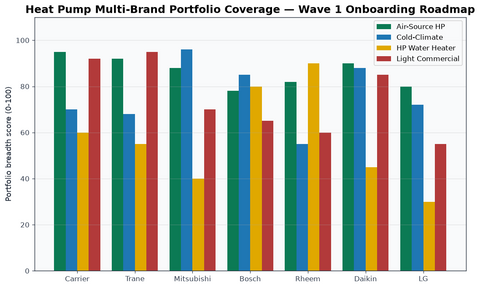
PES is onboarding Carrier, Trane, Mitsubishi, Bosch, and Rheem heat pump lines. Register at axis.pesdistribution.com for early access — contractor pricing, freight quotes, and portal-only calculators the moment stock lands.
Register for Early AccessIs Bosch as good as Mitsubishi below 0°F?
Does Bosch make a Hyper-Heat competitor?
Can I use a 3rd-party thermostat with Mitsubishi Hyper-Heat?
How does refrigerant transition affect these systems?
Which brand has better line-set flexibility?
Are both eligible for the 25C federal tax credit?
What about utility rebates in cold-climate states?
Open a PES Contractor Account — Reserve Heat Pump Access
Register at axis.pesdistribution.com for early heat-pump distribution access, trade pricing, and portal calculators.
Register Now