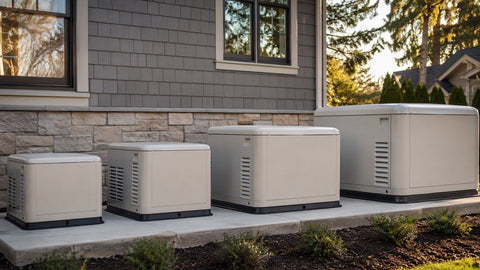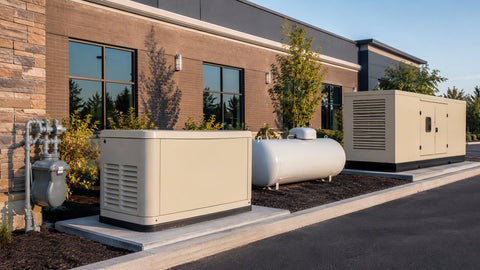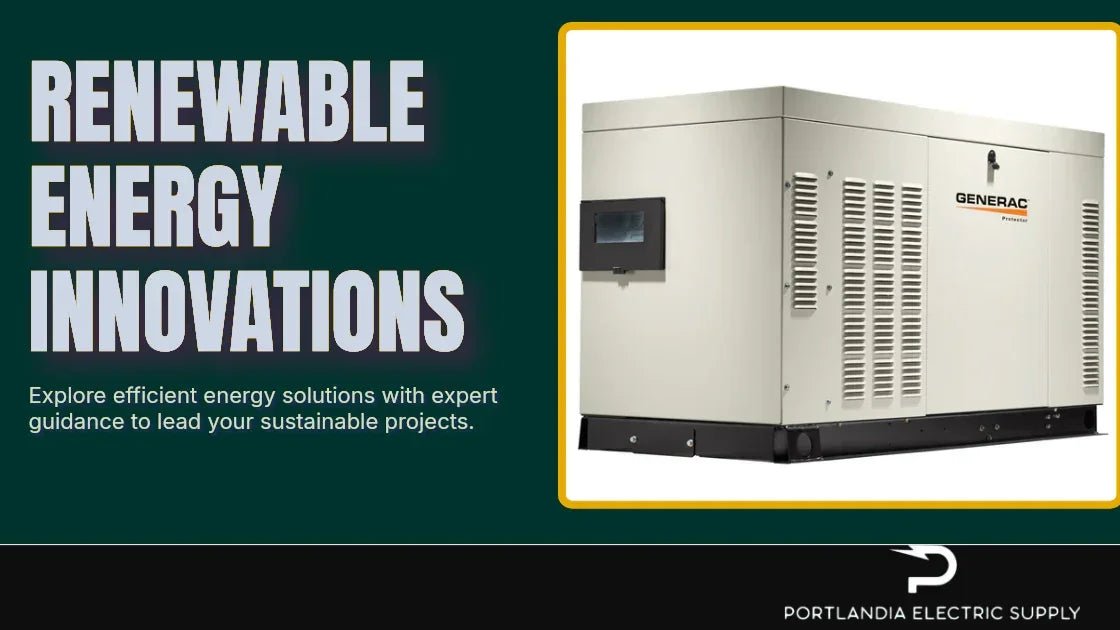
When a facility cannot afford even seconds of downtime, the generator protecting it is almost always liquid-cooled. Air-cooled standby units dominate residential yards because they're simple and cheap, but once the load profile crosses into continuous commercial duty — data centers, hospitals, manufacturing lines, multi-story buildings — the physics demands a cooling system that can shed heat hour after hour without the thermal cycling that kills engines early. We've sized, shipped, and troubleshot both architectures, and the split is clean: air-cooled for intermittent residential loads under about 150 kW, liquid-cooled for anything that runs long, hard, or hot. This guide walks through the engineering, the sizing math, the fuel and maintenance realities, and the installation code that governs commercial standby power.

Why Liquid Cooling Wins for Enterprise Loads
An internal combustion engine converts roughly one-third of its fuel energy into useful work. The rest leaves as heat — out the exhaust, off the block, through the oil. In an air-cooled generator, a fan blows ambient air across fins cast into the block and cylinder head. That works fine for a 22 kW unit running a weekly 12-minute exercise cycle and the occasional 4-hour outage. It does not work fine for a 250 kW unit carrying a hospital's OR suites through a 72-hour hurricane.
Liquid-cooled engines circulate a 50/50 ethylene-glycol/water mix through a jacket surrounding the cylinders, then through a radiator where a thermostatically controlled fan or coolant pump sheds heat to ambient air. The coolant's specific heat capacity — about 0.83 BTU/lb·°F for a 50/50 mix — lets it absorb enormous thermal energy with a modest temperature rise, and the radiator can be sized independently of the engine envelope. The result: stable cylinder-head temperatures, tighter piston-ring tolerances, lower oil temperatures, and an engine life measured in tens of thousands of hours rather than thousands.
We've pulled failed air-cooled heads off 100 kW units that were pressed into quasi-continuous industrial service. The exhaust valves were warped, the seats receded, and the head gasket surfaces were heat-checked into a checkerboard. The same block architecture in liquid-cooled trim, running the same load profile, was still within factory wear limits at twice the hours. Thermal management is not a detail; it's the difference between an asset and a maintenance liability.
Air-Cooled vs. Liquid-Cooled: The Engineering Comparison
| Parameter | Air-Cooled Standby | Liquid-Cooled Standby |
|---|---|---|
| Typical power range | 8–48 kW residential / light commercial | 25 kW–3 MW commercial / industrial |
| Engine speed | 3,600 RPM (2-pole) | 1,800 RPM (4-pole) or 1,200 RPM (6-pole) |
| Operating hours/year | 50–200 hrs (intermittent standby) | 500–8,000+ hrs (prime / continuous capable) |
| Expected engine life | 2,000–4,000 hours to overhaul | 15,000–30,000+ hours to overhaul |
| THD (total harmonic distortion) | 3–7% typical | <3% typical, often <2% |
| Noise at 23 ft (7 m) | 62–72 dB(A) | 58–68 dB(A) with enclosed radiator |
| Fuel options | Natural gas, propane (V-twin or inline) | Diesel, natural gas, propane (inline-6, V-8, V-12, V-16) |
| Block construction | Cast-aluminum or cast-iron, finned | Cast-iron or nodular-iron cylinder block with wet liners |
| Coolant maintenance | None | Every 2–3 years or per OEM schedule |
| Initial cost per kW | Lower ($250–400/kW installed) | Higher ($400–700/kW installed) |
The RPM difference matters for power quality. A 1,800 RPM alternator spins a 4-pole field, producing a smoother sine wave with lower harmonic content than a 3,600 RPM 2-pole machine. For data-center UPS systems, medical imaging, and variable-frequency drives, that cleaner waveform means fewer nuisance trips and longer power-supply life. We spec liquid-cooled units for any site running server racks or CNC equipment — the THD budget alone justifies the upgrade.
How Liquid Cooling Actually Works
The cooling circuit in a commercial standby generator is conceptually identical to a car's, scaled up. A centrifugal coolant pump, usually belt-driven off the crankshaft, circulates coolant through the engine block, the cylinder heads, the oil cooler, and often the turbocharger aftercooler. A thermostat modulates flow to the radiator until the coolant reaches operating temperature — typically 180–200°F (82–93°C) — then opens to allow radiator flow. An electrically or hydraulically driven radiator fan engages when coolant temperature or ambient air temperature crosses a setpoint.
The radiator itself is aluminum tube-and-fin, sized by the engine manufacturer for the generator's full-load heat rejection at a specified ambient temperature — usually 104°F (40°C) for open gensets, sometimes 122°F (50°C) for tropical ratings. Critical specification: if your site's ambient design temperature is 110°F and the genset is only rated to 104°F, you must either upsize the radiator, add remote cooling, or accept a de-rated output. We've seen 300 kW units drop to 260 kW on a 115°F rooftop because the radiator was sized for sea-level, 77°F conditions. Altitude compounds this: every 1,000 ft above sea level costs roughly 3–4% of engine output due to thinner air, and the cooling system must compensate.
Closed coolant systems also permit the use of block heaters — 500W to 2,000W immersion heaters that keep coolant at 90–120°F for instant cold-weather starts. In sub-freezing climates, a block heater is not optional; cold-starting a 2.5L diesel at 0°F without preheat is an exercise in battery abuse and starter-motor replacement. Every liquid-cooled unit we sell into the northern tier ships with a block heater installed.
Sizing Liquid-Cooled Standby Systems for Commercial Loads
Commercial sizing follows the same fundamental rule as residential — total the running watts, then add the largest motor-starting surge — but the scale and the duty cycle change the arithmetic. A hospital has life-safety loads that cannot be shed; a data center has cooling loads that must restart in a specific sequence; a manufacturing line may have 50 hp screw compressors with locked-rotor amps that dwarf the running load.
| Facility Type | Typical Standby Load | Motor-Starting Surge | Recommended Generator Class |
|---|---|---|---|
| Small medical clinic (essential circuits only) | 60–90 kW | 30–50 kW (HVAC + imaging) | 100–125 kW liquid-cooled |
| Midsize office building (200–400 employees) | 150–250 kW | 80–120 kW (chiller + elevators) | 300–400 kW liquid-cooled |
| Hospital — critical branch only (NEC 517) | 300–500 kW | 100–200 kW (chiller, MRI, surgery) | 600–800 kW liquid-cooled, NFPA 110 Type 10 |
| Data center — Tier III, N+1 | 800 kW–2 MW per module | Minimal (UPS-cushioned starts) | 1.5–3 MW per bus, paralleled |
| Manufacturing — continuous process | 200 kW–1 MW | 200–400% of running (large motors) | 400 kW–1.5 MW with soft-start or VFD sequencing |
| Wastewater treatment plant | 150–400 kW | High (aeration blowers, lift pumps) | 300–600 kW with load-shed priority |
The table above is a starting point, not a substitute for a formal load study. For any facility governed by NEC Article 517 (health care) or Article 700 (emergency systems), the load calculation is code-mandated, documented, and reviewed by the authority having jurisdiction. We've supplied generators for enough hospital projects to know that the AHJ will ask for the generator manufacturer's transient voltage dip spec — how far voltage sags when the largest motor hits — and compare it against the motor's minimum starting voltage. A generator that can start the motor but dip voltage below 70% of nominal will trip the motor's own undervoltage release, and you've bought a very expensive no-start.
For motor-heavy loads, we often specify a generator with a 30–40% larger kW rating than the running load alone would suggest, or we add soft starters / VFDs to the largest motors to cap the inrush. A soft starter on a 75 hp chiller reduces locked-rotor current from 600% to 250–350% of FLA, which can drop the generator requirement by a full size class. The cost of three soft starters is often less than the delta between a 400 kW and 600 kW genset.
Fuel, Runtime, and Storage

Liquid-cooled commercial generators run on diesel, natural gas, or propane. The choice is usually dictated by runtime requirements, fuel storage codes, and site constraints — not by engine preference.
| Fuel | Pros | Cons | Typical Runtime |
|---|---|---|---|
| Diesel | Highest energy density; no vapor-lock issues; widely available; simplest storage | Emissions (PM, NOₓ); fuel degradation after 12–18 months without treatment; tank cleaning | 48–96 hours per bulk tank (varies by tank size) |
| Natural Gas | Unlimited runtime (utility-dependent); cleanest combustion; no on-site storage | Pipeline disruption risk; de-rating vs. diesel (~10–15% power loss); seismic valve requirements | Effectively unlimited while gas flows |
| Propane (LP) | Clean burn; storable on-site; no fuel degradation; good cold-start | Lower energy density than diesel (~25% more gallons per kWh); vaporization limits in extreme cold | 24–72 hours per tank; multiple tanks for extended runtime |
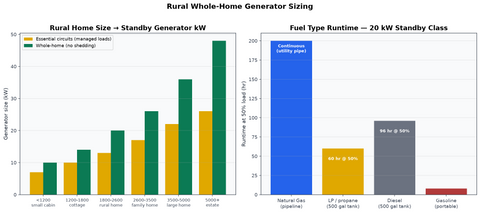
Diesel dominates the 100 kW–2 MW range for a reason: a 1,000-gallon diesel tank stores roughly 137,000,000 BTU of usable energy. At 0.4 gal/kWh for a modern Tier 4 diesel generator, that's about 2,500 kWh of energy, or roughly 25 hours at full load for a 100 kW unit — and 250 hours at half load. For a hospital that needs 96 hours of runtime under NFPA 110, diesel with a 3,000-gallon main tank and a day tank is the standard architecture. Natural gas is attractive for shorter-duration standby — a data center that only needs to bridge to UPS + cooling restart — but we warn every NG customer: the same earthquake, flood, or ice storm that knocks out grid power can damage gas distribution. The 2021 Texas freeze shut down gas pressure regulators across the state; hospitals on diesel kept running.
Fuel storage is code-governed. Bulk diesel tanks above 1,320 gallons fall under EPA SPCC rules. Underground tanks need leak detection. Above-ground tanks need secondary containment — typically 110% of the largest tank's volume. A 3,000-gallon day tank needs a 3,300-gallon containment basin. We've walked sites where the civil engineer sized the generator pad but forgot the containment footprint, and the resulting change order cost more than the genset itself. Size the whole fuel system in the first design pass, not as an afterthought.
NFPA 110, NEC 700, and the Code Landscape
Commercial standby installations are among the most code-intensive projects in electrical construction. The governing documents layer like this:
- NFPA 110: The Standard for Emergency and Standby Power Systems. Defines Type 10 (10-second power restoration), Type 60, Class (fuel supply duration), and Level (life safety vs. property protection). Any health care facility, high-rise, or critical operation falls under Type 10.
- NEC Article 700: Emergency systems. Mandates separate emergency circuits, automatic transfer, and wiring independence from normal systems.
- NEC Article 517: Health care facilities. Requires the critical branch, life safety branch, and equipment branch to be independently transferable, with the generator sized for the total essential load plus the largest motor starting surge.
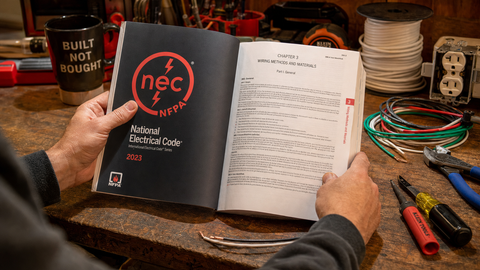
- NEC Article 445: Generators. Covers conductor sizing (125% of nameplate for continuous loads), overcurrent protection, and grounding.
The transfer switch is where code and physics meet. For commercial loads, we specify service-rated ATS units in the 200A–3,000A range, often with closed-transition or bypass-isolation features. Closed-transition ATS momentarily parallels the generator and utility — typically for less than 100 ms — to avoid the power interruption of an open transition. That requires utility approval and sync-check relays, but for data centers and semiconductor fabs, a 4-millisecond open-transition dip is enough to crash a process. We carry 200–225A transfer switches through 800A and larger industrial units for exactly these specifications.
Installation Clearances, Ventilation, and Noise
A liquid-cooled generator in a 500 kW class is not a lawn ornament. It's an engine the size of a small truck, bolted to a structural steel skid, with a radiator, fan, exhaust silencer, and fuel system that together can occupy a 12 ft × 5 ft footprint and weigh 8,000–15,000 lbs. The installation pad must be engineered for that weight plus seismic or wind loads. The exhaust must route through a properly sized silencer and terminate away from air intakes, operable windows, and combustible materials — typically 10 ft minimum from any building opening, per manufacturer and fire-code requirements.
Ventilation is the most commonly underestimated design element. The engine consumes combustion air and the radiator rejects heat. A 500 kW diesel in an enclosed room needs roughly 3,500–5,000 CFM of ventilation air, plus whatever the radiator fan moves. If the room can't move that air, ambient temperature rises, the radiator becomes less effective, and the engine derates or overheats. We've seen rooftop installations where the architect's louver area was adequate for the generator's rated airflow but not for the 115°F ambient plus solar gain on a black EPDM roof. The fix — larger louvers or a remote radiator — added six weeks and $40,000. Model the room as a heat exchanger, not as a closet.
Noise ordinances increasingly govern urban and suburban installations. A 500 kW diesel at full load can hit 105 dB(A) at 1 meter from the block. An industrial-grade enclosure with acoustic insulation, baffled air intakes, and critical-grade exhaust silencers can knock that down to 65–70 dB(A) at 23 feet — comparable to a residential air-cooled unit. The enclosure adds cost and requires maintenance access clearances, but in a hospital courtyard or office park, it's not optional. We specify attenuation in every quote within city limits.
Maintenance: The Calendar That Protects the Asset
| Interval | Task | Parts / Fluids | Estimated Cost |
|---|---|---|---|
| Weekly (automatic) | Exercise cycle under load, 15–30 min | None | $0 |
| Monthly | Visual inspection: leaks, belts, hoses, coolant level, oil level, battery terminals | None | $0 (owner / facilities) |
| 250 hours or 6 months | Oil and filter change; fuel filter; coolant test (pH, freeze point, SCAs) | Oil (CK-4 15W-40), filters, coolant additive | $300–600 |
| 500 hours or 12 months | Above + air filter; valve lash check; belt tension; battery load test; coolant replacement if degraded | Air filter, belts, battery (if failed) | $600–1,200 |
| 2,000 hours or 2 years | Full inspection: injectors, turbo, alternator bearings, cooling system pressure test, control calibration | Injectors, turbo seals, alternator bearings as needed | $2,000–5,000 |
| Overhaul | In-frame or out-of-frame rebuild at 15,000–30,000 hours | Pistons, rings, liners, bearings, gaskets | $15,000–40,000 depending on engine |
The cost table above is for planning, not bidding. Actual maintenance costs vary by engine manufacturer, local labor rates, and whether the site has a service contract. What doesn't vary: the cost of not maintaining. We've responded to emergency no-start calls where the root cause was coolant that had turned to acid and eaten through the cylinder liners, or diesel fuel so algae-contaminated that the injectors were varnished shut. Both failures were preventable with a $40 coolant test strip and a $15 fuel biocide treatment. The resulting downtime cost six figures.
Batteries deserve special attention on liquid-cooled units because the starting load is enormous. A 12.5L diesel at 0°F can demand 1,200–1,800 cold-cranking amps. Most commercial generators ship with two Group 31 AGM batteries in series for 24V. We replace them on a 3-year calendar, load-tested or not — the cost of two AGMs is under $400, and the cost of a no-start during a code-required Type 10 event is a failed inspection, a lawsuit, or worse. Our generator sizing and maintenance guides cover the residential side; the commercial discipline is the same, just bigger numbers.
How to Select a Liquid-Cooled Standby Generator: A Procedural Guide
We've walked enough projects to reduce the selection process to a checklist that catches 90% of the specification errors before they become change orders:
- Define the load category. Life safety (NEC 700), legally required standby (NEC 701), or optional standby (NEC 702)? This determines the code path, the transfer switch requirements, and the fuel-storage mandate.
- Run a formal load study. List every load on the emergency bus, its running kW, its power factor, and its starting kVA. Sum running kW; add the largest single motor-starting kVA (or use diversity factors if motors start sequentially).
- Apply the 125% continuous load factor. NEC 445.13 requires generator conductors to be sized at 125% of continuous load. Size the generator nameplate accordingly — a 400 kW unit running 320 kW continuously is within code; a 350 kW unit is not.
- Select fuel type and storage. Diesel for long runtime; natural gas for clean, short-duration standby; propane where diesel storage is restricted. Size the tank for the required runtime plus a 20% margin.
- Specify the cooling system. Radiator-cooled (unit-mounted) for most applications; remote radiator for enclosed rooms or high-ambient sites. Verify ambient de-rating if above 104°F or above 1,000 ft elevation.
- Size the ATS. Match or exceed the generator output breaker rating. For critical loads, specify bypass isolation or closed transition.
- Plan the pad, ventilation, and exhaust. Engineer for weight, airflow, noise, and code clearances. Model the room temperature under worst-case ambient + solar gain.
- Specify the control and monitoring package. Modern controllers offer Modbus/BACnet integration, remote monitoring via cellular or Ethernet, and predictive maintenance alerts. For facilities with 24/7 operations centers, remote annunciation is not a luxury.
- Budget for first-year maintenance. Oil, filters, coolant test, and a loaded exercise under a temporary load bank to prove the system before the AHJ signs off.
We stock standby generators across the residential-to-commercial spectrum, from 22 kW air-cooled units through 1 MW+ diesel platforms, and we can source industrial paralleling switchgear for multi-megawatt applications. If your project needs a formal load study, we work with electrical engineers who specialize in NEC 517 and NFPA 110 compliance — the specification is too expensive to get wrong.
Frequently Asked Questions
What is the main advantage of a liquid-cooled standby generator?
Liquid cooling allows stable thermal management under continuous or heavy loads, extending engine life from a few thousand hours to 15,000–30,000+ hours and producing cleaner power with lower THD. For commercial duty, it's the only architecture that reliably handles multi-day outages and motor-starting surges.
How long can a liquid-cooled diesel generator run continuously?
Diesel units are limited by fuel storage and oil-change intervals — typically 250 hours between oil changes. With a 3,000-gallon tank and a 500 kW unit burning ~35 gal/hr at half load, runtime exceeds 40 hours at full load or 85+ hours at half load. Natural-gas units run indefinitely while the utility gas line holds pressure.
What size liquid-cooled generator does a hospital need?
Most small-to-midsize hospitals fall in the 300–800 kW range for the critical branch, sized by NEC 517 load calculations that total every life-safety and critical-care load plus the largest motor-starting surge. The exact number requires a formal load study and AHJ review.
Is a liquid-cooled generator louder than air-cooled?
The bare engine is louder, but enclosed liquid-cooled units with acoustic enclosures often run quieter than open air-cooled residential units. Critical-grade enclosures achieve 65–70 dB(A) at 23 ft, which is comparable to normal conversation at a distance.
Can a liquid-cooled generator run on natural gas?
Yes — many liquid-cooled engines are dual-fuel or dedicated natural gas. Expect a 10–15% power de-rating vs. diesel due to lower energy density per cubic foot of NG. Natural gas is ideal for shorter-duration standby where fuel storage is constrained.
How often should coolant be changed in a liquid-cooled standby generator?
Every 2–3 years, or sooner if pH drops below 8.5 or supplemental coolant additive (SCA) levels fall below specification. Neglected coolant becomes acidic and can destroy cylinder liners, water pumps, and radiators — a failure mode we've seen repeatedly on poorly maintained units.
What is NFPA 110 Type 10?
NFPA 110 Type 10 requires emergency power to reach the load within 10 seconds of utility failure. All life-safety generators in health care, high-rise, and critical facilities must meet this. Liquid-cooled units with electronic governors and fast-start controllers reliably achieve 6–8 seconds.
Do liquid-cooled generators require a load bank test?
NFPA 110 recommends monthly exercising under available load, and many AHJs require annual testing at 50% or more of nameplate load. If the building load is insufficient, a portable load bank is used. We coordinate load bank rentals for commissioning and annual testing.
Related Products & Resources
- Standby generators — full catalog from 8 kW residential to 1 MW+ industrial
- 200–225A automatic transfer switches
- 400A ATS units for midsize commercial
- 800A and larger industrial ATS
- Generator sizing guide — residential focus, same math applies
- 2026 whole-home sizing guide
- NEC wire sizing and ampacity charts
- SPD sizing guide — surge protection for generator-fed panels
- Generator transfer switch kits
- Whole-house generator overview
Whether you're protecting an OR suite, a server farm, or a wastewater plant that cannot stop, the pattern is the same: size honestly from the actual load, specify the cooling system for the actual ambient conditions, install to NFPA 110 and NEC 700/517, and maintain on a calendar that treats the generator as critical infrastructure — because the day you need it, it is. The next outage is already on the calendar. The only question is whether your system will start when it arrives.