Updated September 2026 — refreshed against the live PES catalog; product pricing verified 2026-09-26.
We get this question at the counter every week, usually phrased as "how much generator do I actually need?" The real question is which kind of machine fits your life: a portable you wheel out when the sky goes dark, or a permanently installed whole-house unit that starts itself before you've found the flashlight. Both are honest answers to different problems. The wrong choice is expensive in both directions — buy too little and you're cold; buy too much and you've buried five figures in the yard that an $1,800 portable would have covered.
Already decided on whole-house? Jump to our Best Whole House Generators guide for the model-by-model comparison. This article stays on the portable-vs-standby decision itself.

This guide settles it with numbers: load math, installed cost, power quality, fuel logistics, resale value, and the specific household profiles where each type wins. We've sold and serviced both for years, so the opinions below come with receipts — including the warranty claims we've watched get denied and the storm weeks that separated the good purchases from the expensive regrets. Read the load worksheet honestly and the right answer usually picks itself.
Portable Generator vs Whole-House Generator: The Main Difference
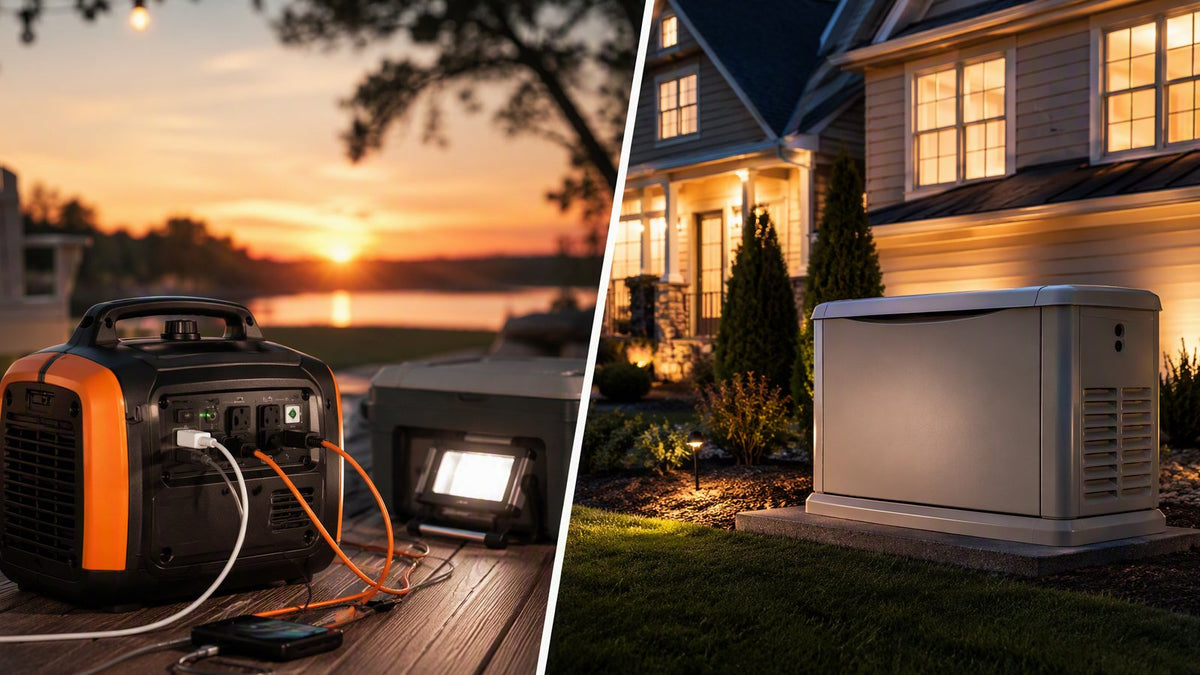
A portable generator is a tool: gasoline or dual-fuel, 2,000–9,500W, stored in the garage, deployed by hand, connected through extension cords or a manual inlet, refueled every 8–14 hours, and priced from $400 to about $2,500. A whole-house (standby) generator is an appliance: permanently plumbed to natural gas or propane, 10–26kW for most homes, bolted to a pad, wired through an automatic transfer switch, self-testing weekly, and installed for $9,000–15,000 turnkey. Everything else — convenience, safety, power quality, cost per year — flows from that single difference: one is something you operate, the other is something you own.
| Attribute | Portable (2–9.5kW) | Whole-House Standby (10–26kW) |
|---|---|---|
| Activation | Manual — you deploy, connect, start | Automatic — ~10 seconds from outage to power |
| Coverage | Selected circuits via cords or interlock | Whole house or managed essential loads |
| Fuel | Gasoline (3–6 month shelf life) or LP cylinders | Natural gas (unlimited) or bulk propane (days–weeks) |
| Continuous runtime | Limited by tank and refueling stamina | Unlimited on NG; ~8 days on a 500-gal LP tank at half load |
| Power quality | Inverter models: clean; open-frame: 6–12% THD | Utility-grade, under 5% THD, tight voltage regulation |
| Noise | 62–78 dB at 23 ft | 63–67 dB at 23 ft (air-cooled); quieter liquid-cooled |
| Installed cost | $400–2,500 (+$800–1,500 inlet/interlock) | $9,000–15,000 turnkey |
| Lifespan | 1,000–2,000 hours | 3,000–5,000 hr air-cooled; 15,000+ liquid-cooled |
| Home resale impact | None — it's personal property | Documented value-add in outage-prone markets |
| Portability | Camping, tailgates, job sites, loaning to family | None — it's a fixture |
Evaluating Your Power Needs: The Worksheet
Generator sizing starts with a pencil, not a catalog. List every load you refuse to lose, find its running watts and motor starting watts, and total honestly:
| Load | Running | Starting | Portable-Feasible? |
|---|---|---|---|
| Refrigerator | 150–250W | 900–1,200W | Yes |
| Gas furnace blower (1/2 hp) | 700–1,000W | 1,800–2,300W | Yes — via transfer means |
| Sump pump (1/3 hp) | 800W | 1,500–2,900W | Yes, staggered |
| Well pump (1/2 hp, 240V) | 1,000–1,100W | 2,000–2,500W | Marginal — needs 7.5kW+ and load discipline |
| Central AC (3-ton) | 3,500W | 5,000–10,000W (soft-start helps) | No — standby territory |
| Electric water heater | 4,500W | 4,500W | No — standby or load-managed |
| Electric range | 3,000–8,000W | — | No |
| EV charging (Level 2) | 7,700–11,500W | — | Standby with load management only |
| Internet, lights, phones, TV | 300–600W | — | Yes |
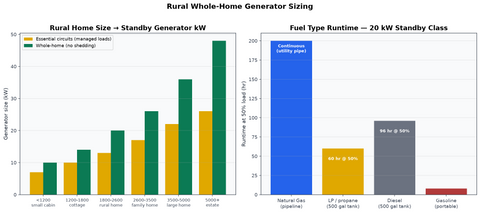
The pattern: portables carry survival loads comfortably — fridge, furnace blower, sump, lights, internet, and maybe a well pump with careful staging, totaling 6,500W managed. The moment your must-run list includes central AC, electric cooking, or electric water heating, you've described a 14–22kW standby with an automatic transfer switch and smart load management. Our standby sizing guide runs the full calculation, and the 26kW guide covers the large-home class.
Cost: Purchase, Install, and a Decade of Ownership
Sticker price lies by omission. Here's the honest ten-year ledger for a storm-belt household averaging 80 outage-hours a year:
| Line Item (10 yr) | Portable Route | Standby Route |
|---|---|---|
| Equipment | $900–2,500 (7.5–9.5kW dual-fuel) | $5,000–6,500 (22kW air-cooled) |
| Electrical work | $800–1,500 (inlet box + interlock) | Included: ATS, wiring, gas plumbing |
| Total installed | $1,700–4,000 | $9,000–15,000 |
| Fuel (800 outage-hr @ 50% load) | ~$1,900 gasoline @ $3.50/gal | ~$2,400 NG @ $1.20/therm |
| Maintenance (10 yr) | ~$500 DIY (oil, plugs, filters) | ~$2,500 (annual pro service) |
| Replacement reserve | One unit over the decade if heavily used | None — 20+ yr seasonal life |
| 10-year total | ~$4,000–8,000 | ~$14,000–20,000 |
Run the per-outage-hour math and the gap narrows emotionally if not financially: the portable costs roughly $5–10 per outage-hour all-in, the standby $18–25. What those extra dollars purchase is automation, unlimited runtime, whole-house coverage, and zero carbon-monoxide choreography at 2 a.m. Whether that's worth $10,000 is a household budget question, not an engineering one — but at least now it's an informed one. Value buyers should compare the majors in Generac vs Kohler, the Briggs & Stratton line, and Champion's value series before signing anything.
Power Quality: Why Your Electronics Care
Open-frame conventional portables produce modified power with 6–12% total harmonic distortion and voltage that wanders with load. Modern furnaces with ECM blower motors, variable-speed appliances, and some medical devices object — sometimes subtly (hot motor windings, shortened life), sometimes immediately (control boards that fault and lock out). Inverter portables and all standby units produce clean sine output under 5% THD, which is to say: indistinguishable from the utility for practical purposes. If your must-run list includes a modern furnace control board or a CPAP with a heated humidifier, power quality is a first-class selection criterion, not a footnote. For sensitive off-grid power generally, our pure sine wave inverter guide explains the waveform physics.
Installation and the Legal Layer
Portables sit in a legal gray zone only when owners make one: backfeeding through a dryer outlet with a double-male cord is illegal, dangerous to line crews, and uninsured when it goes wrong. The legitimate portable setup — generator inlet box on the exterior wall, a listed interlock kit or manual transfer switch at the panel, circuits selected in advance — costs $800–1,500 installed and satisfies NEC 702. Standby systems are fully permitted installations: pad, gas plumbing sized for full-load flow, automatic transfer switch, inspections for both trades. The permit paper trail matters at resale and insurance time; we've seen claim adjusters ask for it after generator-adjacent fires. Our NEC wire and breaker sizing guide covers conductor selection for either route.
Fuel Logistics: The Daily Reality Difference
| Factor | Gasoline Portable | Dual-Fuel Portable | NG Standby | LP Standby |
|---|---|---|---|---|
| Fuel on hand for 3 days @ 50% load | ~36 gal stabilized | ~30 gal LP (3× 100-lb cyl.) | None — piped | ~150 gal from 500-gal tank |
| Refuel interval | 8–12 hr | 8–14 hr | Never | Never |
| Storage risk | Fire code, evaporation, varnish | Low | None on site | Tank setback rules (NFPA 58) |
| Fuel goes stale? | 3–6 months untreated | Propane: never | N/A | Never |
| Cost per outage-day @ 50% | ~$40–55 | ~$55–70 | ~$60 (2.1 therms/hr class) | ~$126 (2.1 gal/hr class) |
Notice that natural gas wins on convenience while propane standby loses on fuel cost — roughly double NG per outage-day at typical prices. The full fuel-physics breakdown, including diesel, lives in our three-fuel comparison. And if your worry is specifically ice storms, the cold-start and vaporization details are in our winter-specific guide.
The Hybrid Answer Nobody Mentions First

A growing share of our customers land on a third configuration: a battery system carrying overnight and short-outage loads, with a portable generator as the recharging engine for long events. The battery handles the 80% of outages that last under four hours silently and instantly; the portable runs two or three hours a day during multi-day events instead of continuously. Fuel consumption drops 70–80%, noise drops proportionally, and the capital cost lands between the two classic routes. The full analysis is in battery backup vs generator, and sizing help lives in the home battery bank sizing guide and runtime calculator. For outage-prone households that balk at $12,000, this middle path deserves an honest look.
Maintenance: The Ownership Reality Nobody Prices
A generator you don't maintain is a lawn ornament with delusions. The maintenance calendars differ more than buyers expect:
| Task | Portable | Standby |
|---|---|---|
| Oil change | First 20 hr, then every 50–100 hr (that's every 4–8 outage-days) | Every 100–200 hr or annually, whichever first |
| Air filter / spark plug | Annually or every 100 hr | Annual service visit |
| Fuel management | Stabilize or drain; rotate stock 2×/yr | None (NG); LP tank gauge checks |
| Exercise | Owner runs it monthly — realistically, owners don't | Automatic weekly self-test, logged and reported |
| Battery | Maintainer between seasons | Replaced ~every 3 yr during service |
| Professional service | Optional | Recommended annually (~$200–350/visit) |
The exercise row decides more real-world reliability than any spec. Standby units wake themselves weekly, circulate oil, charge their battery, and report by app; the machine that starts during your outage is the one that started last Tuesday. Portables depend on owner discipline, and human discipline is the least reliable component in any backup system. If you know yourself — honestly, not aspirationally — and monthly test runs aren't happening, that knowledge belongs in the purchase decision.
Noise, Placement, and Neighborhood Diplomacy
Open-frame portables run 70–78 dB at 23 feet — lawn-mower territory, sustained, for days. In a dense neighborhood during a shared outage, that's a social problem before it's an acoustic one; we've watched generator noise end friendships that hurricanes couldn't. Inverter portables at eco load drop to the low 60s, and air-cooled standby units land at 63–67 dB — noticeable, not hostile. Liquid-cooled standby units run quieter still. Placement rules compound the issue: portables need 20 feet from the house for CO safety, which often pushes them toward the property line — and the neighbors. Standby pads are sited per code at install and stay put. If your lot is tight, walk the placement geometry with a tape measure before you buy anything.
A Tale of Two Households
Household one: young family, gas heat, city lot, outage history of two four-hour events per year. They bought a 7,500W dual-fuel portable, an inlet box, and an interlock for $2,600 all-in. Their outage routine is twenty minutes of setup, then normal life with the fridge humming and the furnace cycling. In six years the system has cost them maybe $300 in fuel and oil. Perfect choice — the standby premium would have bought them nothing they use.
Household two: retirees on acreage, well water, sump pump, a CPAP with a heated hose, and a storm history that includes an eleven-day ice event. They spent $13,400 on a 22kW LP standby with a 500-gallon tank. During the next big ice storm they watched the outage map fill in around them while the house never flickered, and the generator logged 193 hours without asking anyone to go outside. Also a perfect choice. The households that get burned are the ones who buy for the brochure instead of the outage history — portables that can't carry the real load, or standby units guarding houses that lose power ninety minutes a year.
Transfer Switch Options for the Portable Route
If you go portable, the connection method is the system. Three legitimate tiers: a manual transfer switch (6–10 circuits, $400–700 plus labor) gives you labeled breakers for chosen loads — cleanest and most foolproof. A listed interlock kit ($150–300 plus labor) slides to let the generator backfeed selected breakers in your main panel safely — cheapest whole-panel answer. A power inlet box ($80–150) is the weatherproof socket on the wall that both connect to. Skip every tier and you're in suicide-cord territory, which we refuse to sell parts for. An electrician's half-day is the difference between a system and a hazard, and the permit costs less than the insurance deductible when things go wrong.
Features That Actually Matter (and Two That Don't)
Spec sheets shout; a short list whispers the truth. Electric start matters on anything over 5,000W — pulling a recoil cord on a cold 459cc engine is a young person's game. CO shutdown sensors matter more than any other portable feature: modern portables carry automatic carbon-monoxide shutoff that kills the engine when concentrations build, a genuine lifesaver that costs nothing extra on current-model units. Low-oil shutoff saves engines from distracted owners. A fuel gauge you can read at a glance prevents the midnight surprise. On standby units, load management modules matter most — they let a 14kW unit behave like an 18kW by shedding the water heater when the AC compressor starts, saving real money on capacity you rarely need.
Two features that don't deserve your money: electric "remote start" key fobs on portables (you're standing next to the thing anyway) and Wi-Fi apps on units whose owners never open them (though standby monitoring apps genuinely earn their keep — outage alerts when you're traveling are worth the subscription).
The Buying Checklist We Give Family
- Match watts to the worksheet, not the marketing. Running watts first, starting surge second, 20% headroom always.
- Check the service network before the brand. A standby generator is a 20-year appliance; the local dealer's service truck matters more than the logo. Ask who services it and what their response time was during the last regional event.
- Read the warranty exclusions. Five-year limited warranties often exclude labor in years 3–5 and anything "wear-related." Know what you're holding.
- Budget the connection. Portable owners: inlet box, interlock, electrician. Standby buyers: pad, trenching, meter upgrade if required, permits. Surprises live in these line items.
- Buy in the off-season. Generator prices and install lead times spike the week after every regional outage. May is cheaper than September, every year.
Which One Should You Buy? The Decision Profiles
Buy the portable if your outages are measured in hours not days, your must-run list fits in 7,500W (gas heat, no central AC), your budget is under $4,000 all-in, someone in the household is willing and able to operate it, and you'd use it elsewhere — camping, job sites, the neighbor's barn. It's a rational, proven choice for most suburban households with gas heat.
Buy the whole-house standby if outages run multi-day, anyone depends on powered medical equipment, the house sits empty for stretches (the unit protects pipes and sump pumps unattended), you run a home business that can't go dark, your loads include AC or electric appliances, or you're simply done being your own power utility. Households in hurricane, ice, or wildfire-shutoff territory recover the premium in the first long event — measured in spoiled food avoided, hotel nights skipped, and pipes that never froze.
Still torn? Price both. Get the standby quote turnkey (pad, ATS, gas, permits — the whole-house generator overview lists what a complete quote includes), price the portable plus proper inlet and interlock, and compare against your actual outage history from the utility. The answer usually becomes obvious once real numbers replace imagined ones — and if it doesn't, call the counter and we'll walk the worksheet with you line by line.
Frequently Asked Questions
How loud are standby generators compared to portables?
Surprisingly similar on paper, very different in practice. Air-cooled standby units measure 63–67 dB at 23 feet — about like a central air conditioner — while open-frame portables run 70–78 dB, and each 10 dB reads as roughly twice as loud to the ear. The bigger difference is duration and timing: the portable runs whenever you're home to hear it, often just outside a window; the standby sits on its code-compliant pad and runs unattended. Inverter portables in eco mode (low 60s dB) are the quietest option of all, but their capacity tops out around 4,500W.
Should I buy a dual-fuel portable generator?
For most portable buyers, yes. Propane never goes stale, stores safely for years, and eliminates the carburetor-varnish failures that sideline gasoline units after a season of neglect — while the gasoline option remains for deep cold, when small LP cylinders struggle to vaporize enough fuel. Expect about an 8–10% power derate on propane, so size the unit on its LP rating if that's your primary fuel. The flexibility premium is usually $100–200, which is cheap insurance against the single most common portable-generator failure mode we see.
Is a whole-house generator worth the cost?
For households with multi-day outage risk, medical equipment, unattended-property periods, or all-electric loads, yes — the first week-long event typically justifies the premium in avoided losses and hotel costs. For short-outage households with gas heat, a portable plus a proper interlock is the rational buy. It hinges on your outage history, which your utility can provide.
Can a portable generator power a whole house?
Not literally. A 7,500–9,500W portable can carry survival loads — refrigerator, furnace blower, sump pump, lights, internet — through a transfer means, with careful load rotation. Central air, electric water heaters, ranges, and EV chargers are beyond it. If "whole house" means everything runs normally, you're describing a 20kW+ standby.
How long does each type last?
Portables: 1,000–2,000 hours — a decade or two of typical outage duty if maintained. Air-cooled standby: 3,000–5,000 hours, effectively 20+ years of seasonal use with annual service. Liquid-cooled standby: 15,000+ hours. Maintenance discipline, not brand, is the biggest lifespan variable.
Do standby generators add home value?
In outage-prone markets, yes — appraisers and buyers treat a permitted standby system as a fixture improvement, and realtors in hurricane and ice corridors report it as a differentiator. Portables are personal property and add nothing at resale, though they're also the only type you can take with you.
What's the safest way to connect a portable to my house?
A generator inlet box wired to a listed interlock kit or manual transfer switch, installed per NEC 702 — $800–1,500 professionally installed. This isolates your house from the grid so the generator can't backfeed utility lines and endanger line crews. Double-male "suicide cords" through dryer outlets are illegal and genuinely lethal.
Should I consider a battery system instead?
For outages under four hours — which is most outages — a battery is quieter, cleaner, instant, and maintenance-free. Pair it with a small portable for long events and you've built the hybrid system many households find optimal. See our battery vs generator analysis for the crossover math.
Need pricing or availability on anything in this guide?
Portlandia Electric Supply dropships direct from the manufacturer — most items Ship Direct with lead times stated up front, no surprises.
Get a quote from PESBulk, pallet and contractor pricing available.