Generator Fuel Infrastructure Complete Guide: Tanks, Lines, Regulators, and Runtime by Fuel
A specifier's complete reference for backup-power fuel systems — LP vs natural gas vs diesel, tank sizing by generator kW and hour-target, gas line sizing per NFPA 54, day tanks and transfer pumps, and the compliance stack for standby installations.

You cannot size a generator without deciding on fuel, and you cannot decide on fuel without knowing runtime target, site conditions, and code environment. In 2026 the four dominant standby fuels are natural gas, liquid propane (LP), diesel, and — increasingly for smaller residential and light commercial — dual-fuel LP/NG. Bi-fuel (diesel with natural gas assist) exists but is a niche solution for very large data-center-class systems.
Each fuel has a distinct signature. Natural gas has effectively infinite runtime because it comes from the utility, but it derates the generator by 8-12% versus LP, it fails when the utility fails (earthquakes, ice storms, high-consequence events), and it requires a professionally-sized gas line that many older services can't provide without an upgrade. LP is dense energy (91,600 BTU/gallon) storable on-site, but tank sizing determines runtime and refill logistics matter a lot in extended outages. Diesel is the highest energy density of any commonly-available fuel (128,700 BTU/gallon), it's the standard for anything above 60 kW in commercial and industrial, and it comes with its own regulatory environment (EPA Tier 4, spill containment per SPCC, storage tank permitting).
The heuristic that works 80% of the time: residential and light commercial under 30 kW gets dual-fuel LP/NG or straight NG if the gas line supports it; small to mid commercial 30-100 kW gets NG or diesel depending on fuel reliability at the site; anything above 100 kW is diesel unless there's a specific business reason (very long runtime target, no diesel infrastructure, hospital campus with a large gas main) to run gaseous fuel.
| Property | Natural Gas | Liquid Propane | Diesel | Notes |
|---|---|---|---|---|
| Energy density | 1,020 BTU/scf | 91,600 BTU/gal | 128,700 BTU/gal | Diesel is ~40% denser than LP by volume |
| Runtime source | Utility (unlimited*) | On-site tank (sized) | On-site tank (sized) | *Unless utility disruption |
| Typical genset derate | Baseline | -4 to -8% vs baseline | Baseline (own baseline) | NG rated lower than LP on same platform |
| Storage regulatory | None on-site | NFPA 58 (LP-Gas Code) | NFPA 30/30A, SPCC if > 1,320 gal | SPCC is EPA, not fire code |
| Cold-weather concerns | Minimal | Vaporization drops below -20°F | Gelling below cloud point | Additives / heater used |
| Fuel cost per kWh (2026 avg) | $0.11-0.16 | $0.24-0.32 | $0.19-0.28 | Regionally variable |
| Environmental / permit | Minimal | Local siting rules | SPCC + air permit at scale | Tier 4 emissions on new diesel |
| Typical fit | Homes and light comm w/ good gas | Residential rural / suburb w/ tank | Commercial 60kW+ and industrial | Above 500 kW almost always diesel |
The fuel-side sizing question is: given a generator load profile and a runtime target, how much on-site fuel storage do I need? The math has three steps.
Step 1: establish the design load. This is not the generator's nameplate kW — it's the actual load the generator will carry during the outage window. Typical rule: 70-80% of nameplate for continuous emergency loads. A 22 kW residential unit sees ~16 kW average during a real outage.
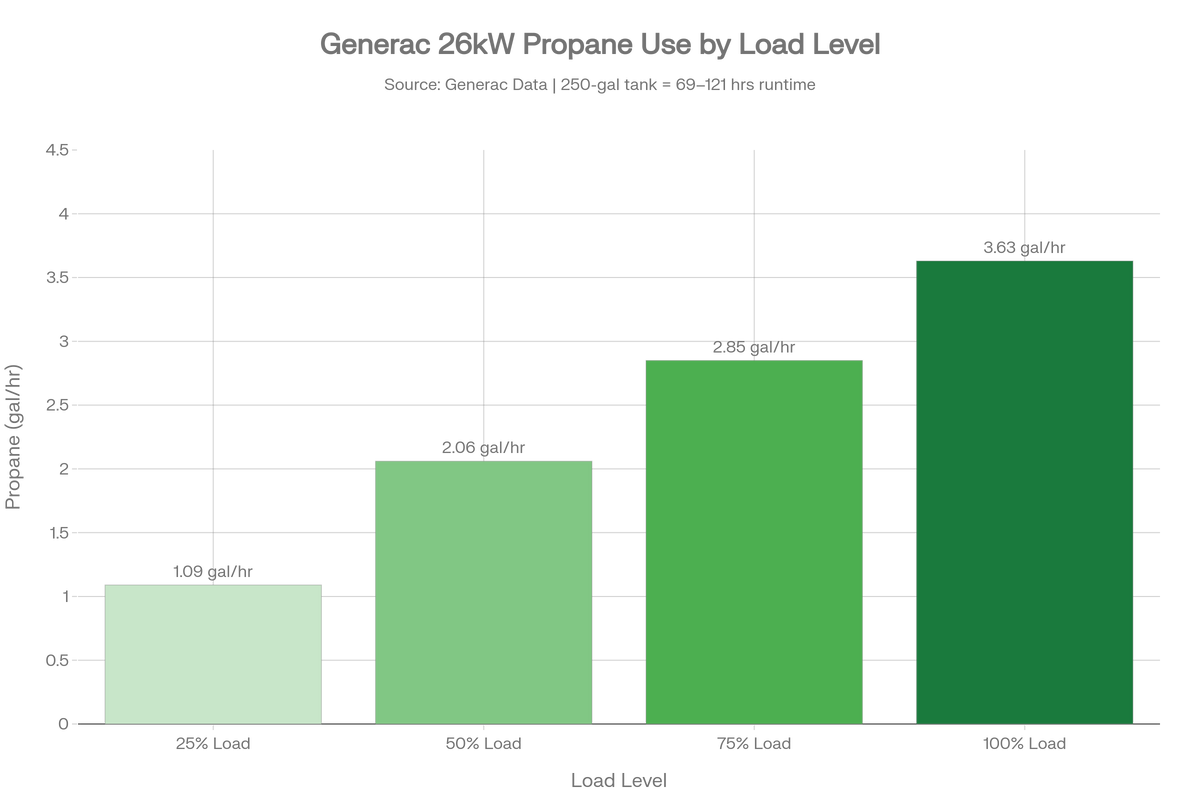
Step 2: convert load to fuel consumption. Manufacturers publish fuel-consumption curves at 25%, 50%, 75%, and 100% load. Interpolate linearly for your average load point. As a rough guide: a 22 kW LP generator at 75% load consumes about 2.9 gph; at 50% load about 2.1 gph. A 60 kW diesel at 75% load consumes about 4.4 gph; at 50% about 3.1 gph. Multiply by your runtime hours.
Step 3: apply the fill-fraction and safety factor. LP tanks are filled to 80% by NFPA 58 (thermal expansion allowance); diesel tanks are typically filled to 90-95% depending on tank design. Apply a 1.25x runtime safety factor for anything supporting critical loads, higher for hospital and data-center-class where 96-hour NFPA 110 Type 10 rules apply.
Worked example: a 26 kW LP generator supporting a residence needs to run 72 hours during an ice storm. Average load 18 kW (69%). Fuel consumption at 75% load from Generac spec sheet: 3.6 gph. Total fuel: 72 × 3.6 = 259 gallons. Apply the 80% fill fraction: 259 / 0.80 = 324 gallons of tank capacity. Round up to a 500-gallon LP tank (nominal) — 400-gallon nominal would only give ~320 gallons usable and eats your safety factor.
-
1
Establish the load and runtime target
Design load (kW), runtime hours, criticality (life safety vs comfort). This is your input. Everything else follows from it.
-
2
Pick the fuel based on runtime, site, and code
Short runtime + good gas + no earthquake risk = NG. Longer runtime + site tank feasible = LP. Long runtime + commercial + no gas = diesel.
-
3
Calculate consumption at design load point
Manufacturer fuel curve × runtime hours × safety factor. Do not use full-load numbers unless the generator will actually run at full load — most don't.
-
4
Size the storage — LP or diesel — to hold the calculated fuel plus buffer
LP tank at 80% fill fraction; diesel tank at 90-95%. Add 25% safety factor for critical loads, more for life safety.
-
5
Size the gas line (NG or LP vapor withdrawal) per NFPA 54
The line must deliver the generator's peak BTU demand at the manufacturer's minimum inlet pressure. Longer runs and more fittings drop pressure — a 200-ft LP vapor line to a 26 kW generator often needs 1-1/4" copper or 1" black iron, not the 3/4" gas piping used for the range.
-
6
Layer the compliance stack
NFPA 58 (LP), NFPA 30/30A (diesel), NFPA 37 (generator installation), NFPA 110 (emergency power), and local AHJ approvals. Miss a stack layer and the ATS commissioning fails.
Three failure patterns account for most of the 'the generator won't start' service calls after commissioning.
Undersized gas line. Homeowners and small commercial customers frequently install a natural gas or LP-vapor generator onto whatever gas piping is nearest, without doing the load calculation on the line itself. When the generator tries to draw 400,000 BTU/hr through a line sized for 120,000 BTU/hr, the inlet pressure drops below the regulator's operating window and the engine either fails to start or runs rich, dumps carbon, and shuts down. The fix is a dedicated gas line, sized per NFPA 54 tables for the specific pipe material, length, elevation changes, and pressure drop budget.
LP tank sized by tank price, not runtime. The 250-gallon tank is cheap and delivers well, so it gets installed on a 22 kW system. At 3.2 gph consumption, that tank at 80% (200 gallons usable) lasts 62 hours — one long outage. The customer expected 'a week of runtime' because that's what the generator marketing brochure implied. Right-size to the target runtime with a real load calc, or install two 500-gallon tanks manifolded for a mid-size residential.
Diesel installation without SPCC compliance. Any diesel storage over 1,320 gallons aggregate on a facility that could reasonably discharge to navigable waters triggers a Spill Prevention Control and Countermeasure plan under 40 CFR 112. Newer diesel tanks (UL-142 double-wall, or UL-2085 protected) are designed for this; older single-wall installations often are not. Adding a 500-gallon diesel to a facility that already has 1,000 gallons in other tanks can push the site over the threshold.
| Generator Size | Load @75% (kW) | Fuel Rate (gph) | 48hr Tank | 72hr Tank | 96hr Tank |
|---|---|---|---|---|---|
| 10 kW | 7.5 kW | 1.4 gph | 120 gal (nominal) | 180 gal (nom.) | 250 gal (nom.) |
| 14 kW | 10.5 kW | 1.9 gph | 150 gal (nom.) | 250 gal (nom.) | 325 gal (nom.) |
| 18 kW | 13.5 kW | 2.5 gph | 250 gal (nom.) | 325 gal (nom.) | 400 gal (nom.) |
| 22 kW | 16.5 kW | 2.9 gph | 250 gal (nom.) | 400 gal (nom.) | 500 gal (nom.) |
| 26 kW | 19.5 kW | 3.6 gph | 325 gal (nom.) | 500 gal (nom.) | 500 gal (nom., 96h tight) |
| 36 kW (comm.) | 27 kW | 5.0 gph | 500 gal (nom.) | 1000 gal (nom.) | 1000 gal (nom.) |
| 48 kW (comm.) | 36 kW | 6.7 gph | 1000 gal (nom.) | 1000 gal (nom.) | 1500-2000 gal |
| 60 kW (comm.) | 45 kW | 8.4 gph | 1000 gal (nom.) | 1500-2000 gal | 2000 gal (nom.) |
Gas line sizing is done per NFPA 54 (National Fuel Gas Code) tables. The inputs are: generator peak BTU demand (from spec sheet), inlet pressure required (usually 5 to 14 inches water column for standby generators, sometimes 2 psi for larger commercial), total developed length of pipe (physical length plus equivalent length of fittings), and pipe material (black iron, corrugated stainless CSST, or copper).
The single number that tells you whether an existing gas service can support a generator is total connected demand. If the house has an existing 199,000 BTU furnace, a 40,000 BTU water heater, a 65,000 BTU range, and a 30,000 BTU dryer — that's 334,000 BTU peak. Adding a 22 kW generator at 400,000 BTU peak brings the total to 734,000 BTU. Most residential gas services are sized to 200,000-350,000 BTU max at the meter. The service will not support the generator without a meter upgrade and often a service upgrade from the gas utility.
Coordinating that upgrade takes weeks to months and adds thousands of dollars to the installed cost. When natural gas is on the table for standby, the gas utility should be brought in during design, not at rough-in.
Every general rule about fuel selection breaks down at specific sites. Below are the site conditions we see most often shifting the answer away from the default.
Utility gas reliability history: in earthquake zones and areas with older cast-iron distribution mains, the gas utility fails during exactly the events that trigger the generator. Post-earthquake gas outages have lasted weeks in California and Alaska. If the site is in a seismic zone or served by pre-1970s distribution, dual-fuel or on-site LP is the right answer even if natural gas is technically available today.
Very cold climates: below -20°F design low temp, LP vaporization becomes marginal on all but the largest tank sizes. Natural gas is fine but the failure mode above shifts weight to diesel. Diesel gelling is the mirror-image problem — untreated fuel gels around 15-20°F cloud point, and requires anti-gel additive and/or an in-tank fuel heater. Both fuels need engineering attention below about -10°F.
Coastal and marine environments: salt air degrades exposed equipment fast. Aluminum-enclosed generators fare well; steel enclosures need active corrosion management. Fuel storage in coastal environments should be stainless-piped or double-wall containment; underground tanks in high-water-table coastal areas are usually not economical because of cathodic protection and containment complexity.
High-elevation sites: above 5,000 feet, gas-fueled engines derate. LP and natural gas generators lose 3.5% output per 1,000 ft above sea level. Diesel loses less (about 1.5% per 1,000 ft with modern turbocharged engines). At 8,000 feet a 26 kW LP generator outputs about 20 kW; a 60 kW diesel outputs about 55 kW. Spec for the actual elevation rather than the nameplate.
Space constraints: urban commercial with no yard space often forces underground LP or diesel, or gas-only if the utility supports it. Rooftop generators are increasingly common in urban commercial and impose serious constraints on fuel — usually mandatory diesel with a day tank in the equipment room and a main tank in the basement or in a fire-rated ground-level tank room. Fuel piping vertically through the building becomes a fire-code question with its own set of NFPA and IBC requirements.
Local air quality permits: California and a growing list of other states impose emission limits on stationary internal combustion engines. Tier 4 Final diesel is the current standard for most new commercial installations; some jurisdictions (South Coast AQMD, Bay Area AQMD) impose additional operating-hour and testing constraints. Non-emergency use of standby generators (peak shaving, demand response) may be regulated separately from emergency-only operation. Check permitting before design commits.
How do I choose between dual-fuel and single-fuel LP?
Do I need a day tank on a diesel generator?
What's the runtime penalty for running natural gas versus LP on the same generator?
How does cold weather affect LP vaporization?
How often is a full fuel-system inspection required?
Talk to a fuel-side specialist about your standby install
Get trade pricing, freight quotes, and portal calculators.
Register Now