EV Charger Installer Certification Guide (EVITP, NABCEP, Manufacturer)
How electrical contractors become certified EV charger installers — EVITP 250-hour program, NABCEP EV Associate credential, ChargePoint / Tesla Wall / FLO / EVBox factory training, NEC 625 code compliance, and the SKUs PES stocks for L2 and DCFC installations.

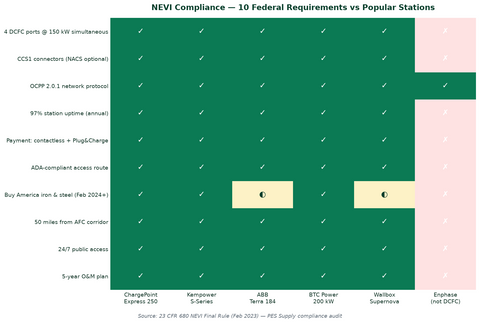
The Bipartisan Infrastructure Law's NEVI (National Electric Vehicle Infrastructure) program funds $5B for public DC fast-charging, and the associated CFI (Charging and Fueling Infrastructure) program adds another $2.5B for community charging. Both programs require installers to hold EVITP (Electric Vehicle Infrastructure Training Program) certification. State-funded programs (California CALeVIP, New York EV Make-Ready, Kentucky KY-NEVI) also require EVITP or state-approved equivalents.
Commercial installers who add EV to their scope without certification lose access to ~$1.4B in state and federal incentive-funded projects. Manufacturer certifications (ChargePoint, Tesla, FLO, EVBox) add specific-brand rebate program eligibility on top.
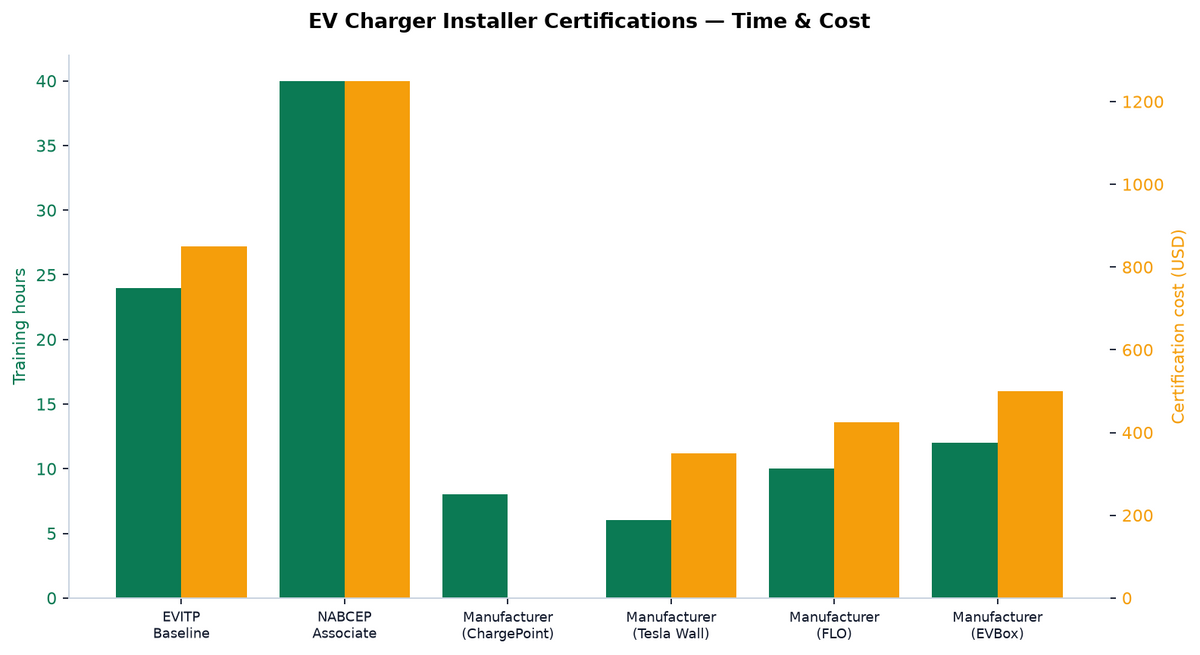
| Certification | Provider | Time / Cost | Renewal | Program Access |
|---|---|---|---|---|
| EVITP | IBEW / NECA joint | 24 hrs online + 16 hrs exam / $850 | 3 years / CEUs | NEVI, CFI, most state programs |
| NABCEP EV Associate | NABCEP | 40 hrs / $1,250 exam | 3 years / CEUs | State programs, professional credibility |
| ChargePoint Certified | ChargePoint | 8 hrs online + hands-on / free | Annual | ChargePoint rebate programs |
| Tesla Wall Connector Certified | Tesla | 6 hrs online + install video / $350 | Annual | Tesla referral network |
| FLO Certified Installer | FLO Networks | 10 hrs blended / $425 | Annual | FLO utility & muni programs |
| EVBox Certified | EVBox | 12 hrs blended / $500 | Annual | EVBox commercial programs |
EVITP is administered by an IBEW/NECA joint apprenticeship trust and is the most widely accepted EV installer credential. The 24-hour online curriculum covers:
- Section 1 — EV history, battery chemistry, drivetrain overview, charging standards (SAE J1772, CCS, NACS, CHAdeMO).
- Section 2 — NEC Article 625 (EV supply equipment): 625.17 disconnect, 625.40 disconnect location, 625.41 rating, 625.46 emergency shutoff, 625.48 interactive systems, 625.60 Level 3 output.
- Section 3 — Level 1 (120V, ~1.4 kW), Level 2 (208-240V, 3-19.2 kW), DC Fast Charging (400-1000V DC, 50-350 kW).
- Section 4 — Load management: 750.30 optional-standby, 220.57 EV load calculation methods (100% of largest, or measured demand).
- Section 5 — Site selection, cable routing, bollards, ADA compliance, signage.
- Section 6 — Utility interconnection for DCFC (transformer sizing, 480V or 600V service, demand charge management).
- Section 7 — Communications: OCPP 1.6J and 2.0.1, network back-end selection, roaming (OCPI).
- Section 8 — Commissioning and load testing.
Cost is $850 for the online modules plus a proctored final exam. Renewal every 3 years with 6 CEUs of continuing education.
NEC 625 is the governing article for EV supply equipment (EVSE) — everything from a residential 40 A Level 2 to a 350 kW DC fast charger. Key sections:
- 625.17 — EVSE must be listed (UL 2202 for DCFC, UL 2594 for Level 2).
- 625.40 — Disconnecting means: for EVSE rated > 60 A or > 150V to ground, a lockable disconnect within sight and within 30 ft. For Level 2 residential Wall Connector-class EVSE, the branch OCPD serves as disconnect.
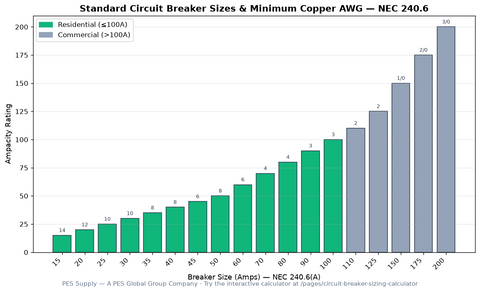
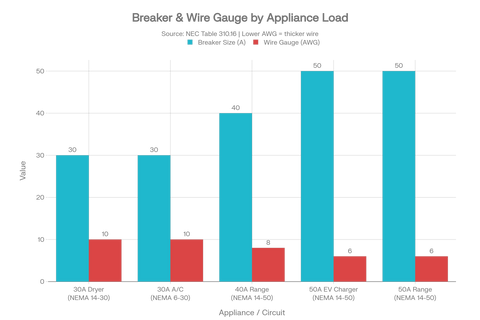
- 625.41 — Overcurrent protection: continuous load per 210.19(A)(1), so a 40 A Level 2 needs a 50 A breaker on #6 THHN copper.
- 625.42 — Rating: EVSE is a continuous load; 125% factor applies to conductors and OCPD.
- 625.46 — Emergency shutoff (DCFC only): must be within 20 ft, red mushroom E-stop, hard-wired to interrupt DC and open AC contactor.
- 625.48 — Interactive systems (vehicle-to-grid, V2G, V2H): requires listing under UL 9741, coordination with 705 interconnection rules.
- 625.54 — GFCI protection: Level 2 EVSE with any conductive path to earth requires 5 mA Class A GFCI (built into most EVSE) OR upstream 30 mA equipment-grounding GFCI (Class C) for DCFC.
- 625.60 — DCFC AC/DC output requirements: DC voltage measurement, isolation monitoring, secondary current limits.
NEC 2023 220.57 added a specific EV load calculation method that most contractors still calculate from 220.55 (which is not the correct article for EVSE). Two acceptable methods:
- Standard method — 100% of the largest EVSE load plus 100% of all other continuous loads. Simple and conservative.
- Measured load method (220.57(B)) — Uses measured 15-minute demand data + 25% for future load. Preferred for existing services where actual usage is documented.
- Load management system (220.57(C)) — Contractors can use listed load management equipment (energy management systems, EMS) to demand-limit multiple chargers to a lower service size. Requires UL 916 or similar EMS listing and utility acceptance.
A 4-port ChargePoint CT4023 (7.2 kW per port, 30 kW total continuous) on a straight standard calculation requires a 40 A service dedicated to charging (30 kW / 240V × 1.25 = 156 A round to 200 A). With EMS load-limiting, the same installation may operate on a 100 A dedicated feeder — a $8,000-$15,000 service upgrade avoided.
| Site | Charger Class | Typical Config | PES SKU Pattern |
|---|---|---|---|
| Single-family home | Level 2 residential | 1 × 40 A on 60 A branch | Tesla Gen 3, ChargePoint Home Flex |
| Multi-tenant residential | Level 2 shared | 4-16 × 32 A with load management | Blink IQ 200, EVBox Elvi |
| Workplace parking (office) | Level 2 networked | 8-40 × 7-9 kW with OCPP | ChargePoint CT4021/CT4023, FLO CoRe+ |
| Retail / hotel | Level 2 networked + 1 DCFC | 6-20 L2 + 1 × 50 kW DCFC | ChargePoint Express Plus 62.5 kW, ABB Terra 54 |
| Highway corridor | DCFC (150-350 kW) | 4-8 × 150-350 kW | ABB Terra HP, Tesla Supercharger V4 |
| Fleet depot | Level 2 + DCFC | 20+ L2 for overnight, 2-4 DCFC for opportunity | FLO SmartTWO, ABB Terra HP |
Public and workplace EV charging must meet accessibility rules (ADA), safety (bollards, striping), and identification (signage). Louisville Metro and Kentucky requirements track federal:
- ADA charging spots — At least 1 accessible for every 25 total charging spots (2010 ADA update pending revision). Accessible spot has 8 ft wide access aisle, level (max 2% slope), and reachable connector height 15-48".
- Bollards — Steel bollards, 4-6" diameter, 3.5-4 ft height, on 3-4 ft centers around EVSE cabinet. Louisville Metro requires bollards on public commercial installations.
- Striping — Parking-lot striping with 'EV ONLY' text (green preferred, per federal MUTCD Sec 2C.44). Some jurisdictions require white pavement message.
- Signage — Federal MUTCD sign D9-11bP with green EV symbol at each charging spot. Wayfinding signage at site entry.
- Lighting — 3-5 foot-candle minimum at the charging spot per IES lighting standards. LED area lighting typically integrated with parking-lot fixtures.
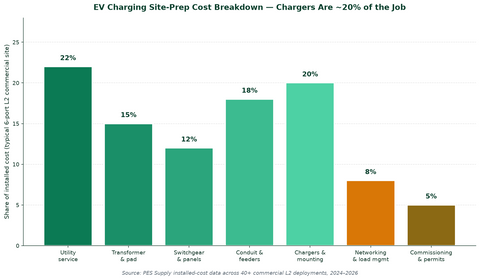
The biggest opportunity for commercial EV charging is load management. A 20-stall workplace L2 installation at 7.2 kW/port draws 144 kW continuous — a 200 A dedicated 480V service (or a much larger 208V service). Utility service upgrade cost: $40,000-$80,000.
With dynamic load management (per NEC 220.57(C)), the same 20-stall installation can operate on a 60-80 A dedicated feeder. The EMS distributes available current dynamically among active vehicles; each vehicle charges at 1.5-4 kW instead of 7.2 kW. Total energy delivered stays the same over an 8-hour workday, service upgrade cost is avoided.
UL 916 (or CSA C22.2 No. 205) listed EMS systems are required. Options:
- ChargePoint Power Management Software (proprietary)
- FLO SmartTWO built-in load balancing
- EVBox EMS (proprietary)
- Third-party (SPAN, EV.Energy, Lunar Energy) for multi-brand installations
Portlandia sales team can specify a load-managed installation with a single-line diagram acceptable to LG&E interconnection engineering.
Contractors bidding commercial EV work should quote rebates alongside equipment. Active programs as of 2026:
- Federal Alternative Fuel Vehicle Refueling Property Credit (30C) — 30% of installation cost up to $100,000 per unit for commercial. Requires U.S.-manufactured components (per IRA). Renewed through 2032.
- Kentucky NEVI — DC fast chargers at 50-mile intervals along interstate corridors. Cost-share 80/20 federal/private. RFP-driven; Portlandia has responded to prior rounds.
- LG&E EV rebate (residential) — Up to $500 rebate on Level 2 EVSE for residential customers. Contractor-installed only.
- LG&E commercial rebate — Variable; check current program at lge-ku.com/business.
- KFC (Kentucky Freight Corridor) — DC fast charging along freight corridors. Utility-partnership model.
Rebate stacking (federal + utility + state) can offset 40-70% of total installation cost on qualifying commercial projects.
Every EV commissioning should include:
- Load test — Charge session at 100% rated power (7.2 kW or 19.2 kW L2, or 50-350 kW DCFC) for 30 min per port. Verify measured power matches rated power.
- Ground continuity — Bond and EGC path verified. Enclosure ground < 5Ω to service ground.
- Network commissioning — OCPP connection to back-end verified, remote start/stop tested, meter reading accuracy verified.
- User interface — RFID / mobile app authentication tested, session receipt validated.
- Emergency stop test (DCFC only) — E-stop drops DC output within 1 second.
- Documentation package — O&M manuals, warranty registrations, single-line diagram, OCPP configuration, EMS load-management settings, load-calculation memo, permit close-out.
Kentucky NEVI projects require additional documentation: NEVI program compliance letter, five-year O&M contract, and quarterly uptime reports.
Before you bid a commercial EV installation, walk the site and answer:
- What is the available service capacity? Measure existing load or pull utility 15-min demand data. Available headroom = service size × 1.0 - existing demand.
- What is the utility service voltage? 208V wye common in commercial; 480V wye required for most DCFC. Voltage change may require transformer upgrade.
- Where is the main service disconnect? EV feeder runs from this point — distance and route affect wire and conduit costs.
- Are there existing spare breaker spaces? Or does the panel need replacement / expansion?
- What is the parking layout? Stall count, orientation, cable routing (cable management overhead vs pedestal).
- ADA / accessibility compliance? At least 1 in 25 stalls accessible.
- Cellular / network coverage? Verify AT&T, T-Mobile, and Verizon signal at each proposed EVSE location; cellular is standard back-end for OCPP.
- Owner's charging policy? Free / employee-subsidized / paid; peak/off-peak rates; access control (RFID, mobile app, public).
- Existing site electrical infrastructure? Panel age, condition, arc-flash label, prior grounding electrode.
- Site drainage and grade? EVSE cabinets must sit above 100-yr flood elevation; concrete pads must drain away.
DC fast charging installations typically require utility engineering, transformer procurement, and site construction over a 6-9 month timeline. Milestones:
- Month 0 — Owner selects site, contractor conducts site assessment, initial concept design.
- Month 1 — Utility application (LG&E new-service or capacity-upgrade application). Includes single-line, load calculation, DCFC equipment cut sheets.
- Month 2-3 — Utility engineering study returns service-point letter, available fault current, and secondary voltage. Transformer procured (24-40 week lead time for padmount > 500 kVA).
- Month 3-4 — Local permits (Louisville Metro Codes, sign permit, environmental).
- Month 4-5 — Site construction: concrete pads, primary and secondary conduit, bollards, striping.
- Month 5-6 — DCFC equipment delivery, installation, and utility connection.
- Month 6-7 — Commissioning, load testing, OCPP network setup, owner training.
- Month 7-8 — Handoff, punch list, warranty registration.
Long-lead items (transformer, DCFC hardware, switchgear) drive the schedule. Order early even if construction is 4+ months out.
Fleet applications (delivery vans, transit buses, refuse trucks) differ from public charging in load profile and scale. Design principles:
- Overnight Level 2 for depot charging — 10-20 vehicles charged 8-12 hr overnight on 7-19 kW L2. Total depot load 100-400 kW, well within 480V 3Ø service capability.
- DCFC for opportunity charging — Route flexibility supported by 50-150 kW DCFC at return-to-base yards. 1-2 DCFC serves 10-20 vehicle fleet.
- Load management critical — Depot with 40 vans on 7 kW L2 = 280 kW peak. Load-managed to 100-150 kW off-peak = 30-40% smaller service.
- Metering / TOU rates — Fleet operators benefit from time-of-use rates; charging scheduled during off-peak windows. LG&E offers CBS-1 (commercial time-of-use) and specific EV fleet rates.
- Managed charging network — Fleet operators typically use single-vendor networks (ChargePoint Fleet, Amply, Highland Fleet) for integrated billing, telematics, and OCPP management.
Charging speed depends on battery chemistry and BMS charging curve, not just charger output. Practical charging behaviors:
- Level 1 (120V, 12-16 A) — adds 3-5 miles/hr. Home overnight charging only.
- Level 2 (240V, 16-80 A) — adds 12-60 miles/hr. Standard for home, workplace, retail.
- DCFC 50 kW — adds 100-200 miles in 30 min for most vehicles.
- DCFC 150 kW — adds 150-250 miles in 20 min for capable vehicles.
- DCFC 350 kW — adds 200-300 miles in 15 min for very capable vehicles (Porsche Taycan, Lucid Air, Rivian R1T-R1S).
Most EVs cap charging speed based on state-of-charge (SOC): rapid charging up to 80% SOC, tapering above that to protect battery life. Charging past 80% at DCFC is inefficient and slow.
Modern EVSE connects to a back-end network for authentication, billing, and reporting. Open Charge Point Protocol (OCPP) 1.6J (widely deployed) or 2.0.1 (newer) provides vendor-agnostic communication:
- Authentication — RFID card, mobile app, plug-and-charge (ISO 15118).
- Billing — per-kWh, per-hour, or subscription rates. Payment processing integrated with credit-card networks.
- Session data — time, energy delivered, meter readings, transaction ID.
- Uptime monitoring — heartbeat every 60 seconds; alerts on offline chargers.
- Firmware updates — over-the-air firmware push to keep chargers up-to-date.
Network selection is often driven by end-user relationship (owner already uses ChargePoint) rather than technical merit. Contractors should verify OCPP compatibility so the equipment can move between networks if needed.
Post-commissioning maintenance for commercial EV installations:
- Annual visual inspection — cables, connectors, cabinet for wear or damage.
- Annual electrical testing — ground continuity, insulation resistance.
- Firmware updates — verify current version and network compatibility.
- Connector wear — J1772 and CCS connectors rated ~10,000 insertion cycles; heavy-use public chargers may need connector replacement every 3-5 years.
- Cable replacement — DCFC cables rated ~4,000-6,000 cycles at high power; typically replaced at 5-7 years.
Fleet or heavy-use installations should have a service contract with the OEM or an authorized service partner. Portlandia can facilitate service contracts for ChargePoint, Tesla, FLO, and EVBox installations.
Public and workplace EV installations should be modeled for utilization, uptime, and (where applicable) revenue. Metrics to track:
- Utilization — Percentage of daylight hours (or 24-hr for public) with active charging session. Typical workplace: 30-50%; public shopping-center: 15-25%; highway-corridor DCFC: 5-15% (rising).
- Session count — Number of charging sessions per day per port. Correlates to visibility of the site and vehicle penetration in the area.
- Energy delivered — kWh per session; kWh per day per port. Directly proportional to revenue on paid chargers.
- Uptime — Percentage of scheduled time the charger is operational. NEVI mandates 97% uptime for publicly-funded installations; commercial should target 95%.
- Session duration — Average minutes per session. Long sessions on DCFC (past 80% SOC) reduce utilization; consider idle fees to encourage vehicle turnover.
Portlandia can help owners model expected utilization based on site type, local EV penetration, and comparable installations in Louisville metro.
The EV regulatory landscape evolves quickly. Contractors should track:
- Federal Highway Administration NEVI — Program updates on eligibility, uptime, and payment requirements. Portlandia monitors for Kentucky-relevant changes.
- NEC cycle updates — Article 625 (EV supply equipment), Article 706 (ESS), Article 705 (interconnection) evolving each cycle.
- IECC / ASHRAE 90.1 building energy code — EV-ready parking requirements increasing. IECC 2024 requires 20-40% of parking spaces to be EV-ready in new commercial construction.
- SAE J3400 (NACS) — North American Charging Standard formalized. All new commercial DCFC installations should specify NACS or dual CCS/NACS.
- ISO 15118 plug-and-charge — ISO 15118-2 (unidirectional) and 15118-20 (bidirectional / V2G). Commercial installations after 2025 should specify OCPP 2.0.1 to enable ISO 15118 authentication.
Is EVITP required in Kentucky?
Do I need EVITP for residential Level 2 installs?
How much does DCFC installation typically cost?
What is the difference between OCPP 1.6J and OCPP 2.0.1?
Do I need a transformer for DCFC?
What about the new NACS connector standard (Tesla Supercharger)?
Order EV Charging Equipment from PES
ChargePoint, Tesla Wall Connector, FLO, EVBox, ABB DCFC — stocked and configured for Kentucky NEVI and private commercial installations.
Register Now