Updated September 2026 — refreshed against the live PES catalog; product pricing verified 2026-09-26.
NEC 2026 Effective: Top Changes Solar Installers Must Implement Now
Reading time: ~9 min read
Published January 15, 2026 — PES Supply Electrical Accessories
The 2026 edition of the National Electrical Code (NFPA 70) is published and beginning to take effect across jurisdictions nationwide. Published by the National Fire Protection Association on its three-year cycle, the 2026 NEC introduces significant changes to Article 690 (Solar Photovoltaic Systems), Article 705 (Interconnected Power Sources), and Article 706 (Energy Storage Systems), along with code-wide reorganization that will affect how solar permit sets are designed, reviewed, and inspected ([NFPA](https://www.nfpa.org/codes-and-standards/nfpa-70-standard-development/70)).
For solar installers and electrical contractors, the transition to NEC 2026 is not a future concern — it is a present reality in several states. This guide breaks down the changes most likely to impact your installations, the state-by-state adoption timeline, and the practical steps to bring your design templates and labeling into compliance. At PES Supply, our 50,000+ SKUs from 169 authorized brands include NEC-listed components across disconnects, conduit, electrical accessories, and balance of system categories.
Rapid shutdown is where I see the most red tags in 2026, and almost always because somebody designed to a memory of an older code cycle instead of the numbers in front of them. The controlled-conductor limits are the whole ballgame. Post them in the design office:
| Zone (NEC 690.12(B)) | Voltage Limit | Time Limit | What It Means in Hardware |
|---|---|---|---|
| Outside the array boundary | ≤ 30 V | Within 30 seconds of initiation | Home runs and conductors leaving the array must collapse to touch-safe levels fast — module-level shutdown or equivalent |
| Inside the array boundary | ≤ 80 V | Within 30 seconds | Module-level power electronics (MLPE) or listed rapid-shutdown equipment at each module or small group |
| Initiation device | — | Readily accessible, labeled | A single, obvious initiating device at the service or first responder location |
That 80 V inside-boundary number is why string-only shutdown is effectively dead for rooftop work. A 600 V string with a rooftop contactor still leaves hundreds of volts sitting on the conductors between modules after initiation—compliant on paper in old cycles, a violation now. Microinverters and DC optimizers satisfy the limit by design, which is why our microinverter collection moves so much volume to residential installers. The full requirement set, including the listing rules for rapid shutdown equipment, cross-references the disconnect requirements in our solar disconnect and overcurrent protection guide.
Nothing about the core PV conductor math changed in 2026, but the reorganized sections mean inspectors are reading 690.8 with fresh eyes, and sloppy calculations that slid through before are getting kicked back. The math is two stacked 125% factors: first for irradiance (690.8(A)), then for continuous duty (690.8(B)). On paper:
| String Isc (Datasheet) | ×1.25 Irradiance (690.8(A)) | ×1.25 Continuous (690.8(B)) | Min Conductor (Cu, 90°C, NEC 310.16) | Next OCPD (NEC 240.6) |
|---|---|---|---|---|
| 10 A | 12.5 A | 15.6 A | 14 AWG (25 A) | 20 A |
| 13 A | 16.25 A | 20.3 A | 12 AWG (30 A) | 25 A |
| 15 A | 18.75 A | 23.4 A | 12 AWG (30 A) | 25 A |
| 18 A | 22.5 A | 28.1 A | 10 AWG (40 A) | 30 A |
| 20 A | 25.0 A | 31.2 A | 10 AWG (40 A) | 35 A |
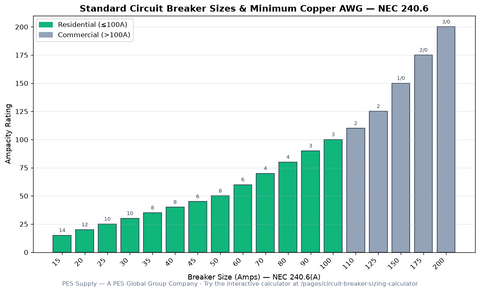
Notice the right-hand column: fuse and breaker selection rounds up to the next standard size in NEC 240.6, and it must still sit at or below the conductor's protected ampacity after derating. That interplay is covered line-by-line in the standard breaker sizes chart and the ampacity chart. When the home runs land in conduit, verify fill against the conduit fill chart—upsized conductors for a 1500 V string eat raceway capacity fast.
What the new code cycle looks like from the ladder
- The labeling red tag. Our first inspection under an adopted-2026 jurisdiction failed on one missing label: the rapid shutdown initiation device placard at the service. The hardware was perfect. The inspector was right. We now print the full 690.56 label set as a standard kit with every residential closeout package.
- The grandfathered trap. A customer added eight modules to a 2019 system and assumed the old rules applied. The AHJ treated it as new work and required the current rapid shutdown limits on the added circuit. We scoped an MLPE retrofit on the new string and passed. Addition means new work—write it into your proposals.
- The 706 walkthrough. On a battery job, the fire marshal walked the ESS location before the electrical inspector arrived and asked for the suppression and spacing documentation first. Article 706 made the battery room a two-inspector job in our county. We book both on the same morning now and keep the NEC compliance guide checklist in the truck.
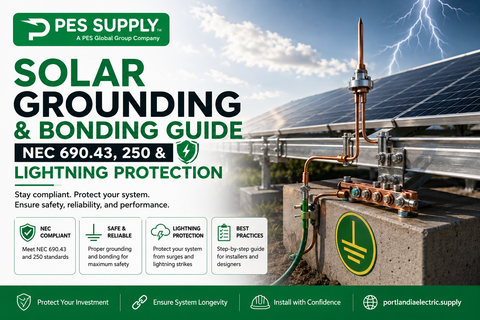
The shops that are cruising through 2026 inspections share one habit: they design to the strictest reading of the new sections even where the AHJ has not formally adopted yet. Retrofitting compliance after a red tag costs ten times what designing it in costs. Our sister piece, the NEC 2026 preview, covers the preparation side, and the grounding and bonding guide handles the 690.43/250 side of the same inspections.
The NEC is a model code — it becomes legally binding only when adopted by a state or local Authority Having Jurisdiction (AHJ). Adoption lags publication by 12 to 36 months, and as of early 2026, jurisdictions enforce editions ranging from the 2014 through the 2023 NEC, with the 2020 edition remaining the most common ([SurgePV](https://www.surgepv.com/blog/solar-nec-compliance-usa)).
Early Adopters of the 2026 NEC
| State / Jurisdiction | Effective Date | Notes |
|---|---|---|
| Massachusetts | April 24, 2026 | Board of Fire Prevention Regulations adopted 2026 NEC with state amendments (527 CMR 12.00) |
| Minnesota | Tentative July 1, 2026 | Board of Electricity rulemaking in progress; effective date or five days after Notice of Adoption, whichever is later |
| Colorado (Denver) | August 1, 2026 | Colorado Electrical Board approved adoption May 27, 2026; projects submitted before Aug 1 may remain under 2023 NEC |
Massachusetts became one of the first states to adopt the 2026 NEC, with the Board of Fire Prevention Regulations voting to approve amendments based on the 2026 edition of NFPA 70, effective April 24, 2026 ([ICC-NTA](https://www.icc-nta.org/code-updates/)). Minnesota's Board of Electricity and Department of Labor and Industry continue rulemaking with a tentative effective date of July 1, 2026 ([Minnesota DLI](https://www.dli.mn.gov/sites/default/files/pdf/review79summer26.pdf)). Denver's Community Planning and Development confirmed that all new project submittals must comply with the 2026 NEC effective August 1, 2026 ([Denver CPD](https://denvergov.org/Government/Agencies-Departments-Offices/Agencies-Departments-Offices-Directory/Community-Planning-and-Development/CPD-News-and-Events/CPD-News/2026/New-electric-standards-to-be-effective-Aug.-1)).
Adoption Patterns to Watch
- Early adopters (California, Massachusetts, Washington): Typically adopt the newest NEC cycle within 12–18 months of publication, sometimes with state-specific amendments like California's Title 24 energy addendums.
- Mid-cycle states (Texas, Florida): May lag by one full cycle, currently enforcing the 2020 or 2023 NEC while the 2026 updates circulate.
- Local amendments: Even if your state adopts the 2026 NEC, local municipalities can strike out specific clauses or add stricter requirements. Always call your local building department to verify the active code year before pulling a permit ([ElectricalFlux](https://electricalflux.com/wire-general/electrical-wiring-news-nec-code-updates-explainer)).
Plan sets built on NEC 2023 templates will start failing plan check as states adopt the 2026 edition. Confirm which edition each AHJ currently enforces before ordering hardware, because a device compliant under one cycle can fail plan review under another ([Sun Supply PV](https://sunsuppv.com/rapid-shutdown-devices-for-nec-compliant-solar-installs/)).
Rapid shutdown exists for one reason: firefighters cut roofs. A live PV array produces DC voltage whenever the sun shines, and energized conductors on a roof being ventilated are a lethal hazard. NEC 690.12 establishes two controlled spatial zones measured from the array boundary (defined as the perimeter extending 1 foot in all directions from the outermost edge of the PV modules):
- Outside the array boundary: Conductors more than 1 foot from the array, or extending inside a building, must be reduced to 30V or less within 30 seconds of rapid shutdown initiation.
- Inside the array boundary: Conductors within the 1-foot boundary must be reduced to 80V or less within 30 seconds of initiation ([SurgePV](https://www.surgepv.com/blog/solar-nec-compliance-usa)).
The 2026 NEC reorganizes the rapid shutdown initiation-device language in 690.12(C) without changing the underlying voltage and time performance targets. The reorganization clarifies the requirements for initiation devices and allows for E-stop style switches, bringing the code in line with industrial emergency-stop conventions ([Heaven Designs](https://heavendesigns.in/blog/nec-code-changes-solar-designers/)).
Compliance Paths
- Module-level power electronics (MLPE): Microinverters and DC optimizers satisfy 690.12 by design, shutting down at the module level without additional hardware.
- Module-level rapid shutdown devices (RSDs): Dedicated transmitters and receivers installed behind each module, common with string inverter systems.
- Array-level RSD: Requires a separate device paired to a receiver at each module or string, adding cost and a second point of failure ([Sun Supply PV](https://sunsuppv.com/rapid-shutdown-devices-for-nec-compliant-solar-installs/)).
Every compliant device must hit 80 volts within 30 seconds inside the 1-foot array boundary and 30 volts within 30 seconds outside it. Do not take a manufacturer's compliance claim at face value — check the listed spec sheet numbers against those two thresholds directly. Shop rapid shutdown devices and MLPE in our microinverters and electrical accessories catalogs.
Article 690 received several technical changes that affect conductor sizing and voltage calculations for PV systems. The 2026 NEC introduces four changes that matter for the drawings you produce:
1. Fractions-of-an-Ampere Rule (690.4(G))
The 2026 edition addresses calculations that result in a fraction of a volt or ampere. Calculations of voltage or current may now be rounded to the nearest whole number, and fractions of 0.5 or less can be ignored — eliminating a long-standing source of ambiguity in conductor sizing ([Heaven Designs](https://heavendesigns.in/blog/nec-code-changes-solar-designers/)).
2. Removal of the 100 kW Cap (690.7(A)(3) and 690.8(A)(1)(a)(3))
The 2026 NEC removes the 100 kW threshold that previously limited engineer-calculated PV voltage and current methods to smaller systems. This change expands the use of calculated rather than table-based voltage and current values to larger PV systems, providing more accurate sizing for commercial and utility-scale projects.
3. Bifacial Current Calculation Method (690.8(A)(1)(a)(2))
As bifacial modules become the industry standard, the 2026 NEC adds a manufacturer-instruction method for calculating bifacial module current. This provides a code-compliant path to account for additional rear-side current — critical for properly sizing conductors and overcurrent protection on bifacial installations.
4. Conductor Sizing Basics
Regardless of the 2026 changes, the fundamentals remain: PV circuit conductors must be sized at 125% of continuous current per 690.8, and the grounding conductor size follows Table 250.122 based on the overcurrent device rating. For example, a short-circuit current of 41 amps requires a 10 AWG (6 mm²) copper grounding conductor ([SurgePV](https://www.surgepv.com/blog/solar-nec-compliance-usa)).
Table 310 Changes Affecting All Wiring
| Table | 2026 Change | Impact |
|---|---|---|
| 310.12 | Split into 310.12(A) copper and 310.12(B) aluminum; extended range to 500 kcmil | Reduces misreading errors; addresses all-electric homes with EV charging and heat pumps |
| 310.16 | Added ampacity rows for compact-stranded aluminum; correction factors extended to 60°C | More accurate sizing for MC cable and cable tray installations |
| 310.15(C)(1) | 0.65 multiplier for raceways with 7–9 current-carrying conductors | Tighter derating for conduit fill |
Source: ([ECalPro](https://ecalpro.com/standards/nec/conductor-sizing-2026), [Rocky Mountain Electrical Training Institute](https://www.rmeti.com/blog/nec-changes-that-matter-for-2026-what-journeymen-must-know)).
For PV-specific wire, browse our conduit and electrical accessories selections for THHN/THWN and PV-rated conductors.
The 2026 NEC expands arc-fault and ground-fault circuit-interrupter protection coverage. Article 210.12 (AFCI) and Article 210.8 (GFCI) have effectively made standard thermal-magnetic breakers obsolete for residential branch circuits. The code now mandates both AFCI and GFCI protection for nearly all 120V, 15A and 20A residential circuits, including kitchens, laundry areas, bedrooms, and living rooms ([ElectricalFlux](https://electricalflux.com/wire-general/electrical-wiring-news-nec-code-updates-explainer)).
Key AFCI/GFCI Changes for Solar Installers
- Expanded AFCI coverage: The updated arc-fault protection rules expand to more dwelling unit locations and circuit types, requiring AFCI devices in additional areas ([University of Missouri](https://www.lsfellowship.missouri.edu/article/2026-nec-code-book-latest-electrical-compliance-guide)).
- HVAC GFCI: Outdoor residential HVAC units must now have GFCI protection. Use high-frequency rated GFCIs for inverter-driven systems, which can trip standard GFCIs due to high-frequency leakage current ([Rocky Mountain Electrical Training Institute](https://www.rmeti.com/blog/nec-changes-that-matter-for-2026-what-journeymen-must-know)).
- DC arc-fault protection (690.11): DC arc-fault detection remains required for PV circuits. Some inverters (such as SolarEdge and EG4) include this protection built-in, while others require a separate device ([SurgePV](https://www.surgepv.com/blog/solar-nec-compliance-usa)).
On the AC output side of any solar installation, GFCI and AFCI requirements still apply. Verify circuit compatibility and ensure proper coordination between ground-fault protection and arc-fault protection where both are required.
Labeling is one of the four sections that generate the most inspection failures, alongside rapid shutdown, conductor sizing, and interconnection. The 2026 NEC continues the consolidation of solar terminology and labeling that began in the 2023 cycle, with definitions moving to Article 100 and labeling consolidated under specific sections.
Required Labels for Solar PV Systems
| Label | Code Reference | Location |
|---|---|---|
| DC disconnect operating voltage/current | 690.13(B) | At PV DC disconnect |
| "Photovoltaic System Equipped with Rapid Shutdown" | 690.56(B) | At service entrance |
| Rapid shutdown initiator location map | 690.56(C) | At service entrance |
| "Warning: Dual Power Source" | 705.10 | At all disconnects |
| Backfed breaker label | 705.12(B)(3)(2) | At load-side interconnection |
| Maximum DC voltage of PV system disconnect | 690.7(D) | At PV disconnect |
Source: ([Heaven Designs](https://heavendesigns.in/glossary/sld/), [PV Labels](https://www.pvlabels.com/solar-placement-guide/)).
Each citation must appear on the single-line diagram (SLD) or in a labels schedule sheet that cross-references back to the SLD. A design detail that passes under one NEC edition can fail under another — double-check that older plan templates and labels reflect current section numbers before submission.
Article 705 — Interconnected Power Sources
The 2026 NEC reinstates a conductor-length limit in 705.11(C)(1) that was dropped in the 2023 edition, restoring a constraint on the length of conductors between the interconnection point and the disconnecting means. The 120% rule for load-side taps remains: inverter OCPD rating plus main breaker rating must not exceed 120% of the busbar rating. For a 200A panel with a 200A main breaker, the inverter breaker is limited to 40A ([Heaven Designs](https://heavendesigns.in/glossary/nec-705/)).
Article 706 — Energy Storage Systems
The 2026 NEC deletes section 706.16 and routes most residential storage backup systems through Article 702 (Optional Standby Systems) instead. A new 702.4 backup-power option for one- and two-family dwellings simplifies the regulatory framework for residential storage backup systems, making compliance easier for installers ([Heaven Designs](https://heavendesigns.in/blog/nec-code-changes-solar-designers/)). This change aligns with the surging residential battery attachment rates that made storage a default configuration in 2026.
Beyond the solar-specific articles, the 2026 NEC includes a significant code-wide reorganization that every installer should understand:
- Load calculations moved to Article 120: Branch circuit, feeder, and service load calculation rules previously in Article 220 are now in Article 120 in Chapter 1 ([EC&M](https://www.ecmweb.com/national-electrical-code/code-basics/article/55387143/global-code-wide-changes-and-overview)).
- Medium-voltage content reorganized: Articles 265 through 270 now house requirements for systems above 1,000VAC or 1,500VDC — relevant for utility projects stepping up to 34.5 kV collection lines.
- Energy management systems: Rules now sit in Article 130.
- Outdoor service disconnect: The 2026 NEC requires the main service disconnect to be outdoors and within sight of the dwelling when required, improving first-responder access ([Rocky Mountain Electrical Training Institute](https://www.rmeti.com/blog/nec-changes-that-matter-for-2026-what-journeymen-must-know)).
- Verify your AHJ's active code edition before pulling any permit — do not assume the 2026 NEC applies everywhere.
- Update SLD and labeling templates for Article 690 and 706 changes before your first NEC 2026 submission.
- Verify rapid shutdown device spec sheets against the 80V/30s (inside boundary) and 30V/30s (outside boundary) thresholds.
- Use the bifacial current calculation method in 690.8(A)(1)(a)(2) for bifacial module installations to properly size conductors.
- Confirm HVAC GFCI protection uses high-frequency rated devices for inverter-driven systems.
- Source listed components — verify UL 1741 listing for inverters, and ETL/CSA acceptability where applicable.
The 2026 NEC brings meaningful changes to how solar PV systems are designed, labeled, and inspected — from the reorganized rapid shutdown language in 690.12 to the new bifacial current calculation method, expanded AFCI/GFCI coverage, and the streamlined storage backup framework in Article 702. State adoption is already underway in Massachusetts, Minnesota, and Colorado, with more jurisdictions following throughout 2026 and 2027.
Installers who update their design templates, verify component listings, and confirm the active code edition with each AHJ will avoid inspection delays and rework. PES Supply supports your compliance journey with 50,000+ SKUs from 169 authorized brands across disconnects, conduit, electrical accessories, inverters, and balance of system categories. Plan for 7-10 business days delivery on stocked components, and order early for projects in jurisdictions that have adopted the 2026 NEC.
When does NEC 2026 take effect?
NEC 2026 was published in late 2025 and is adopted on a state-by-state basis. As of mid-2026, approximately 12 states have begun the adoption process. The effective date depends on your local AHJ — check your jurisdiction's current code adoption status before submitting permit applications.
What are the biggest NEC 2026 changes for solar installers?
Key changes include: stricter rapid shutdown requirements (80V within 30 seconds, down from 600V), expanded BESS fire suppression requirements under Article 706, new EV charging infrastructure rules under Article 625, and updated DC arc-fault circuit interruption (AFCI) standards under 690.11.
Do I need to upgrade existing systems for NEC 2026 compliance?
No. NEC changes apply to new installations and major modifications only. Existing permitted systems are grandfathered. However, if you add panels to an existing system or replace an inverter, the new work must meet the current code edition enforced by your AHJ.
Which NEC edition applies to my permit application?
The edition your AHJ has adopted on the date the permit is issued — not the date you designed the system and not the latest published edition. Confirm the adopted edition with the building department before submitting; if adoption is pending mid-project, most jurisdictions honor the permit under the edition it was issued, but expired permits may require resubmission under the new code.
Do microinverters automatically satisfy the 2026 rapid shutdown rules?
In practice, yes for rooftop arrays: because microinverters put AC on the roof conductors and shut down with the grid, the system meets the 690.12(B) controlled-conductor limits by design. The equipment still must be listed for rapid shutdown compliance, and the required 690.56(C) labels and initiation device are still mandatory. DC optimizer systems satisfy the rule the same way on the DC side.
Ready to build your system? PES Supply stocks 50,000+ SKUs from 169 authorized brands, with delivery in 7-10 business days. Here are the products mentioned in this article:
- BR Solar Group BR-M310W
- Conext Insight Home
- DU221RB Safety Disconnect
- BR Solar Group BR-M315W
- Conext XW Conduit Box
Browse all electrical · Browse all circuit breakers · Browse all surge protection
Need pricing or availability on anything in this guide?
Portlandia Electric Supply dropships direct from the manufacturer — most items Ship Direct with lead times stated up front, no surprises.
Get a quote from PESBulk, pallet and contractor pricing available.