Load Management for EV Charging Sites: The Engineer's Field Guide
Dynamic load management is what makes an EV site work on a constrained service. This is the practitioner guide — protocols, hardware, NEC citations, and the sizing math that decides whether you need a service upgrade or not.

Load management (also called EVEMS — Electric Vehicle Energy Management System) is the technique of dynamically throttling multiple EV chargers so their combined draw never exceeds a pre-set ceiling, typically bounded by the site's utility service or a chosen demand-charge target. NEC 750 (added in the 2020 code cycle) formally recognizes EVEMS as an accepted method of sizing an EV service without applying NEC 625's default 100% simultaneous continuous load assumption.
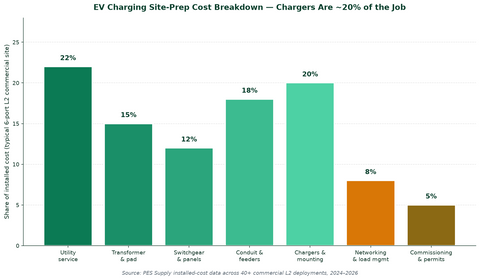
In plain terms: instead of sizing the service for the worst case where every charger is at full 48A simultaneously, you install a supervisor that measures the site's actual real-time load and slows chargers down when the ceiling is approached. Six 48A chargers on paper need 360A of service capacity; with load management, they can safely share 200A. That is the difference between a $60k service upgrade and no upgrade.
Who this guide is for: electrical contractors sizing EV branch circuits and services, facility engineers deciding whether load management is needed at their site, distributors like PES Supply spec'ing the controller and CT hardware, and inspectors reviewing NEC 220.87 alternative-calculation submittals.
Load management is not vendor magic; it is codified in the National Electrical Code and UL standards:
- NEC 220.87 (Maximum Demand Data) — allows using 12 months of actual demand data plus 25% growth allowance as the design load, rather than a purely calculated worst-case connected load.
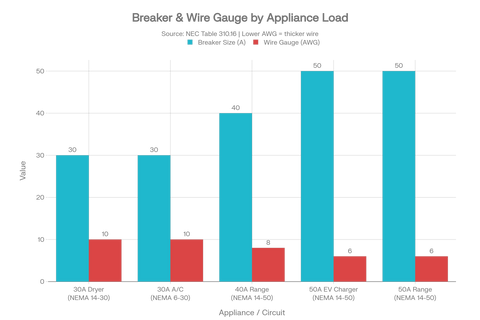
- NEC 625.42 (Rating of EV Branch Circuits) — the base rule that EV branch circuits are 100% continuous loads, sized at 125% of the rated current.
- NEC 625.42(A) (Adjustable Settings) — permits sizing feeders/services based on the maximum setpoint of an EVEMS rather than the nameplate rating of individual chargers.
- NEC Article 750 (Energy Management Systems) — the umbrella article covering EVEMS, DERMS, and load-shedding systems, added in NEC 2020 and clarified in 2023.
- UL 916 (Energy Management Equipment) — the safety standard for energy management controllers.
- UL 3141 (Power Control Systems) — the specific safety standard for EV power-control systems, added 2023.
- ISO 15118 (Vehicle-to-Grid Communication) — communication protocol that supports V2G and Plug&Charge, used by newer chargers for grid-service participation.
The permit implication: to use load management to size an EV service below the sum of individual charger nameplates, the AHJ needs a UL 3141-listed controller (or a UL 916 controller with an EV-specific listing letter), a one-line showing the controller in the current path, and typically a load calculation using NEC 220.87 methodology.
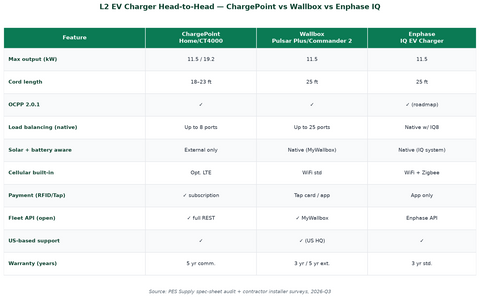
1. Charger-internal daisy chain (Wallbox Power Boost, ChargePoint Power Management)
The chargers themselves communicate over Modbus RS-485 or a proprietary bus. One charger is designated the "master" with a CT clamp on the panel main; masters instruct slaves to throttle. Cheapest architecture, tightly coupled to one charger brand, scales to 8 ports (ChargePoint) or 25 ports (Wallbox). No separate controller box.
2. Site-level EVEMS controller (SmartEVSE, WattLogic Load Balancer, PowerCharge Solutions)
A separate UL 3141 controller box lives near the panel with CT clamps on the main. The controller talks OCPP or Modbus TCP to any brand of charger and enforces the ceiling. More flexible (brand-agnostic), higher initial cost ($3,500–$8,000 for the controller), better for mixed-brand sites or complex load-shed logic.
3. Panel-level power control (Span Panel, Lumin Smart Panel)
A smart panel replaces the standard load center. The panel measures every branch, controls contactors on individual circuits, and coordinates the whole home/building load. Overkill for pure EV sites, but ideal for a single-family home doing solar + battery + EV where the entire electrical service is being modernized.
4. Utility DR-integrated (OpenADR 2.0b, IEEE 2030.5)
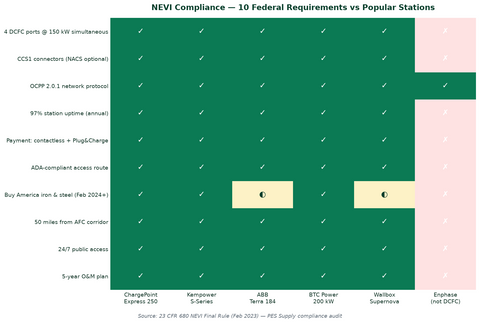
The site accepts demand-response signals from the utility over OpenADR or 2030.5, throttling EV chargers during grid stress in exchange for tariff incentives. Requires an OpenADR gateway (Kitu Systems, IPKeys, OpenADR Alliance member equipment) and a utility program enrollment. Common at large fleet depots and NEVI sites in demand-response utility territories.
| Controller | Architecture | Max ports | Multi-brand | UL listing | Contractor price |
|---|---|---|---|---|---|
| Wallbox Power Boost (built-in) | Charger-internal | 25 | Wallbox only | UL 3141 | $550 (Power Meter only) |
| ChargePoint Power Management | Charger-internal + gateway | 8 | ChargePoint only | UL 3141 | $1,400 gateway + $300/port lic. |
| SmartEVSE 3 | Site EVEMS | 12 (per unit) | OCPP any brand | UL 3141 | $1,800–$2,400 |
| WattLogic Load Balancer | Site EVEMS | 48 | OCPP any brand | UL 3141 | $4,500–$7,000 |
| Span Smart Panel | Panel-level | 40 circuits total | Any J1772/NACS | UL 916/67 | $3,500 panel + install |
| Kitu Systems OpenADR gateway | Utility DR | Site-wide | Any OpenADR-compliant | UL 916 | $2,800–$4,200 |
| EnergyHub Mercury | Utility DR + EVEMS | Site-wide | OCPP + OpenADR | UL 916 | Utility-provided in some programs |
A 30,000 sq ft warehouse in Louisville plans to add 6 Wallbox Commander 2 ports (48A each, 240V single-phase) to its existing 400A 208Y/120V service. The existing service peak was 240A over the past 12 months (pulled from Duke's interval data portal). Without load management, the calculation is:
- Existing peak: 240A
- 25% growth allowance per NEC 220.87: 240 × 1.25 = 300A design load
- Added EV load per NEC 625.42: 6 × 48 × 1.25 = 360A
- Total required: 300 + 360 = 660A — well over the 400A service
Result: service upgrade required, ~$45k utility + contractor cost, 10–14 week delay.
With Wallbox Power Boost load management set to a 120A EV ceiling (well under 400A - 300A existing = 100A + some margin):
- Existing peak: 240 × 1.25 = 300A
- EV load capped by EVEMS at 120A × 1.25 = 150A
- Total: 300 + 150 = 450A — still over 400A
Tighten the EV cap to 80A:
- 80 × 1.25 = 100A EV allowance
- Total: 300 + 100 = 400A exactly at service rating
Now the site fits on the existing 400A service. At 80A shared across 6 ports, each port averages 13.3A when all are active — enough for a 24-hour recharge of ~90 kWh, which covers a typical fleet-van duty cycle overnight. Zero service upgrade required. Savings: ~$45k capex, 10 weeks on schedule.
This is the entire economic case for load management: it transforms a site-upgrade project into a same-service project.
-
1
Pull 12 months of interval data
From the utility portal, download 15-min interval data for the last 12 months. Compute the maximum 15-min demand and the 4 CP or 1 CP that matters for the local tariff. This becomes your NEC 220.87 baseline.
-
2
Sum the EV load — nameplate and coincident
Nameplate sum = number of ports × amperage × voltage × 1.25 continuous factor. Coincident load = the number the EVEMS controller will actually enforce. On a fleet depot with 20 vans and overnight dwell, coincident is often 30–50% of nameplate. On a public charging site with random arrivals, coincident approaches nameplate.
-
3
Pick the EVEMS ceiling
Set the ceiling to (service capacity × 0.8) − existing peak × 1.25. This leaves 20% headroom on the service and satisfies NEC 220.87 growth allowance. In the warehouse example above, that gives 80A of EV headroom on the 400A service.
-
4
Spec the controller and CTs
For single-brand fleets, use the charger's built-in load management (Wallbox Power Boost, ChargePoint Power Management). For mixed-brand or complex sites, use a UL 3141 site controller. Every architecture needs a CT clamp on the main — spec continuous-duty CTs sized for the service (200A/5A, 400A/5A, 800A/5A).
-
5
Document for AHJ
The permit package needs: one-line showing the EVEMS in the load path, cut sheet with UL 3141 or 916 listing, NEC 220.87 load calculation showing the sized ceiling, and a note stating the EVEMS ceiling setpoint is field-programmed and locked.
-
6
Commission and lock the setpoint
After energization, verify the EVEMS actually enforces the ceiling. Simulate all-ports-active with 3–4 test vehicles and confirm the coincident draw peaks at the ceiling. Password-lock the setpoint per NEC 750 (adjustments require an authorized user).
-
7
Periodic re-verification
Annually, re-pull interval data. Confirm the site is not exceeding the design assumptions and that the EVEMS is still enforcing correctly. Update the ceiling if the base load has grown.
Beyond service sizing, load management shaves demand charges. On a $18/kW-month rate, saving 100 kW of monthly peak = $1,800/month = $21,600/year. Sample scenarios:
- Small office park, 4 L2 ports, existing 400A service: Load management set to keep EV load under 60 kW during business hours drops peak coincidence with HVAC and lighting, saving ~$400/month on a $12/kW rate.
- Fleet depot, 20 vans, 800A service: Setting the ceiling at 150 kW instead of the nameplate 230 kW saves ~80 kW × $16/kW = $1,280/month, $15,360/year. Payback on the load-management license (~$8,000): 7 months.
- Highway travel plaza with 4× 150 kW DCFC: A 500 kW BESS + load-management controller keeps peak grid draw below 300 kW even when all DCFCs are simultaneously active, saving ~$2,600/month on a $13/kW rate.
The savings scale with the demand-charge rate and the ratio of EV load to base load. In territories with high demand charges (California, New York, Illinois, most western utilities), the payback is typically under a year. In territories with low demand charges (Kentucky, Tennessee, parts of the South), the payback stretches to 2–3 years but the service-upgrade avoidance still justifies the investment.
Failure 1 — CT clamps installed backwards
Every load-management install has one CT clamp on the panel main sensing total site current. If installed backwards (arrow pointing away from load), the controller reads negative and either (a) shuts off all chargers thinking the site is exporting, or (b) never throttles. Always verify CT polarity at commissioning with a known non-zero load.
Failure 2 — Modbus daisy-chain miswiring
Wallbox Power Boost daisy chains up to 25 chargers on RS-485 Modbus. Miswiring A/B lines, forgetting termination resistors at the ends, or using unshielded cable in noisy environments causes intermittent load-management dropouts. Always use 120Ω termination at both ends and shielded twisted-pair rated for RS-485.
Failure 3 — OCPP heartbeat loss
Site-level EVEMS controllers talk OCPP to chargers. If cellular or WiFi drops, the EVEMS may fall back to a fail-safe minimum (usually 6A per port) — safe but disruptive. Configure OCPP heartbeat intervals to 30 seconds max and use redundant network paths on production sites.
Failure 4 — AHJ rejects NEC 220.87 calculation
Some AHJs are unfamiliar with NEC 220.87 methodology and default-reject alternative calculations. Include the NEC 220.87 code reference, the UL 3141 controller listing, and the setpoint-lock statement in the permit narrative. If still rejected, escalate to the state chief electrical inspector — the code allows this method explicitly.
Failure 5 — Setpoint drift
An unlocked setpoint gets bumped up by a facility manager to speed charging one day and forgotten. Next month, the demand charge spikes. Lock the setpoint per NEC 750 and log every change in the O&M binder.
Do I need load management for a residential 40A charger?
Can I use load management to avoid a utility interconnect upgrade for a DCFC site?
Is load management OK for public charging where drivers expect full speed?
Which UL listing does the AHJ need to see?
Can load management include demand response?
What's the software footprint — do I need my own server?
How do I verify the EVEMS is actually working after commissioning?
What happens to load management if the network drops?
Get a load-managed site design with NEC 220.87 sizing
Register for the PES Supply contractor portal. Upload your utility interval data and planned EV port count — we return a full load-management design: controller spec, CT sizing, NEC 220.87 calculation for the AHJ, and a full BOM including a UL 3141-listed controller.
Register Now