Updated September 2026 — refreshed against the live PES catalog; product pricing verified 2026-09-26.
Choosing a circuit breaker sounds simple until you're standing in front of a live panel with a load calculation in one hand and a code book in the other. I've spec'd breakers for everything from a single garage receptacle to 400-amp commercial services, and the questions that come over the counter at Portlandia Electric Supply are the same handful every week: what sizes do breakers even come in, what wire goes with what breaker, and when do I have to upsize for a continuous load. This guide answers all three with the actual NEC tables — bookmark it, because it's the same reference our counter staff uses when you call in.
Sizing a breaker, not just looking one up? How to Size Circuit Breakers: NEC 125% Rule walks the load calculation step by step. This page is the reference chart — NEC 240.6 standard sizes and breaker-to-wire matching.
Quick answer — the standard breaker sizes
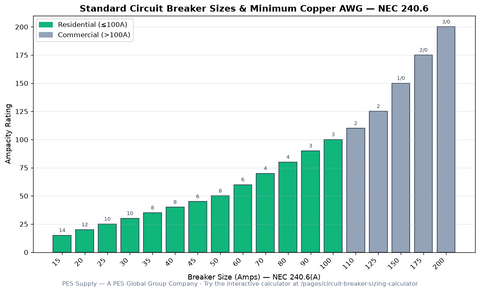
NEC 240.6(A) standard breaker sizes (amperes): 15, 20, 25, 30, 35, 40, 45, 50, 60, 70, 80, 90, 100, 110, 125, 150, 175, 200, 225, 250, 300, 350, 400, 450, 500, 600, 700, 800, 1000, 1200, 1600, 2000, 2500, 3000, 4000, 5000, 6000. If a calculated load falls between two sizes, the next-larger standard size is permitted per NEC 240.4(B) — up to 800 A. The full chart, wire pairings, and sizing rules are below.
The NEC standard breaker sizes chart (240.6(A))


NEC 240.6(A) defines the standard ampere ratings for fuses and inverse-time circuit breakers — the breakers you can actually buy off a shelf. Anything outside this list is a non-standard or specialty trip unit, and no, you cannot special-order a 37-amp breaker because your load calc says 37:
| Standard breaker sizes (amps) | Typical residential/commercial use |
|---|---|
| 15, 20 | Lighting and general-purpose receptacle circuits |
| 25, 30 | Water heaters, dryers (30A), small AC units, RV/TT-30 |
| 35, 40, 45, 50 | Ranges, ovens, EV chargers, hot tubs, subpanels |
| 60, 70, 80, 90, 100 | Subpanels, large EV chargers, small services |
| 110, 125, 150, 175, 200 | Main breakers, large subpanels, small commercial |
| 225, 250, 300, 350, 400 | Commercial services, large feeders |
| 450, 500, 600, 700, 800 | Large commercial/industrial mains |
| 1000, 1200, 1600, 2000 | Industrial switchgear |
| 2500, 3000, 4000, 5000, 6000 | Utility-scale / large facility mains |
Two notes that save people a return trip. First, 25A, 35A, and 45A breakers exist on paper but many big-box shelves skip them — supply houses stock them, so don't redesign the circuit just because the aisle doesn't have one. Second, if your calculated load lands between two sizes, NEC 240.4(B) generally lets you round up to the next standard size — as long as the conductor ampacity is at least equal to the actual load, the load isn't continuous above the conductor rating, and the next size up doesn't exceed 800A.
The breaker protects the wire, not the appliance. Burn that into memory. These are the standard pairings using THHN/THWN-2 copper at 75°C ampacity from NEC 310.16, with the NEC 240.4(D) small-conductor limits applied — the limits that override everything else on 14, 12, and 10 AWG:
| Breaker size | Minimum copper wire (THHN/THWN-2) | Aluminum equivalent | Common application |
|---|---|---|---|
| 15A | 14 AWG | 12 AWG | Lights, general outlets |
| 20A | 12 AWG | 10 AWG | Kitchen/bath/garage receptacles |
| 25A | 10 AWG* | 8 AWG | Small water heaters, some mini-splits |
| 30A | 10 AWG | 8 AWG | Dryer, water heater, RV outlet |
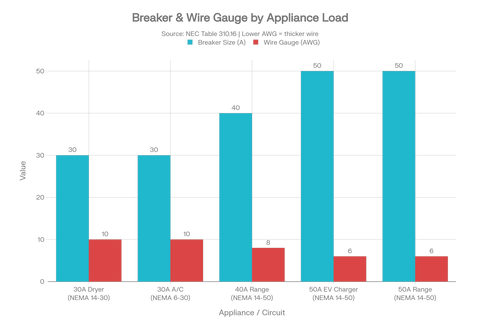
| 40A | 8 AWG | 6 AWG | Range, EV charger (32A) |
| 50A | 8 AWG** | 6 AWG | Range, EV charger (40A), hot tub |
| 60A | 6 AWG | 4 AWG | Subpanel, EV charger (48A) |
| 70A | 4 AWG | 3 AWG | Subpanel, shop feeders |
| 80A | 4 AWG | 2 AWG | Large subpanel |
| 90A | 3 AWG | 2 AWG | Subpanel, small commercial |
| 100A | 3 AWG | 1 AWG | Subpanel, small service |
| 125A | 1/0 AWG | 2/0 AWG | Large subpanel |
| 150A | 1/0 AWG | 3/0 AWG | Small commercial feeder |
| 175A | 2/0 AWG | 4/0 AWG | Commercial feeder |
| 200A | 3/0 AWG | 250 kcmil | Residential main service |
| 225A | 4/0 AWG | 300 kcmil | Large residential / light commercial |
*25A breakers pair with 10 AWG copper only at 75°C terminations (35A ampacity ≥ 25A); with NM-B at the 60°C column, 10 AWG is capped at 30A anyway, so you're fine either way. **50A breakers pair with 8 AWG copper only when the 75°C ampacity (50A) applies; with 60°C terminations (NM-B/Romex), 6 AWG is required. When in doubt, upsize the wire — nobody ever failed an inspection for one gauge too big.
For the full conductor story at every gauge and temperature column — plus the derating math when you stuff four current-carrying conductors into one conduit — our wire ampacity chart has the tables, and the conduit fill chart tells you how many of those conductors legally fit in the raceway you already ran.
The pairings above come straight from the copper 75°C and aluminum 75°C columns of NEC Table 310.16. Here are the ampacities themselves, so you can see the headroom — and where the 240.4(D) caps cut the smaller gauges back:
| Wire size | Copper 60°C | Copper 75°C | Copper 90°C | Aluminum 75°C | Max OCPD (240.4(D)) |
|---|---|---|---|---|---|
| 14 AWG | 15A | 20A | 25A | N/A* | 15A |
| 12 AWG | 20A | 25A | 30A | 20A | 20A (Cu) / 15A (Al) |
| 10 AWG | 30A | 35A | 40A | 30A | 30A (Cu) / 25A (Al) |
| 8 AWG | 40A | 50A | 55A | 40A | No cap — use 75°C |
| 6 AWG | 55A | 65A | 75A | 50A | No cap |
| 4 AWG | 70A | 85A | 95A | 65A | No cap |
| 3 AWG | 85A | 100A | 115A | 75A | No cap |
| 2 AWG | 95A | 115A | 130A | 90A | No cap |
| 1 AWG | 110A | 130A | 145A | 100A | No cap |
| 1/0 AWG | 125A | 150A | 170A | 120A | No cap |
| 2/0 AWG | 145A | 175A | 195A | 135A | No cap |
| 3/0 AWG | 165A | 200A | 225A | 155A | No cap |
| 4/0 AWG | 195A | 230A | 260A | 180A | No cap |
| 250 kcmil | 215A | 255A | 290A | 205A | No cap |
*NEC 310.16 begins aluminum ampacities at 12 AWG — 14 AWG aluminum is not a listed size.
Read the table the way an inspector does: 12 AWG copper is rated 25A at 75°C, but 240.4(D) still limits its overcurrent protection to 20A. The insulation can take more heat than the code allows you to ask of it. That mismatch trips people up constantly — I've watched a homeowner argue with an inspector that "the table says 25 amps" while the inspector just tapped the 240.4(D) line with one finger. The inspector wins that argument every time.
Most sizing mistakes come from ignoring continuous loads. NEC defines a continuous load as one that runs at maximum current for three hours or more — EV chargers, water heaters, heat pumps, grow lights, server closets. The rule, straight from NEC 210.19(A)(1) and 210.20(A):
- Continuous loads: multiply the load by 125%, then pick the next standard breaker size at or above that number.
- Non-continuous loads: the breaker just needs to be at or above the load (and protect the conductor).
- The wire must always be protected: conductor ampacity ≥ breaker rating, with the 240.4(B) round-up exception.
Here's the math laid out for the continuous loads we size most often — this is the table to screenshot and keep on your phone:
| Actual load (continuous) | × 125% | Breaker (next standard size) | Min. copper wire (75°C) |
|---|---|---|---|
| 12A (1.5 HP well pump circuit, continuous duty) | 15.0A | 15A | 14 AWG |
| 16A (small EV charger) | 20.0A | 20A | 12 AWG |
| 24A (EV charger @ 80% of 30A) | 30.0A | 30A | 10 AWG |
| 32A (Level 2 EV charger) | 40.0A | 40A | 8 AWG |
| 40A (fast Level 2 EV charger) | 50.0A | 50A | 8 AWG |
| 48A (max home EV charge rate) | 60.0A | 60A | 6 AWG |
| 18.75A (4,500W water heater @ 240V) | 23.4A | 25A | 10 AWG |
| 80A (large subpanel feeder, continuous) | 100.0A | 100A | 3 AWG |
Worked example: EV charger circuit
You're installing a 32-amp Level 2 EV charger. EV charging is a continuous load per NEC 625.41, so: 32A × 1.25 = 40A. A 40A breaker with 8 AWG copper THHN in conduit is the correct minimum. Want the faster 40-amp charger? 40A × 1.25 = 50A breaker, still 8 AWG copper at 75°C — but 6 AWG if you're pulling NM-B Romex, because Romex lives in the 60°C column. Stepping up to a 48-amp charger (the sweet spot for most home installs) needs a 60A breaker and 6 AWG copper. The full EV table is in our EV charger circuit size chart, and if the run goes through EMT, check conductor count against the conduit fill chart before you buy wire.
Worked example: electric water heater
A standard 4,500-watt, 240V residential water heater draws 4,500 ÷ 240 = 18.75A. Water heaters run in long cycles, so treat it as continuous: 18.75 × 1.25 = 23.4A → round up to a 25A breaker on 10 AWG copper. Most manufacturers simply spec a 30A/10 AWG circuit, which also works and gives you replacement headroom if the next heater is 5,500W. Either way, never put that heater on the 20A breaker that's conveniently open in the panel — that's the call we get after the second burned-up receptacle.
Worked example: electric range
A residential range with a 40A nameplate is non-continuous — the elements cycle. A 40A breaker and 8 AWG copper covers it. If the nameplate says 45A, round up to a 50A breaker per NEC 240.4(B). Household ranges also get the NEC 220.55 demand-factor treatment in a full load calculation, but for the branch circuit itself, nameplate rules.
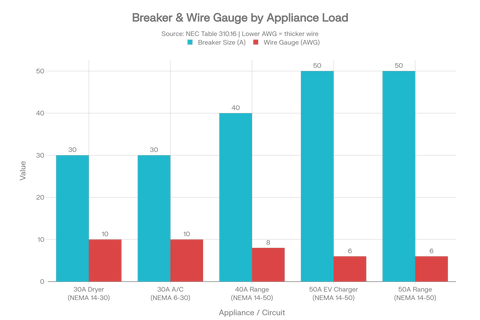
The cheat sheet version for the circuits we get asked about daily. Assumptions: 240V single-phase where applicable, copper conductors, 75°C terminations:
| Appliance / circuit | Typical load | Breaker | Wire (Cu) |
|---|---|---|---|
| General lighting & receptacles | 3 VA/sq ft (NEC 220.41) | 15A or 20A | 14 or 12 AWG |
| Refrigerator (dedicated) | 6–8A | 15A or 20A | 14 or 12 AWG |
| Microwave (dedicated) | 10–13A | 20A | 12 AWG |
| Dishwasher + disposal | 10–12A | 20A | 12 AWG |
| Electric dryer | 22–25A | 30A | 10 AWG |
| Water heater (4,500W) | 18.75A cont. | 25A or 30A | 10 AWG |
| Electric range | 40A nameplate | 40A or 50A | 8 or 6 AWG |
| EV charger (32A) | 32A cont. | 40A | 8 AWG |
| EV charger (48A) | 48A cont. | 60A | 6 AWG |
| Hot tub (most 240V spas) | 40–50A | 50A or 60A GFCI | 8 or 6 AWG |
| Central AC (per nameplate MOCP) | MCA varies | Per nameplate, often 30–60A | Per MCA |
| 100A subpanel | Up to 80A continuous | 100A | 3 AWG Cu / 1 AWG Al |
| 200A main service | Up to 160A continuous | 200A | 3/0 Cu / 250 kcmil Al |
Panel and service rows express typical load as the NEC 80% continuous-load rule: breaker rating × 0.8 (100A × 0.8 = 80A; 200A × 0.8 = 160A).
One AC note, because it generates endless confusion: air-conditioning condensers follow NEC 440, not the generic rules. The nameplate gives you Minimum Circuit Ampacity (MCA) for the wire and Maximum Overcurrent Protection (MOCP) for the breaker — and the MOCP is often bigger than the MCA would suggest, because the breaker only provides short-circuit protection while the compressor's internal overload handles the thermal side. A condenser labeled "MCA 26A, MOCP 45A" gets 10 AWG wire and up to a 45A breaker. That's legal and correct even though it looks wrong against the chart above.
The amp rating is only half the spec — the type of breaker matters just as much to code and safety:
- Standard (thermal-magnetic): the default for most circuits. Trips on overload (thermal element) and short circuit (magnetic element).
- GFCI: required by NEC 210.8 in kitchens, bathrooms, garages, outdoors, basements, laundry areas, and anywhere near water — and 210.8(D) extends it to HVAC equipment and 240V appliances like ranges and dryers in those locations. Trips on a 4–6 mA ground fault to protect people from shock.
- AFCI: required in most living areas (bedrooms, living rooms, hallways, dens) by NEC 210.12. Detects dangerous series and parallel arcing — the loose-connection failure mode behind a large share of residential electrical fires.
- Dual-function (AFCI+GFCI): one breaker covers both requirements — the clean answer for laundry rooms, kitchens, and any remodel where both rules apply.
- GFPE (ground-fault protection of equipment): higher 30 mA trip threshold, used for heat trace, some EV equipment, and pool gear.
Two practical notes from the counter. First, breaker types are panel-specific — a Square D Homeline breaker does not belong in a Siemens panel, even if it physically clicks in, and mixing brands voids the panel's listing under NEC 110.3(B). Match the breaker to the panel label; if the label is gone, bring us a photo and the panel model number and we'll cross it. Second, tandem (half-width) breakers are only legal in panel positions specifically marked for them. Cramming tandems everywhere to dodge a panel upgrade fails inspection, and I've seen bus stabs cooked to the point the breaker fell out of the panel. If the panel's full, it's full.
- Upsizing the breaker to stop nuisance trips. If a 20A breaker trips, the fix is finding the overload or the fault — never a 30A breaker on 12 AWG wire. That's a fire smoldering inside a wall while the breaker holds. Last summer a customer walked in asking exactly that for his shop compressor; we sold him a clamp meter instead, and the "bad breaker" turned out to be a 24-amp motor on a 20-amp circuit with the wrong wire entirely.
- Forgetting 240.4(D). Regardless of insulation ampacity, 14 AWG is capped at 15A, 12 AWG at 20A, and 10 AWG at 30A overcurrent protection (motor and welder circuits excepted).
- Mixing conductor metals without checking terminations. Aluminum branch circuits need CO/ALR-rated devices and antioxidant compound on every termination. Skip the compound and the joint loosens itself over thermal cycles.
- Ignoring panel bus rating. A 100A subpanel fed from a 100A breaker is fine. A 100A breaker stuffed into an already-loaded 100A main panel leaves nothing for the rest of the house — do a load calculation per NEC 220.83 first.
- Back-feeding a panel without a listed interlock. A generator cord through a dryer outlet with both breakers on is not a transfer solution — it's how linemen get hurt. Do it legally with an interlock kit or a proper transfer switch sized to your panel.
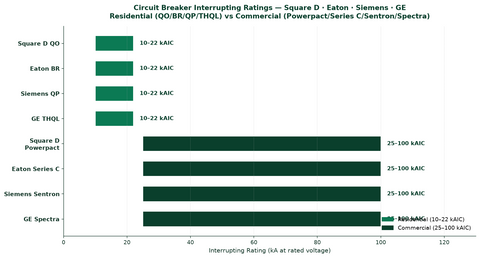
Everything above assumes 120/240V single-phase residential work. Commercial adds three wrinkles. Three-phase services change the wire math (balanced 208V and 480V feeders use the same 310.16 tables but different load math), breaker interrupting ratings start mattering — a 10,000 AIC residential breaker has no business on a commercial service with 42,000A of available fault current — and adjustable-trip breakers above 800A get their own NEC 240.6(C) rules. If you're speccing a 400A+ service, you're past chart territory and into engineered drawings; call us with the one-line and we'll quote the gear to match. The DC side of solar has its own breaker rules too — PV-rated DC breakers like the ones below are not interchangeable with AC breakers, and the solar wire and cable guide covers the conductor side of that equation.
Commercial services use the same NEC 240.6(A) standard sizes but tend to cluster in three ranges: 100-200 A for retail and small offices, 400-800 A for mid-size buildings, and 1000-1200 A for larger buildings with rooftop HVAC and commercial kitchens.
| Service Size | Typical Occupancy | Notes |
|---|---|---|
| 100-200 A | Retail shop, small restaurant, professional office (up to ~4,000 sq ft) | Often single-phase 120/240 V or three-phase 120/208 V |
| 225-400 A | Medium restaurant, small strip center, mid-size office (4,000-12,000 sq ft) | Usually 120/208 V three-phase, occasional 277/480 V |
| 400-600 A | Larger office (12,000-25,000 sq ft), small manufacturing, urgent care | 480 V/277 V three-phase common; step-down transformer for 120 V loads |
| 800 A | Anchor tenant retail, medium manufacturing, mid-size assembly | 480 V three-phase standard; often with a service transformer |
| 1000-1200 A | Large office (25,000+ sq ft), medium manufacturing, large restaurant | Almost always 480 V three-phase; switchgear rather than switchboard often |
Industrial and utility switchgear uses the top of the NEC 240.6(A) list. Above 1200 A, breakers are almost always power circuit breakers (drawout, air-frame designs) rather than the molded-case breakers used below 1200 A. Above 4000 A, most gear uses bus duct rather than cable feeders because parallel-cable ampacity would require an impractical number of runs.
| Rating | Typical Setting | Breaker Type |
|---|---|---|
| 1600 A | Utility main service to mid-size plant, mid-size data center service | Insulated-case or LV power breaker |
| 2000 A | Large plant main, data center switchgear main | LV power circuit breaker (LVPCB) |
| 2500 A | Heavy manufacturing main, hyperscale data center | LVPCB, drawout |
| 3000 A | Utility distribution, aluminum smelter, steel mill sub | LVPCB or MV vacuum breaker |
| 4000 A | Utility substation, high-current bus duct main | LVPCB, air-frame |
| 5000 A | Utility distribution, large data center campus | LVPCB or MV |
| 6000 A | Utility main gear, largest industrial services | LVPCB, drawout, forced-air-cooled |
NEC 240.6(B) allows adjustable-trip breakers to be considered rated at their maximum setting if the trip adjustment is inaccessible (e.g., sealed, locked, or requires a tool). NEC 240.6(C) allows the actual set point to be used if the adjustment is restricted to qualified personnel only. This is how a 1200 A breaker with an 800 A trip setting can serve as an 800 A breaker in service equipment.
| Feature | Standard (Fixed) Breaker | Adjustable / Electronic-Trip Breaker |
|---|---|---|
| Typical range | 15 A - 400 A | 150 A - 6000 A |
| Trip mechanism | Thermal-magnetic | Solid-state / microprocessor (LSIG) |
| Adjustability | Fixed at nameplate | Long-time pickup, short-time delay, instantaneous, ground fault |
| Cost | $25 - $500 | $800 - $25,000+ |
| Applications | Residential, small commercial | Commercial mains, industrial, data center |
| NEC citation | 240.6(A) | 240.6(B), (C) |
| Selective coordination | Limited | Excellent — allows coordinated trip curves |
HACR stands for Heating, Air Conditioning, and Refrigeration. HACR-rated breakers are thermal-magnetic breakers UL-tested for the high inrush current of hermetic compressor motors. NEC 440.22 requires the OCPD for group motor compressors to be marked "HACR" — nearly all modern 15-100 A residential breakers meet this rating, but always verify the nameplate on breakers protecting HVAC equipment.
Flip a breaker over and the molded case tells you three things beyond the amp rating. The frame size (100A frame, 225A frame) is the physical platform the trip unit lives in — a 20A breaker and a 60A breaker can share a frame. The interrupting rating (10kAIC, 22kAIC, 65kAIC) is how much fault current the breaker can safely clear without welding itself shut; residential panels assume 10,000 amps of available fault current, but if your service is close to a utility transformer, the available fault current can exceed that and the inspector will ask for 22kAIC gear. The voltage rating (120/240V slash rating vs. 240V straight rating) decides whether the breaker is legal corner-grounded delta or 480V work — residential folks can ignore this one, commercial folks cannot.
Voltage drop: the reason charts aren't the whole answer
Every pairing in this guide assumes a reasonable run length. Past about 100 feet one-way, voltage drop starts eating your margin, and the NEC's 3%-branch-circuit / 5%-total recommendation (210.19(A) informational note) becomes the binding constraint instead of ampacity. Quick field check for 240V circuits: a 30A load on 10 AWG copper holds 3% out to roughly 95 feet; step to 8 AWG and you get about 150 feet. A 50A RV or hot-tub run on 8 AWG is done at about 90 feet — which is why long shop and barn feeds so often end up 6 AWG or 4 AWG even when the ampacity chart says smaller would pass. We had a customer wire a detached garage 180 feet away with 10 AWG for a 30A subpanel because "the chart said so." Lights dimmed every time the table saw spun up. One spool of 6 AWG later, problem gone — an expensive way to learn that ampacity keeps wire from melting, but voltage drop keeps equipment happy.
Frequently asked questions
What are the NEC standard breaker sizes?
15, 20, 25, 30, 35, 40, 45, 50, 60, 70, 80, 90, 100, 110, 125, 150, 175, 200, 225, 250, 300, 350, 400, 450, 500, 600, 700, 800, 1000, 1200, 1600, 2000, 2500, 3000, 4000, 5000, and 6000 amps (NEC 240.6(A)).
What size breaker do I need for a 30-amp load?
If it's continuous, 30A × 1.25 = 37.5A → round up to a 40A breaker with 8 AWG copper. If non-continuous, a 30A breaker with 10 AWG copper is correct.
Can I put a 20-amp breaker on 14-gauge wire?
No. NEC 240.4(D) limits 14 AWG to 15A overcurrent protection. Use 12 AWG for a 20A circuit.
What size wire for a 100-amp subpanel?
3 AWG copper THHN (100A at 75°C) or 1 AWG aluminum, plus the grounding conductor. Many installers upsize to 2 AWG or 1/0 for voltage drop on runs over 100 feet.
Is a double-pole 30A breaker 60 amps?
No. Each leg is 30A at 240V — it supplies 30 amps of 240V load (7,200 watts), not 60.
Why does my breaker trip immediately, not after warming up?
An instant trip is the magnetic element seeing a short circuit or a locked-rotor motor — that's a fault, not an overload. A breaker that trips after 10–30 minutes of load is the thermal element seeing a genuine overload. The timing of the trip tells you which problem you're hunting.
Get the right gear
Portlandia Electric Supply stocks breakers, disconnects, wire, and panels for residential through commercial work. Browse our Safety and Protection collection for DC and AC protection like the MidNite Solar MNEPV30-300 circuit breaker, the MidNite 175A panel-mount DC breaker, and the OutBack 20A DIN-mount PV array breaker; the full Circuit Breakers collection for branch and feeder breakers like the Eaton CHF250 2-pole 50A; or the wider Electrical Supplies collection for conductors, conduit, and fittings. Pairing a standby generator with a new panel? See our automatic transfer switches.
Need a hand matching a breaker to a load? Call the counter — we do this all day, and we'd rather spend five minutes on the phone than read about your panel in an insurance claim.