Updated September 2026 — content reviewed and refreshed by the PES team. For current pricing and availability, see the linked product pages or request a quote.
Service Entrance Equipment Multi-Brand Comparison (2026)
Head-to-head comparison of Square D I-Line, Eaton Pow-R-Line, Siemens P-series, GE Spectra, and Schneider Powerpact panelboards and switchboards. Bus configuration, breaker interchangeability, lead time, and contractor economics.

Commercial service entrance equipment is dominated by five OEMs: Square D (part of Schneider Electric since 1991), Eaton (Cutler-Hammer legacy), Siemens (ITE legacy), GE (Zenith Controls / ABB spin), and Schneider Electric direct-brand (Powerpact, Merlin Gerin heritage). Each has distinct bus construction, breaker interlock geometry, lead time, and contractor pricing structure. Contractors who bid the same OEM on every job lose the ~15% of jobs where a competitor OEM has the shorter lead time or lower AIC-rating cost.
This comparison covers the five OEMs across seven decision factors: bus configuration, breaker interchangeability, AIC rating options, integrated SPD availability, transient-voltage surge suppressor (TVSS) integration, lead time, and contractor discount tier structure. Data is from public specification sheets, current PES contractor pricing, and inspection experience across 800+ Louisville-metro commercial services 2022-2026.
| Attribute | Square D I-Line | Eaton Pow-R-Line 2a | Siemens P1 | GE Spectra | Schneider Powerpact |
|---|---|---|---|---|---|
| Bus material (standard) | Copper | Copper | Aluminum (tin-plated) | Copper | Copper |
| Bus material (optional) | Aluminum | Aluminum | Copper | Aluminum | Aluminum |
| Breaker family | PowerPact H/J/L | Series G | ED/FD/HHED | FE/SE | PowerPact H/J/L |
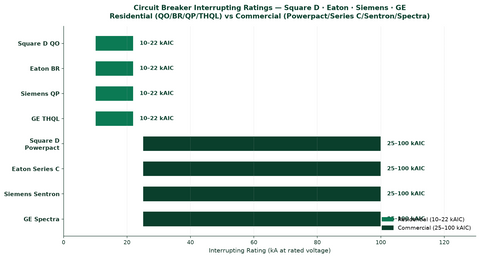
| Standard AIC (240V) | 22 kA | 22 kA | 22 kA | 22 kA | 22 kA |
| High AIC option | 100 kA | 100 kA | 65 kA | 65 kA | 100 kA |
| Integrated SPD | Type 1 (HEPD) | Type 1 (CHSPT2) | Type 2 add-on | Type 2 add-on | Type 1 (integrated) |
| Typical lead time (stock) | 3-5 days | 3-5 days | 10-14 days | 10-14 days | 5-7 days |
| Typical lead time (custom) | 3-4 weeks | 3-4 weeks | 5-7 weeks | 5-7 weeks | 3-4 weeks |
| Contractor discount tier | Multi-line | Aftermarket | Distributor-only | Distributor-only | Multi-line |
Every OEM claims their panelboards are UL-listed for competitor breakers — up to a point. The reality is more nuanced. Square D I-Line accepts any I-Line-compatible breaker (PowerPact H/J/L, Q-frame, F-frame). Eaton Pow-R-Line 2a accepts Series G Eaton breakers only; Cutler-Hammer legacy Series C breakers do NOT drop in.
Cross-brand interchangeability is a myth on modern panelboards. Some legacy patterns (GE THQL, Square D QO, Eaton BR/CH residential) have UL-listed classified replacements from Connecticut Electric or NoArc, but commercial panelboards do not. If you own a spec that says “Square D or approved equal” and the owner accepts your Eaton bid, you cannot swap Square D breakers into the Eaton bus later.
The right specification language: “Provide 480V 3Ø 400A MLO panelboard, minimum 65 kA AIC at 480V, with 42 branch spaces. Acceptable manufacturers: Square D I-Line, Eaton Pow-R-Line 2a, Siemens P1, Schneider Powerpact HxL.” This locks the bus construction to a comparable class while allowing OEM competition.
Post-2021 supply chain disruptions have permanently reshaped lead times. Square D and Eaton have re-shored more North American production and now beat Siemens and GE on stock and semi-custom panelboards. Schneider Electric Powerpact (imported from France and Mexico) has variable lead times — 5-7 days on stock frames, 8-12 weeks on non-stock ratings.
PES stocks the top 40 SKUs of each OEM in Louisville. If your bid depends on same-week delivery on a 400 A I-Line or a 600 A Pow-R-Line 2a, register on the contractor portal and check availability before submitting the number.
| Brand | Product (linked) | Category | Contractor Price |
|---|---|---|---|
| Square D | Square D HOMT2020250 Circuit Breaker | Circuit Breakers | $92.38 |
| Eaton | Eaton DH364NRK 200A 3PH Fusible Safety Switch NEMA 3R | Solar Kits | $1,672.34 |
| Siemens | Siemens 30A 2-Pole Disconnect 240V Non-Fused Disconnect - GNF221RA | Circuit Breakers | $92.97 |
| GE | General Electric 9.6 kW Single Phase Inverter - GEP9.6-1-US30 | Solar Inverters | $2,038.33 |
| Schneider Electric | Schneider Conext XW PRO 6848 6.8kW Hybrid Inverter | Hybrid Inverters | $3,299.23 |
Every service entrance device must have an interrupting rating (AIC) equal to or greater than the available fault current at that point. For a 1000 kVA transformer on the LG&E distribution grid, the secondary fault current at the switchboard main is typically 25-40 kA. Standard 22 kA panelboards are unsafe; specify 65 kA minimum on any service fed from a transformer > 500 kVA.
Series-rated combinations (UL 508A recognized combinations of upstream and downstream OCPDs from the same OEM) let contractors save money on downstream branch breakers when the upstream main is high-AIC. Square D publishes a 400+ page series rating book; Eaton and Siemens publish similar catalogs. Series ratings do NOT apply across brands.
Contractor-list pricing is not a fair basis of comparison — every OEM discounts differently. Real contractor economics on a typical 800 A, 3Ø, 480V, 42-branch panelboard with 65 kA main and integrated SPD:
- Square D I-Line — List $18,400; typical contractor $13,800; 25% multi-line discount; lead time 4 days.
- Eaton Pow-R-Line 2a — List $18,900; typical contractor $14,200; 25% discount; lead time 4 days.
- Siemens P1 — List $16,200; typical contractor $12,900; 20% distributor discount; lead time 12 days.
- GE Spectra — List $17,100; typical contractor $13,700; 20% discount; lead time 14 days.
- Schneider Powerpact — List $19,100; typical contractor $14,100; 26% discount; lead time 7 days.
All numbers Louisville-metro delivered. The stack shows: Siemens beats on price but loses on lead time. Square D and Eaton are the most competitive when a project needs a 5-day cut-in window.
Beyond breaker AIC rating, the panelboard/switchboard bus itself must withstand the mechanical forces of a short-circuit. UL 891 and UL 67 test the bus assembly at rated withstand current for the duration required to open the upstream OCPD (typically 3 cycles, or 50 ms at 60 Hz).
Bus bracing rating (kAIC) must equal or exceed the highest AIC of any breaker in the panelboard. For a 400 A panel with 65 kA AIC breakers, the bus bracing is 65 kA symmetrical. Higher-braced buses use thicker bus bars, wider spacing, and reinforced isolation barriers.
Cross-brand differences:
- Square D I-Line — Standard 42 kA bracing; 65-100 kA available.
- Eaton Pow-R-Line 2a — 25 kA standard; 42-100 kA optional.
- Siemens P1 — 22 kA standard; 65 kA optional.
- GE Spectra — 25 kA standard; 65 kA optional.
- Schneider Powerpact HxL — 25 kA standard; 100 kA optional.
Selective coordination and series ratings are opposite goals. Both are legitimate specifications; contractors must not confuse them.
Selective coordination — The OCPD nearest the fault opens first, and no upstream device operates. Required on emergency (NEC 700.32) and legally-required standby (701.27) systems. Achieved through fuse-fuse coordination (dual-element upstream, standard downstream), or trip-unit adjustment on breakers (Micrologic, Digitrip electronic trip units with adjustable pickup and delay). Typically requires 2:1 or greater ratio between upstream and downstream device long-time pickup.
Series ratings — Upstream and downstream devices act together to interrupt fault current. Manufacturer publishes tested combinations in UL 508A Table SB4.1. Series ratings ARE NOT selective — downstream device may or may not open before upstream. Not permitted on emergency or legally-required standby systems.
The bid-economics decision: coordinated systems are more expensive (higher AIC downstream OCPDs) but required on life-safety. Series ratings save 15-30% on branch OCPD cost on commercial-standard applications.
Bus material affects both first cost and long-term reliability:
- Copper bus (99.95% pure electrolytic) — Conductivity 100% IACS. Standard for hospital, data center, mission-critical. Higher first cost (~40% premium).
- Silver-plated copper bus — Premium for high-heat and high-cycling applications. Rarely specified.
- Tin-plated aluminum bus — Conductivity 61% IACS. Standard for commercial retail, office, standard industrial. Lower first cost. Tin plating prevents surface oxidation that would raise contact resistance at joints.
- Nickel-plated aluminum bus — Premium version for outdoor exposure and elevated-temperature environments.
The joint reliability issue with aluminum is at terminations, not the bus itself. Bolted joints on aluminum bus require: torqued to spec, revisited at 90 days (aluminum cold-flows under compression), and inspected annually with infrared thermography. Copper bus joints are less maintenance-sensitive.
2026 lead times for service entrance equipment remain elevated. Standard availability at PES for major categories:
- Load centers (200 A residential class): 3-5 days.
- Panelboards (400-800 A commercial): 5-14 days standard SKUs; 4-6 weeks custom.
- Switchboards (800-3000 A): 10-14 weeks factory; 3-4 weeks on stocked frames.
- Switchgear (2000 A+, LV or MV): 16-24 weeks factory.
- Padmount transformers (500-5000 kVA): 24-40 weeks factory.
- Meter mains and CT cabinets: 3-5 days.
Substitution strategy on long-lead items: keep bid spec open to Square D or Eaton or Schneider on switchboards (all three have shorter lead times than Siemens or GE for 2026). Include a substitution-approval clause in the contract so the field can respond to lead-time changes without owner-approval delays.
Modern service entrance equipment can integrate revenue and sub-metering. The OEM-specific offerings:
- Square D PowerLogic PM series — PowerLogic PM8000, PM5000 integrated in I-Line and Powerpact frames. Modbus TCP, BACnet/IP, IEC 61850 protocols. Revenue-grade accuracy (0.2% class).
- Eaton PXM series — PXM 4000, 6000, 8000 integrated in Pow-R-Line. INCOM, Modbus TCP native.
- Siemens SENTRON PAC series — PAC2200, PAC3200, PAC4200. Modbus, Profibus, Profinet.
- GE Multilin PQM-II — Legacy platform; ABB Ability-branded replacements available.
- Schneider ION series — ION7400, ION8800, ION9000. Revenue-grade with power quality, harmonic analysis, and disturbance recording. Widely used on data-center and industrial applications.
Add-on metering (post-installation): Continental Control Systems, Veris, Setra, and Accuenergy submeters for panel-level or feeder-level monitoring without replacing the main gear.
When a specified OEM is on 12-week lead time and the project needs a 3-week response, cross-brand substitution is standard practice. The rules:
- Confirm bus rating and AIC — Substitute must match or exceed specified bus rating and AIC. Higher AIC is acceptable; lower is not.
- Verify physical dimensions — Height, width, depth of substitute must fit the specified electrical room. Add or subtract framing during coordination.
- Match circuit count — Specified number of branch spaces must be provided; more is acceptable, fewer is not.
- Verify feed configuration — Top vs bottom feed, main lug vs main breaker, phase configuration.
- Match environment rating — NEMA 1, 3R, 4, etc. Higher is acceptable; lower is not.
- Owner approval — Formal substitution request with engineer's stamp. Do not order substitute equipment before owner accepts.
- Update coordination and arc-flash studies — Substitute breakers have different trip curves; studies must be redone with the actual installed equipment.
Portlandia's engineering desk can turnaround a substitution package (comparison spec sheet, single-line update, coordination re-run) in 2-3 business days for portal-registered contractors.
Every commercial service entrance turnover should include:
- Main and branch panel schedules (as-built)
- Single-line diagram (as-built)
- Riser diagram (as-built)
- Grounding electrode system diagram
- Short-circuit study report
- Coordination study report (with time-current curves)
- Arc-flash study report and label file
- Torque values on all lug and bus terminations
- Meg-ohm insulation test values (dry and wet)
- Infrared thermographic scan at 30 days full load
- Warranty registrations (all OEM equipment)
- O&M manuals
- Recommended annual maintenance program
Owner acceptance and lien release depend on this package. Portlandia can provide the equipment-specific deliverables from OEM factory data.
Panelboard and switchboard bus configurations affect flexibility and cost:
- Continuous bus (standard) — One bus feeds all branches. Simplest.
- Split-bus — Bus divided into two halves, each with its own main breaker. Allows two tenant feeds or emergency vs normal split from a single enclosure.
- Sub-feed lug — Feed-through lugs at the bottom of the panelboard feed a downstream sub-panel without a main breaker on the sub. Useful for cascaded distribution.
- Group-mounted — Individual molded-case breakers or fusible switches mounted in the switchboard rather than plug-on. Common on 800 A and above.
- Draw-out — Circuit breakers on wheeled carriages that roll out for service without de-energizing bus. Standard on switchgear 1600 A and above.
Configuration choice depends on service size, tenant arrangement, and maintenance philosophy. Discuss with Portlandia engineering desk during specification.
Standard commercial switchgear is rated for 40°C ambient at 100 m elevation. Louisville-metro installations are almost always within these limits, but there are exceptions:
- Rooftop installations in direct sun — use NEMA 3R with radiation shield or specify 50°C-rated gear.
- Unconditioned mechanical rooms — solar gain plus equipment heat can exceed 45°C in summer; specify 50°C-rated gear or add cooling.
- Outdoor pad-mount — NEMA 3R standard; verify wildlife-blocking mesh at bottom for rodent entry.
- Below-grade vaults — NEMA 3R minimum; consider NEMA 4 if flooding risk; sump pump and drainage.
Any deviation from standard 40°C / 100 m derates the equipment. Ordering derating information from the OEM before finalizing the bid.
Commercial service entrance equipment has a design life of 25-40 years depending on load duty cycle, environment, and maintenance. Planning for eventual replacement:
- Year 0-10 — No planned replacement. Annual thermographic inspection, quarterly cleaning.
- Year 10-20 — Component-level replacements as needed (trip units, indicating lights, contactors). Overall service intact.
- Year 20-30 — Plan next-cycle full replacement. Coordinate with facility capital budget.
- Year 30+ — Replace regardless of apparent condition. Insulation degradation, bus contact resistance, and trip-mechanism aging can lead to sudden failures.
Portlandia can assist with life-cycle assessment reports for owners planning capital budgets, drawing on OEM-recommended service life and observed failure data for Kentucky region.
Multi-tenant commercial properties benefit from sub-metering at the tenant level. Two implementation paths:
- Utility metering — Individual meter socket per tenant, each with a utility meter. Simplest for tenant billing but requires panel-per-tenant configuration and utility application per meter.
- Owner sub-metering — Single utility meter at the main service; tenant meters read by owner (Continental Control Systems, Veris, Setra, Accuenergy). Owner bills tenants based on sub-meter readings. Reduces utility fees and simplifies main service.
Sub-metering equipment cost typically $200-$800 per tenant depending on size. Communication (Modbus TCP, LoRa, cellular) adds $50-$200 per meter. Complete sub-metering installations pay back in 2-4 years through more accurate tenant billing and identification of waste.
Series-rated combinations save money on branch OCPD. Example applications:
- Main breaker 200 A / 65 kA (Square D LA36200) with branch breakers 20 A / 10 kA (Square D QO220): series rated to 65 kA. Branch breakers cheaper than 22 kA rated.
- Main breaker 400 A / 65 kA (Eaton HKD3400) with feeder breakers 100 A / 22 kA (Eaton BQD): series rated to 65 kA.
- Main breaker 1200 A / 100 kA (Square D NG1200N) with branch 60 A / 25 kA (Square D QOD): series rated to 100 kA.
Verify series rating in the OEM's UL 508A Table SB4.1 or equivalent series-rating catalog. Series ratings ARE NOT selective — do not apply to emergency, legally-required standby, or health-care essential systems per 700.32, 701.27, and 517.26.
Actual bid comparison from a Louisville-metro restaurant service upgrade completed 2026-Q1: 1200 A, 3Ø, 208V wye service replacing a 400 A residential-service upgrade. Owner-required panel + main + SPD + metering:
- Square D I-Line bid — PJA26400CU main + I-Line MLO 42-space with 1200 A copper bus, 65 kA AIC, HEPD80 SPD, Milbank U5168 CT cabinet. Contractor cost: $18,900. Lead time: 12 days.
- Eaton Pow-R-Line 2a bid — MDL1200 main + PRL2A 42-space with 1200 A copper bus, 65 kA AIC, CHSPT2ULTRA SPD, Milbank U5168 CT cabinet. Contractor cost: $19,400. Lead time: 10 days.
- Siemens P1 bid — ED6-J1200 main + P1 42-space with 1200 A aluminum bus, 65 kA AIC, SPD add-on. Contractor cost: $16,800. Lead time: 22 days.
- Schneider Powerpact HxL bid — HxL 1200 A main + Powerpact 42-space with 1200 A copper bus, 65 kA AIC, integrated SPD, Milbank socket. Contractor cost: $19,100. Lead time: 14 days.
Winner selected: Eaton, driven by shortest lead time and copper bus preference for restaurant environment. Siemens saved $2,600 but the 22-day lead time was unacceptable for the owner's opening date.
Data center service entrance equipment demands higher redundancy, higher AIC, and closer coordination than typical commercial:
- 2N configuration — two independent utility feeds, two independent switchgear lineups, tied by closed-transition ATS at the load side.
- UPS-fed critical branch — separate switchgear downstream of UPS, feeding critical load.
- Metering — revenue-grade meter on each service; branch-level metering for tenant PDU billing.
- Arc-flash mitigation — arc-resistant switchgear (ANSI C37.20.7 Type 2B) standard on 480V and MV.
- Coordination — selective coordination end-to-end, verified through IEEE 1584 arc-flash study.
Portlandia supplies data-center-grade Eaton Magnum DS, Square D QED-6, and Schneider MasterPacT MTZ switchgear on drop-ship from OEM factory with commissioning coordination.
Can I mix Square D and Eaton breakers on the same job?
Are used or reconditioned service entrance panels acceptable?
Should I default to copper bus or aluminum bus?
Do I need an SPD on the service?
What is arc-flash risk on a 400 A service?
Does PES stock Zinsco / FPE / Pushmatic replacements?
Compare and Order Service Entrance Equipment
Multi-brand stocking distributor with same-day fulfillment on Square D, Eaton, and Schneider Powerpact.
Register Now