Standard Circuit Breaker Sizes: NEC 240.6 Chart (15A to 6000A)
Complete chart of NEC-listed circuit breaker sizes with applications, wire sizes, and sizing rules.

NEC Article 240.6(A) defines the standard ampere ratings that thermal-magnetic and molded-case circuit breakers are legally allowed to have in North America. These aren't arbitrary — they're the sizes UL 489 requires manufacturers to certify, and the sizes that inspectors will look for on a nameplate during rough-in.
The full NEC 240.6(A) standard list is: 15, 20, 25, 30, 35, 40, 45, 50, 60, 70, 80, 90, 100, 110, 125, 150, 175, 200, 225, 250, 300, 350, 400, 450, 500, 600, 700, 800, 1000, 1200, 1600, 2000, 2500, 3000, 4000, 5000, and 6000 amperes. Anything not on this list is a "non-standard" size and requires either an adjustable trip unit or a fusible switch to protect the circuit correctly.
Home services
Small business, office
Manufacturing, data center
Substation, main gear
The master reference below pairs every NEC 240.6(A) standard rating with the minimum copper and aluminum wire size at 75°C terminations (NEC Table 310.16), the ampacity limit of that wire, and the most common application. This is the same table electricians and inspectors reference during rough-in and pre-inspection.
| Breaker (A) | Minimum Wire (75°C) | Wire Ampacity | Typical Application |
|---|---|---|---|
| 15 A | 14 AWG Cu / 12 AWG Al | 15 A | Lighting, general receptacles |
| 20 A | 12 AWG Cu / 10 AWG Al | 20 A | Kitchen, laundry, general 20 A |
| 25 A | 10 AWG Cu / 8 AWG Al | 30 A | Electric heat, small AC |
| 30 A | 10 AWG Cu / 8 AWG Al | 30 A | Dryer (30 A), water heater |
| 35 A | 8 AWG Cu / 6 AWG Al | 50 A | Small subpanel, electric heat |
| 40 A | 8 AWG Cu / 6 AWG Al | 50 A | Range branch, small feeder |
| 45 A | 8 AWG Cu / 6 AWG Al | 50 A | Electric range, EV L2 charger |
| 50 A | 8 AWG Cu / 6 AWG Al | 55 A | Range, EV charger, welder |
| 60 A | 6 AWG Cu / 4 AWG Al | 65 A | Subpanel feeder, hot tub |
| 70 A | 4 AWG Cu / 3 AWG Al | 85 A | Subpanel, small commercial branch |
| 80 A | 4 AWG Cu / 2 AWG Al | 85 A | Larger subpanel, HVAC RTU |
| 90 A | 3 AWG Cu / 2 AWG Al | 100 A | 100 A subpanel derated |
| 100 A | 3 AWG Cu / 1 AWG Al | 100 A | 100 A service or subpanel |
| 110 A | 2 AWG Cu / 1/0 AWG Al | 115 A | 110 A feeder |
| 125 A | 2 AWG Cu / 1/0 AWG Al | 130 A | 125 A subpanel |
| 150 A | 1 AWG Cu / 2/0 AWG Al | 150 A | 150 A residential service |
| 175 A | 2/0 AWG Cu / 3/0 AWG Al | 175 A | 175 A subpanel |
| 200 A | 2/0 AWG Cu / 4/0 AWG Al | 200 A | 200 A residential service (most common) |
| 225 A | 3/0 AWG Cu / 250 kcmil Al | 230 A | Small commercial service |
| 250 A | 4/0 AWG Cu / 300 kcmil Al | 255 A | Commercial subpanel |
| 300 A | 300 kcmil Cu / 500 kcmil Al | 285 A | 300 A commercial service |
| 350 A | 500 kcmil Cu / 700 kcmil Al | 380 A | Small industrial service |
| 400 A | 500 kcmil Cu / 700 kcmil Al | 380 A | 400 A commercial service |
| 500 A | Parallel 250 kcmil Cu (x2) | 510 A | Commercial, hospital |
| 600 A | Parallel 350 kcmil Cu (x2) | 620 A | Small industrial main |
| 800 A | Parallel 500 kcmil Cu (x2) | 760 A | Industrial subfeed |
| 1000 A | Parallel 750 kcmil Cu (x2) | 950 A | Large industrial main |
| 1200 A | Parallel 500 kcmil Cu (x3) | 1140 A | Large plant main |
| 1600 A | Parallel 600 kcmil Cu (x4) | 1620 A | Utility service |
| 2000 A | Parallel 750 kcmil Cu (x4) | 1900 A | Utility main / large data center |
| 2500 A | Bus duct or utility switchgear | 2500 A | Industrial switchgear |
| 3000 A | Bus duct | 3000 A | Utility/heavy industrial |
| 4000 A | Bus duct | 4000 A | Utility substation |
| 5000 A | Bus duct | 5000 A | Utility distribution |
| 6000 A | Bus duct | 6000 A | Utility main gear |
Wire sizes shown are the smallest NEC-compliant copper or aluminum conductor at 75°C termination. Larger wire is always permitted; smaller is a code violation. Continuous loads (three hours or more) require 125% conductor sizing per NEC 210.19(A) and 215.2(A) — see the sizing section below.
Every residential electrician works with the same short list of breaker sizes 90% of the time: 15 A, 20 A, 30 A, 40 A, 50 A, 60 A, 100 A, and 200 A. Knowing what each covers eliminates 90% of design-time lookups.
| Rating | Where It's Used | Wire |
|---|---|---|
| 15 A | General lighting circuits, most bedroom and living-area receptacles (NEC 210.11(A)) | 14 AWG Cu |
| 20 A | Kitchen small-appliance branch circuits (NEC 210.11(C)(1)), bathroom (210.11(C)(3)), laundry (210.11(C)(2)), garage receptacles (210.52(G)) | 12 AWG Cu |
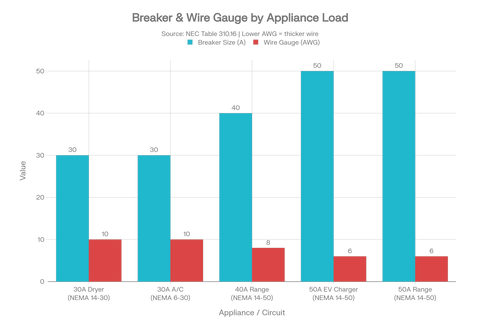
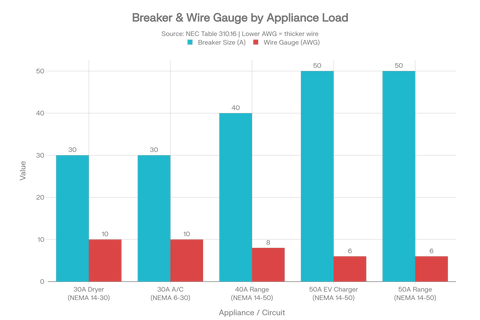
| 30 A | Electric clothes dryer (NEC 210.23(B)(1)), central air conditioner, tankless water heater | 10 AWG Cu |
| 40 A | Electric range, small EV charger | 8 AWG Cu |
| 50 A | Electric range with double oven, EV Level 2 charger, welder | 8 AWG Cu / 6 AWG Al |
| 60 A | Hot tub, sub-panel for detached garage, large A/C compressor | 6 AWG Cu |
| 100 A | Sub-panel to detached garage or ADU, older 100 A whole-house service | 3 AWG Cu / 1 AWG Al |
| 125 A | Modern EV-ready sub-panel, small home addition | 2 AWG Cu / 1/0 AWG Al |
| 150 A | Legacy 150 A service (1970s-1990s), some townhomes | 1 AWG Cu / 2/0 AWG Al |
| 200 A | Standard modern residential service — most common size in new construction | 2/0 AWG Cu / 4/0 AWG Al |
Residential 200 A vs 400 A service
200 A remains the default for new US homes because 200 A at 240 V is 48 kW — enough to run central AC, an electric range, a dryer, an EV charger, and general loads simultaneously without approaching the service limit. 400 A services are increasingly common for all-electric homes with two EVs, heat pumps, and battery storage, or for homes with ADUs — but they require utility coordination and often a step up in meter socket, service panel, and grounding electrode size.
Commercial services use the same NEC 240.6(A) standard sizes but tend to cluster in three ranges: 100-200 A for retail and small offices, 400-800 A for mid-size buildings, and 1000-1200 A for larger buildings with rooftop HVAC and commercial kitchens.
| Service Size | Typical Occupancy | Notes |
|---|---|---|
| 100-200 A | Retail shop, small restaurant, professional office (up to ~4,000 sq ft) | Often single-phase 120/240 V or three-phase 120/208 V |
| 225-400 A | Medium restaurant, small strip center, mid-size office (4,000-12,000 sq ft) | Usually 120/208 V three-phase, occasional 277/480 V |
| 400-600 A | Larger office (12,000-25,000 sq ft), small manufacturing, urgent care | 480 V/277 V three-phase common; step-down transformer for 120 V loads |
| 800 A | Anchor tenant retail, medium manufacturing, mid-size assembly | 480 V three-phase standard; often with a service transformer |
| 1000-1200 A | Large office (25,000+ sq ft), medium manufacturing, large restaurant | Almost always 480 V three-phase; switchgear rather than switchboard often |
Industrial and utility switchgear uses the top of the NEC 240.6(A) list. Above 1200 A, breakers are almost always power circuit breakers (drawout, air-frame designs) rather than the molded-case breakers used below 1200 A. Above 4000 A, most gear uses bus duct rather than cable feeders because parallel-cable ampacity would require an impractical number of runs.
| Rating | Typical Setting | Breaker Type |
|---|---|---|
| 1600 A | Utility main service to mid-size plant, mid-size data center service | Insulated-case or LV power breaker |
| 2000 A | Large plant main, data center switchgear main | LV power circuit breaker (LVPCB) |
| 2500 A | Heavy manufacturing main, hyperscale data center | LVPCB, drawout |
| 3000 A | Utility distribution, aluminum smelter, steel mill sub | LVPCB or MV vacuum breaker |
| 4000 A | Utility substation, high-current bus duct main | LVPCB, air-frame |
| 5000 A | Utility distribution, large data center campus | LVPCB or MV |
| 6000 A | Utility main gear, largest industrial services | LVPCB, drawout, forced-air-cooled |
NEC 240.4 is the master rule for conductor overcurrent protection: a conductor must be protected at its ampacity. The breaker sizing process combines this with NEC 210.19 (continuous load), 210.20 (branch OCPD), 215.2/215.3 (feeder OCPD), and the standard sizes from 240.6.
Calculate the load
use the actual nameplate amperage of the equipment, or sum branch-circuit loads per NEC Article 220. Identify which portion is continuous (three hours or more of continuous operation).
Apply the 125% continuous-load factor
NEC 210.19(A) and 215.2(A) require: OCPD ≥ 100% non-continuous load + 125% continuous load. A 40 A continuous load requires a 50 A breaker.
Select conductor size for the calculated OCPD
use NEC Table 310.16 at 75°C for most 100 A+ terminations. Conductor ampacity must equal or exceed the breaker rating.
Apply derating factors
NEC 310.15(B) ambient temperature adjustment and 310.15(C) more-than-three-current-carrying-conductor factor. Divide adjusted ampacity by the breaker rating to confirm compliance.
Round up to the next NEC 240.6(A) standard size
you can round up under NEC 240.4(B) if the load doesn't exceed the conductor ampacity, the conductor doesn't supply receptacle branch circuits, and the next standard rating is 800 A or less.
Verify AIC rating
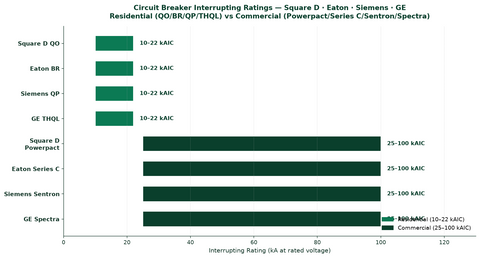
the breaker's interrupting capacity (typically 10 kAIC residential, 22-65 kAIC commercial, 100+ kAIC industrial) must exceed available fault current at the point of installation.
Check series ratings
if using a lower AIC breaker downstream of a higher-AIC main, confirm the pair is UL series-rated on the manufacturer's posted list.
Confirm GFCI/AFCI requirements
bathroom, kitchen, outdoor, garage, and basement receptacles need GFCI (NEC 210.8); bedroom, living area, and most 15/20 A circuits need AFCI (NEC 210.12).
Continuous load sizing examples
| Load | Calc | Breaker | Wire |
|---|---|---|---|
| EV Level 2 charger, 32 A continuous | 32 × 1.25 = 40 A | 40 A | 8 AWG Cu THHN |
| EV Level 2 charger, 48 A continuous | 48 × 1.25 = 60 A | 60 A | 6 AWG Cu THHN |
| Solar inverter, 32 A continuous output | 32 × 1.25 = 40 A | 40 A | 8 AWG Cu THHN |
| Rooftop HVAC RTU, 65 A FLA | 65 × 1.25 = 81 A → 90 A standard | 90 A HACR | 3 AWG Cu THHN |
| Commercial kitchen, 100 A continuous | 100 × 1.25 = 125 A | 125 A | 2 AWG Cu / 1/0 Al |
| Data center PDU, 400 A | 400 × 1.25 = 500 A | 500 A | Parallel 250 kcmil Cu |
NEC 240.6(B) allows adjustable-trip breakers to be considered rated at their maximum setting if the trip adjustment is inaccessible (e.g., sealed, locked, or requires a tool). NEC 240.6(C) allows the actual set point to be used if the adjustment is restricted to qualified personnel only. This is how a 1200 A breaker with an 800 A trip setting can serve as an 800 A breaker in service equipment.
| Feature | Standard (Fixed) Breaker | Adjustable / Electronic-Trip Breaker |
|---|---|---|
| Typical range | 15 A - 400 A | 150 A - 6000 A |
| Trip mechanism | Thermal-magnetic | Solid-state / microprocessor (LSIG) |
| Adjustability | Fixed at nameplate | Long-time pickup, short-time delay, instantaneous, ground fault |
| Cost | $25 - $500 | $800 - $25,000+ |
| Applications | Residential, small commercial | Commercial mains, industrial, data center |
| NEC citation | 240.6(A) | 240.6(B), (C) |
| Selective coordination | Limited | Excellent — allows coordinated trip curves |
Beyond the basic thermal-magnetic breaker, NEC requires specialty protection for many residential and commercial circuits:
| Type | Trip Threshold | Where Required (NEC) |
|---|---|---|
| GFCI (Class A) | 4-6 mA ground fault | Bathrooms, kitchens, outdoors, garages, basements, laundry, pool, spa (NEC 210.8) |
| GFPE (equipment) | 30 mA ground fault | 1000 A+ service disconnects (NEC 230.95), heat trace over 100 A (426.28) |
| AFCI (combination) | Arc signature detection | Bedroom, living area, kitchen, laundry receptacles 15/20 A (NEC 210.12) |
| DFCI (arc + gnd) | Both arc and ground fault | Solar DC combiner boxes (NEC 690.11), where required by AHJ |
| Dual-function CAFCI+GFCI | 6 mA + arc detection | Kitchen and laundry receptacle circuits when GFCI+AFCI both required |
HACR stands for Heating, Air Conditioning, and Refrigeration. HACR-rated breakers are thermal-magnetic breakers UL-tested for the high inrush current of hermetic compressor motors. NEC 440.22 requires the OCPD for group motor compressors to be marked "HACR" — nearly all modern 15-100 A residential breakers meet this rating, but always verify the nameplate on breakers protecting HVAC equipment.
Standard breaker-to-wire pairings at 75°C terminations (NEC 110.14(C) and Table 310.16). Copper is default; aluminum requires anti-oxidant compound at terminations. Do not use aluminum smaller than 6 AWG on branch circuits.
| Breaker | Copper (Cu) | Aluminum (Al) | Cu Ampacity | Al Ampacity |
|---|---|---|---|---|
| 15 A | 14 AWG | 12 AWG | 20 A | 20 A |
| 20 A | 12 AWG | 10 AWG | 25 A | 25 A |
| 30 A | 10 AWG | 8 AWG | 35 A | 35 A |
| 40 A | 8 AWG | 6 AWG | 50 A | 50 A |
| 50 A | 8 AWG | 6 AWG | 50 A | 50 A |
| 60 A | 6 AWG | 4 AWG | 65 A | 55 A |
| 70 A | 4 AWG | 3 AWG | 85 A | 75 A |
| 80 A | 4 AWG | 2 AWG | 85 A | 90 A |
| 90 A | 3 AWG | 2 AWG | 100 A | 90 A |
| 100 A | 3 AWG | 1 AWG | 100 A | 100 A |
| 125 A | 2 AWG | 1/0 | 130 A | 120 A |
| 150 A | 1 AWG | 2/0 | 150 A | 135 A |
| 175 A | 2/0 | 3/0 | 175 A | 155 A |
| 200 A | 2/0 | 4/0 | 175 A | 180 A |
| 225 A | 3/0 | 250 kcmil | 225 A | 205 A |
| 250 A | 4/0 | 300 kcmil | 260 A | 230 A |
| 300 A | 300 kcmil | 500 kcmil | 285 A | 310 A |
| 400 A | 500 kcmil | 700 kcmil | 380 A | 375 A |
Forgetting the 125% continuous-load factor
the #1 cause of nuisance tripping on EV chargers and commercial equipment. A 40 A EV charger needs a 50 A breaker, not a 40 A.
Using 60°C ampacity when equipment allows 75°C
this leaves conductor headroom unused and wastes copper. Verify termination temperature and use the highest allowed column of Table 310.16.
Assuming aluminum is one size larger than copper
actually 2 sizes for larger conductors (e.g., 4/0 Al replaces 2/0 Cu, not 3/0 Cu). Always verify against Table 310.16.
Missing the AIC rating on the fault-current calc
a 10 kAIC breaker in a location with 22 kA available fault current will explode instead of trip.
Using a plain thermal-magnetic breaker for a hermetic compressor
many older breakers lack HACR marking. Verify the nameplate.
Not verifying series ratings
a 10 kAIC downstream breaker under a 65 kAIC main is only permitted if the specific pair is listed on the manufacturer's UL series-rated combinations sheet.
Skipping GFCI/AFCI on required circuits
inspection failure guaranteed. Refer to NEC 210.8 and 210.12 for full requirements.
What are the standard circuit breaker sizes?
NEC 240.6(A) defines the standard ampere ratings for inverse-time breakers: 15, 20, 25, 30, 35, 40, 45, 50, 60, 70, 80, 90, 100, 110, 125, 150, 175, 200, 225, 250, 300, 350, 400, 450, 500, 600, 700, 800, 1000, 1200, 1600, 2000, 2500, 3000, 4000, 5000, and 6000 amperes.
What is the most common residential breaker size?
15 A and 20 A breakers cover most residential branch circuits — 15 A for general lighting and bedroom receptacles, 20 A for kitchen, bathroom, laundry, and garage. The main service breaker is typically 100 A on older homes and 200 A on new construction.
Can I use a bigger breaker if I upsize the wire?
Only for feeders under 800 A, and only if the load does not exceed the conductor ampacity, per NEC 240.4(B). You can round up to the next standard size if there's no exact match. Above 800 A, you must match the breaker to the conductor ampacity exactly.
What size wire for a 200 A breaker?
For 200 A copper at 75°C, use 2/0 AWG THHN or 3/0 AWG for continuous loads. For aluminum, use 4/0 AWG under NEC 310.12 for a residential service, or 250 kcmil for a commercial 200 A feeder under Table 310.16.
What is the 80% rule for breakers?
The 80% rule is shorthand for NEC 210.19(A): a breaker's continuous load may not exceed 80% of its rating. A 20 A breaker can carry 16 A continuously; a 100 A breaker can carry 80 A continuously. Equivalently, the breaker must be sized at 125% of the continuous load.
What is HACR on a circuit breaker?
HACR stands for Heating, Air Conditioning, and Refrigeration. HACR-rated breakers are UL-tested for the high inrush current of hermetic compressor motors and are required by NEC 440.22 for equipment protecting compressor motors.
Do I need a GFCI or AFCI breaker?
Both, in many cases. NEC 210.8 requires GFCI protection for receptacles in bathrooms, kitchens, outdoors, garages, basements, laundry, and near water. NEC 210.12 requires AFCI protection for most 15/20 A branch circuits serving dwelling units. Dual-function CAFCI/GFCI breakers cover both.
What is the difference between 20 A and 30 A breakers?
A 20 A breaker uses 12 AWG copper and is for general 20 A branch circuits (kitchen, bath, laundry). A 30 A breaker uses 10 AWG copper and is for a single dedicated load like an electric dryer, water heater, or small AC. You cannot use a 30 A breaker for a general receptacle circuit — NEC 210.23 prohibits it.
Can a 15 A outlet be on a 20 A circuit?
Yes. NEC 210.21(B)(3) permits standard duplex 15 A NEMA 5-15R receptacles on a 20 A branch circuit as long as there are two or more outlets on the circuit. A single receptacle on a 20 A circuit must be a 20 A NEMA 5-20R.
Why are some breaker sizes not in NEC 240.6?
Sizes like 55 A, 65 A, 85 A, or 550 A are not on the NEC 240.6(A) standard list. They exist as adjustable settings on electronic-trip breakers but are not sold as fixed-rating molded-case breakers. NEC 240.6(B) allows adjustable breakers to be considered rated at their max setting when the adjustment is restricted.
- Shop Circuit Breakers at PES Supply
- Complete NEC Wire Ampacity Chart
- 14 AWG Wire Specs (15 A circuits)
- 12 AWG Wire Specs (20 A circuits)
- 10 AWG Wire Specs (30 A circuits)
- 8 AWG Wire Specs (40-50 A circuits)
- 6 AWG Wire Specs (60-65 A circuits)
- 4 AWG Wire Specs (70-85 A circuits)
- 2 AWG Wire Specs (100-115 A circuits)
- 2/0 AWG Wire Specs (175 A circuits)
- 3/0 AWG Wire Specs (225 A circuits)
- 4/0 AWG Wire Specs (250 A circuits)
- 300 MCM Wire Specs (285 A circuits)
Need the circuit breakers and panels for this job?
PES Supply stocks NEC-compliant electrical, HVAC, and solar SKUs — shipped from our Louisville, KY warehouse.
Get contractor pricing