ChargePoint vs Wallbox vs Enphase IQ EV Charger: 2026 L2 Head-to-Head
Three of the most-specified commercial Level 2 platforms compared spec-by-spec — power, load management, solar integration, warranty, and the deployment scenarios where each one wins.

ChargePoint, Wallbox, and Enphase are the three most-specified Level 2 EV charger platforms landing on PES Supply contractor quotes in 2026. Each represents a distinct product philosophy:
- ChargePoint is the incumbent networked-EVSE brand — 15+ years in the market, deep OCPP integration, subscription-based network services, and the widest installed base among commercial and workplace deployments.
- Wallbox came out of the European residential and light-commercial market with a design-forward hardware line and the strongest native load-balancing story. US HQ in Arlington, TX; strong small-fleet and multi-family footprint.
- Enphase arrived at EV charging through solar. The IQ EV Charger is designed to slot into an existing Enphase IQ8 microinverter and IQ Battery site so the whole solar-battery-EV system reports through one app. Best-in-class for solar-heavy residential and small-commercial retrofits.
This is a head-to-head against the mainline commercial L2 SKUs from each — the ChargePoint Home Flex and CT4000-series, Wallbox Pulsar Plus and Commander 2, and Enphase IQ EV Charger. It is not an exhaustive product-line comparison; it is the picking-the-right-one-for-your-site version.
Power output
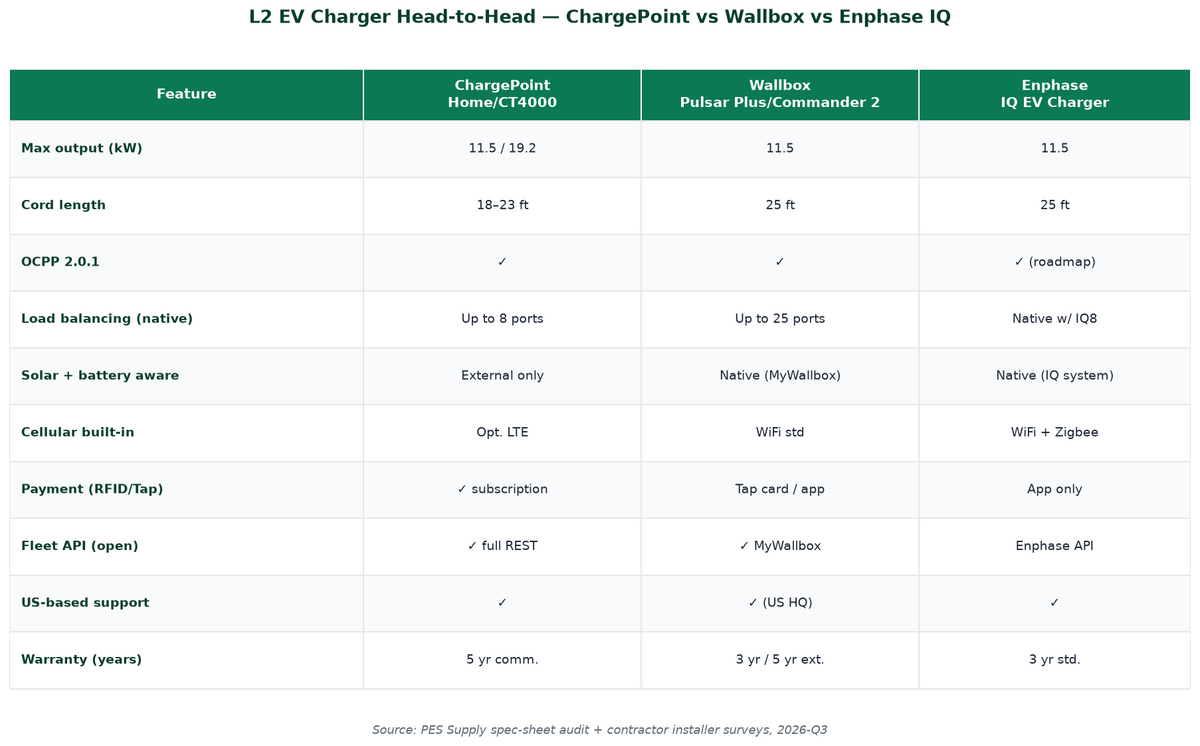
All three max out at ~11.5 kW (48A at 240V) on the residential/light-commercial line. ChargePoint's CT4000-series commercial units go to 19.2 kW (80A at 240V) — the class-leading L2 output — which matters for shorter-dwell fleet applications like a courier van doing a lunch top-up. Wallbox and Enphase do not have an 80A L2 SKU in 2026.
Cord length and connector
ChargePoint's residential Home Flex ships with 23 ft of cable, the CT4000 commercial units come in 18 ft (single) and 25 ft (dual-port). Wallbox Pulsar Plus is 25 ft standard. Enphase IQ EV Charger is 25 ft standard. All three offer both J1772 (universal) and NACS variants as of mid-2026 — Wallbox and Enphase were slower to ship NACS but both have production units by Q3 2026.
Load management
This is where the platforms diverge sharply.
ChargePoint Power Management: license-based dynamic load balancing across up to 8 ports on a shared circuit. Adds ~$300–$500 per port in software license. Requires a Power Management gateway (~$1,400) and an external CT meter clamp on the panel main. Works well; scales to 8 ports before requiring a second circuit.
Wallbox Power Boost: native dynamic load balancing built into every Pulsar Plus and Commander 2, up to 25 chargers on one circuit via daisy-chain over Modbus. No per-port license. Requires a Wallbox Power Meter (~$550, single unit) and the MyWallbox portal. This is the strongest native load-balancing story of the three — a 20-vehicle fleet depot on a single 400A service is a 1-day install rather than a $6,000 licensing add-on.
Enphase IQ EV Charger: native load management is tied to the Enphase Ensemble system — the IQ Combiner, IQ System Controller, and IQ8 microinverters coordinate the whole site (solar generation, battery state, home loads, EV charging) through the Enlighten app. If you do not already have an Enphase solar system on-site, the EV charger's native load management is limited. If you do, it is best-in-class because the system already knows real-time PV production and battery state.
Solar + battery awareness
Enphase wins here. The IQ EV Charger is designed as an Enphase Ensemble component: it dynamically ramps charging power to match instantaneous solar production, so 100% of EV energy on a sunny day comes from the array without exporting to grid or discharging the battery. This is a killer feature for residential + small-commercial solar homes and unavailable in a comparable form on ChargePoint or Wallbox.
Wallbox Solar Green Mode is a solid second: MyWallbox reads a compatible CT-clamp export meter and throttles the charger to consume only excess solar. It requires a supported CT meter and does not have deep integration with any specific solar inverter brand.
ChargePoint requires an external system (a Span Panel, an EnergyHub controller, or a third-party PV-EV coordinator) — solar-awareness is not native to the charger.
Networking and cellular
ChargePoint CT4000 ships with optional LTE cellular (extra module ~$500) plus WiFi and Ethernet standard. Wallbox Pulsar Plus is WiFi + Bluetooth standard; commercial Commander 2 adds Ethernet and cellular option. Enphase IQ EV Charger uses the Enphase IQ Gateway's existing network — no dedicated cellular for the charger itself.
Payment and access control
ChargePoint's commercial units support RFID card and app-based payment through the ChargePoint network subscription (~$26/port/month). Wallbox commercial has integrated tap-card or MyWallbox app payment through their Pay & Charge product. Enphase has no built-in payment — Enlighten app access is free but not billable to third parties, so Enphase is not the pick for revenue-generating public charging.
Fleet API
ChargePoint's Cloud API is the deepest — full REST endpoints for session data, remote start/stop, and driver management, well-documented. Wallbox's MyWallbox API is solid and increasingly comprehensive. Enphase's API is oriented around energy-system telemetry (production, consumption, battery SOC) rather than session-level charging control. For a fleet operator building a custom dispatch integration, ChargePoint is the deepest, Wallbox is close, Enphase is a distant third.
Warranty
ChargePoint commercial (CT4000): 5-year parts warranty standard, extendable to 8 years with the ChargePoint Assure service contract. Wallbox: 3-year standard, 5-year extended (~$120/unit). Enphase IQ EV Charger: 3-year standard. ChargePoint wins on default warranty term; Wallbox extended matches ChargePoint standard at ~$120 upgrade.
| Feature | ChargePoint Home Flex / CT4000 | Wallbox Pulsar Plus / Commander 2 | Enphase IQ EV Charger |
|---|---|---|---|
| Max output | 11.5 kW residential / 19.2 kW commercial | 11.5 kW | 11.5 kW |
| Cord length | 18–25 ft | 25 ft | 25 ft |
| Connector | J1772 or NACS | J1772 or NACS | J1772 or NACS |
| Native load balancing | License, up to 8 ports | Built-in, up to 25 ports | Ensemble-only (site-wide) |
| Solar aware | External integration required | MyWallbox Green Mode (CT meter) | Native (IQ system) |
| Payment | Network subscription | Tap card or app (Pay & Charge) | None (free app only) |
| OCPP 2.0.1 | Yes | Yes | On roadmap |
| Cellular | Optional LTE module | Optional cellular (commercial only) | Via IQ Gateway (WiFi/Zigbee) |
| Fleet API | REST, well-documented | MyWallbox API | Enlighten API (energy-focused) |
| Warranty | 5 yr standard, 8 yr Assure | 3 yr standard, 5 yr extended | 3 yr standard |
| Contractor price (single, unnetworked) | $650–$700 | $570–$650 | $700–$800 |
| Contractor price (dual-port commercial) | $5,500–$6,200 (CT4023) | $3,900–$4,800 (Commander 2) | N/A (single-port only) |
Scenario A: Single-family home with existing Enphase solar
Winner: Enphase IQ EV Charger. The install is a firmware add to the existing IQ Gateway; the charger reports through the same Enlighten app as the solar and battery; and the native solar-consumption mode is genuinely useful (fills the car from the array without exporting). Skip Wallbox and ChargePoint here — they solve a problem this site does not have.
Scenario B: Single-family home without solar
Winner: Wallbox Pulsar Plus. Cheapest of the three, cleanest install, best mobile app for a residential user, tap-card payment for guest charging if wanted. ChargePoint Home Flex is a solid alternative if the buyer prioritizes the ChargePoint network ecosystem (roaming, workplace credits). Enphase without an existing solar system is over-priced for what it offers.
Scenario C: Multi-family building, 8–20 stalls
Winner: Wallbox Commander 2. Native load balancing across up to 25 ports means one 400A service can safely support 15 concurrent chargers — no per-port license fees, one Modbus daisy chain. ChargePoint's per-port license makes an 15-port MFH install $5–8k more expensive over 5 years. Enphase's site-wide model works if the building has Enphase solar, otherwise it is not the right pick.
Scenario D: Workplace parking, 4–20 stalls, no revenue generation
Winner: Wallbox Commander 2 for the same reason as MFH — best load management economics at scale. If the site prefers deeper OCPP maturity and 5-year default warranty, ChargePoint CT4000 is a close second.
Scenario E: Workplace parking with revenue-share billing
Winner: ChargePoint CT4000. The ChargePoint network's billing, driver-account management, and workplace-credit features are more mature than Wallbox's. The 5-year default warranty and ChargePoint Assure add reliability that a revenue-generating asset justifies. Wallbox is catching up but not yet at parity for complex billing workflows.
Scenario F: Public commercial charging (retail, hotel, restaurant)
Winner: ChargePoint CT4000. Public visibility on the ChargePoint app drives incremental traffic; the payment infrastructure handles credit-card, subscription, and roaming; the warranty and service network is the widest. Wallbox is a plausible alternative for smaller sites; Enphase is not the right fit for public charging because there is no built-in payment.
Scenario G: Small-fleet depot (5–15 vans)
Winner: Wallbox Commander 2. The native load management and lower per-port cost win against ChargePoint's licensing model. For larger fleets (20+ ports), ChargePoint's fleet-specific tools may pull ahead — but at pilot scale, Wallbox wins on pricing and simplicity.
Scenario H: Small-commercial with existing Enphase solar + battery
Winner: Enphase IQ EV Charger. Same logic as Scenario A — the whole-site energy coordination is worth the trade-off of Enphase's weaker networking and no built-in payment. Small dental offices, veterinary clinics, and legal offices with employee EV parking commonly land here.
-
1
Q1: Does the site already have Enphase solar?
If yes AND the site is not doing revenue-generating public charging, Enphase IQ EV Charger is the pick. Move to install planning. If no, continue to Q2.
-
2
Q2: Is the site revenue-generating public charging (hotels, retail, restaurants)?
If yes, ChargePoint CT4000 is the safest pick — mature payment, biggest driver network, longest warranty. If no, continue to Q3.
-
3
Q3: How many ports will the site have — now or in the next 3 years?
If 8+ ports, Wallbox Commander 2 wins on load-management economics (no per-port license). If 1–7 ports and public, ChargePoint. If 1–3 ports residential, either Wallbox Pulsar Plus or ChargePoint Home Flex — pick on preferred app UX.
-
4
Q4: Do you need OCPP 2.0.1 today?
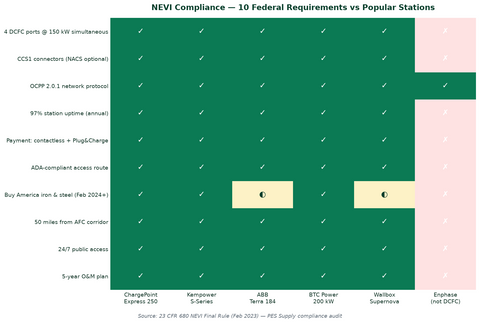
If yes (NEVI, fleet management platform, third-party network operator), Wallbox and ChargePoint qualify; Enphase is on the roadmap but not shipping 2.0.1 in 2026.
-
5
Q5: What's the max L2 power needed per port?
If any port needs 19.2 kW (80A), only ChargePoint CT4000-series delivers. Otherwise, all three are equivalent at 11.5 kW.
All three brands install onto standard 240V (residential) or 208Y/120V, 240/120V, or 480Y/277V (commercial) branch circuits. The physical install is a common electrical job; the differentiation is in the commissioning software and network registration.
ChargePoint installation notes
Commercial CT4000 units require a bolted pedestal base ($400–$600) or wall-mount kit. Cable strain relief through the pedestal collar is critical — poorly finished terminations account for most warranty claims. Network activation requires a ChargePoint CPO account and can take 3–10 days for a new activation. Plan the commissioning window accordingly.
Wallbox installation notes
Pulsar Plus is small (7.9" × 5.7" × 3.9") and wall-mounts with 4 screws. Commander 2 is a pedestal or wall unit with an integrated 7" display for public-facing sites. Commissioning is a Bluetooth pairing to the installer app, then WiFi credentials. Wallbox commissioning is 3–5 minutes per unit — fastest of the three.
Enphase IQ EV Charger installation notes
The IQ EV Charger commissions through the Enphase Installer Toolkit app, same tool the electrician already uses for IQ microinverters and IQ Battery installs. This is a real advantage on Enphase-shop sites — no new tool to learn. Uses the existing IQ Gateway for networking; if the site is Enphase-native, add commissioning time is 5–10 minutes.
Universal commissioning steps
For all three: torque the terminal lugs to manufacturer spec (typically 4–6 Nm for #6–#4 CU), verify GFCI trip with a test button, confirm ground continuity with a low-ohm meter, run one full charging session with a test vehicle, and register the unit with the network operator (or Enphase Enlighten site). Total commissioning time: 20–40 min per unit for a first install, 10–15 minutes once the electrician has done a few.
Contractor pricing does not tell the full story. Each platform has ongoing costs that materially affect 5-year TCO.
ChargePoint monthly recurring
- Cloud Plan: $26/port/month for public sites, $18 for workplace. Includes driver network, billing, remote monitoring.
- ChargePoint Assure (warranty + O&M): $250–$450/port/year for extended warranty and dispatched service.
- Cellular data: $8–$12/port/month if using ChargePoint's cellular gateway.
Wallbox monthly recurring
- MyWallbox Business: $12/port/month for load balancing, driver management, and Pay & Charge (revenue-generating sites).
- Extended warranty (year 4–5): ~$120/unit one-time.
- No cellular fee — uses site WiFi standard.
Enphase monthly recurring
- Enlighten Manager Basic: free (included with IQ Gateway).
- No network subscription — charger reports through IQ Gateway.
- No payment infrastructure — not applicable for revenue sites.
Over 5 years on a 10-port workplace site, ChargePoint's recurring cost = 10 × $18 × 60 = $10,800 network + $15,000 Assure = $25,800. Wallbox = 10 × $12 × 60 = $7,200 + $1,200 extended warranty = $8,400. Enphase = $0. The recurring cost tilts significantly toward Enphase and Wallbox for cost-sensitive workplace sites, and toward ChargePoint only when the network features (public billing, driver credits, roaming) justify the premium.
Can I mix ChargePoint, Wallbox, and Enphase on the same site?
Is Wallbox's 25-port daisy chain reliable in production?
Does Enphase's solar-awareness work with a non-Enphase solar array?
Which is easiest for a residential DIY install?
What about ChargePoint Home Flex vs Wallbox Pulsar Plus for a residential 240V install?
Are all three ADA-compliant?
Do I need OCPP compliance to future-proof?
Where does PES Supply fit in the stocking picture?
Get all 3 quoted head-to-head against your site plan
Register for the PES Supply contractor portal. Upload your site plan and load profile — we quote ChargePoint, Wallbox, and Enphase side-by-side with real installed costs, warranty terms, and load-management license fees so you can pick with real numbers, not marketing sheets.
Register Now