Updated September 2026 — content reviewed and refreshed by the PES team. For current pricing and availability, see the linked product pages or request a quote.
Motor Control Selector for Electrical Contractors — DOL, Soft-Start, VFD
Select the right starter for any three-phase induction motor from 1 HP fractional to 400 HP industrial. NEMA vs IEC sizing, NEC 430 branch-circuit rules, VFD harmonics, PES-stocked Square D, Eaton, and Schneider Electric drives.

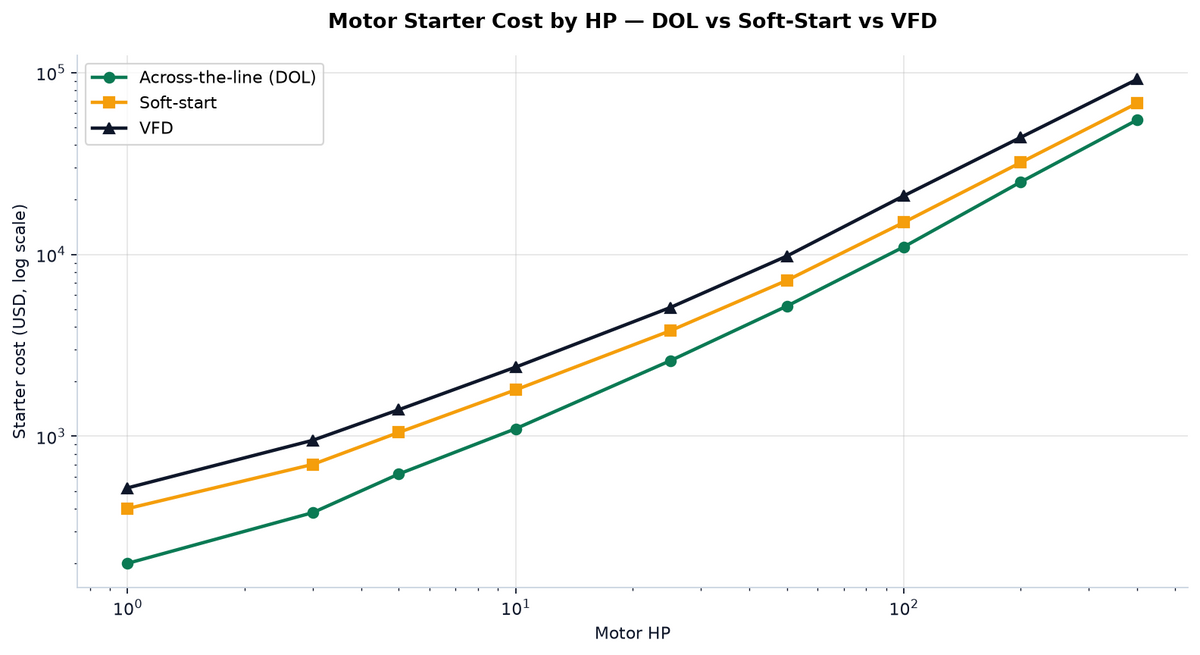
Every three-phase motor needs a starter. Contractors who default to across-the-line (DOL) starters lose bids on any motor above 20 HP because the inrush current (typically 600-800% of FLC) either violates the utility service agreement or trips upstream OCPDs. Contractors who default to VFDs on every motor overspend by 30-50% on motors that only need across-the-line or soft-start.
The three-way selection depends on: motor size, driven load (constant torque, variable torque, high-inertia), utility voltage-flicker limits, energy efficiency mandate (2024 IECC 90.1), and duty cycle. This guide gives the decision framework and the PES-stocked SKUs for each path.
| Motor HP | Constant torque (conveyor, mixer) | Variable torque (fan, pump) | High-inertia (chiller, blower) |
|---|---|---|---|
| < 5 HP | DOL magnetic (Eaton XT / Square D 8536) | DOL magnetic | DOL magnetic |
| 5-25 HP | DOL or soft-start | DOL or VFD (if speed control needed) | Soft-start |
| 25-100 HP | Soft-start (Eaton S811+, Schneider ATS22) | VFD (Eaton PowerXL DG1, Schneider ATV340) | Soft-start or reduced-voltage |
| 100-300 HP | Soft-start or VFD | VFD (energy savings pays back in 12-24 mo) | Soft-start with bypass |
| > 300 HP | Medium-voltage soft-start or VFD | Medium-voltage VFD | Medium-voltage soft-start |
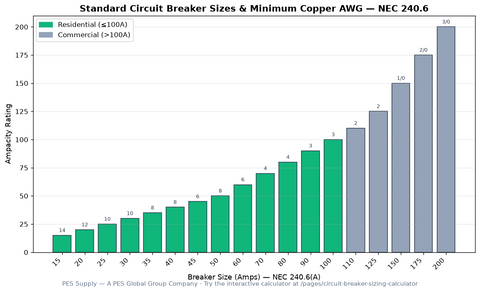
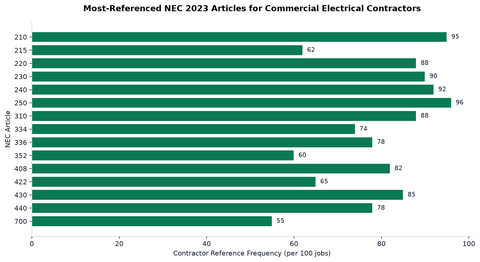
Motor branch circuits break the standard 240.4(D) OCPD-vs-conductor rule. NEC 430 has its own table (430.52) for maximum overcurrent device size — up to 250% of FLC for inverse-time breakers on Design A/B motors, up to 300% for Design C, up to 400% for time-delay fuses.
The three separate sizing calculations for a single motor branch:
- Conductor size — 430.22: not less than 125% of motor FLC from Table 430.250 (three-phase). A 20 HP 480V motor has an FLC of 27 A; the branch conductor is sized for 27 x 1.25 = 33.75 A minimum — #10 THHN at 75°C (35 A).
- Overcurrent device — 430.52: for the same 27 A motor, inverse-time breaker sized to 27 x 2.50 = 67.5 A, rounded up to 70 A per 430.52(C)(1) exception 1. Yes — a 70 A breaker on a #10 conductor. This is the motor-branch exception.
- Overload protection — 430.32: separate device (usually inside the starter contactor) rated 115-125% of the motor's actual nameplate FLA, not the Table 430.250 value.
Contractors who size the OCPD from 240.4(D) instead of 430.52 fail motor start every time (breaker trips on inrush) or install a breaker too small to carry the running load.
Soft-starters ramp voltage from ~30% to 100% over 5-30 seconds, limiting inrush to ~350% of FLC and mechanical shock to belts, couplings, and pump seals. They cost 40-60% of a VFD and are the correct choice when:
- The motor runs at fixed speed once started
- Reducing inrush and mechanical shock is the only requirement
- Utility flicker limits (ANSI C84.1) are the driver
VFDs (variable-frequency drives) modulate both frequency and voltage, giving continuous speed control from 0-100% (and beyond, with over-frequency capability). They are the correct choice when:
- The driven load (fan, pump) benefits from speed reduction — cube-law power savings mean a 20% speed reduction on a fan saves 49% power
- Process control requires variable throughput
- The motor duty cycle involves frequent starts (VFDs handle 1000+ starts per hour vs 6-10 for magnetic starters)
2024 IECC 90.1 tables 6.5.3.2.1 and 10.4 mandate VFDs on many HVAC fan and pump applications. If you are bidding a commercial retrofit or new construction, verify the mechanical spec — a lot of contractors bid across-the-line and lose the change order to a VFD upgrade mid-project.
| Brand | Product (linked) | Category | Contractor Price |
|---|---|---|---|
| Square D | Square D HOMT2020250 Circuit Breaker | Circuit Breakers | $92.38 |
| Square D | CIRCUIT BREAKER, QOU, 30A, 120/240VAC / 48VDC MAX, 2-POLE, SQUARE D, SURFACE OR DIN MNT, 1.5IN, QOU230 | Electrical | $86.23 |
| Eaton | Eaton DH364NRK 200A 3PH Fusible Safety Switch NEMA 3R | Solar Kits | $1,672.34 |
| Eaton | Eaton Dura-blok Rooftop Channel Support 1' Channel 5' x 6' x 9.6' - DB10 | Racking & Mounting | $31.88 |
| Schneider Electric | Schneider Conext XW PRO 6848 6.8kW Hybrid Inverter | Hybrid Inverters | $3,299.23 |
VFDs generate harmonic distortion on the AC input side. Standard 6-pulse drives produce 30-45% total harmonic current distortion (THD-i) at the drive terminals; IEEE 519-2014 limits this at the point of common coupling (PCC) to 5% THD-v and current distortion based on the short-circuit ratio (I_sc / I_L).
Options to meet IEEE 519 on a commercial retrofit:
- Line reactors (3-5% impedance) — cheapest at ~$300-$800 per drive up to 100 HP. Reduces THD-i to 30-35%. Sufficient if PCC ratio > 100.
- DC-bus chokes — Built into premium drives. THD-i to 30%. Same $300-$800 line-reactor bracket.
- Passive harmonic filters — ~$1,500-$4,000 per drive up to 100 HP. THD-i to 8-12%.
- Active harmonic filters — $8,000-$20,000 per drive. THD-i to < 5%. Required only on large systems or sensitive locations.
- 18-pulse or 24-pulse drives — Premium ~1.4x cost vs 6-pulse. THD-i to < 8% without external filtering.
Portlandia stocks Eaton PowerXL DG1 with built-in DC-bus chokes and Schneider ATV630 with integrated line reactor — good IEEE 519 compliance without external hardware for most commercial applications.
Before ordering any motor starter, collect the motor nameplate and driven-load characteristics. The 12 data points that drive starter selection:
- Voltage — 208V, 240V, 460V, 480V, 575V, 600V; single-phase or three-phase.
- Horsepower — Motor nameplate HP (this determines contactor and overload size).
- Full-load amps (FLA) — From nameplate. This is more accurate than Table 430.250 FLC for overload sizing.
- Service factor — 1.0 (standard) or 1.15 (continuous-duty). Affects overload trip point.
- NEMA design (A, B, C, D) — Design B is most common; C is for high-inertia loads; D for very high-torque intermittent-duty.
- Code letter (locked-rotor code) — Letter A through V from NEMA MG 1 Table 10-6. Higher letters = higher inrush.
- Motor efficiency class — IE1, IE2, IE3, IE4, or NEMA Premium. Affects VFD compatibility (inverter-duty).
- Frame size — NEMA T-frame (56T, 143T, 254T, etc.) or U-frame (older).
- Enclosure — ODP (open drip-proof), TEFC (totally-enclosed fan-cooled), TENV, WPI/WPII.
- Insulation class — Class B, F, H. Affects VFD compatibility.
- Ambient temp — Usually 40°C rated.
- Application — Compressor, fan, pump, conveyor, mixer, hoist — determines starting torque profile.
Missing any of these lengthens the order by 24-72 hours while the counter clarifies with the customer.
NEMA contactor sizes 00, 0, 1, 1P, 2, 3, 4, 5, 6, 7, 8, 9 correspond to specific HP ratings at each voltage. IEC contactors are current-rated (typically 9 A, 12 A, 18 A, 25 A, 32 A, 40 A, 50 A, 65 A, 80 A, 95 A, 115 A, 145 A, 185 A, 265 A, 330 A, 400 A, 500 A, 630 A, 800 A) and duty-rated (AC-1 through AC-4).
NEMA advantages: rugged construction, longer contact life on high-cycling applications, tolerant of overload without immediate contact tip degradation. Standard for U.S. industrial, particularly on frequent-cycling applications.
IEC advantages: smaller physical size (30-50% smaller than equivalent NEMA), lower cost, easier to specify by amperage rather than HP look-up. Standard for commercial HVAC, packaging equipment, and OEM machines.
PES stocks both: Eaton XT series (IEC) 9A-800A, Eaton A200 series (NEMA) size 00-8, Schneider TeSys D (IEC) 9A-150A, Schneider 8536 (NEMA) size 00-6.
Modern VFDs have 200-800 programmable parameters. Contractors delivering commissioned drives should configure at minimum:
- Motor nameplate parameters — Voltage, FLA, frequency, base speed, HP.
- Start / stop control source — Terminal strip vs keypad vs communication.
- Reference (speed command) source — Terminal 0-10V, 4-20 mA, keypad, communication.
- Acceleration time — Ramp from 0 to base speed. Typical 5-30 sec for fans, 2-10 sec for pumps.
- Deceleration time — Ramp from base speed to 0. Typical 5-30 sec; long enough to avoid overvoltage on braking.
- Maximum frequency — Usually 60 Hz; can be raised for overspeed applications up to 90-100 Hz with motor OEM approval.
- Minimum frequency — Usually 6-12 Hz. Below this, motor cooling drops off and thermal overload risk climbs.
- Torque boost — Manual or auto voltage boost at low speed to overcome breakaway load torque.
- Switching frequency — Higher (8-16 kHz) reduces motor audible noise but increases drive heating and cable-length sensitivity. Standard 4-8 kHz.
- Overload class — Class 10, 20, 30 — trip time at 600% overload.
- Fault reset — Auto-reset count and delay.
- PID loop (if closed-loop) — Setpoint source, feedback source, proportional, integral, derivative gains.
Deliver the programmed parameter list as an as-built to the owner. Store the drive-specific EDS (Electronic Data Sheet) or FDT/DTM object with the O&M documentation.
NEC 430 minimum protection is overload and short-circuit / ground-fault. Best practice on critical motors adds:
- Phase-loss protection — Detects single-phasing (loss of one of three phases). Standard on modern electronic overload relays (Eaton C440, Schneider LR9).
- Ground-fault protection (motor) — 30 mA or 100 mA equipment ground-fault, faster than the branch OCPD.
- Thermistor / RTD monitoring — Motor winding-embedded thermistors (PTC) or RTDs (100Ω Pt) monitored by the overload relay or a separate motor-protection module.
- Reverse rotation detection — Phase-rotation monitoring on high-consequence loads (pumps, compressors) prevents damage from reversed leads.
- Under-voltage protection — Drops out contactor on utility voltage sag to prevent stalling.
- Motor bearing monitoring — Vibration and temperature sensors on critical motors, wired to the plant PLC or PdM system.
Modern integrated motor-management units (Eaton C441, Schneider TeSys T, ABB M102) combine 6-12 of these functions in a single DIN-rail device with Modbus TCP or EtherNet/IP communication to the plant control system.
NEC 430.52 permits several OCPD types on motor branch circuits. The two most common in commercial installations:
Motor Circuit Protector (MCP) — Instantaneous-trip only (no long-time thermal element). Trip range typically 6-13x motor FLC, adjustable. Requires overload protection separately (in the starter). Advantage: highest permitted OCPD (up to 1300% of FLC) minimizes nuisance trips on motor start. Disadvantage: no thermal element means the MCP does not protect against sustained overloads — the overload relay is the sole thermal protection.
Inverse-time motor-rated breaker — Thermal-magnetic breaker with a trip curve suited to motor loads. Table 430.52 limits to 250% of FLC. Advantage: provides both short-circuit and thermal protection. Disadvantage: lower permitted rating means nuisance trips on high-inrush motors.
PES stocks Square D HDA and Eaton HMCPS motor circuit protectors, and standard inverse-time breakers from all five OEMs for motor applications.
Long motor cables from VFDs cause voltage spikes at the motor terminals due to reflected waves. NEMA MG 1 Part 31 requires inverter-duty motors to withstand 1600 V peak with 0.1 µs rise time. Beyond 100-300 ft cable length (depending on drive switching frequency), field-added protection is required:
- Output reactor — 3% impedance three-phase reactor at the drive output. Slows the voltage rise time. Adds ~$250-$1,500 per drive.
- dV/dt filter — LC filter reducing peak voltage and rise time. Adds ~$400-$3,000 per drive.
- Sine-wave filter — Full LC filter producing near-sinusoidal output. Adds ~$800-$8,000 per drive. Used for very long cable runs (> 1000 ft).
VFD cable specification: use shielded VFD cable (Belden 29xxx series, General Cable Carol Brand SuperVee) with symmetrical grounding. Ground shield at both ends via 360° termination. Standard THHN in raceway is NOT recommended for VFD outputs longer than 25 ft — capacitive coupling causes bearing currents in the motor.
Motor control assemblies range from NEMA 1 indoor panels to NEMA 4X washdown to NEMA 7 hazardous. Selection questions:
- Environment (indoor / outdoor / wet / corrosive / hazardous)
- Ambient temperature range
- Space constraints (mounting depth, clearance)
- Access requirements (front-only vs front-and-rear)
- UL 508A vs NEMA ICS 6 vs foreign standard
Common configurations:
- Individual motor starter — Single starter in wall-mount NEMA 1 or NEMA 4X box. Rated 1-100 HP typically. Simplest and cheapest.
- MCC (motor control center) — Multiple starters, VFDs, and control components in a vertical bus assembly. Standard for > 5 motors. NEMA 1 indoor typical; Eaton Freedom 2100, Square D Model 6, Siemens Sinvert MCC lines.
- Combination starter cabinet — Multiple starters in a single door-through-cover cabinet, common in commercial HVAC and industrial packaging equipment.
PES supplies all three configurations, from individual XT starters through fully-engineered MCCs.
The two largest categories of motor applications in commercial and industrial installations are fans (HVAC air handlers, exhaust) and pumps (chilled water, condenser water, boiler feed). Both are variable-torque loads: torque varies with the square of speed, power varies with the cube.
Practical implications:
- VFDs are the correct starter choice for most fan and pump applications above 5 HP. The energy savings (~20-40% at typical operating points) pay back drive cost in 12-36 months.
- ASHRAE 90.1 and IECC 2024 mandate VFDs on many fan applications, particularly VAV air handling systems, chilled water pumps > 50 HP, and cooling tower fans.
- Minimum speed limits — Below ~30% speed, motor cooling drops off and thermal margin shrinks. VFD parameters set minimum frequency accordingly.
- Bypass contactor — Almost always specified for critical fan/pump loads so a drive failure does not shut down the load.
Portlandia stocks Eaton PowerXL DG1, Schneider Altivar 630, and Yaskawa Z1000 drives specifically configured for HVAC applications.
Refrigeration compressors, air compressors, and positive-displacement pumps present different starting characteristics than centrifugal fans/pumps:
- High starting torque required (100-200% of full-load torque).
- Constant-torque load throughout the operating range.
- Frequent starting (some applications 20+ starts/hr).
Starter choices:
- Soft-start on 30 HP and above — typical selection. Ramps to full voltage in 5-15 seconds while limiting inrush to ~350% of FLC.
- DOL on smaller compressors where inrush is acceptable to the utility service.
- VFD only when process requires variable output (variable-speed screw compressors, variable-speed rooftop refrigeration).
For refrigeration specifically, verify motor is suitable for VFD operation — some hermetic and semi-hermetic compressors are not.
Motor OEMs (Baldor, WEG, Marathon, TECO) preserve warranty based on the motor's operating envelope. Common warranty-voiding conditions:
- Operation outside voltage tolerance (typically ±10% of nameplate).
- Operation outside frequency tolerance (typically ±5% of nameplate).
- VFD operation on a non-inverter-duty motor (NEMA MG 1 Part 30 pre-1998 motors).
- Ambient temperature above nameplate (typically 40°C).
- Extended low-speed operation without VFD-compatible cooling.
- Water ingress on ODP motors.
Preserving warranty requires: nameplate documentation at commissioning (photograph nameplate, save to project file), operating parameters logged (VFD historian or plant PLC), and maintenance records (bearing greasing, insulation testing) kept for warranty period.
Beyond basic overload protection, modern motor management includes predictive maintenance:
- Motor current signature analysis (MCSA) — Analyzes current waveform harmonics to detect broken rotor bars, air-gap eccentricity, and bearing damage. Portable analyzers (Emerson AMS, Fluke 438-II) or permanent monitors (Eaton MP-4000, Schneider TeSys T).
- Vibration monitoring — Accelerometers on motor housing detect bearing wear, misalignment, and unbalance. Handheld (Fluke 810) or permanent wireless (Emerson AMS Wireless, SKF Enlight).
- Insulation resistance — Meg-ohm testing at 500-1000 V DC. Trend over time detects insulation aging.
- Polarization index (PI) — Ratio of 10-min to 1-min meg-ohm reading. PI < 2 indicates aged or contaminated insulation.
Facility managers adopting predictive maintenance typically avoid 60-80% of unexpected motor failures. Portlandia can quote monitoring hardware, portable analyzers, and integration with plant PLCs.
VFDs create common-mode voltage that can drive shaft-to-ground current through motor bearings, causing electrical discharge machining (EDM) pitting. Mitigation:
- Shaft grounding rings — AEGIS SGR, Inpro/Seal MGS. Conductive ring shorts shaft to frame, diverting bearing current.
- Insulated bearings — Ceramic or coated bearings prevent current flow. Standard on premium inverter-duty motors.
- Common-mode chokes — At VFD output, reduces common-mode voltage.
- Sine-wave filter — Full LC filter eliminates high-frequency common-mode voltage.
Motors below 30 HP typically tolerate VFD operation without additional mitigation. Above 30 HP with cable runs > 100 ft, add shaft grounding ring or insulated bearings.
When is a magnetic starter (DOL) the wrong choice?
Do I need a bypass contactor with a VFD?
NEMA vs IEC contactor rating — which do I bid?
What is the difference between a soft-starter and a reduced-voltage starter?
Do VFDs work with premium-efficiency (IE3/IE4) motors?
Can VFDs be used on 208V systems?
Order Motor Control Equipment from PES
Eaton XT & PowerXL, Square D 8536 & Altivar, Schneider ATV & ATS lines. Same-day fulfillment on stocked SKUs.
Register Now