Updated September 2026 — content reviewed and refreshed by the PES team. For current pricing and availability, see the linked product pages or request a quote.
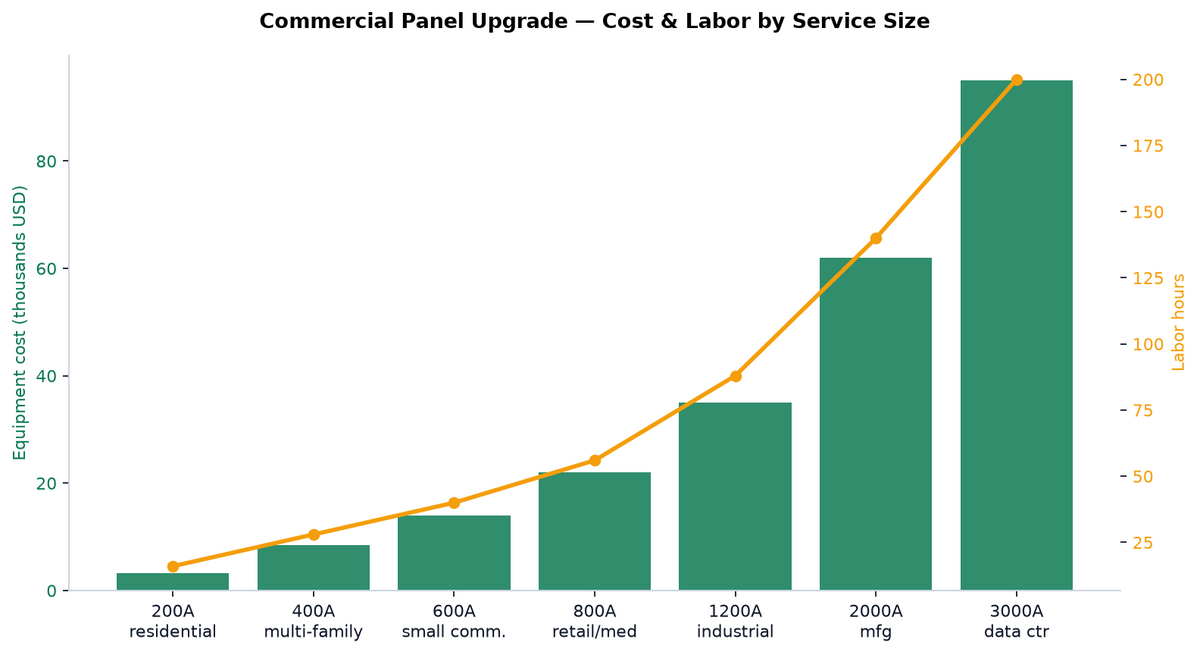
Commercial Panel Upgrade Contractor Guide — 200A to 3000A Service
Bid, permit, and install commercial service upgrades from 200 A residential-fed to 3000 A switchgear. Load calculations, utility coordination, transformer sizing, panelboard vs switchboard vs switchgear selection, and the multi-brand equipment matrix for Square D, Eaton, Siemens, GE, and Schneider.

Every commercial service upgrade starts with a load study, not with a Square D catalog page. NEC 220 dictates two acceptable methods: 220 Part III (standard calculation from occupancy VA/ft² and connected load) and 220.87 (measured maximum demand plus 25%). The measured method typically returns a smaller (and cheaper) service size — a 400 A calculated load often becomes a 320 A measured load, and the customer saves $12,000 on switchboard delta.
Deploy a Fluke 1738 or Dranetz HDPQ recording meter for 30 days on the existing service; NEC 220.87 accepts any 15-minute-interval data set that captures the highest-demand period. Portal-registered PES contractors can rent metered loggers from our loaner pool for a $200 refundable deposit.
-
1
Step 1 — Measured load study (NEC 220.87)
Install recording meter on existing service for ≥ 30 days including peak season. Extract 15-minute demand data. New service size = maximum recorded demand + 25% for new load.
-
2
Step 2 — Coordinate with utility
For LG&E (Louisville metro) or your local utility: submit new-service application, receive service-point letter, confirm transformer capacity and secondary voltage. Utility engineering typically 3-8 week response.
-
3
Step 3 — Select service entrance equipment
Panelboard (up to 1200 A, molded-case), switchboard (up to 5000 A, group-mounted MCCBs or LV insulated-case), or switchgear (metal-clad, drawout, medium-voltage). See the multi-brand matrix below.
-
4
Step 4 — Coordinate short-circuit and selective coordination study
NEC 110.9 requires interrupting rating ≥ available fault current. NEC 700.32 / 701.27 require selective coordination on emergency and legally-required standby systems. Both usually done in SKM Power*Tools or ETAP.
-
5
Step 5 — Draft riser diagram and single-line
Include utility metering, service disconnect, GEC and MBJ, transient voltage surge suppressor (SPD), tap boxes, downstream feeders, and grounding electrode system. Submit with permit.
-
6
Step 6 — Permit and Metro plan review
Louisville Metro Codes & Regulations reviews commercial service ≥ 400 A within 10 business days. Include stamped drawings for Kentucky PE if service > 800 A.
-
7
Step 7 — Cutover planning
Coordinate downtime window with tenant; typical 4-8 hour outage for like-for-like, 12-24 hours for size increase. Utility hot cut coordinated 72 hours in advance.
-
8
Step 8 — Install and test
Grounding electrode system first (250.53), then transformer secondary and service conductors, then panelboard/switchboard bus, then feeders. Meg-ohm test all phase conductors before energization.
-
9
Step 9 — Utility inspection and energization
Utility inspector verifies metering, grounding, and service disconnect labeling. LG&E typically energizes within 48 hours of green tag.
-
10
Step 10 — Load balance and commissioning
Measure phase currents at 25%, 50%, 75% load; rebalance branch circuits with the portal load balance calculator. Deliver as-builts, warranty registrations, and manufacturer commissioning reports to owner.
| Ampacity | Equipment class | Typical use | PES-stocked brand |
|---|---|---|---|
| 100-200 A | Load center (1Ø) | Small retail / office | Square D QO, Eaton BR |
| 200-400 A | Panelboard (I-Line, Pow-R-Line 1a) | Multi-tenant, large retail | Square D I-Line, Eaton Pow-R-Line |
| 400-800 A | Panelboard (Class-1 or 2, main-lug or main-breaker) | Small commercial, restaurants, industrial branch | Square D NF/NQ, Eaton PRL2a, Siemens P1 |
| 800-1600 A | Panelboard or LV switchboard | Mid-size commercial, industrial feeders | Square D I-Line, Eaton Pow-R-Line C, Siemens P2 |
| 1600-3200 A | Low-voltage switchboard | Large commercial, industrial main service | Square D QED-2/QED-3, Eaton Magnum, Siemens WL |
| 3200-5000 A | Switchboard or switchgear (LV) | Data centers, hospitals, campuses | Square D QED-6, Eaton Magnum DS, Siemens WL |
| 4160V+ | Medium-voltage switchgear | Utility interface, large industrial | Square D SM/HVL, Eaton VacClad-W, Siemens Type GM |
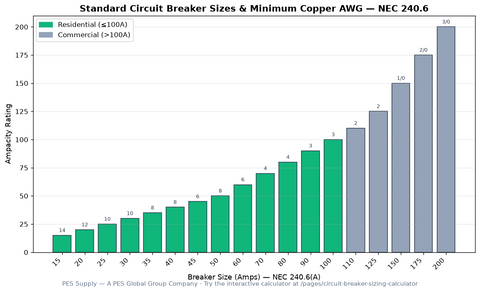
For services above 400 A, parallel conductors become mandatory (NEC 310.10(H)). Two 250 kcmil copper conductors per phase carry 510 A at 75°C — comfortably under a 500 A OCPD with 25% headroom. The parallel rule (310.10(H)(2)) requires all conductors in a set to be identical length, size, insulation, and terminated identically.
Use the wire-sizing calculator and voltage-drop calculator together — a 400 A service run 250 ft to a distant subpanel needs 500 kcmil copper (not 250 kcmil) to keep voltage drop below the 3% recommended value in 210.19(A) informational note 4.
| Brand | Product (linked) | Category | Contractor Price |
|---|---|---|---|
| Square D | Square D HOMT2020250 Circuit Breaker | Circuit Breakers | $92.38 |
| Square D | CIRCUIT BREAKER, QOU, 30A, 120/240VAC / 48VDC MAX, 2-POLE, SQUARE D, SURFACE OR DIN MNT, 1.5IN, QOU230 | Electrical | $86.23 |
| Eaton | Eaton DH364NRK 200A 3PH Fusible Safety Switch NEMA 3R | Solar Kits | $1,672.34 |
| Eaton | Eaton Dura-blok Rooftop Channel Support 1' Channel 5' x 6' x 9.6' - DB10 | Racking & Mounting | $31.88 |
| GE | General Electric 9.6 kW Single Phase Inverter - GEP9.6-1-US30 | Solar Inverters | $2,038.33 |
| GE | General Electric 7.7 kW Single Phase Inverter - GEP7.7-1-US30 | Solar Inverters | $1,956.53 |
| Schneider Electric | Schneider Conext XW PRO 6848 6.8kW Hybrid Inverter | Hybrid Inverters | $3,299.23 |
The biggest bid loser in commercial service upgrades is underestimating downtime. Building owners with a 24/7 operation (data center, hospital, hospitality) will not accept a 12-hour outage. Options:
- Temporary generator with paralleling switchgear — 500-2000 kW rental with an ATS pre-installed. Cost: $8,000-$30,000 for a 3-day rental including fuel and operator.
- Kirk-key interlocked temporary feeder — Pull new service into a temporary termination cabinet, transfer load device-by-device, then cut over the interlock. Downtime per device: 15 min. Total planned outage: 0.
- Utility hot-swap — LG&E can hot-swap a padmount transformer if the secondary is above ground and accessible. Coordination required 60 days in advance; usually free.
Contractors who quote a bare-metal cutover ($$$ savings on paper) lose the bid to competitors offering a 0-downtime option. Portlandia stocks Square D QOD kirk-key kits and Eaton XT-series interlock accessories in-house.
NEC 230.95 requires ground-fault protection of equipment (GFPE) on solidly-grounded wye services rated 1000 A and larger at 150-600V phase-to-ground. This is not a person-protecting 5 mA GFCI — it is a line-side ground-fault relay trip protecting the equipment from arcing faults that overcurrent devices might not clear.
Implementation options:
- Zero-sequence current transformer — Donut-shaped CT around all phase conductors AND neutral. Any imbalance = ground-fault current. Cheapest.
- Residual (ground return) — CTs on each phase and neutral, summed electronically. Suits parallel-feeder installations where zero-sequence CT does not fit around all conductors.
- Ground-strap sensing — CT on the main bonding jumper. Simpler but only catches ground faults; misses phase-to-neutral faults.
NEC 230.95 requires GFPE trip ≤ 1200 A with a max time delay of 1 second. Field testing per 230.95(C) required at commissioning (annual is best practice). PES stocks Bender ground-fault relays, Square D Micrologic-equipped trip units, and Eaton Digitrip trip units integrated on Magnum and Pow-R-Line switchgear.
NEC 700 (emergency), 701 (legally-required standby), and 702 (optional standby) drive the number, type, and installation of ATS and gensets on commercial services. Buildings that trigger emergency requirements:
- Life-safety egress lighting — Any building requiring illuminated egress per NFPA 101 or IBC.
- Fire pumps — NFPA 20 fire pumps require Article 695 alternate power (typically a dedicated ATS from the emergency source).
- Elevator emergency lowering — Elevator machine-room lighting and lowering circuit on emergency.
- Smoke evacuation fans — High-rise smoke-control fans on emergency or legally-required standby depending on building.
Selective coordination (NEC 700.32, 701.27) requires the OCPD nearest the fault to open FIRST and no upstream device to operate. Achieved through fuse-fuse coordination (dual-element fuses upstream, standard fuses downstream), breaker settings with instantaneous-trip discrimination, and time-current curve analysis in SKM Power*Tools or ETAP.
Metering configuration drives the meter socket, current transformers, and enclosure. LG&E Louisville and KU (Kentucky Utilities) both require specific meter socket brands: Milbank, Durham, or Eaton per LG&E specification 2022-1. Meter socket configurations:
- Self-contained — Up to 200 A single-phase or 400 A three-phase; meter connects directly to socket blades. Simplest and cheapest.
- CT-rated (400 A single-phase or 800 A three-phase and above) — Meter reads current through utility-supplied CTs (typically 200:5 through 3200:5) and voltage taps. Meter enclosure separate from CT enclosure.
- Instrument-transformer rated (MV and large LV) — Both CT and PT transformation; typically 15-25 kV primary or large LV services above 3000 A.
LG&E requires meter socket location within 5 ft of service disconnect for CT metering, and meter number and wire-way clearance specifications documented in their spec book. Portlandia stocks the approved meter sockets and pre-wired CT cabinets.
NEC 408.4 requires a legible panel directory identifying every circuit — device type, occupancy, area served. Digital panel schedules (created in Bluebeam, Revit, or AutoCAD panel schedule blocks) are standard on commercial projects and required deliverables on institutional and public projects.
Panel schedule elements:
- Circuit number, phase, pole count
- Breaker rating and interrupting rating (AIC)
- Circuit type: L (lighting), R (receptacles), M (motor), K (kitchen), etc.
- Load per phase in VA or A
- Description of load / area served
- Feeder size and length
- Panel bus rating, voltage, phase, wire configuration
Turnover includes: panel schedules (as-built), single-line diagram (as-built), short-circuit study, coordination study, arc-flash study, warranty registrations for OEM equipment, commissioning reports (megger, thermographic scan, insulation resistance), and torque values on all lug terminations.
Many commercial panel upgrades involve stepping down utility service voltage. LG&E's typical secondary is 208V/120V wye or 480V/277V wye; some legacy 240V delta systems remain. Transformer sizing:
- Calculate load in kVA — Sum of phase loads / power factor. Assume PF 0.85 unless nameplate data available.
- Add 25% for growth — NEC 220.87 practice.
- Round up to standard rating — 15, 30, 45, 75, 112.5, 150, 225, 300, 500, 750, 1000, 1500, 2000, 2500, 3000 kVA.
- Verify impedance — %Z typically 3-6%. Higher impedance limits fault current but increases voltage regulation.
- K-factor — For loads with non-linear currents (VFDs, LED lighting, IT equipment) specify K-4, K-13, or K-20 transformer. Standard K-1 overheats on modern building loads.
Portlandia stocks Square D EE and Eaton DT-series dry-type transformers 15-500 kVA; larger drop-shipped. Use the portal transformer sizing calculator for quick estimates.
Full switchgear replacement in a 24/7 operation is often prohibitively disruptive. Panel retrofit options:
- Interior retrofit — Existing enclosure kept, internals (bus, breakers, wiring) replaced. Works when enclosure is in good condition and manufacturer offers a retrofit kit (Square D I-Line, Eaton Pow-R-Line have retrofit kits for most current-generation frames).
- Cover replacement + branch reorganization — Enclosure and bus retained; branch breakers upgraded to current AIC ratings; SPD added; panel schedule redone.
- Overlay panel — New panel installed adjacent to existing; load migrated device-by-device over multiple planned outages.
- Bus-plug retrofit — Modular bus-plug additions to existing I-Line or Bus Duct without disturbing existing bus.
Retrofit economics typically save 30-50% versus full replacement when the enclosure and bus are in acceptable condition. Not appropriate for FPE, Zinsco, or Pushmatic panels — those need complete replacement.
NEC 110.16 requires arc-flash warning labels on service equipment, panelboards, meter socket enclosures, and industrial control panels. Labels must include:
- Nominal system voltage
- Arc-flash boundary in inches or feet
- Available incident energy or PPE category
- Site-specific hazard information
- Equipment ID and study date
Arc-flash calculations follow IEEE 1584-2018. Inputs: available fault current, arc duration (from time-current curves), electrode configuration (VCB/VCBB/VOA/VOAB/HCB), working distance, and enclosure type. Output: incident energy at working distance in cal/cm² and required PPE category (0 through 4 in NFPA 70E, or specific cal/cm² rating).
Deliverables: study report, single-line with incident-energy tags at each device, arc-flash label file (ready for printing on Brady or Panduit label material), and PPE recommendations for owner's electrical safety program.
For a 30-year-old commercial service, contractors face a repair-vs-replace decision. Rules of thumb for Louisville metro:
- < 15 years old, no known problems: retrofit is almost always cheaper.
- 15-25 years old, some issues (thermal hot-spots, occasional trips): plan for full replacement within 5 years; interim retrofit acceptable.
- > 25 years old, FPE / Zinsco / Pushmatic: replace immediately regardless of apparent condition.
- Aluminum service conductors from 1965-1975 (pre-AA-8000 alloy): plan for full replacement of terminations, minimum.
Retrofit dollar range: $8,000-$40,000 for a 400 A service (interior only). Full replacement dollar range: $25,000-$85,000 for the same service size. Retrofit saves 40-60% but does not extend the equipment life indefinitely.
Panel upgrade bids typically break down as:
- Equipment (panelboard, switchboard, breakers, SPD, meter socket) — 35-50% of bid.
- Labor (rough-in, terminations, testing) — 25-35% of bid.
- Utility coordination & permit — 5-10% of bid.
- Cutover / temporary power — 5-15% of bid, depending on downtime tolerance.
- Documentation (coord study, arc-flash, as-builts) — 3-8% of bid.
- Contingency / profit — 10-15% of bid.
Bidders who cut corners on utility coordination or documentation lose money on the back end when the utility rejects the service application or the AHJ requires deliverables that were not budgeted.
After a panel upgrade, best-practice is annual thermographic inspection under full load. Infrared cameras detect hot-spots at bus terminations, breaker contacts, and lug connections before they progress to failure. Threshold ratings:
- < 10°F above ambient: normal.
- 10-25°F above ambient: monitor; consider re-torquing at next planned outage.
- 25-40°F above ambient: schedule re-torque within 30 days.
- > 40°F above ambient: emergency re-torque or replacement.
Portlandia partners with two thermographic-inspection firms in Louisville metro for annual service contracts. Offer bundled with panel upgrade closes the loop on contractor's ongoing customer relationship.
How long does an LG&E service upgrade coordination take in Louisville?
Do I need a PE stamp on the drawings?
Selective coordination — what is it and when required?
Can I re-use the existing meter socket in a service upgrade?
What about temporary power during a switchgear replacement?
How is short-circuit fault current calculated?
Order Commercial Service Entrance Equipment from PES
Square D I-Line, Eaton Pow-R-Line, Siemens P-series, GE Spectra, and Schneider Powerpact — priced for contractors and expedited from Louisville stock.
Register Now