Looking back from 2026, the solar industry's 2022 calendar year reads like a pivot point written in bold. That was the year n-type cell architectures stopped being a conference-presentation curiosity and started showing up on purchase orders, the year heterojunction set a certified silicon world record that still frames efficiency conversations, and the year perovskite-silicon tandems crossed psychological thresholds that pulled commercialization timelines forward by half a decade. I remember it clearly because it's the year my own buying behavior changed: in late 2022 I started writing more TOPCon line items into quotes than PERC, and my warehouse has never looked back.
This retrospective covers what actually happened in 2022, why each milestone mattered at the time, and — more useful for anyone buying equipment today — what each breakthrough turned into on distributor shelves by mid-2026. Every record cited below was a certified measurement at the time, and the follow-through data comes from current shipment rankings and module listings.
The Records That Fell in 2022
Four technology families posted certified milestones in 2022. The table below is the original record set as published, preserved because these numbers are the benchmark everything since is measured against.
| Cell Technology | 2022 Efficiency Milestone | Manufacturer / Institution |
|---|---|---|
| N-type TOPCon (cell) | 26.1% | JinkoSolar |
| N-type TOPCon (module) | 23.86% | JinkoSolar |
| Silicon HJT | 26.81% | LONGi Solar |
| Large-area silicon HJT-IBC | 26.6% | LONGi (ISFH-confirmed) |
| Perovskite/silicon tandem | 32.5% | Helmholtz-Zentrum Berlin (HZB) |
| Perovskite/silicon tandem | 31.3% | EPFL/CSEM |
Three things stand out in hindsight. First, JinkoSolar's 26.1% TOPCon cell result proved that tunnel oxide passivated contact architecture had headroom beyond what most analysts modeled — TOPCon was supposed to be a modest 0.5-point step over PERC, not a platform with 26%+ cell potential. Second, LONGi's 26.81% silicon HJT result, confirmed by Germany's ISFH, was at that moment the highest efficiency ever recorded for a crystalline silicon cell of any kind. Third, two perovskite-silicon tandem results above 31% in a single year — EPFL/CSEM in July and Helmholtz-Zentrum Berlin in December — signaled that the tandem ceiling wasn't 30%, it was somewhere past 33%.
TOPCon Cells Moved From Lab to Mainstream Production
The single most commercially consequential event of 2022 wasn't a lab record — it was JinkoSolar shipping the Tiger Neo at volume. TOPCon modules hit genuine mass production in 2022, with multiple gigawatts of capacity ramping across JinkoSolar, Trina Solar, and JA Solar. I had installers calling me that autumn asking whether the Tiger Neo hype was real; by the following spring, the same contractors were speccing TOPCon by default because the price premium over PERC had collapsed to nearly nothing while the efficiency gain held at roughly half a percentage point on module datasheets.
The manufacturing logic was irresistible. TOPCon could be built on largely existing PERC production lines with added steps — boron diffusion, tunnel oxide deposition, polysilicon passivation — rather than the ground-up rebuild that HJT demanded. That retrofit path meant capacity scaled fast and cheap. The result, visible four years later in the InfoLink 1H26 global shipment ranking: TOPCon accounts for roughly 83% of shipments among the top eleven module suppliers, with 580W to 770W products spanning residential through utility applications. The 2022 bet paid off so completely that PERC production at Tier 1 makers ceased through 2025, and 2026 PERC inventory is distress-clearance merchandise.
| Attribute | PERC (P-type, 2022 baseline) | TOPCon (N-type, 2022 launch) | TOPCon (2026 volume standard) |
|---|---|---|---|
| Typical module efficiency (residential) | 20.5–21.5% | 21.8–22.5% | 23.0–24.0% (Jinko Tiger Neo 3.0: 24.0%) |
| Typical residential wattage | 370–400W | 410–450W | 440–520W |
| First-year degradation | ~2.0% | ~1.0% | ~1.0% (n-type standard) |
| Annual linear degradation | 0.55%/yr | 0.40%/yr | 0.35–0.40%/yr |
| Bifaciality factor | 70 ± 5% | 80 ± 5% | 80–85% |
| Production status | Dominant in 2022 | Ramping, gigawatt scale | ~83% of top-11 shipments (1H26) |
Heterojunction (HJT) Set a Record That Still Frames the Conversation
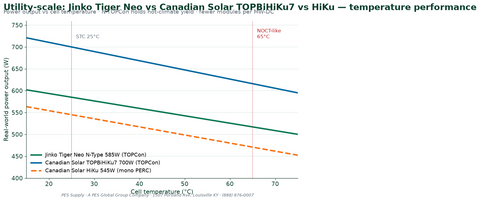
LONGi's 26.81% silicon HJT cell in November 2022 — certified by ISFH CalLab — took the all-time crystalline silicon record. It mattered beyond the trophy: HJT combines crystalline silicon with thin amorphous silicon layers, delivering the best temperature coefficients in mainstream PV (around -0.24%/°C versus roughly -0.29%/°C for TOPCon and -0.35%/°C for PERC) plus superior bifacial response. REC had already proven the residential market would pay for HJT with its Alpha series, which is why the REC Alpha HJT line held a premium shelf position through this entire period.
The honest epilogue is that HJT's record-setting physics never converted into volume dominance. HJT requires mostly new production equipment, silver paste consumption ran high, and no HJT-first manufacturer cracked the InfoLink 1H26 top ten. Risen's Hyper-ion Pro 740 and Huasun's Himalaya G12-132 serve utility niches, and REC's Alpha Pure-RX (22.6%, 470W, 25-year product warranty) remains the premium residential HJT answer — but the mass market belongs to TOPCon, with back-contact architectures taking the efficiency crown that HJT briefly wore. If you're weighing the two architectures for a hot-climate project, our TOPCon vs HJT comparison walks the temperature-coefficient math line by line.
Perovskite Tandems Crossed Two Thresholds in Five Months
EPFL and CSEM posted 31.3% for a perovskite-silicon tandem in July 2022. Helmholtz-Zentrum Berlin answered with 32.5% in December 2022. Two certified results above 31% from independent labs in one calendar year changed how serious people talked about tandems — the question shifted from "if" to "when." Four years later the "when" is getting concrete: tandem pilot lines exist, and the technology sits at the top of every roadmap discussion, though field-deployable product with bankable warranties remains the missing piece as of mid-2026. The trajectory from 2022's lab cells to the current state of the art is mapped in our 2026 cell technology outlook.
One caution I've repeated to every contractor who asks me about tandem pre-orders: a certified cell efficiency and a warranted, UL-listed module you can put on a roof are separated by encapsulation durability testing, IEC certification, and years of field data. The 2022 records were real; the productization curve is equally real and should be respected.
400W+ Modules Became the Residential Standard
The milestone that touched the most rooftops in 2022 wasn't exotic at all: residential modules crossed the 400W line as a standard offering rather than a premium option. That threshold quietly rewired system design math — fewer modules per kilowatt, fewer roof attachments, less racking, fewer electrical connections per install. The progression since shows how durable that shift was:
| Year | Typical residential module wattage | Dominant architecture | Modules needed for a 7.6 kW array |
|---|---|---|---|
| 2019 | 320–370W | Mono PERC, 60/72-cell | 21–24 |
| 2021 | 370–400W | Mono PERC, half-cut mainstream | 19–21 |
| 2022 | 400–450W | PERC peak; TOPCon entering | 17–19 |
| 2024 | 430–480W | TOPCon dominant | 16–18 |
| 2026 | 440–520W | TOPCon, BC/ABC, HJT premium | 15–17 |
Run the arithmetic on the right-hand column: a 7.6 kW residential array that took 22 modules in 2019 takes 16 modules with 2026-vintage 475W product. That's six fewer roof attachments, six fewer clamp sets, and roughly an hour shaved off a two-person crew's day. Multiplied across an installer's season, the wattage creep that started being obvious in 2022 is a labor-cost story as much as a technology story. For a wattage-by-wattage look at current products, the 500W panel buyer's guide and the most efficient panels of 2026 roundup are the current references.
What Each 2022 Milestone Turned Into by 2026
The fairest way to judge a technology milestone is to audit what it became. Here's the follow-through ledger, using current shipment and listing data:
| 2022 milestone | 2026 status | Where it shows up today |
|---|---|---|
| JinkoSolar 26.1% TOPCon cell | TOPCon is ~83% of top-11 supplier shipments (InfoLink 1H26); Tiger Neo 3.0 at 24.0% module efficiency, Tiger Neo 5.0 entering the 700W class | Jinko Tiger Neo dealer specs |
| LONGi 26.81% HJT cell record | LONGi pivoted its flagship line to HPBC back-contact; Hi-MO X10 at 23.7–24.8% commercial module efficiency with a 25.4% module record (Fraunhofer ISE) | LONGi Hi-MO dealer specs |
| HZB 32.5% perovskite tandem | Pilot-line stage; no bankable tandem module at volume yet | Roadmaps, not rooftops |
| 400W residential standard | 440–520W is the 2026 residential band; 700W+ is standard at utility Tier 1 | Current solar panel catalog |
The surprise in that ledger is LONGi: the company that set the HJT record in 2022 built its 2026 flagship business on back-contact cells instead. The lesson for buyers is that cell records signal a manufacturer's process capability, not necessarily its product roadmap. When I evaluate a new module line for the JA Solar, Trina, or Jinko shelves, I look at warranted degradation and shipment volume first, and lab records a distant third.
What 2022 Meant for Installers Specifying Equipment
Contractors who moved early on n-type product captured three durable advantages. First, lower degradation: the jump from PERC's 0.55%/year linear rate to TOPCon's 0.40%/year compounds into roughly 2.2 percentage points of extra warranted output at year 25 — on a 400 kW commercial array that's meaningful production the owner keeps. Our degradation and lifespan guide shows the warranty math in full. Second, better bifacial factors (80% versus 70%) made ground-mount and carport bids more competitive. Third, higher module efficiency freed roof area, which on space-constrained residential jobs is often the difference between covering the load and falling short — the sizing consequences are worked through in our system sizing guide.
I watched one of my long-time contractor customers re-bid a church project in early 2023 purely because TOPCon product had shipped: same roof, same budget, 9% more nameplate capacity, and the efficiency margin let him drop a string and simplify the inverter plan. That project came straight out of what 2022 made available. I saw the flip side too — installers who stayed loyal to familiar PERC lines through 2023 ended up relearning the lesson at their own expense when their bids came in with fewer watts per dollar than competitors who had switched. In distribution you get a front-row seat to which contractors adapt, and the pattern from that era was unambiguous: the ones who read the 2022 signals early banked two years of advantage while the technology laggards paid full price for yesterday's product.
The Cell Format War Nobody Expected: 182mm vs 210mm
One 2022 development that got less press than the efficiency records but shaped the supply chain just as hard was the wafer format split. The industry fractured into camps around 182mm and 210mm wafer standards, and 2022 was the year both ecosystems matured enough that module makers had to pick lanes. Four years later the outcome is visible on every distributor price sheet: 182×182mm and 182×210mm rectangular formats dominate the 580–670W classes that make up the bulk of procurement inquiries, while 210×210mm (G12) established itself as the ultra-high-power utility format — the 700W to 770W class that became standard at Tier 1 after SNEC 2026, with products like Tongwei's TNC 3.0 at 770W and Astronergy's 825W 72-cell reserve product defining the top end.
For a buyer, the format war matters for one practical reason: interchangeability. Racking, clamping zones, and string-length calculations all key off module dimensions, and mixing format generations on a truck order creates jobsite headaches. When I build a quote today, the first thing I check after wattage is the physical format class, because a 670W G12 module and a 670W M10R module are not the same product on a roof or a rack even when the nameplates match. The Canadian Solar HiKu/HiHero spec guide is a good example of how one manufacturer runs both size classes in parallel.
Degradation and Warranty: The Quiet Milestone
Buried under the efficiency headlines, 2022 also normalized a better degradation contract. First-year degradation on n-type product settled around 1.0% against PERC's 2.0%, and annual linear degradation dropped from 0.55% to 0.40% per year. Compounded over a 25-year performance warranty, that difference is not cosmetic:
| Checkpoint | PERC (2.0% yr 1, 0.55%/yr) | TOPCon (1.0% yr 1, 0.40%/yr) | TOPCon advantage |
|---|---|---|---|
| Year 5 warranted output | 95.8% | 97.4% | +1.6 pts |
| Year 10 warranted output | 93.05% | 95.4% | +2.35 pts |
| Year 15 warranted output | 90.3% | 93.4% | +3.1 pts |
| Year 25 warranted output | 84.8% | 89.4% | +4.6 pts |
On a 400 kW commercial array producing about 560,000 kWh in year one at a typical inland site, that 4.6-point gap at year 25 is roughly 23,000 kWh of additional warranted production in a single year — real energy with real bill value, delivered by a warranty term most buyers skim. This is the part of the 2022 shift I put in writing on every commercial proposal, because it's the cheapest production a project owner will ever buy: it costs nothing extra, it just requires choosing the post-2022 cell architecture.
Metallization and Interconnection: The Incremental Stack
The least glamorous 2022 shift was arguably the most reliable one: multi-busbar interconnection became universal. Sixteen-busbar (16BB) half-cut cells went from premium feature to industry standard during that window, and the reliability case was straightforward — shorter current paths through the cell, lower resistive losses, better tolerance of microcracks. The leading edge has since moved to zero-busbar (0BB) designs on premium back-contact and HJT lines, where the busbar disappears entirely and fine-wire interconnects take over. None of this makes a marketing headline, but it's part of why a 2026 module harvests measurably more energy per rated watt than its 2019 ancestor: the gains stacked up in half-percent increments at the cell-interconnect level while the architecture changed underneath.
What We Got Wrong in 2022 — and What That Teaches Buyers
An honest retrospective has to include the misses. In 2022, most distributor-side forecasts — including the ones I was quoting to customers — assumed HJT and TOPCon would split the n-type transition fairly evenly. That didn't happen; TOPCon's retrofit-friendly economics crushed HJT's capital cost disadvantage, and HJT ended up a premium niche instead of a co-standard. We also underestimated how fast the price curve would fall: nobody I worked with in 2022 predicted the 2023 module price collapse that cut costs roughly in half. And we overestimated tandem timing — the "three years to commercial product" estimates from 2022 stretched into pilot-line reality.
The purchasing lesson is durable: bet on architectures with manufacturing momentum, not on the most elegant physics. When two technologies are close on performance, the one that scales cheaper wins the shelf, and the winner compounds — more volume funds more R&D, which widens the gap. That's exactly how TOPCon went from a 2022 ramp story to the backbone of the current solar panel catalog, and it's why I watch shipment-share data more closely than record announcements when deciding what to stock deep.
Reading a 2022-Era Datasheet Today
A practical skill this retrospective teaches: if you're evaluating leftover or secondary-market product from the 2022 vintage, the datasheet tells you exactly what generation you're holding. PERC product from that era carries ~21% module efficiency, 2.0% first-year degradation, and 0.55%/year linear fade; early TOPCon reads ~22%, 1.0%, and 0.40%. Both can be legitimate buys at the right discount for the right project — an off-grid barn doesn't need 2026 efficiency — but the warranty terms and the manufacturer's survival matter more than the sticker. I've bought end-of-run modules at steep discounts for non-critical applications and been glad of it, and I've also watched customers buy orphaned product whose warranty path evaporated. The rule: discount product for non-critical loads only, and verify the manufacturer's pulse before you pay.
The Through-Line to Today's Shelf
Every technology family that mattered in 2022 has a direct descendant in the current catalog. TOPCon's 2022 ramp is today's Trina Vertex N and JA Solar DeepBlue volume lines. The HJT record lives on in REC's premium residential offering and utility-scale Risen product. The tandem records sit at the front of every manufacturer's roadmap deck. And the 400W threshold that felt like a milestone in 2022 is now the floor of the residential band, not the ceiling. For a side-by-side of how the current architectures compare on efficiency, temperature coefficient, and ROI, see the 2026 technology comparison and the n-type vs TOPCon vs HJT explainer.
If you're speccing a project now and want help matching the post-2022 technology landscape to your roof, budget, and timeline, request a quote and we'll build the bill of materials with current-generation modules. Bring your last twelve months of usage and your roof or site dimensions; we'll bring the architecture comparison, the degradation math, and honest advice about which 2022-era promises actually shipped.
Looking Ahead
The 2022 vintage also reminds us that the next milestone wave is already visible: back-contact architectures taking the residential efficiency crown, 700W-class utility product standardizing, and tandem pilot lines converting 2022's lab physics into manufacturable product. The buyers who benefit from each wave are the ones who understand what the last one actually delivered — which is the entire point of keeping score.
Frequently Asked Questions
What was the most important solar cell record of 2022?
LONGi's 26.81% silicon heterojunction cell, certified by ISFH in November 2022, was the highest certified efficiency for any crystalline silicon cell at that time. In commercial terms, JinkoSolar's 26.1% TOPCon cell result mattered more, because TOPCon scaled to dominate global module shipments within four years.
Did TOPCon really replace PERC that fast?
Yes. TOPCon entered mass production in 2022, reached price parity with PERC within roughly a year, and by the first half of 2026 accounted for about 83% of shipments among the top eleven module suppliers. Tier 1 PERC production ended through 2025.
Are perovskite tandem panels available to buy now?
Not yet at bankable volume. The 2022 tandem records (31.3% EPFL/CSEM, 32.5% HZB) led to pilot lines, but as of mid-2026 no tandem module offers the certified durability testing and warranty backing that mainstream procurement requires.
Is HJT still worth buying after losing the volume race?
For specific use cases, yes. HJT's temperature coefficient (around -0.24%/°C) is the best in mainstream PV, which pays off in hot climates, and premium residential HJT like the REC Alpha Pure-RX carries a 25-year product warranty. It's a niche-by-choice technology rather than a dead end.
How much has residential module wattage actually grown since 2022?
The typical residential module moved from the 400–450W band in 2022 to 440–520W in 2026. A 7.6 kW array that required 17–19 modules in 2022 now requires 15–17, cutting attachments, racking, and install labor proportionally.