Three numbers define solar panel technology in 2026: 83%, 770W, and 33%. TOPCon now carries roughly 83% of shipments among the top module suppliers. Utility-class panels have blown past 500W to a 670–770W standard. And perovskite-silicon tandem cells have crossed 33% efficiency in the lab, with commercial modules finally in pilot production. This is the state of the art as of August 2026 — what's shipping, what's coming, and what it means if you're buying panels this year.
We watch this from the buying desk, not the conference stage. Every quarter our catalog changes with the technology — the N-type section doubles, the legacy listings shrink, and the spec sheets creep upward. Here's the honest map of where the technology stands and where it's going, with the sources we trust: InfoLink's shipment rankings, Kiwa PVEL's Scorecard, BloombergNEF's Tier 1 list, and the manufacturer datasheets we verify against delivered product.
TOPCon's Dominance: How One Architecture Won
Tunnel Oxide Passivated Contact technology won the solar industry the way most industrial battles are won — on capital efficiency. TOPCon cells add a two-nanometer oxide layer and a doped polysilicon film to the rear of an N-type wafer, a modification that existing PERC production lines could absorb through retrofit rather than replacement. Factories that converted in 2023–2024 got N-type efficiency and yield at a fraction of new-build cost, and the snowball never stopped. By the first half of 2026, InfoLink's shipment ranking shows TOPCon at about 83% of volume across the top eleven suppliers, with ranked shipments totaling 181.39 GW for the half-year.
The products tell the story better than the percentages. Jinko's Tiger Neo 3.0 runs 24.0% efficiency at volume, and the Tiger Neo 5.0 shown at SNEC in June 2026 enters the 700W class. Trina's Vertex N Gen 3 with i-TOPCon Ultra reaches 760W. JA Solar's DeepBlue 5.0, Canadian Solar's TOPBiHiKu7, Astronergy's ASTRO N7/N8, and Tongwei's TNC 3.0 — 670W in production now, 770W entering mass production at end of Q2 2026 — fill out a bench so deep that TOPCon is simply what "a solar panel" means in 2026.
| Technology | 1H26 Shipment Share (top 11 suppliers) | Efficiency (module) | Status |
|---|---|---|---|
| TOPCon (N-type) | ~83% | 22.5–24.8% | Volume leader across residential, C&I, utility |
| Back-Contact (BC/ABC/HPBC, N-type) | ~16% (~30 GW) | 23.7–26.0% | Mainstreaming; premium residential and C&I |
| HJT (N-type) | <1% of top-11 volume | 22.6–23.8% | Premium niche; best temperature coefficient |
| PERC (P-type) | ~0% of new production | 20.5–21.5% (old stock) | End-of-life; distress clearance in 2026 |
One nuance worth noting: the top-ten suppliers' combined shipments fell 31% year-over-year in 1H26, a demand-side story driven by weak Chinese installations after the export tax-rebate change — not a technology retreat. Non-China markets took 60.1% of top-11 shipments, up 18 points, and US plants — Illuminate USA, Jinko's US facility, T1 Energy, American Panel Solutions — count in the totals. The technology consolidated while the manufacturing map decentralized.
The 500W+ Standard: Power Classes Have Moved
It wasn't long ago that 400W was a premium panel. In 2026 the classes look like this, and buyers should calibrate expectations accordingly:
| Application | 2026 Power Range | Dominant Technology | Format |
|---|---|---|---|
| Residential (54/60-cell) | 440–520W | BC/ABC, HJT, TOPCon | M10 half-cut; all-black aesthetics common |
| Residential (72-cell) | 580–670W | TOPCon, HPBC | M10R/G12R rectangular |
| C&I rooftop | 580–700W | TOPCon, BC bifacial | Dual-glass standard |
| Utility ground-mount | 670–770W | TOPCon, HJT, BC bifacial | G12 210mm, 1500V, bifacial default |
| Utility ultra-high | 740–825W | TOPCon, HJT, ABC | Astronergy's 825W ASTRO N8 Pro is the reserve-class marker |
The 550–709W class and 700W-plus shelves are where the action is now. Just remember the practical ceiling: above ~640W, panel dimensions and weight push past one-person handling, electrical specs drift out of residential inverter windows, and racking compatibility narrows. The right panel is the biggest one your crew, roof, and inverter can all accept — not the biggest one on the price sheet. Our array sizing writeup translates watts into the roof area they actually occupy.
Perovskite Commercialization: Real, Careful, and Early
Perovskite-silicon tandems are the first technology in decades with a credible path past silicon's ~29% single-junction ceiling. A perovskite top cell harvests high-energy photons that silicon wastes as heat; the silicon bottom cell keeps the rest. Lab tandems have exceeded 33%, and Oxford PV has shipped first commercial tandem product into pilot projects — small volumes, premium prices, utility and specialty applications first. Chinese majors including LONGi, Trina, and Jinko all run tandem pilot lines, with LONGi's demonstrated tandem cell records setting the pace.
The honest caveats haven't changed: perovskite stability under heat, moisture, and UV remains the engineering fight, and no tandem module yet carries a 25-year field history because the technology hasn't existed long enough to have one. Expect tandems to appear where their density commands premium value — space-constrained sites, weight-sensitive structures, utility pilots — and to take years, not quarters, to reach mainstream residential price points. When they do, expect 24–28% commercial modules as the first real step. We'll stock them when the warranty terms convince us, not before.
What the Reliability Data Says in 2026
Technology claims are cheap; accelerated testing is not. Kiwa PVEL's 2026 Scorecard — its twelfth edition — now runs seven test categories: thermal cycling, damp heat, mechanical stress, PID, the new UV-induced degradation sequence, LETID, and hail stress. The results separate the marketing from the metallurgy. AIKO took Top Performer in all seven categories with its ABC modules. LONGi extended its streak to nine consecutive years. Trina's Vertex S+, Jinko's Tiger Neo, JA's DeepBlue 4.0 Pro, and Astronergy's ASTRO series all hold recent Top Performer status. If the panel you're considering isn't on the scorecard, ask the manufacturer why — the answer is usually informative.
Bankability runs parallel. BloombergNEF's Q2 2026 Tier 1 list covers 42 manufacturers, with Vikram Solar and Jolywood newly admitted and Maxeon removed — a reminder that Tier 1 tracks financial deployability, and that corporate distress (Maxeon entered judicial management in April 2026) moves faster than panel degradation. For quality signals, PVEL; for financing signals, BNEF; for incentive eligibility, the CEC list. Smart buyers check all three.
Prices and Tariffs: The 2026 Buying Reality
Technology abundance has collided with trade policy scarcity. Factory-gate prices are at record lows — Tier 1 TOPCon FOB China at $0.085–0.095/W, BC at a 12–15% premium, HJT's premium compressed to 2–8% — but the August 2026 Section 232 Minimum Import Price program sets a $0.38/W floor on modules entering the US, plus a 15% duty stacked on AD/CVD and Section 301. Here's the buyer's translation:
| Segment | Global Price Signal (Aug 2026) | US Buyer Reality |
|---|---|---|
| Budget TOPCon 580–600W | $0.085–0.095/W FOB China; Tier 3 clears ~$0.065/W | MIP floor $0.38/W dominates; shop domestic-assembly options |
| Mid-range 600–670W | SE Asia FOB $0.098–0.11/W | AD/CVD varies by country (Malaysia 9–14%, Vietnam 56–272%) |
| Premium BC/HJT | $0.14–0.20/W FOB | Premium compresses on a delivered basis as fixed tariffs spread over more watts |
| Utility 700W+ containers | $0.07–0.10/W FOB, 1500V | Pre-August 6, 2026 fixed contracts exempt; new contracts price to MIP |
US-delivered Tier 1 offers ran $0.27–0.32/W earlier this year and are repricing upward through Q4. The move we're advising: lock delivered pricing with a validity window, and evaluate US-assembled product seriously — Illuminate USA, Jinko's US lines, T1 Energy, and others now compete on more than incentives.
The Supporting Cast: Cells, Busbars, and Glass
Under the headline technologies, the component-level march continues. Sixteen-busbar half-cut cells are the volume standard; zero-busbar (0BB) designs are spreading through BC and HJT premium lines, trimming silver consumption and shading losses together. Dual-glass construction has become the default for anything bifacial or commercial — better fire ratings, better moisture resistance, better mechanical life. Anti-reflective coatings and textured glass claw back oblique-angle losses. None of these trends will ever headline a press release, and all of them show up in your production meter for thirty years. When we evaluate a new line for the catalog, these quiet details — plus connector authenticity and junction-box build quality — carry as much weight as the cell architecture.
What to Buy in Late 2026
Distilled to purchasing advice: residential buyers should default to volume TOPCon from a PVEL-tested, BNEF Tier 1 brand — Jinko, Trina, JA Solar, Canadian Solar, Silfab, Qcells — and step up to back-contact premium glass when roof space is tight. Commercial and utility buyers should spec 580–770W bifacial TOPCon and let the rear side harvest what the site offers. Everyone should read our efficiency explainer for the physics, check the 2026 roundup for current picks, and run the system calculator before deciding how many of these 500W-plus monsters your roof actually needs. The technology has never been better. The buying discipline it demands hasn't changed at all.
The 1H26 Shipment League Table: Who's Actually Winning
InfoLink's first-half 2026 ranking, published August 15, reordered the industry's leaderboard in ways that matter for buyers choosing long-term partners. JinkoSolar and LONGi tied at the top — Jinko riding pure TOPCon volume, LONGi splitting its effort between HPBC back-contact and TOPCon. Trina holds third with its TOPCon 3.0 platform, JA Solar fourth with a TOPCon-plus-BC portfolio, and Tongwei fifth as the vertically integrated giant whose TNC 3.0 line is scaling into the 700W class. Astronergy, Yingli, and a four-way tie among DMEGC, AIKO, TCL Solar, and GCL round out the ranked eleven. Canadian Solar and Risen both fell out of the ranked group this half — a shipment story, not a product-quality verdict, and both remain bankable lines we stock.
The structural takeaway: the top four suppliers now hold about 59% of ranked shipments. Consolidation means the brands with real R&D budgets and warranty reserves are separating from the pack, which simplifies buyer diligence. Pick from the consolidated leaders, verify with the scorecards, and move on to the parts of your project that actually carry risk — permitting, interconnection, and installation quality.
Manufacturing Geography: The Quiet US Buildout
The most consequential 2026 technology story isn't a cell architecture — it's a ZIP code. LONGi's Illuminate USA joint venture, Jinko Solar's US plant, Trina-linked T1 Energy, and JA Solar's American Panel Solutions partnership with Corning all feed US module supply from US lines, and their output counts toward InfoLink's shipment totals. Tariff architecture is the driver: with the Section 232 MIP at $0.38/W on imported modules and Section 301 at 50% on Chinese product, domestic assembly with imported cells — themselves MIP-floored at $0.22/W — is suddenly rational economics rather than incentive-chasing.
For buyers, the practical effect is choice. US-assembled TOPCon from these plants competes directly with imported product on delivered price while simplifying domestic-content documentation for commercial projects chasing the ITC bonus under the post-OBBBA rules. The FEOC compliance question — whether equipment traces to foreign entities of concern — now sits on every financed commercial checklist, and buying from documented US lines answers it cleanly. Our incentives guide tracks the moving parts state by state.
Pairing High-Power Modules With the Rest of the System
A 700W bifacial panel is only as useful as the equipment that accepts its output, and the balance-of-system conversation has genuinely changed. String currents of 14–18A with bifacial boost push conductor sizing per NEC 690.8 into territory older designs never saw — we've laid out the math in the ampacity chart and the PV wire guide. String inverters now advertise multiple high-current MPPT inputs specifically for these modules; microinverter lines like Enphase's IQ8 series support 540W-class residential panels, and the GaN-based IQ9N-3P handles 600W commercial modules on 480Y/277V three-phase services. Voltage windows matter in winter: a string of high-Voc N-type modules on a record-cold, snow-reflective morning can brush the 1000V or 1500V ceiling faster than legacy arrays ever did. Run the coldest-day math with bifacial gain included, or let us run it for you.
Storage pairing is the other half of a modern design. High-power arrays feeding hybrid inverters and LFP battery banks need charge-rate headroom — a 15 kW array on a battery that accepts only 10 kW leaves production on the table every sunny afternoon. The inverter sizing calculator and battery bank sizing guide keep the pieces honest relative to each other. The technology story of 2026 isn't just bigger panels; it's systems designed as systems.
The Roadmap: What 2027–2030 Actually Holds
Strip away the hype cycles and the near-term roadmap is legible. TOPCon keeps grinding efficiency upward toward its practical ceiling around 25.5% in production, with Tiger Neo 5.0-class products normalizing the 700W residential-comparable class. Back-contact continues its climb from 16% toward a quarter of volume as JA, GCL, and TCL capacity joins Aiko and LONGi. Perovskite tandems move from pilot to early commercial product at 24–28% efficiency with durability warranties that start conservative and lengthen as field data accumulates. And the wafer format wars settle into a stable duopoly: M10R for roofs, G12 for fields.
| Horizon | Expected Milestone | Confidence |
|---|---|---|
| 2026–2027 | 700W-class TOPCon standard at Tier 1; 0BB spreads through premium lines; US-assembled capacity ramps | High — already in production or announced lines |
| 2027–2028 | BC approaches ~25% of top-supplier volume; first tandem modules with 25-yr warranties in pilot fleets | Moderate-high — capacity is being built now |
| 2028–2030 | Perovskite tandem commercial volume at 24–28% module efficiency; HJT silver-free metallization matures | Moderate — durability data is the gate |
| 2030+ | Tandem mainstream; possible triple-junction pilots; silicon single-junction approaches practical ceiling | Direction clear, timing uncertain |
The pattern across all of it is the industry's oldest truth: laboratory records arrive on schedule, and bankable products arrive years later. Plan your projects around what's shipping with a warranty, track what's in pilot, and let the press releases entertain rather than inform.
What We Tell Commercial Buyers in 2026
Commercial procurement teams face a genuinely different calculus than residential shoppers this year. The FEOC rules make supply-chain provenance a financing requirement, not a preference. The MIP floor makes early procurement with price locks worth real money — we watched two Q3 projects save six figures by signing before the August 6 exemption cutoff, and the window for that move has closed. And the technology consolidation means vendor risk is lower than it's been in a decade: pick a consolidated leader with PVEL results and BNEF standing, negotiate the warranty enforcement terms, and spend your diligence budget on the installer and the interconnection instead. The panel is the most reliable component in the system. The paperwork isn't.
Don't Sleep on HJT
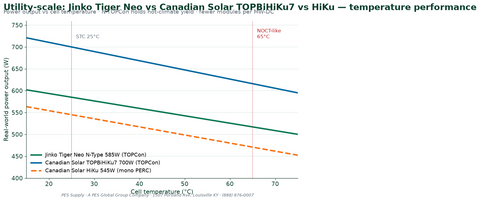
Lost in TOPCon's volume story is the technology with the best datasheet physics: heterojunction. HJT cells sandwich crystalline silicon between amorphous layers, delivering the industry's best mass-production temperature coefficient (around −0.24 %/°C), bifaciality up to 90%, and superb low-light yield. REC's Alpha Pure-RX at 22.6% with a 25-year product warranty, Risen's Hyper-ion Pro at 740W, and Huasun's Himalaya G12 at 730W are real products with real fans — particularly in hot climates, where the temperature coefficient converts directly into summer revenue. HJT's constraint has never been performance; it's silver consumption and capital cost. Copper metallization and 0BB designs are attacking exactly that, and the HJT premium over TOPCon has already compressed to 2–8% at the Chinese factory gate. If your project sits in Phoenix, Houston, or anywhere the August heat index reads like an oven setting, ask us to price HJT alongside TOPCon. The answer surprises people — we've quoted enough of these head-to-head comparisons to know the hotter the site, the narrower the real cost gap gets over a full year of production.
Frequently Asked Questions
Six questions our commercial and residential buyers ask most about the 2026 technology landscape, answered with current data rather than last year's assumptions.
What is TOPCon and why did it take over the solar industry?
TOPCon (Tunnel Oxide Passivated Contact) is an N-type cell architecture that adds an ultra-thin oxide layer and doped polysilicon film to reduce electron recombination, reaching 22.5–24.8% module efficiency. It took over because existing PERC factories could retrofit to produce it, letting the industry convert to N-type performance at low capital cost. By the first half of 2026, TOPCon accounted for roughly 83% of shipments among the top eleven module suppliers.
Are 500W+ solar panels suitable for home roofs?
Yes, within limits. Modern residential panels run 440–520W in the 54/60-cell format and 580–670W in larger 72-cell formats, and most current string inverters and microinverters support them. Check panel dimensions against your roof planes, weight against handling limits, and electrical specs against inverter input windows. Above roughly 640W, panels become two-person commercial products better suited to flat roofs and ground mounts.
When will perovskite solar panels be commercially available?
They already are, barely: Oxford PV has shipped first commercial perovskite-silicon tandem modules into pilot projects, and several Chinese majors run pilot lines. Mainstream availability with 25-year warranty confidence is a late-decade story. Durability under heat, moisture, and UV remains the engineering challenge, so expect tandems in premium and utility pilots first, residential shelves years later.
Is it worth waiting for perovskite panels before going solar?
No. Today's N-type panels at 22–25% efficiency are excellent, warranted for 25–30 years, and priced near historic lows at the factory gate. Waiting years for tandem technology trades certain savings for uncertain future gains. Install now with quality current product; tandem modules will be an upgrade path for your next array, not a reason to skip this one.
What is the difference between TOPCon, HJT, and back-contact panels?
All are N-type architectures. TOPCon dominates volume with the best cost-performance balance. HJT offers the best temperature coefficient (around −0.24 %/°C) and up to 90% bifaciality at a small premium, ideal for hot climates. Back-contact (BC/ABC/HPBC) removes all front-side metal for the highest efficiencies — up to 25–26% — and cleanest aesthetics, commanding a 12–15% factory-gate premium over TOPCon.
Why are US solar panel prices rising if technology keeps improving?
Trade policy, not technology, sets US prices. The August 2026 Section 232 Minimum Import Price program imposes a $0.38/W floor on imported modules plus a 15% duty, stacked on existing AD/CVD orders and 50% Section 301 tariffs on Chinese product. Factory-gate prices are at record lows globally, but US-delivered pricing is repricing upward through late 2026. Domestic-assembly options and pre-August 6, 2026 contracts are the main relief valves.