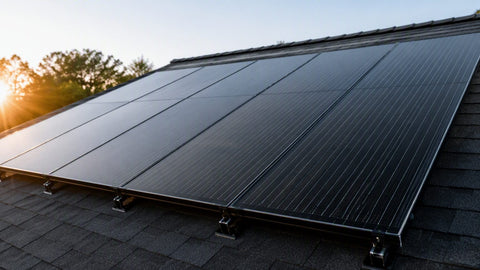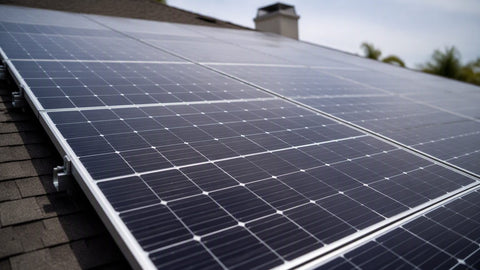
In January 2019, the premium residential solar panel market is dominated by two N-type monocrystalline heavyweights: Panasonic HIT and LG NeON 2. Both lines command a price premium over standard polycrystalline and mono-PERC alternatives, but they deliver class-leading efficiency, low degradation rates, and 25-year warranties that justify the investment for homeowners with limited roof space or high electricity bills. If you are evaluating a premium monocrystalline system this quarter, this head-to-head comparison breaks down the exact specs, real-world pricing, and regulatory context you need to make an informed decision.
Panasonic's HIT (Heterojunction with Intrinsic Thin layer) technology has been in continuous production for over two decades, and the SA17 series represents the current U.S. lineup as of early 2019. The HIT architecture pairs N-type monocrystalline silicon wafers with ultra-thin amorphous silicon layers on both sides of each cell, creating a heterojunction that reduces electron recombination and boosts voltage output.
The SA17 series ships in four nominal wattages: VBHN325SA17 (325 W), VBHN330SA17 (330 W), VBHN335SA17 (335 W), and VBHN340SA17 (340 W). All four models share a 96-cell layout — an unconventional configuration compared to the industry-standard 60-cell or 72-cell formats. The 96-cell design uses smaller individual cells arranged in a pyramid structure that improves light absorption and reduces surface reflection. Module efficiency ranges from 19.4% on the 325 W model up to 20.3–20.4% on the 340 W flagship.
Physical dimensions are compact: 1,590 mm × 1,053 mm × 40 mm (62.6 in × 41.5 in × 1.6 in) with a weight of roughly 18.5–19.0 kg. The black anodized aluminum frame includes a water drainage design to reduce standing water and potential freezing damage. All SA17 modules carry a 600 V DC maximum system voltage rating for U.S. residential applications and use MC4-compatible connectors.
The standout specification for Panasonic HIT is the temperature coefficient. At -0.258%/°C for Pmax, Panasonic achieved an industry-leading figure at mass-production scale in May 2017 — well ahead of competing premium panels that typically range from -0.29% to -0.37%/°C. For installers working in hot climates such as Arizona, Texas, or Florida, this coefficient translates to measurably higher summer output. Degradation is also exceptionally low: Year 1 output is guaranteed at 97% of rated power, followed by roughly 0.26% annual linear degradation through Year 25, yielding a 90.76% power guarantee at the end of the warranty term.
Panasonic backs the SA17 series with a 25-year product warranty (materials and workmanship) and a 25-year linear performance warranty. Manufacturing originates primarily from Panasonic's Kadoma facility in Osaka, Japan, with additional capacity at the Kulim Hi-Tech Park plant in Malaysia. Wholesale distributor pricing for the 330 W module sits at approximately $1.09/W module-only, while fully installed residential systems typically fall in the $2.61–$3.45/W range depending on market, roof complexity, and inverter pairing.
Sources: Panasonic HIT N340/N335 SJ53 datasheet; Panasonic Newsroom Global (May 24, 2017); Solaris-shop.com wholesale data (Sept 2018).
LG Electronics entered the solar module business leveraging its deep semiconductor and LCD manufacturing expertise, and the NeON 2 line has quickly become one of the most-specified premium panels in the U.S. residential market. The NeON 2 uses N-type monocrystalline cells paired with LG's proprietary CELLO (Cell Connection with Low Loss & Optimized) technology, which replaces conventional 3–5 ribbon busbars with 12 thin wire busbars. This multi-wire approach reduces electrical resistance, improves current collection, and gives the panel a cleaner aesthetic with less visible silver grid.
LG offers the NeON 2 in two frame variants. The A5 series features a silver anodized aluminum frame with a white backsheet and spans LG325N1C-A5 (325 W) through LG340N1C-A5 (340 W). The V5 series upgrades to a black frame with a white backsheet and pushes wattage higher: LG345N1C-V5 (345 W), LG350N1C-V5 (350 W), and LG355N1C-V5 (355 W). All NeON 2 models use a standard 60-cell (6 × 10) layout, making them physically closer to conventional modules than Panasonic's 96-cell design. Module efficiency runs from approximately 19.6% on the 325 W A5 model up to 20.7% on the 355 W V5 flagship.
Dimensions for the 60-cell series are 1,686 mm × 1,016 mm × 40 mm (66.38 in × 40 in × 1.57 in), with a weight of roughly 18.5–19.0 kg. The V5 black-frame variant is particularly popular for visible rooflines where aesthetics matter. All NeON 2 modules are rated for 1,000 V DC maximum system voltage and use standard MC4 connectors. Mechanical load ratings meet IEC 61215-2:2016 standards at 5,400 Pa front / 4,000 Pa rear.
The NeON 2's double-sided cell structure captures some reflected and bifacial illumination on the rear of the cell, improving yield in high-albedo environments such as white membrane roofs or snowy ground conditions. While not a true bifacial module, this design provides a modest output boost in reflective installations. The temperature coefficient for Pmax is -0.36% to -0.37%/°C — competitive against conventional silicon but trailing Panasonic's industry-leading figure. Degradation is guaranteed at 98% after Year 1 and 0.33% annually through Year 25, yielding a 90.08% power guarantee at Year 25.
LG's warranty is particularly installer-friendly: a 25-year product warranty covering parts and labor, including up to $450 in labor reimbursement for U.S. replacements. Manufacturing is based at LG's Gumi facility in South Korea, with a new U.S. assembly plant in Huntsville, Alabama — announced in June 2018 and now producing NeON 2 60-cell modules in early 2019. The Alabama facility assembles modules from imported cells and provides installers with a domestic-content option for projects where origin matters. Wholesale pricing for the 330 W A5 module is approximately $1.04/W module-only, with installed residential systems typically landing in the $2.50–$3.00/W range.
Sources: LG NeON 2 A5 datasheet (v4); BayWa re Solar Distribution V5 preliminary datasheet; EcoDirect.com product listings; LG Electronics press release (June 27, 2018).
Both Panasonic HIT and LG NeON 2 sit at the top of the premium solar panel tier, but their design philosophies diverge. Panasonic optimizes for thermal performance and long-term stability through heterojunction engineering, while LG prioritizes peak wattage per panel and installer-friendly warranty terms through CELLO multi-wire architecture. The table below compares exact 2019 U.S. models side by side.
| Property | Panasonic HIT (SA17) | LG NeON 2 (A5 / V5) |
|---|---|---|
| Peak Wattage | 325–340 W | 325–355 W |
| Module Efficiency | 19.4–20.4% | 19.6–20.7% |
| Cell Count | 96 | 60 |
| Dimensions | 1,590 × 1,053 mm | 1,686 × 1,016 mm |
| Weight | ~18.5–19.0 kg | ~18.5–19.0 kg |
| Frame | Black anodized | Silver (A5) / Black (V5) |
| Cell Technology | HIT heterojunction | N-type mono + CELLO 12-busbar |
| Temp Coeff (Pmax) | -0.258%/°C | -0.36 to -0.37%/°C |
| Year 1 Degradation | 97% | 98% |
| Annual Degradation | ~0.26% | 0.33% |
| Year 25 Guarantee | 90.76% | 90.08% |
| Product Warranty | 25 years | 25 years (incl. labor up to $450) |
| Max System Voltage | 600 V DC | 1,000 V DC |
| Connector | MC4-compatible | MC4 |
| Wholesale $/W (330W) | ~$1.09/W | ~$1.04/W |
| Manufacturing | Japan + Malaysia | South Korea + Alabama, USA |
Best in class
Highest in comparison
Year 2 rate active now
Through end of 2019
The choice between these two lines often comes down to climate and project constraints. In hot, high-irradiance regions, Panasonic's superior temperature coefficient produces more kilowatt-hours per watt of nameplate capacity over the system lifetime. In space-constrained installations where every watt matters, the LG NeON 2 V5's 355 W peak output means fewer modules per array. For installers, the 60-cell LG format simplifies string sizing with conventional string inverters, while Panasonic's 96-cell design requires slightly different voltage calculations.
Any panel purchase decision in January 2019 must account for the Section 201 safeguard tariffs currently in effect. Under Presidential Proclamation 9693, signed January 23, 2018 and published at 83 FR 3541, the United States imposes duties on imported crystalline silicon photovoltaic (CSPV) cells and modules. The Year 1 rate of 30% (February 7, 2018 – February 6, 2019) has now stepped down to 25% for Year 2, covering the period from February 7, 2019 through February 6, 2020.
The tariff applies to HTSUS 8541.40.60 (cells and modules) and related statistical reporting numbers. A tariff-rate quota exempts the first 2.5 GW of imported solar cells annually, though assembled modules receive no such exemption. Thin-film modules — notably First Solar's CdTe technology — are excluded entirely. Certain GSP-eligible developing nations are excluded subject to individual 3% and collective 9% caps, though major Asian manufacturing hubs are not covered by these exclusions.
Pre-tariff benchmark pricing in Q1 2017 positioned standard polycrystalline modules at roughly $0.35–$0.38/W and premium mono PERC modules at $0.42–$0.48/W. The Section 201 safeguard has added approximately $0.13–$0.14/W to premium module landed costs. As of January 2019, premium monocrystalline modules in the 300W+ class are trading at roughly $0.55–$0.62/W at the import level. For complete systems, the tariff has increased total installed costs by approximately 6–11% depending on segment — residential projects feel a larger proportional impact because modules represent a higher share of total system cost than in utility-scale developments.
On the incentive side, the federal Investment Tax Credit (ITC) remains at 30% for both residential (Section 25D) and commercial (Section 48) systems placed in service through the end of 2019. The ITC schedule was established by the Protecting Americans from Tax Hikes (PATH) Act of 2015 and steps down to 26% in 2020, 22% in 2021, and 10% for commercial / 0% for residential beginning in 2022. Importantly, the Section 201 tariffs do not affect ITC eligibility or rate — the 30% credit applies to the full project cost inclusive of tariff impact.
Sources: Presidential Proclamation 9693 (83 FR 3541, Jan 25, 2018); USTR fact sheet (Jan 22, 2018); PATH Act of 2015 (PL 114-113); GTM Research / NREL Q1 2017 pricing benchmarks.
For installers and EPCs specifying premium panels this quarter, the 25% Year 2 tariff changes procurement math in three concrete ways.
Landed cost budgeting. At the module level, expect premium mono panels to land at $0.55–$0.62/W before markup, compared to roughly $0.42–$0.48/W in the pre-tariff era. For a typical 7 kW residential system using 20–22 premium modules, the tariff adds approximately $900–$1,400 to module costs alone. The 30% ITC partially offsets this increase — a $3.00/W pre-incentive system with a $0.15/W tariff impact sees roughly $0.045/W net cost after the credit.
Domestic-content alternatives. LG's Huntsville, Alabama assembly plant offers a U.S.-assembled NeON 2 option that may qualify for certain domestic-content preferences or satisfy procurement requirements where origin documentation is required. Panasonic's modules are manufactured in Japan and Malaysia; while both countries are subject to the 25% tariff, Panasonic's premium positioning and superior temperature coefficient still make it competitive in high-yield applications.
String sizing and inverter pairing. Panasonic's 96-cell SA17 modules produce higher voltage per module than standard 60-cell designs. At STC, the VBHN330SA17 carries an open-circuit voltage (Voc) of roughly 69.6 V and a maximum power voltage (Vmp) of roughly 58.0 V. The LG NeON 2 60-cell modules produce lower per-module voltage — the LG330N1C-A5 carries a Voc of roughly 40.8 V and Vmp of roughly 33.9 V. When designing strings for string inverters, Panasonic arrays will hit voltage limits with fewer modules per string, while LG arrays allow longer strings. Both lines pair well with modern MLPE (power optimizers or microinverters) where string voltage constraints are less relevant.
Documentation. Ensure your supplier provides proper country-of-origin certificates and HTSUS classification for any project requiring tariff compliance documentation. Distributors such as PES Supply maintain documentation packages for both Panasonic and LG lines to support permit and interconnection applications.
Why does Panasonic's temperature coefficient matter for my installation?
Solar panels lose output as cell temperature rises above 25°C. Panasonic's -0.258%/°C coefficient means a panel operating at 65°C loses only about 10.3% of its rated output, whereas a panel with a -0.40%/°C coefficient loses 16%. In hot climates with ambient temperatures above 35°C and dark roofs, this difference compounds into significant lifetime yield gains for Panasonic HIT arrays.
Does the 96-cell Panasonic design require special inverters or racking?
No special racking is required — the SA17 series uses standard rail clamps and the same mounting hole spacing as most 60-cell modules. For inverters, the higher per-module voltage means shorter strings on string inverters, but modern string inverters and all MLPE systems handle the voltage profile without issue. Always verify string voltage calculations against your inverter's maximum DC input voltage.
Which warranty is better: Panasonic's or LG's?
Both carry 25-year product and performance warranties. Panasonic guarantees 90.76% output at Year 25 versus LG's 90.08%, giving Panasonic a slight long-term edge. However, LG's warranty includes labor reimbursement up to $450 for replacement costs, which Panasonic does not explicitly match. For most residential buyers, both warranties are best-in-class and the practical difference is minimal.
How does the 25% Section 201 tariff affect my total system price?
The tariff adds roughly $0.13–$0.14/W at the module import level. On a 7 kW residential system, this translates to approximately $900–$1,400 in additional module cost. Because the 30% federal ITC applies to the full system cost including the tariff, the net out-of-pocket impact is reduced by roughly one-third. Your installer or distributor can provide an itemized breakdown showing tariff pass-through on your quote.
Should I choose the LG NeON 2 V5 black frame for aesthetic reasons?
The V5 series offers a black anodized frame that blends better with dark composite shingles and standing-seam metal roofs. The A5 silver frame is functionally identical but costs slightly less. Both V5 and A5 share the same cell technology and warranty terms. If the array is visible from the street or the homeowner association has aesthetic requirements, the V5 black frame is worth the modest premium.
Are Panasonic HIT or LG NeON 2 eligible for the 30% federal tax credit?
Yes. Both lines qualify fully for the 30% Investment Tax Credit (ITC) for residential and commercial systems placed in service in 2019. The ITC is based on total system cost and is not affected by the Section 201 tariff. Systems must be installed and operational by December 31, 2019 to secure the 30% rate before the scheduled step-down to 26% in 2020.
Where It Stands Today
This article was originally published in January 2019 and reflects the market conditions, pricing, and product availability of that era. Both the Panasonic HIT and LG NeON 2 product lines have since been discontinued — Panasonic transitioned away from in-house solar manufacturing in 2021, and LG exited the solar business entirely in 2022.
For current projects seeking premium N-type performance in the same tier, PES Supply now recommends two direct successors. The REC Alpha Pure-RX series carries forward heterojunction (HJT) cell technology with even higher efficiency and lower temperature coefficients than the original Panasonic HIT line. For installers and EPCs prioritizing North American manufacturing and premium build quality, the Silfab Elite series offers a domestically produced alternative with competitive warranties and modern cell architecture.
Browse our full solar panel collection for current stock, or contact our team for legacy-compatible recommendations if you are expanding an existing Panasonic HIT or LG NeON 2 array.
Ready to spec premium panels for your next project?
PES Supply stocks both Panasonic HIT and LG NeON 2 with full tariff documentation, warranty registration support, and project-level pricing. B2B customers can check live inventory and pricing at my.pesdistribution.com.
Request a Project Quote