1. Company Overview
BYD — Build Your Dreams — is not a battery startup that stumbled into solar storage. It's a Shenzhen industrial giant founded in 1995 that became the world's largest manufacturer of rechargeable batteries and one of the largest electric vehicle makers on earth, and the Battery-Box line is what happens when that scale gets pointed at stationary storage. The chemistry under every Battery-Box module is lithium iron phosphate (LFP), the same cobalt-free chemistry BYD pioneered in its Blade Battery EV packs: thermally stable, long-cycling, and free of the nickel-cobalt supply chain drama that haunts NMC-based competitors.
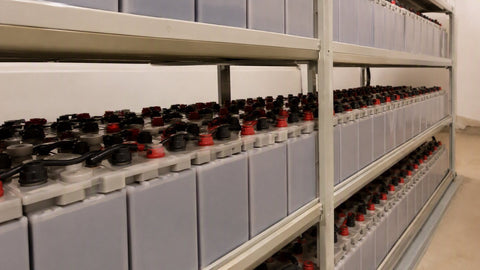
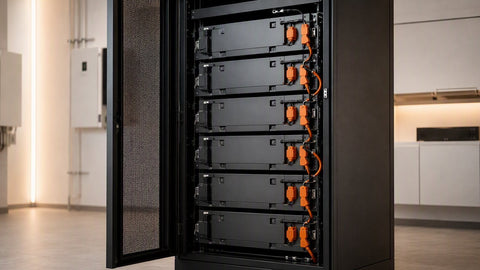
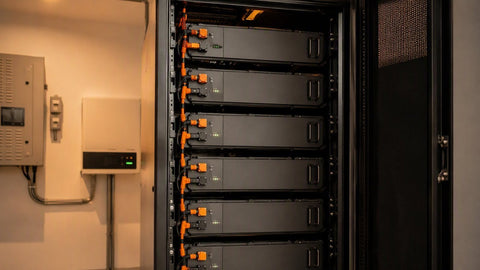
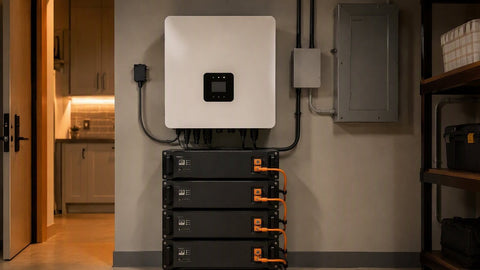
Our field read after years around residential and commercial storage: the Battery-Box is the modular thinking person's battery. Instead of a monolithic wall unit that you either need or don't, BYD ships stackable modules you scale to the load — start with what you need, clip on more capacity later. That modularity, plus an unusually wide third-party inverter compatibility list, is why the Battery-Box shows up in so many off-grid and hybrid designs we quote. It's also why our service techs like it: when a module underperforms in year seven, you slide one module out and slide one in, and the homeowner pays for a module instead of a whole system. Browse the line in our BYD collection and the wider solar battery catalog.
2. Current Product Lines
| Series | Voltage Class | Module Energy | Per-Tower Capacity Range | Best For |
|---|---|---|---|---|
| Battery-Box Premium HVS | High voltage | 2.56 kWh | 5.1–12.8 kWh (2–5 modules) | Residential hybrid, self-consumption |
| Battery-Box Premium HVM | High voltage | 2.76 kWh | 8.3–22.1 kWh (3–8 modules) | Larger homes, small commercial |
| Battery-Box Premium HVM+ | High voltage | 2.76 kWh | 8.3–22.1 kWh, higher power per module | Whole-home backup with heavy loads |
| Battery-Box Premium LVS | Low voltage (48V class) | 4.0 kWh | 4–24 kWh per tower; parallel to 256 kWh | Off-grid, 48V inverter ecosystems |
| Battery-Box LVL | Low voltage | 15.4 kWh | 15.4 kWh per unit; stackable/parallel | Big single-box installs, light commercial |
Figures above reflect the published Premium-series architecture; confirm the exact datasheet for the SKU you're quoting, because BYD revises the line and regional variants exist. The HVS/HVM split confuses everyone at first: same tower concept, different module energy and different series counts, and the HVM+ raises discharge power rather than capacity.
Series Deep-Dive: Which Tower for Which Job
HVS: the self-consumption specialist
The HVS is the right tower when the goal is shifting solar production into the evening rather than surviving outages. Its 5.1–12.8 kWh envelope maps neatly onto the daily cycle of a typical efficient home: charge off the array by 2 PM, discharge through dinner and the evening peak, repeat for years. Paired with a mainstream hybrid inverter it's the lowest-drama path into storage we sell. Where it runs out of room is whole-home backup with heavy 240V loads — that's HVM+ territory.
HVM and HVM+: the whole-home workhorses
Eight modules of HVM gets you 22.1 kWh in one tower, and towers parallel for more. The HVM+ variant keeps the same capacity ladder but raises discharge power per module — the spec that decides whether the battery can start a well pump or carry a soft-started AC compressor without the inverter folding. On backup-critical quotes we spec the + and don't apologize for it. I've watched a properly powered HVM+ tower carry a 4-ton soft-started heat pump through a January night; I've also watched an under-powered battery config fault out on the same load, and the difference is this spec line, not marketing.
LVS and LVL: the 48V off-grid world
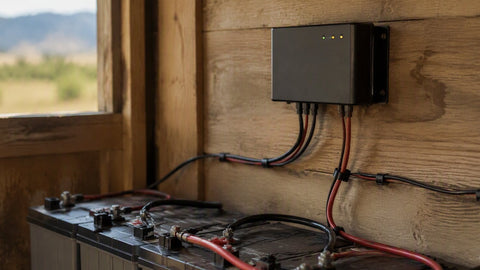
Low-voltage LFP at 48V is where off-grid cabins, RVs at the serious end, and Victron/Schneider-class systems live. The LVS 4.0 kWh blocks build towers to 24 kWh and parallel into the hundreds of kWh; the LVL puts 15.4 kWh in a single big box for installers who'd rather lift one unit than clip six modules. Both behave properly in cold-soak and daily-cycling duty. For the rest of the 48V ecosystem — charge controllers, inverter-chargers, rack batteries — our MPPT vs. PWM guide and charge controller sizing guide cover the upstream equipment.
Economics: What a Battery-Box Costs to Own
Storage economics run on three numbers: installed cost per kWh, warranted throughput, and the value of what the battery does. Self-consumption systems earn by shifting solar from low-value midday export to high-value evening use; backup systems earn by preventing losses — the basement that doesn't flood, the freezer that doesn't thaw, the home office that doesn't go dark mid-contract. LFP's long cycle life is what makes the math work: a tower cycled daily for fifteen years spreads its cost over five-thousand-plus cycles, and the cost per stored kWh drops below what most utilities charge for peak power. Add the federal and state incentives cataloged in our incentive resources and the payback conversation gets short in high-rate markets.
Financing reality from the quote desk: buyers fixate on the battery price and under-budget the rest of the system — the hybrid inverter, the critical-loads panel work, permits, and commissioning labor typically add substantially to the tower's sticker. We quote whole systems, not boxes, because a battery without its supporting cast is furniture. The good news buried in that reality: every one of those supporting components is a one-time cost, while the tower itself keeps accepting modules as the household grows — the system you buy at 11 kWh this year can be the 22 kWh system you needed all along by the time the second EV arrives.
Common Mistakes We See With Modular Storage
First, sizing from the brochure instead of the load list — the tower that "should be plenty" usually isn't once the well pump and the freezer both land on it. Second, ignoring temperature: LFP towers in unconditioned garages in extreme climates lose years of calendar life, and no BMS setting fixes physics. Third, CAN and firmware mismatches discovered at commissioning because nobody checked the compatibility list against the inverter's actual firmware revision. Fourth, mixing module vintages on a tower without checking BYD's mixing rules. And fifth, the quiet killer: no documentation. Photograph the serials, save the commissioning log, register the warranty. The owners who do this get fast warranty service; the owners who don't get archaeology.
3. Why LFP Chemistry Wins in Stationary Storage
We've torn down enough failed battery systems to have opinions about chemistry. LFP's advantages in a garage or utility room are structural, not marketing:
| Property | LFP (BYD) | NMC (many competitors) | Field Impact |
|---|---|---|---|
| Thermal stability | Excellent; high runaway threshold | Good but more energetic failure mode | Insurance and inspector conversations go easier |
| Cycle life | Long; thousands of cycles to 80% retention | Shorter under deep cycling | Daily-cycling ROI math favors LFP |
| Cobalt content | None | Significant | Supply-chain and ethics exposure removed |
| Energy density | Lower | Higher | LFP towers are bigger; wall space matters |
| Calendar aging | Slow | Faster at high state of charge | LFP tolerates sitting full without drama |
The density penalty is real and worth planning around: an LFP tower is physically larger per kWh than an NMC wall unit. In a tight garage, measure before you fall in love. In every other dimension that matters for a box that cycles daily for fifteen years, LFP is the chemistry we spec first.
4. Inverter Compatibility: The Real Reason Installers Love It
BYD publishes and maintains one of the broadest third-party inverter compatibility lists in the storage business. Across the Premium line, the Battery-Box communicates over CAN with major hybrid and off-grid inverters — Fronius, SMA, Victron, GoodWe, Solis, Sungrow, and others have appeared on BYD's official compatibility documentation at various points. That breadth changes project economics: you can pair a BYD tower with the inverter that fits the job instead of buying into a walled-garden ecosystem.
The discipline that saves you a service call: check the compatibility list for the exact inverter model AND firmware version, and configure the battery profile in the inverter during commissioning, not after. We've responded to more than one "battery won't charge" call that turned out to be a CAN termination resistor or a wrong battery-type setting in a Victron GX device. Fifteen minutes with the manual at install beats a truck roll every time. For inverter selection across the market, see our inverter picks guide and the hybrid inverter explainer.
5. Warranty & Cycle Life
| Term | Typical Premium-Series Coverage | Buyer Note |
|---|---|---|
| Product warranty | 10 years | Industry-standard term for tier-one storage |
| Capacity retention | Guaranteed floor (commonly ~60–70% at end of term) | Read the exact retention table in the warranty document |
| Throughput / cycle conditions | Defined per series | Deep daily cycling is expected use — that's the point of LFP |
| Transferability | Varies by region | Matters at home resale; ask before purchase |
The retention guarantee is the number to actually read. A battery warranted to hold 60% of original capacity at year ten is a very different asset from one warranted at 70%, and both exist in this market. For degradation strategy, our 20/80 battery rule guide and battery life maintenance guide cover the operating habits that keep LFP healthy: avoid chronic 0% and 100% states, keep charge rates inside the BMS envelope, and keep the tower inside its temperature rating.
6. Sizing a Battery-Box: The Math We Actually Run
Start from the load, never from the box. List the circuits that must survive an outage, measure or estimate their watts, multiply by hours of autonomy, then divide by usable depth of discharge and inverter efficiency. A worked example from a real quote: refrigerator (150 W cycling, ~1.2 kWh/day), furnace blower (600 W × 6 hr = 3.6 kWh), lights and outlets (~1.5 kWh), well pump allowance (1 kWh), internet and misc (0.7 kWh) — call it 8 kWh per day of essentials. For one day of autonomy at 90% usable capacity and 95% round-trip efficiency, that's roughly a 9.4 kWh nameplate target: an HVM tower with four modules (11.04 kWh) covers it with margin, and clips on more modules later without replacing anything.
Run your own numbers with the battery backup runtime calculator and the home battery bank sizing guide. For off-grid-scale builds, the off-grid storage sizing guide goes deeper into multi-day autonomy math.
7. Popular BYD Products at PES Supply
The HVM and HVM+ towers dominate our quotes — the capacity range covers most whole-home backup jobs, and the HVM+'s higher discharge power handles well pumps and AC soft-starts that stress lesser batteries. The LVS series owns the 48V off-grid ecosystem where Victron-class inverters run the show; for that world also see our 48V battery range and LFP battery collection. Rack-format alternatives live in server rack batteries, and budget-friendly LFP options in the EG4 range.
8. Technical Comparison
| Dimension | BYD Battery-Box | Monolithic wall batteries | DIY rack LFP |
|---|---|---|---|
| Chemistry | LFP | Mixed (NMC and LFP) | LFP |
| Scalability | Clip-on modules, grow later | Add whole units | Add rack modules |
| Inverter openness | Broad published compatibility | Often ecosystem-locked | Open but DIY-configured |
| Install labor | Low; tower clips together | Moderate; heavy wall mount | High; wiring and config on you |
| Price position | Mid-premium | Premium | Budget |
| Warranty support | Manufacturer + distributor | Manufacturer | Varies widely |
Against the Tesla-style monolith, BYD trades sleekness for flexibility and serviceability — a failed module in a Battery-Box is a module swap, not a whole-unit RMA. Against DIY rack batteries, BYD costs more and buys you certified system integration, a real warranty desk, and an inspector-friendly listing. Both trades are rational; pick based on who's maintaining the system in year eight.
9. BMS & Monitoring
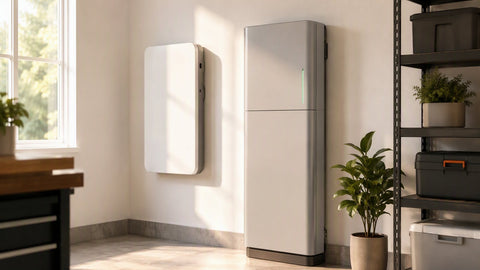
Every Battery-Box tower carries its own battery management system handling cell balancing, temperature supervision, and charge/discharge limits, and it reports over CAN to the inverter, which becomes your monitoring window. Set the inverter's battery profile correctly and the BMS does the rest — the tower protects itself from over-charge, over-discharge, and temperature excursions without owner involvement. What owners should actually watch: state-of-health trends in the inverter's logs and any recurring fault codes, which are worth a service call before they become a dead tower in an outage.
10. Installation Notes
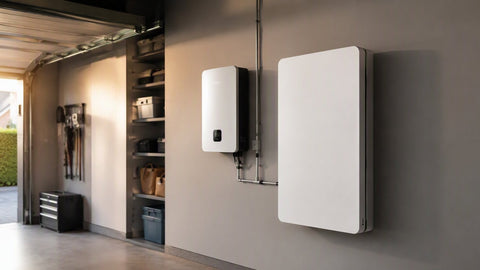
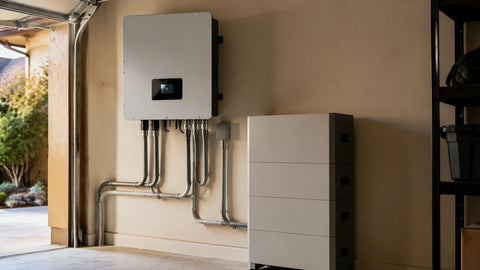
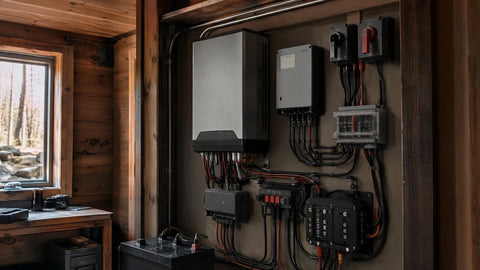
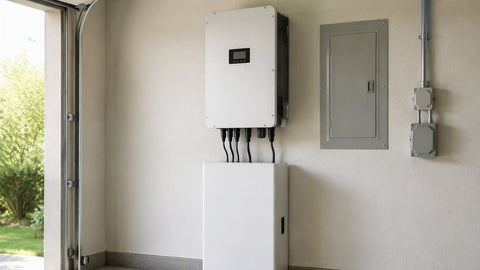
Wall or floor mount on a solid surface, level, with the clearances the manual specifies — battery towers reject leaning drywall anchors the hard way. Keep the tower inside its temperature envelope; LFP charges poorly below freezing without heating and ages faster in a 110°F garage, so conditioned or insulated space pays for itself in capacity retention. DC side wiring follows the inverter manual and NEC Article 706 for energy storage systems, with the disconnect and overcurrent requirements covered in our disconnect and overcurrent guide and ampacity from the wire ampacity chart. Commission in this order: physical, DC, CAN communication, inverter battery profile, then a controlled charge-discharge test with the numbers logged.
One commissioning habit that pays: photograph the module serial stickers and the final tower configuration before you button up. Warranty claims and module additions years later both go faster when the original configuration is documented.
Also plan the working space like a technician, because one will eventually stand there. Leave the clearances the manual specifies in front of and above the tower, keep the CAN and DC routing serviceable rather than drywall-buried where possible, and label both ends of every cable. The installer who services your system in year nine — possibly me, possibly someone I've never met — will silently thank you, and the service call will cost less because the diagnosis started from clean infrastructure instead of a mystery bundle behind the tower.
Recent Releases (2025–2026)
BYD's stationary line keeps consolidating around the Premium architecture: the HVM+ brought higher discharge power into the standard tower format, the LVL scaled the low-voltage side into bigger single-box territory, and the compatibility list keeps absorbing new inverter models and firmware trains. The direction is unmistakable — more power per module, broader inverter openness, and manufacturing scale that no Western storage brand currently matches. For buyers, the practical translation is stable pricing and real availability; through the supply crunches of the last few years, BYD towers shipped while smaller brands quoted lead times in quarters. As always, quote against the current datasheet: this catalog revises fast enough that last year's module count table is a history document.
How It Stacks Up: Powerwall, PWRcell, and the Rack World
The three-way cross-shop we run most often: Tesla Powerwall wins on sleekness, ecosystem polish, and brand recognition; Generac's PWRcell (covered in our PWRcell cost guide) wins when the home already runs Generac standby gear; the Battery-Box wins on modularity, inverter freedom, and LFP serviceability. DIY rack LFP undercuts all three on price and buys the savings with your own labor and your own warranty risk. None of these answers is wrong — they're different answers to different priorities, and the honest guide matches the architecture to the household, not the household to a favorite brand. Run the capacity question through the runtime calculator first and half the brand arguments settle themselves.
Sources & Standards
Electrical guidance in this guide references NEC Article 706 (energy storage systems), NEC 690 where PV coupling applies, NEC 250 for grounding, and NEC 310.16 for conductor ampacity. Product figures reflect BYD's published Premium-series documentation and our own installation experience; regional variants exist, so the current datasheet and the current inverter compatibility list are the documents of record for any live quote. Warranty terms summarized here are typical of the line and the exact retention and throughput tables in the warranty certificate govern.
11. Frequently Asked Questions
Do I need to buy a BYD inverter with a BYD Battery-Box?
No — that's the line's biggest strength. BYD maintains a published compatibility list spanning major third-party hybrid and off-grid inverters. Match the exact inverter model and firmware against the current list before you commit.
Can I add more capacity to my Battery-Box later?
Yes, and it's the design's core trick. Premium towers accept additional modules within the series limits, so a system installed at 11 kWh can grow toward 22 kWh without replacing anything. Plan the initial tower location and wiring for the final size.
What is the difference between HVS and HVM?
Both are high-voltage Premium towers, but the HVS uses 2.56 kWh modules in 2–5 module stacks (5.1–12.8 kWh) while the HVM uses 2.76 kWh modules in 3–8 module stacks (8.3–22.1 kWh). HVM+ raises discharge power at the same capacities. They're different series — modules don't mix across them.
Is the HVM+ compatible with older HVM modules?
The HVM+ is designed as an evolution of the HVM line with higher power capability, but module mixing rules are strict in this ecosystem. Confirm the exact combination against BYD's current documentation before blending old and new hardware on one tower.
What is the BYD Blade Battery?
BYD's LFP cell format famous from its electric vehicles — long, thin cells packed cell-to-pack for structural strength and thermal stability. The same cobalt-free LFP philosophy underpins the Battery-Box stationary line.
How long will a Battery-Box last?
LFP chemistry plus a conservative BMS means thousands of cycles; with a 10-year warranty and sensible operating habits, fifteen-plus years of daily cycling is a rational planning horizon. Degradation is gradual, not a cliff — an aging tower just holds less, it doesn't die overnight.
12. Shop BYD Battery-Box at PES Supply
Browse the BYD collection, compare across solar batteries, battery storage, and battery backup kits, or request a quote with your load list and we'll size the tower, match the inverter, and document the commissioning the way we'd want it done on our own homes. We stock the Battery-Box because the service log says it earns the space: clean commissioning, boring reliability, and module-level serviceability that turns potential disasters into Tuesday-afternoon parts swaps. In stationary storage, boring is the highest compliment there is — and this tower earns it on every single job we've commissioned so far.