Updated September 2026 — refreshed against the live PES catalog; product pricing verified 2026-09-26.
2026 product line update
| Product | Class | Price |
|---|---|---|
| Canadian Solar 710W TOPCon Bifacial Solar Panel | 710W | $340.80 |
| Hyundai 640W 156-Cell TOPCon Bifacial Solar Panel | 640W | $220.78 |
| Thornova Solar TS-BGT72(600) 600W Bifacial Solar Panel | 600W | $165.76 |
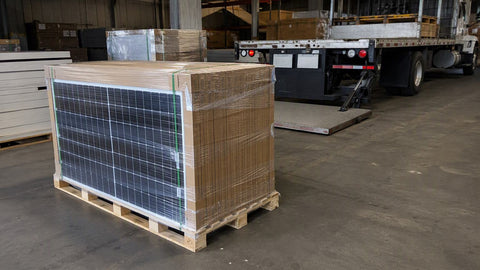
| Thornova Solar 595W Solar Panel 144 Cell Bifacial TS-BGT72(595) Wholesale 31 panels per pallet | 595W | $164.64 |
| ZNShine Solar 585W 144-Cell Bifacial Solar Panel | 585W | $246.99 |
| Hyundai HiS-S585OJ 585W Clear on Transparent156 Half-Cell Bifacial Solar Panel | 585W | $195.86 |
Live prices verified 2026-09-26. The current pallet line tops out at 550–640W, plus the Canadian Solar 710W TOPCon flagship panel.
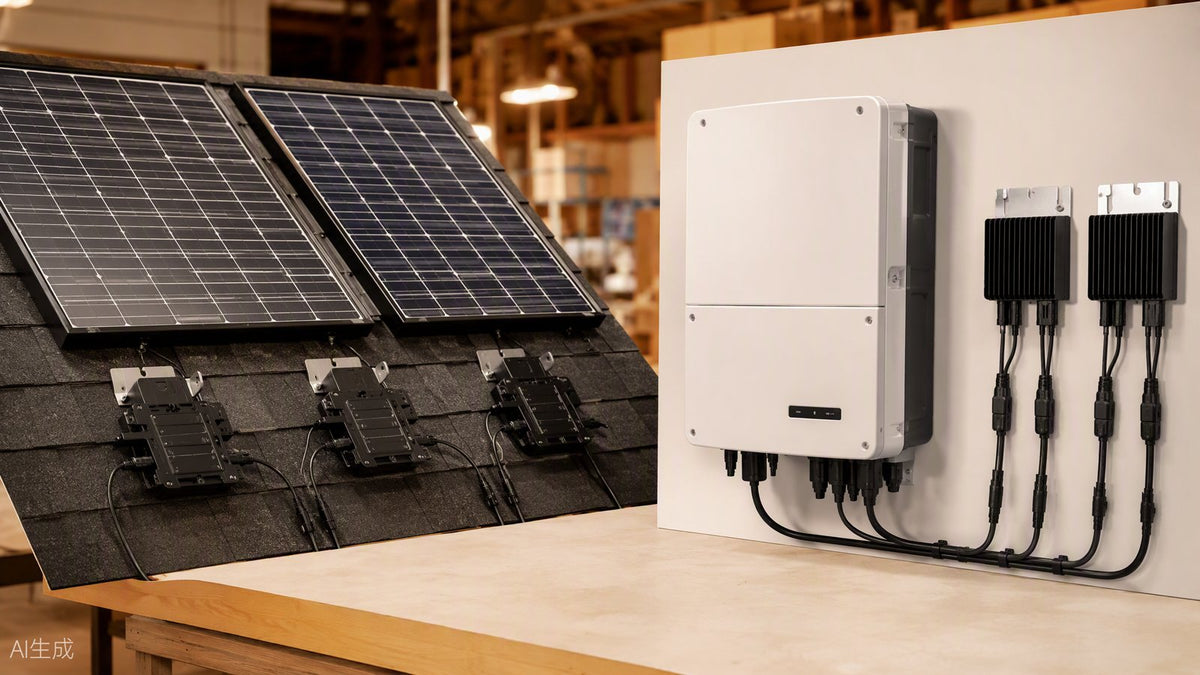
July 2018. The residential solar market is splitting down an architectural fault line, and every installer I know has picked a side. On one side: Enphase's new IQ7 microinverters — one unit per panel, AC on the roof, no central inverter at all. On the other: SolarEdge's HD-Wave, the sleek new string inverter that just won an Edison Award, paired with a power optimizer bolted behind every module. Same job, two philosophies, and your choice commits you for 25 years. I've installed both this season — IQ7s on a split-plane Victorian last month, an HD-Wave 7.6 on a new-build ranch the week before — and this guide is the honest head-to-head: specs, wiring reality, NEC 2017 compliance, monitoring costs, and the financial-stability question nobody wants to ask out loud but everybody should.
Note for readers finding this in the archive: this is a 2018-era analysis preserved and annotated. Jump to "Where It Stands Today" at the end for how the fight resolved.
The Platforms at a Glance
Enphase's pitch is total decentralization: the IQ7 family (250–320 VA per unit) converts DC to AC right at the module, so the roof carries nothing but plain 240V AC branch circuits. No DC strings, no homeruns, no central point of failure. SolarEdge's pitch is the hybrid: a DC power optimizer behind each panel handles module-level MPPT and monitoring, but the actual DC-to-AC conversion happens once, centrally, in the HD-Wave — a string inverter so redesigned that SolarEdge claims 99% CEC-weighted efficiency, which, if the field data holds, would be the highest number the residential industry has ever shipped.
Table 1: Enphase IQ7 Lineup (July 2018)
| Model | Peak Output | Continuous | Cell Type | CEC Efficiency | Max DC Input | Warranty |
|---|---|---|---|---|---|---|
| IQ7-60-2-US | 250 VA | 240 VA | 60-cell | 97.0% @ 240V | 60V / 14A | 25 years |
| IQ7PLUS-72-2-US | 295 VA | 290 VA | 60/72-cell | 97.0% @ 240V | 60V / 14A | 25 years |
| IQ7X-96-2-US | 320 VA | ~310 VA | 96-cell | 97.0% | 80V / 14A | 25 years |
Three SKUs, three panel formats, and the one number that matters: 97% CEC efficiency per micro. The IQ7X deserves a nod for covering the 96-cell oddballs — Panasonic HIT and SunPower formats — that string systems handle awkwardly. Pairing math in 2018 is easy: 60-cell modules in the 260–330W class go on IQ7, 72-cell up to ~350W on IQ7+, and high-voltage 96-cell on IQ7X. The 14A input limit hasn't bitten anyone yet; the coming 400W residential modules will test it within a few product cycles, and I expect Enphase knows it.
Table 2: SolarEdge HD-Wave Lineup (July 2018)
| Model | Rated AC Output | CEC Efficiency | Max Efficiency | Max DC Input | Max DC Power |
|---|---|---|---|---|---|
| SE3000H-US | 3.0 kW | 99% | 99.2% | 480 Vdc | 4,650 W |
| SE3800H-US | 3.8 kW | 99% | 99.2% | 480 Vdc | 5,700 W |
| SE5000H-US | 5.0 kW | 99% | 99.2% | 480 Vdc | 7,750 W |
| SE6000H-US | 6.0 kW | 99% | 99.2% | 480 Vdc | 9,000 W |
| SE7600H-US | 7.6 kW | 99% | 99.2% | 480 Vdc | 11,400 W |
That 99% CEC figure is the headline of the season. The HD-Wave dumps the old magnetics-heavy design for a distributed switching approach (SolarEdge's marketing calls it "HD-Wave technology"; the practical effect is a smaller, lighter, more efficient box). The SE7600H covers the meat of the residential market — 7.6 kW handles up to 11.4 kW of DC, which is a healthy 1.5 DC:AC ratio. And the whole inverter weighs what one person can wall-mount solo, which my back appreciates more than any spec.
Table 3: SolarEdge Power Optimizers (2018)
| Optimizer | Max Input Power | Max Input Current | Efficiency | Typical Use Case |
|---|---|---|---|---|
| P300 | 300 W | 9.5 A | 99.5% | Standard residential, up to ~330W modules |
| P370 | 370 W | 10.0 A | 99.5% | Higher-power residential, up to ~400W modules |
| P400 / P401 | 400 W | 10.1 A | 99.5% | High-wattage modules, up to ~400W |
| P404 | 405 W | 11.5 A | 99.5% | Max-current variant, up to ~405W short strings |
Remember when adding up the architecture: the optimizer's 99.5% efficiency stacks with the inverter's 99% — 0.995 × 0.99 = 98.5% system-level, still a point and a half ahead of the micros' 97% on paper. Whether that paper advantage survives real roofs — with shade, mismatch, and soiling — is the argument the rest of this guide is about.
Table 4: Head-to-Head Platform Comparison
| Factor | Enphase IQ7 | SolarEdge HD-Wave |
|---|---|---|
| Architecture | Microinverter (one per panel) | String inverter + power optimizer (one optimizer per panel) |
| Inverter CEC Efficiency | 97.0% | 99.0% (98.5% on SE11400H) |
| System-Level Efficiency | ~97.0% (no additional losses) | ~97–98% (including optimizer losses) |
| Wiring | AC branch circuits from roof; no DC homeruns | DC string homeruns to wall-mounted inverter |
| Module-level monitoring | Yes (Enlighten) | Yes (SolarEdge portal) |
| Single point of failure | None at array level | Central inverter (whole array down if it fails) |
| Inverter warranty | 25 years | 12 years standard (extendable to 20–25 for a fee) |
| Optimizer warranty | n/a | 25 years |
| Battery retrofit path (2018) | AC-coupled (Enphase AC Battery, third parties) | StorEdge w/ LG Chem RESU (DC-coupled) |
| Cost per watt (hardware) | Higher (~$0.30–0.35/W typical residential) | Lower (~$0.20–0.25/W) |
Enphase IQ7: The Case for Decentralization
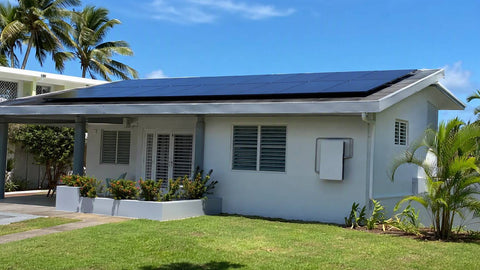
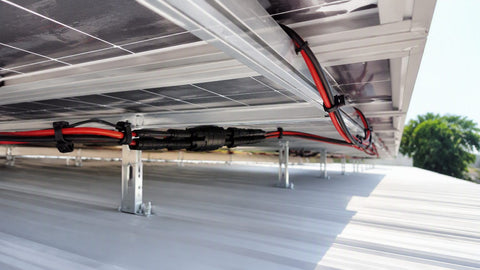
The IQ7 is a refinement, not a revolution — the IQ6's electronics matured, costs squeezed, and the same core proposition carried forward: every panel is its own power plant. What that buys you in the field is real. Shade on one module costs you one module's output, not a string's. A failed unit takes out 300 watts, not 7,600. There is no DC arc-fault territory on the roof beyond the module leads themselves, and the 240V AC branch circuits come down in ordinary conduit into ordinary breakers — your electrical inspector has seen it a thousand times. The trade-offs are equally real: hardware cost runs higher per watt, every roof penetration carries one more device to weather-seal around, and when a micro does fail at year 9, the replacement means someone on the roof with the panels racked out — not a five-minute box swap at ground level.
One thing the spec sheet undersells: the IQ7's per-module monitoring via the Envoy gateway is the best sales tool and the best service tool in residential solar. Homeowners watch individual panels like fantasy football. And I've diagnosed a squirrel-chewed lead from the production curve before the customer noticed anything. That granularity changes the service economics of a 25-year asset in ways that don't show up in a bid comparison.
SolarEdge HD-Wave: The Case for Centralized Intelligence
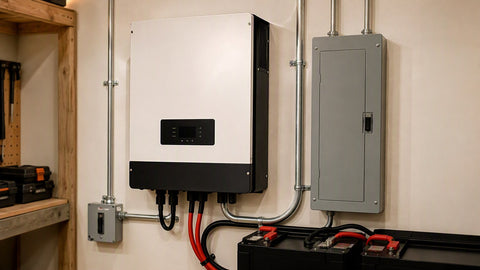
The HD-Wave's argument is thermodynamic and economic. Central conversion at 99% CEC wastes less energy than distributed conversion at 97%. One inverter on the wall is cheaper than twenty-five micros on the roof, easier to service, and keeps the power electronics out of the worst thermal environment in the system (under a module in August). The optimizers behind each panel handle the shade and mismatch problems that killed plain string inverters, add module-level monitoring, and deliver SafeDC — automatic DC voltage reduction at the module level when the inverter or grid drops. The weaknesses are structural too: the central inverter is a single point of failure for the entire array; the standard 12-year inverter warranty is half the micros' 25 (the optimizers carry 25, but they're the part that almost never fails); and a battery retrofit means working around a DC-coupled architecture that predates the storage boom.
I'll give the HD-Wave this, having hung two of them: the physical design is the best in the business right now. Half the weight of the old SolarEdge units, a genuinely quiet fan-free enclosure, and a commissioning flow via smartphone that had a 7.6 kW system reporting in under ten minutes. The Edison Award wasn't charity.
NEC 2017 and Rapid Shutdown: What Changes in 2019
The 2017 NEC's module-level rapid shutdown (690.12) is the regulatory shadow over this whole comparison, because it takes effect in jurisdictions adopting the 2017 code starting January 1, 2019. The good news: both platforms are already compliant, just differently. Enphase microinverters comply inherently — kill the AC and every module de-energizes. SolarEdge complies via SafeDC in the optimizers, dropping DC to touch-safe voltage when the inverter goes offline. Neither needs the add-on rooftop transmitter boxes that plain string systems now require, which is precisely why this two-horse race exists.
| Requirement | Enphase IQ7 | SolarEdge HD-Wave |
|---|---|---|
| NEC 2014 Array-Level Shutdown | Compliant (breaker-off shutdown) | Compliant (SafeDC optimizer shutdown) |
| NEC 2017 Module-Level Shutdown | Compliant (microinverter ceases output when AC breaker opens) | Compliant (SafeDC reduces DC to safe voltage at optimizer level) |
| UL 1741-SA (CA Rule 21) | Listed | Listed |
| Additional hardware needed | None | None |
The Installer Workflow: Wiring, Commissioning, and Monitoring Cost Reality
Wiring: IQ7 jobs are electrically simple and mechanically busy — every module gets a micro bolted to the rail, a trunk cable clipped in, and a bonding connection torqued. HD-Wave jobs are electrically denser and mechanically simpler on the roof — optimizers snap in fast — but then you're pulling DC homeruns in EMT, landing strings, and mounting the inverter with its clearances. On a 24-panel job I'd call labor a wash; on a 60-panel commercial-lite job, the string architecture pulls ahead on install hours.
Commissioning: SolarEdge's smartphone flow is faster today. Enphase requires the Envoy on the network and serial mapping that's more finicky, though the Installer Toolkit app has closed most of the gap this year.
Monitoring costs: this is where the quotes quietly diverge. Enphase's full Enlighten per-module monitoring carries a service fee structure that homeowners notice; SolarEdge's portal monitoring is free for the system's life. On a 25-year ownership model, that recurring line deserves to be in the bid comparison, not discovered in year two.
Expansion: adding panels later favors Enphase structurally — new micros, new branch, done. SolarEdge expansions hit the inverter's DC power ceiling, and an SE7600H already loaded to 11.4 kW DC has nowhere to grow but a second inverter. For the "start small, add later" customer, that's often the deciding factor.
Financial Stability Context: The Elephant on the Roof
Now the uncomfortable part. A 25-year warranty is a promise from a company, and in July 2018 these two companies are in very different financial positions.
Enphase is mid-comeback, and the comeback is unfinished. The company nearly died in 2017 — layoffs, a stock price under a dollar, real delisting risk. The restructuring under the new CEO has cut costs and the IQ7 launch is landing well, and the stock has recovered off the lows, but anyone selling a 25-year Enphase warranty today is selling a company whose survival two years ago was an open question. I say that as someone installing their product weekly: the engineering is excellent, and the balance sheet is healing, not healed. Enphase's counterargument — and it's not nothing — is that a distributed architecture degrades gracefully: even in a worst-case scenario, your array keeps producing; what you lose is monitoring and the warranty counterparty.
SolarEdge is the dominant incumbent printing money. Profitable, growing, taking share from everyone, with the optimizer-plus-string architecture now the default volume play in residential. The business risk conversation here is almost inverted: SolarEdge's question isn't survival, it's whether its 12-year inverter warranty and free monitoring model hold up as the installed base ages and the storage transition reshuffles the architecture deck.
What this means for your bid: if your customer's decision hinges on warranty counterparty risk, SolarEdge is the safer 2018 answer on paper. If it hinges on architecture — shade, expansion, no single point of failure, inherent rapid shutdown — Enphase's engineering case is genuinely stronger. My own practice: I disclose the financial picture to customers, install both, and let the roof decide more often than the logo.
The Bidding Math: A Real 2018 Quote Comparison
Abstractions settle nothing; invoices do. Here's the hardware math from an actual 24-panel job I quoted both ways this spring — 6.96 kW DC of 290W-class 60-cell modules on a two-plane comp roof with a chimney shadow on the west array:
| Line Item | Enphase IQ7 Bid | SolarEdge HD-Wave Bid |
|---|---|---|
| Power electronics | 24 × IQ7-60 @ ~$165 = $3,960 | SE7600H $1,850 + 24 × P300 @ ~$62 = $3,338 |
| Trunk cable / homeruns | Q-cable + terminators ≈ $320 | EMT + PV wire homeruns ≈ $280 |
| Combiner / disconnects | IQ Combiner ≈ $650 | AC disconnect + breakers ≈ $180 |
| Monitoring | Envoy included; Enlighten fees over time | Portal free for life |
| Hardware subtotal | ≈ $4,930 (~$0.71/W) | ≈ $3,798 (~$0.55/W) |
| Install labor delta | Roof-busy, wall-simple | Roof-simple, wall-busy — wash on this roof |
Call it a $1,100 hardware delta on a ~$21,000 job — roughly 5%. That's the honest size of the Enphase premium in 2018: real, but not the deal-breaker the string camp claims, and on this particular roof the chimney shadow handing 3–4% of lifetime production back to the micros closes most of it. On a shade-free barn roof, the SolarEdge bid wins and I'd sign it myself. The spreadsheet doesn't have a favorite; the roof does.
One more line that never appears on either quote: service expectations. Budget one truck roll for a micro replacement somewhere in the system's life (rooftop labor, an hour or two with racking) and budget one string-inverter replacement around year 12–15 on the SolarEdge side (ground-level swap, half a day, plus the unit cost after the 12-year warranty lapses unless the customer bought the extension). Priced honestly over 25 years, the lifecycle cost gap narrows further — which is why the experienced shops in my market sell the architecture to the roof and stop arguing about the logos.
Sources and Method Notes
Specs in this guide come from the manufacturers' July 2018 datasheets — the Enphase IQ7 series datasheets (250/295/320 VA variants) and the SolarEdge HD-Wave SE3000H–SE7600H documentation — cross-checked against the CEC efficiency listings current at publication. Pricing figures reflect mid-2018 distributor quotes in the Pacific Northwest market and will vary by region and volume. Efficiency math uses published CEC-weighted figures multiplied across the optimizer-plus-inverter chain; field production varies with shade, temperature, and soiling in ways no datasheet captures. For the current-generation successors to everything discussed here, see our Enphase ecosystem guide and the live SolarEdge and Enphase inventories.
Frequently Asked Questions
What is the difference between Enphase IQ7 and SolarEdge HD-Wave?
IQ7 is a microinverter — full DC-to-AC conversion at each panel, AC wiring off the roof, no central inverter. HD-Wave is a string inverter paired with per-panel DC optimizers — module-level management on the roof, but conversion happens centrally on the wall. Both deliver module-level monitoring and NEC 2017 rapid-shutdown compliance.
Which is more efficient: Enphase IQ7 or SolarEdge HD-Wave?
On paper, SolarEdge: 99% inverter CEC × 99.5% optimizer ≈ 98.5% system-level versus the IQ7's 97%. In the field, shade tolerance and per-module MPPT on the micro side often claw back the difference on imperfect roofs — on clean unshaded arrays, the SolarEdge advantage is real.
How much did Enphase IQ7 cost per panel in 2018?
IQ7 hardware typically ran $130–190 per micro at distribution in mid-2018 depending on model and volume — roughly $0.30–0.35 per watt of system capacity installed, versus $0.20–0.25/W for the HD-Wave plus optimizer stack.
Does SolarEdge HD-Wave require power optimizers?
Yes — the HD-Wave is designed as a system with SolarEdge optimizers, which provide module-level MPPT, monitoring, and SafeDC rapid shutdown. Running it without optimizers isn't a supported configuration; the optimizer is the per-panel half of the architecture.
Was Enphase financially stable in 2018?
Enphase was mid-turnaround: it nearly failed in 2017 (sub-$1 stock, layoffs, delisting risk) and was recovering under new management, but its balance sheet remained the weakest among major inverter makers. SolarEdge, by contrast, was profitable and growing. Both warranties remained in force throughout.
What does NEC 2017 require for rapid shutdown?
NEC 2017 690.12 requires module-level rapid shutdown inside the array boundary — conductors must drop to 30V within 30 seconds — effective in adopting jurisdictions from January 2019. Microinverters comply inherently; SolarEdge complies via SafeDC; plain string systems need add-on module-level shutdown devices.
Can you add batteries to either system in 2018?
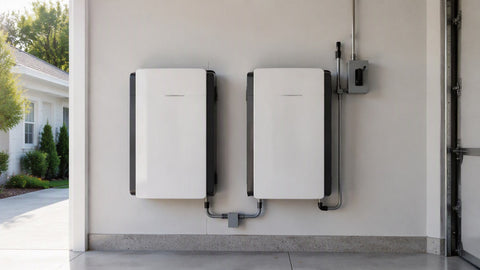
Yes, differently. Enphase systems accept AC-coupled batteries (Enphase's own AC Battery or third-party units) without touching array wiring. SolarEdge offers the StorEdge DC-coupled path with the LG Chem RESU. AC coupling is the more flexible retrofit; DC coupling is more efficient for new storage-first builds.
Which platform is better for shaded or complex roofs?
Both handle shade far better than plain strings. Enphase's per-module conversion gives the most graceful shade behavior and no central ceiling on layout complexity; SolarEdge optimizers achieve most of the same recovery at lower cost. For heavily shaded roofs, Enphase; for mildly shaded cost-sensitive roofs, SolarEdge.
Where It Stands Today (2026 Update)
Eight years on, this 2018 showdown reads like a fossil record of a fight that both companies transcended. Enphase completed the comeback that looked so uncertain in 2018 — the IQ8 platform made microinverters grid-forming, the IQ Battery line turned the ecosystem into a full energy system, and the company that nearly delisted became the residential inverter benchmark. If you're speccing today, our current Enphase brand guide covers the IQ7-to-IQ8 transition in detail, and the Enphase collection carries the modern lineup — from the IQ8A and IQ8M micros to the IQ Battery 5P that made Sunlight Backup a whole-home reality.
SolarEdge's road was rockier than 2018 suggested: the HD-Wave generation gave way to newer residential platforms, the company weathered a brutal inventory correction in 2023–2024, and the architecture debate it championed — optimizer-plus-string — remains the main alternative to micros. The SolarEdge collection and hardware like the SE3800H still sell to installers who swear by centralized conversion, and for straightforward unshaded roofs the value case is intact. For a broader view of where module-level electronics sit now, our Enphase vs Tigo comparison covers the optimizer market's other survivor, and the full solar inverter catalog maps every architecture we stock.
The lessons that survived both companies' journeys are the ones I still teach apprentices: architecture follows the roof, not the logo; warranties are promises from balance sheets, so read both; module-level monitoring pays for itself in service calls you never roll; and NEC compliance is a design input, not an afterthought — the 690.12 transition covered above was just the first of several code-driven reshuffles, with NEC 2023 and the 2026 cycle continuing the pattern. For the battery side of what these systems grew into, the energy storage catalog and our battery sizing guide pick up where 2018's StorEdge-versus-AC-coupling argument left off — and for the panels these inverters were driving, from the REC and Qcells lines to the current full panel catalog, the modules changed even more than the electronics behind them.
The 2018 verdict, confirmed by history: the roof decides. Shaded Victorian? Micros. Clean ranch with a price-sensitive owner? Optimized string. Both platforms honored their warranties, both monitoring ecosystems survived, and both architectures still ship today in evolved forms. And the company everyone worried about in 2018 out-executed the company nobody worried about — a reminder that in this trade, the only durable hedge is installing quality hardware and keeping your customers' roofs producing year after year in the field, no matter whose name is printed on the box.
Need pricing or availability on anything in this guide?
Portlandia Electric Supply dropships direct from the manufacturer — most items Ship Direct with lead times stated up front, no surprises.
Get a quote from PESBulk, pallet and contractor pricing available.